

Gothic doom metal has long made peace with the eleven-minute track. Where most heavy music forms justify duration through acceleration or instrumental display, this tradition earns its length through accumulation — the slow layering of grief upon grief, each section adding weight rather than momentum.
‘Nocturnes,’ the fourth full-length album by Avignon’s Angellore, is due May 15th, 2026 on Ardua Music — the conclusion of a nine-year creative process that began with a single keyboard-and-guitar session in February 2017.
Both pre-release singles illuminate what the record holds: ‘Falling Birds,’ an eleven-minute meditation on grief and dissolved memory that opens the album; and ‘Black Sun River,’ a more directed composition accompanied by an official lyric video. Together, they function less as advertisement than as disclosure.
Old Stone, New Sound
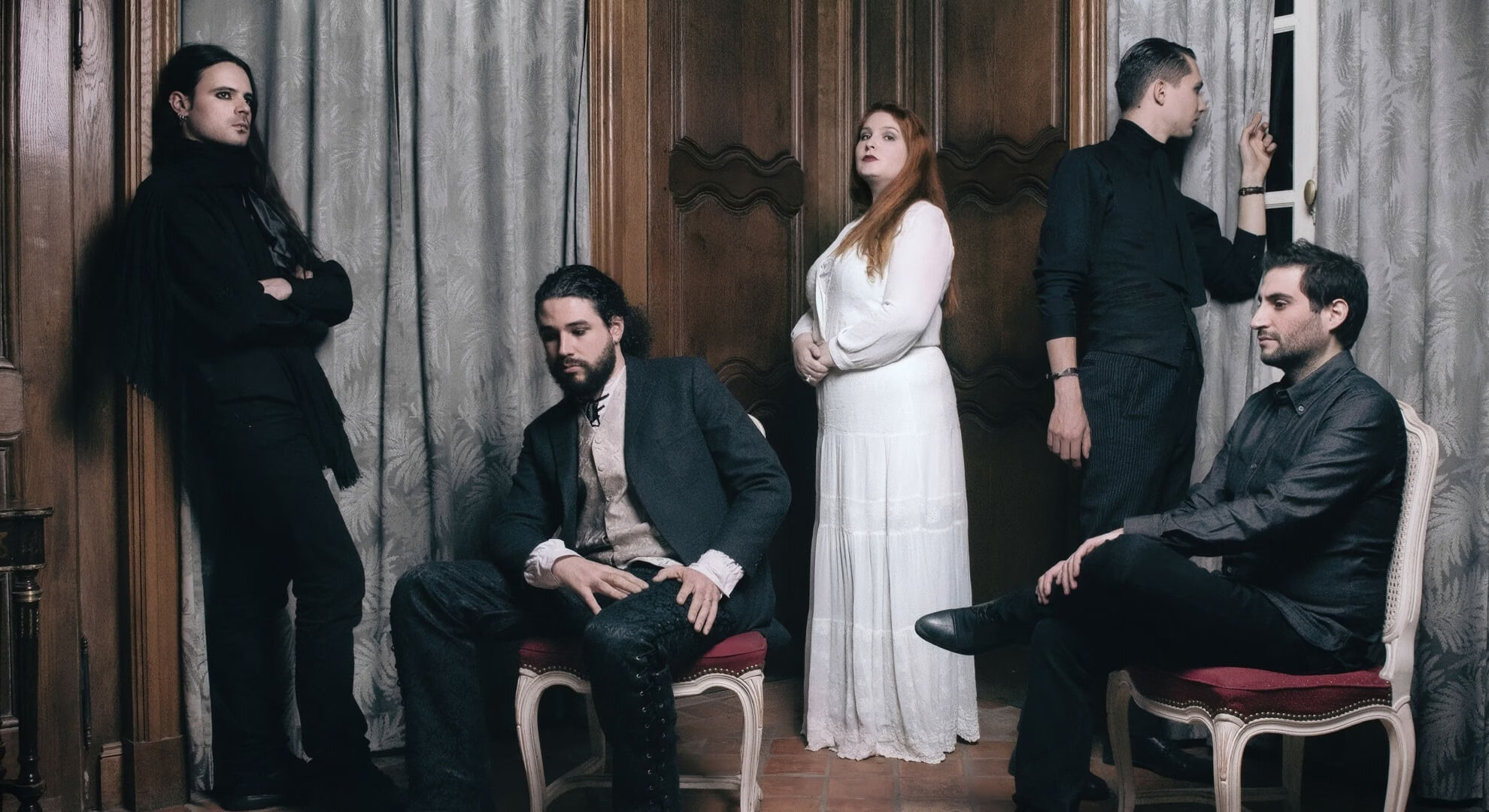
Angellore formed in Avignon in July 2007, during the Festival d’Avignon, when founders Rosarius and Walran first met. France’s oldest continuously running theater festival provided an unlikely but appropriate cradle for a band whose aesthetic would draw as heavily from Romantic literature and painting as from any strain of metal.
The name itself was taken from Tristania’s ‘Widow’s Weeds’ (1998), the Norwegian gothic metal album that had established what symphonic darkness could achieve in the late twentieth century, drawing a track title from that record as the band’s own name.
That acknowledgment places Angellore within a specific Northern European lineage — one running through Tristania, Draconian, Saturnus, and Ecstatic Fear — while the band maintains a distinctly southern French relationship to Romantic imagery.
Founders Walran and Rosarius have cited Caspar David Friedrich and J.M.W. Turner among their visual influences, alongside the Gothic novelists Ann Radcliffe, Storm Constantine, and Tanith Lee.1 The result is a band that operates with one foot in the death-doom tradition the late 1990s Norwegian scene crystallized and another in the broader European Romantic inheritance of grief as aesthetic form.
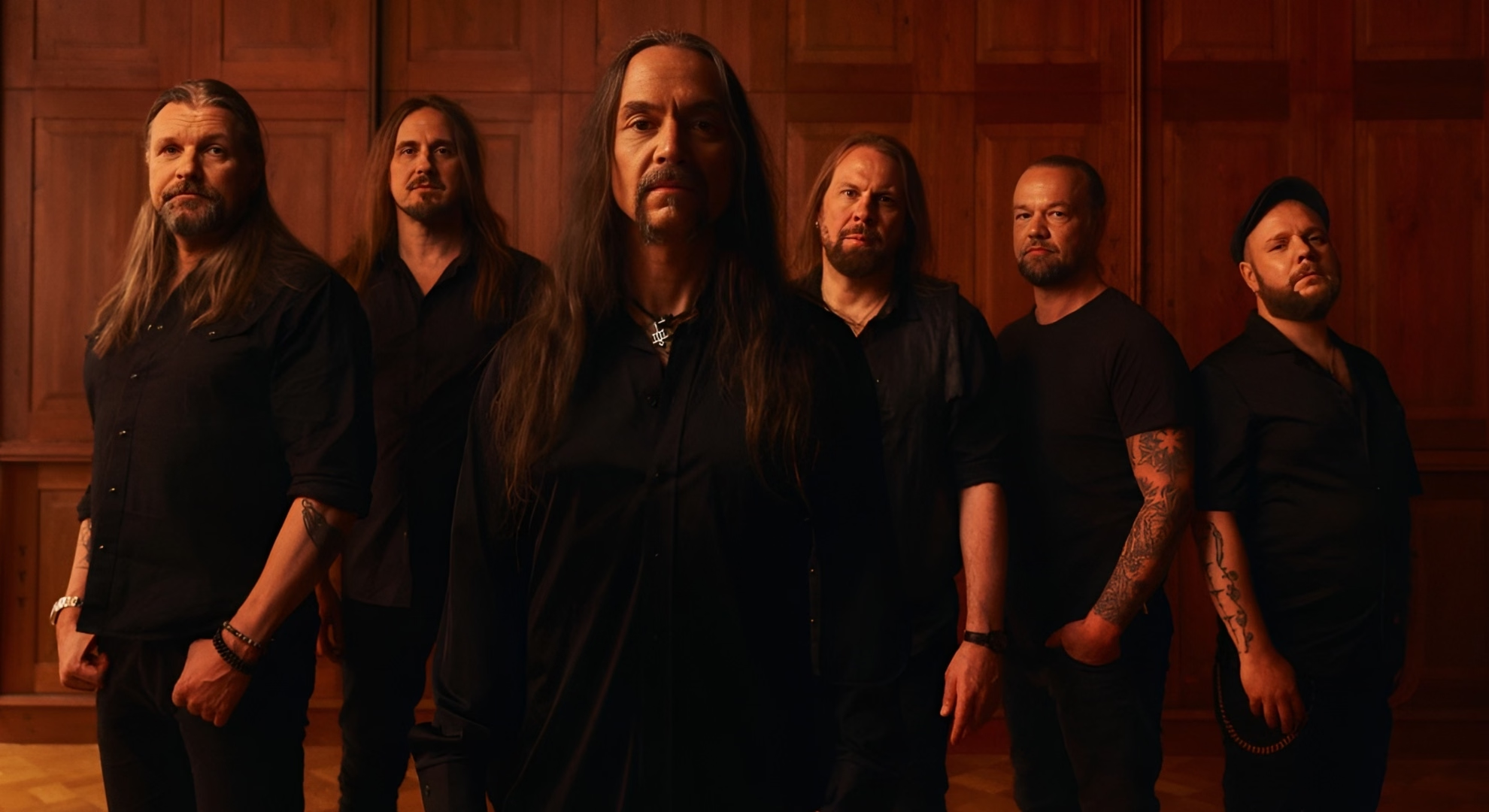
After the debut ‘Errances’ (2012) and ‘La Litanie des Cendres’ (2015), the addition of Lucia on vocals and Celin on bass in 2016 gave the band its current five-member configuration, a lineup that came to full expression on ‘Rien Ne Devait Mourir’ (2020) — the album whose critical reception preceded the six-year silence that ‘Nocturnes’ now ends.
What ‘Nothing Should Die’ Made Possible
‘Rien Ne Devait Mourir’ arrived on February 14th, 2020 on Finisterian Dead End and Shunu Records, the fullest realization to that point of what Angellore could assemble.
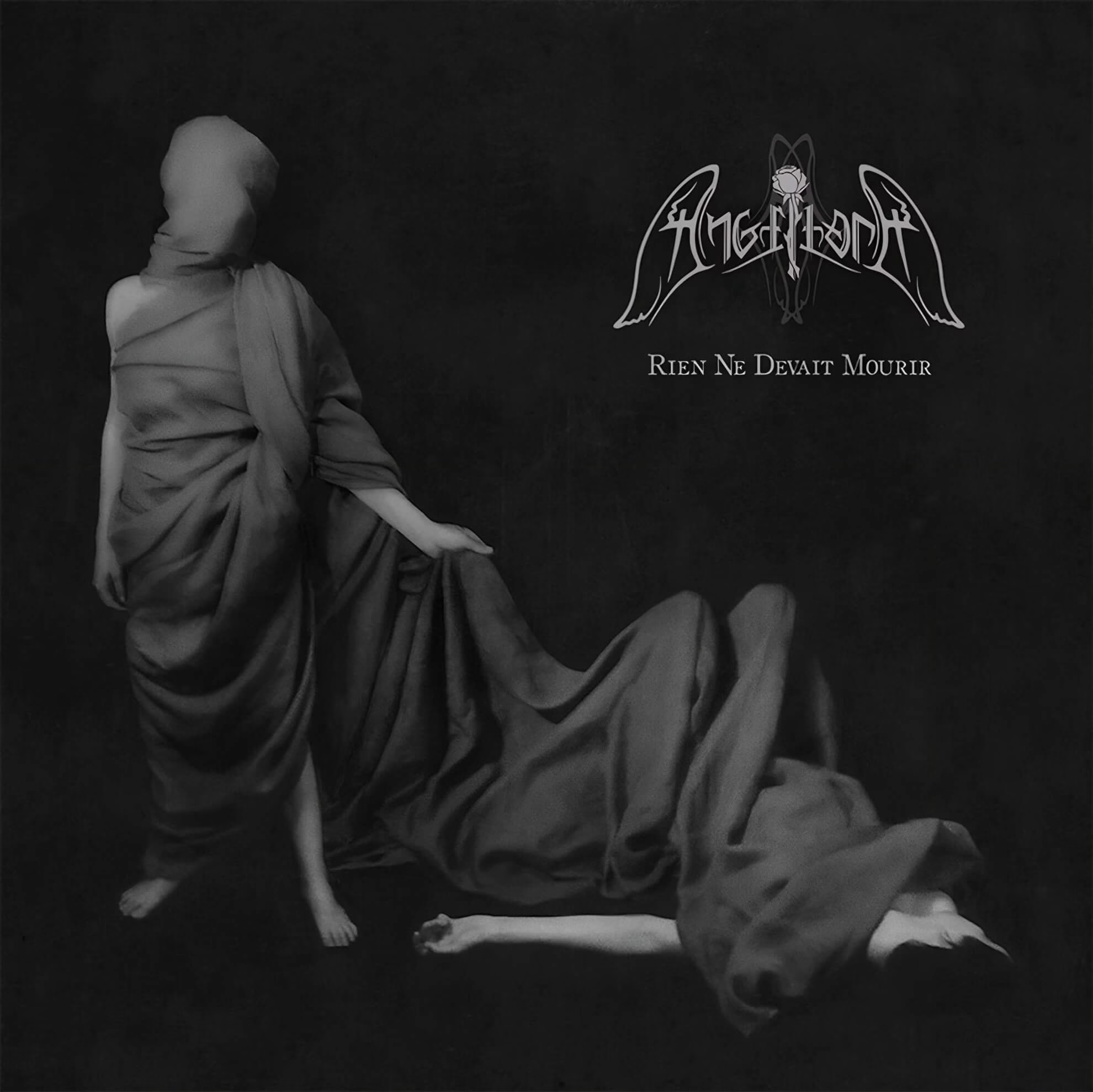
Six tracks approaching one hour — opened by ‘A Romance of Thorns,’ a composition sustaining nearly twenty minutes alone — the album brought together a funeral choir alongside cello, harp, organ, and violin, recorded across multiple French locations. The band described it as their “darkest, most symphonic and ambitious work to date,” and the critical reception confirmed the scale of the achievement, drawing the broadest audience of the band’s career.
The relationship between that record and ‘Nocturnes’ is not rupture but concentrated reorientation. Where ‘Rien Ne Devait Mourir’ accumulated — six tracks, an orchestral palette recorded across churches and studios throughout France — ‘Nocturnes’ contracts: five tracks, a focused woodwind trio, and a production entrusted for the first time to Déhà in place of Florent Krist.
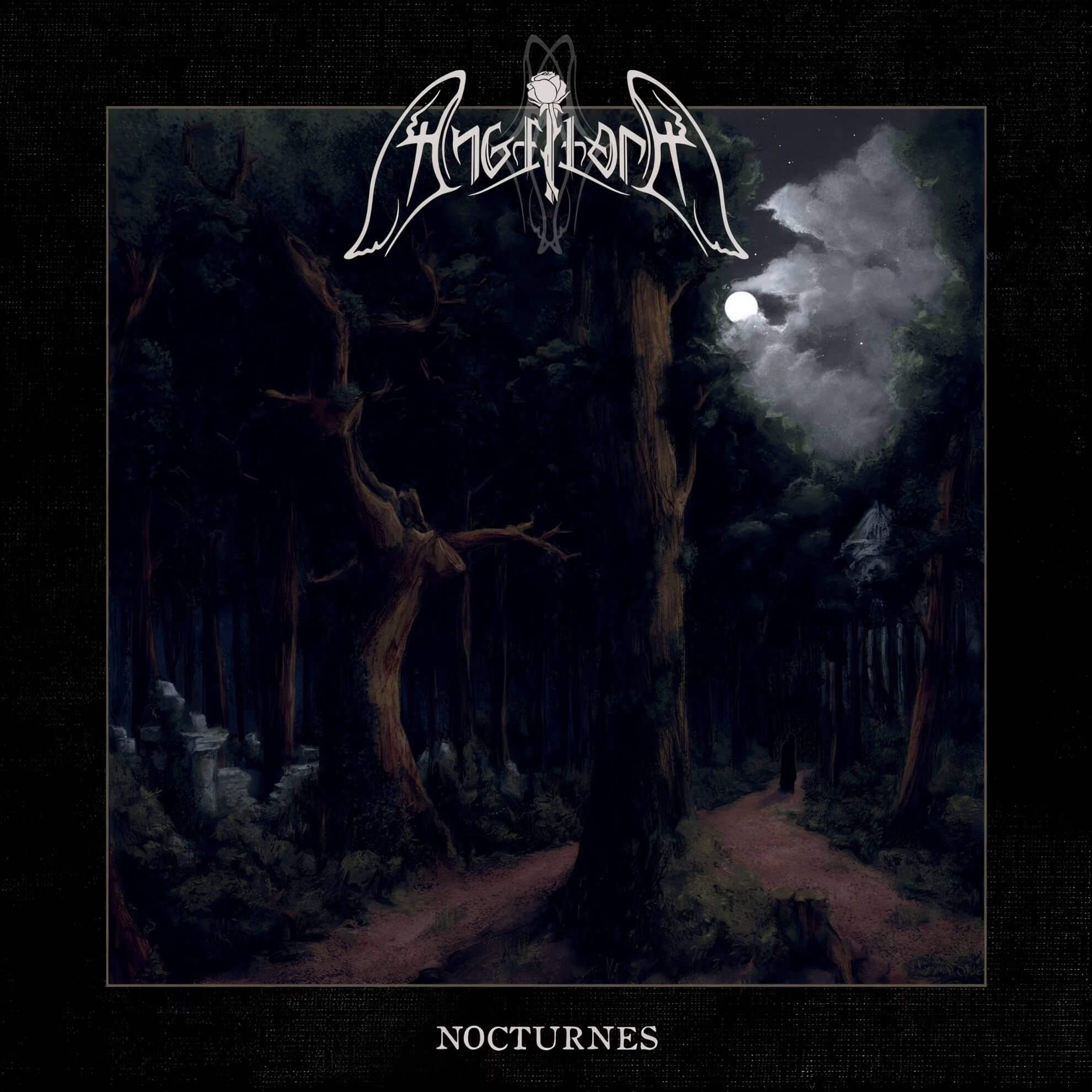
The cover artwork registers the shift: Celin’s design steps back from the Polaroid collage of ‘Rien Ne Devait Mourir’ toward painting — ruins, moonlight, a solitary figure in a forest — aligning the new album with the nineteenth-century Romantic tradition the band has long cited as foundational. ‘Nocturnes’ does not argue that its predecessor said too much. It argues that a different form was required.
The Song That Refused to Wait
‘Falling Birds’ was written in February 2017, while the band was still working on the material that would become ‘Rien Ne Devait Mourir’ — a temporal fact that establishes the song’s position as the album’s oldest composition and its role as a thematic foundation.
Walran described the writing session as beginning in the manner of the band’s earliest work: Rosarius and Walran alone, with a keyboard, a guitar, and a recording setup. The intention was to distill what gothic death-doom meant to them, and the guitar harmonies Rosarius played immediately recalled for both of them the opening passages of Tristania’s ‘Widow’s Weeds’ — not as a source to imitate but as a standard of emotional clarity to pursue.
The song’s conceptual premise, established during that early session, concerns memory’s departure rather than death itself, though the two are held in deliberate ambiguity. Walran described envisioning “an old woman waking up in the middle of the night, disoriented, walking barefoot in her nightgown toward a ruined castle she once knew in its former splendor.” The falling birds of the title are the memories that leave her over time.
The lyrical strategy compounds this ambiguity by refusing to anchor the singing voice to a single perspective: it remains uncertain whether the voice belongs to the one who has died or the one who has survived the loss. ‘Falling Birds’ stages grief not as the property of the living but as a shared condition — an argument the eleven-minute structure reinforces by refusing to accelerate toward resolution.
What Cannot Be Replaced by Code
Angellore’s vocal arrangements have always been central to their appeal, and ‘Falling Birds’ draws on all three voices in the current lineup. Lucia’s soprano carries the most exposed passages; Rosarius shifts between clean singing and harsher registers as structural intensity increases; Walran occupies the middle ground between them. The three voices do not compete but function as gradations of a single emotional register, modulating its intensity without altering its fundamental character.
Three guest musicians contribute equally to the song’s identity. Gunnar Ben returns on oboe, a collaboration already established on ‘Rien Ne Devait Mourir’; Ségolène Perraud contributes flute across three of the album’s five tracks; Dirk Goossens appears for the first time in Angellore’s recorded catalog on bass clarinet.
Walran has been direct about the reasoning behind these collaborations: the warmth and breath-dependent phrasing of acoustic woodwind instruments cannot be approximated by software equivalents, and the three voices those instruments produce on ‘Falling Birds’ — oboe’s nasal grief, flute’s fragile brightness, bass clarinet’s low solemnity — create an emotional spectrum that the heavier passages could not sustain alone.
The Still Image Holds Its Ground
‘Falling Birds’ was presented without a directed music video. The official visual release is the full album stream published on the Ardua Music YouTube channel, in which the album artwork designed by the band’s bassist Florent “Celin” Castellani serves as the sustained visual companion to the music.
The album’s first pre-release single, ‘Black Sun River,’ received a different treatment: an official lyric video recorded and assembled by Angellore and Deadsign Studio, published on the Ardua Music YouTube channel on April 2nd, 2026. That ‘Falling Birds’ was presented without equivalent visual production — despite the infrastructure clearly being available — suggests a deliberate differentiation. The eleven-minute duration renders even the lyric video format insufficient for the music’s demands.
The choice to present an eleven-minute composition as an audio stream with illustrated artwork rather than a directed video is not an absence but a position. Gothic doom has never been primarily a performance genre; its relationship to visual imagery is closer to the tradition of Romantic painting than to music video convention.
The artists Angellore cite as visual influences — Friedrich, with his isolated figures confronting vast and indifferent nature; Turner, with his dissolution of solid forms into atmospheric light — both produced images that hold still and demand time from the viewer. A directed video would impose its own editorial rhythm onto ‘Falling Birds’ and, in doing so, compete with the music’s deliberate refusal to accelerate. The static illustrated image does not compete. It waits with the listener.
The Romantic visual precedent the band inherits also connects to the song’s literary and iconographic content. The image of the woman approaching the ruined castle — the crumbling structure, the nocturnal garden, the birds departing — belongs to a tradition running through eighteenth and nineteenth-century Gothic fiction, from Ann Radcliffe’s heroines navigating decayed interiors to the graveyard poetry of the period.2
Celin’s album cover inhabits this tradition directly — ruins, moonlit forest, the solitary wanderer. Walrus’s illustration works differently: it takes the song’s central metaphor as its sole subject, rendering the falling bird as a literal image rather than placing it within a Gothic landscape.
The Depth of Nine Years
‘Nocturnes’ was recorded between October 2021 and February 2022 at Opus Magnum Studios and Blackout Studios in Brussels. The album marks the first collaboration between Angellore and Belgian producer and mixing engineer Déhà — known for his work with Inborn Suffering, Wolvennest, and Cult of Erinyes — and was mastered by Markus Skroch at Kalthallen Studios in Germany.
The production reflects the album’s dual nature: the woodwind and piano elements receive space and warmth, while the heavier passages retain the density the band’s earlier work established.
The album’s five tracks — ‘Falling Birds,’ ‘Black Sun River,’ ‘Forsaken Fairytale,’ ‘Martyrium,’ and ‘A Dormant Stream’ — were released through Ardua Music, the independent label based in Málaga, Spain, with which Angellore renewed its relationship after the label had previously issued a double-LP edition of ‘Rien Ne Devait Mourir’ in 2020.
The album is available through the Ardua Music and Angellore Bandcamp pages. Streaming figures were not publicly available at the time of publication.
What the Falling Cannot Return
A composition that took nine years to reach its audience carries a different weight than one written in a single sustained session. ‘Falling Birds’ arrives with the specific gravity of long-term work: it does not claim its emotions, it has absorbed them. The song’s subject — the departure of memories, the ambiguity between loss and death, the persistence of grief as a form of continuity — has not been selected for thematic adequacy but earned through the duration of its making.
That quality of accumulation allows the work to reach listeners whole, regardless of the distance it crosses. That quality belongs not just to ‘Falling Birds’ but to ‘Nocturnes’ as a whole — five tracks written across years, shaped by grief and precision, recorded across multiple European locations, and due on May 15th, 2026 via Ardua Music. The album does not require a stage to make its argument. It arrives complete.
With ‘Nocturnes’ placing duration and accumulation at the center of its aesthetic — five tracks, nearly a decade in the making — does an album built on sustained grief ask something different of the listener than a record written and released within a conventional cycle?
References
- Joseph Leo Koerner, ‘Caspar David Friedrich and the Subject of Landscape’ (London: Reaktion Books, 2009), 95—102. ↩︎
- Michael Gamer, ‘Romanticism and the Gothic: Genre, Reception, and Canon Formation’ (Cambridge: Cambridge University Press, 2000), 78—83. ↩︎
Leave a Reply