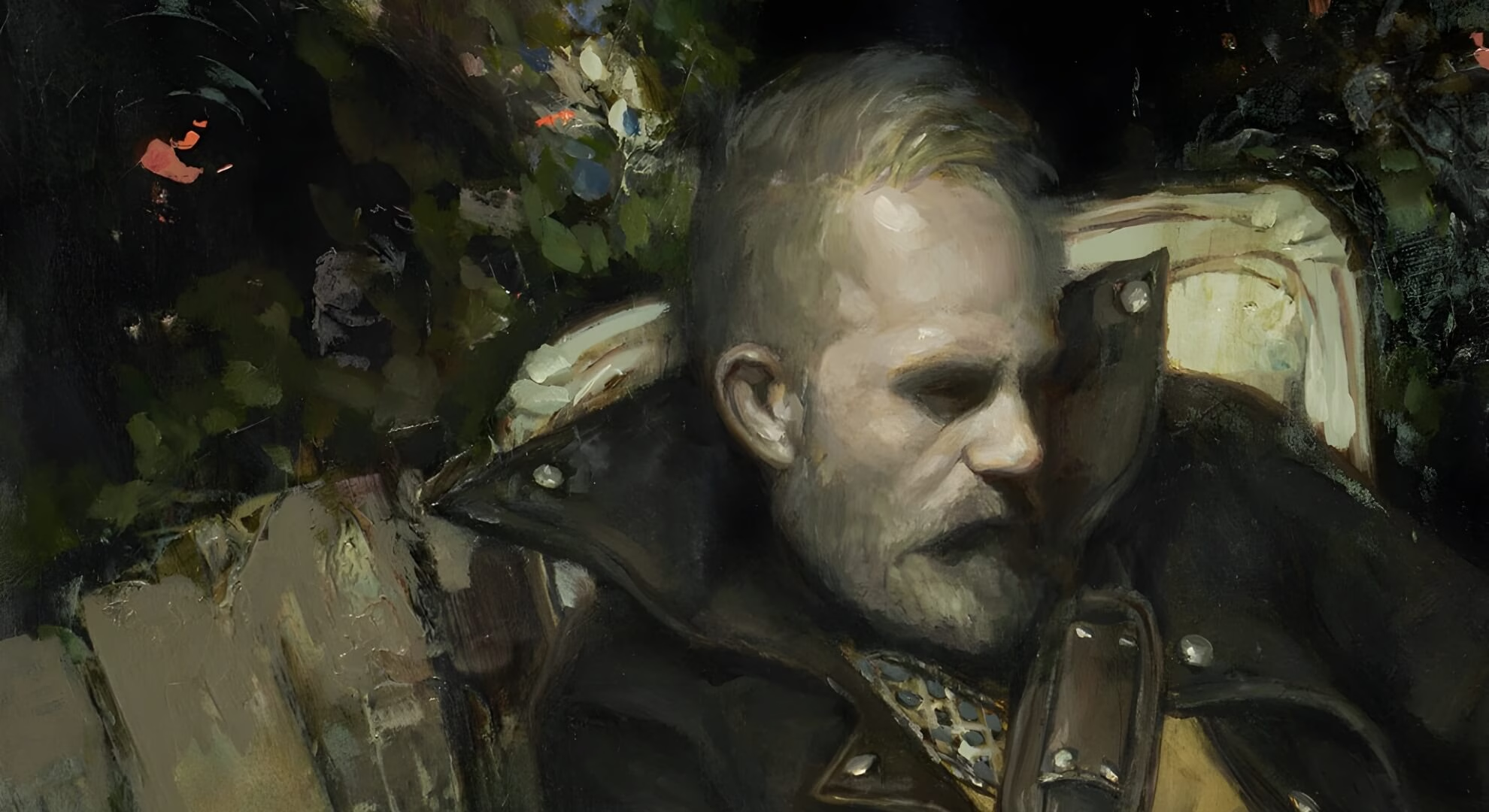


The word “playful” arrives early in Modern Eden Gallery’s description of Nadezda’s new body of work, and it does what gallery framing almost always does with that word: it positions the show as an interlude, a lighter step in a longer practice. Nadezda’s ‘Hopscotch’, on view through May 24th, 2026, is described as a mini-collection built in “a spirit of quiet experimentation” — paintings and drawings in which “each work feels like a small leap between worlds.” The framing is not wrong. The work, however, does not fully resolve into it.
For an artist whose practice spans painting, drawing, sculpture, photography, and theater-inspired work with live performers, a show called ‘Hopscotch’ carries an implicit promise of reduction — a narrowing of means in favor of immediacy.
Nadezda, a Barcelona-based painter who has developed her practice across multiple solo exhibitions at Modern Eden Gallery, is documented by the gallery as building her work around “narratives carefully gathered from the hidden chambers of her imagination” alongside theater-inspired work with actors, dancers, and models.
‘Hopscotch’ pulls back from the theatrical and the staged. The question the work itself raises is whether a reduction of means produces a corresponding reduction in psychological weight, or whether the same visual logic operates at a different scale.
Modern Eden Gallery has established itself as a primary commercial venue in San Francisco for contemporary fantastical figuration — a visual tradition that draws from late nineteenth-century Symbolist interiority, twentieth-century Surrealist dreamspace, and the post-punk commercial gallery culture that consolidated in American cities through the nineteen-nineties and two-thousands.
Nadezda, one of the gallery’s recurring artists, has developed across her Modern Eden shows — including ‘Imaginary Friends,’ ‘Once There Was, Once There Wasn’t,’ and ‘Secret Hallway’ — a practice progressively more formally deliberate in its compositional control and more precise in its management of psychological space. Against that trajectory, ‘Hopscotch’ is framed as a deliberate step sideways: a test of what the practice looks like when it relaxes its grip.
The contemporary fantastical figuration tradition has historically been summarized in gallery framing through words like “whimsy,” “dreamscape,” and “playful” — vocabulary that positions the tradition as accessible rather than psychologically serious, as charming rather than unsettled. Whether ‘Hopscotch’ accepts or resists that resolution is what makes the show worth examination.
What Nadezda’s Paintings Actually Do
The larger oils in ‘Hopscotch’ do not carry the lightness the title suggests. ‘Big Cat,’ one of the exhibition’s more substantial paintings, centers on a feline subject whose scale and treatment carry the formal deliberateness of Nadezda’s prior large-canvas work — the “playful” of the title present in the subject matter but organized by a painterly control that has nothing casual about it.
‘Bubbles’ returns to a similar compositional register: the subject matter is light, the handling is not. Together they demonstrate that the reduction of means this show advertises is not accompanied by a reduction of pictorial attention.
The most formally provocative work in ‘Hopscotch’ is also its most comic in title. ‘Fred the Meathead’, an oil on panel measuring 8 by 10 inches, presents a bare-chested male figure standing frontal and planted — muscular torso, suspenders, belt, fists clenched at his sides — in a posture the portrait tradition reads as authority. The head is gone. In its place, a large dark mushroom cap sits squarely on the shoulders, its gills exposed beneath the cap rim, a bone protruding horizontally from the gill cavity in the precise position of a mouth.
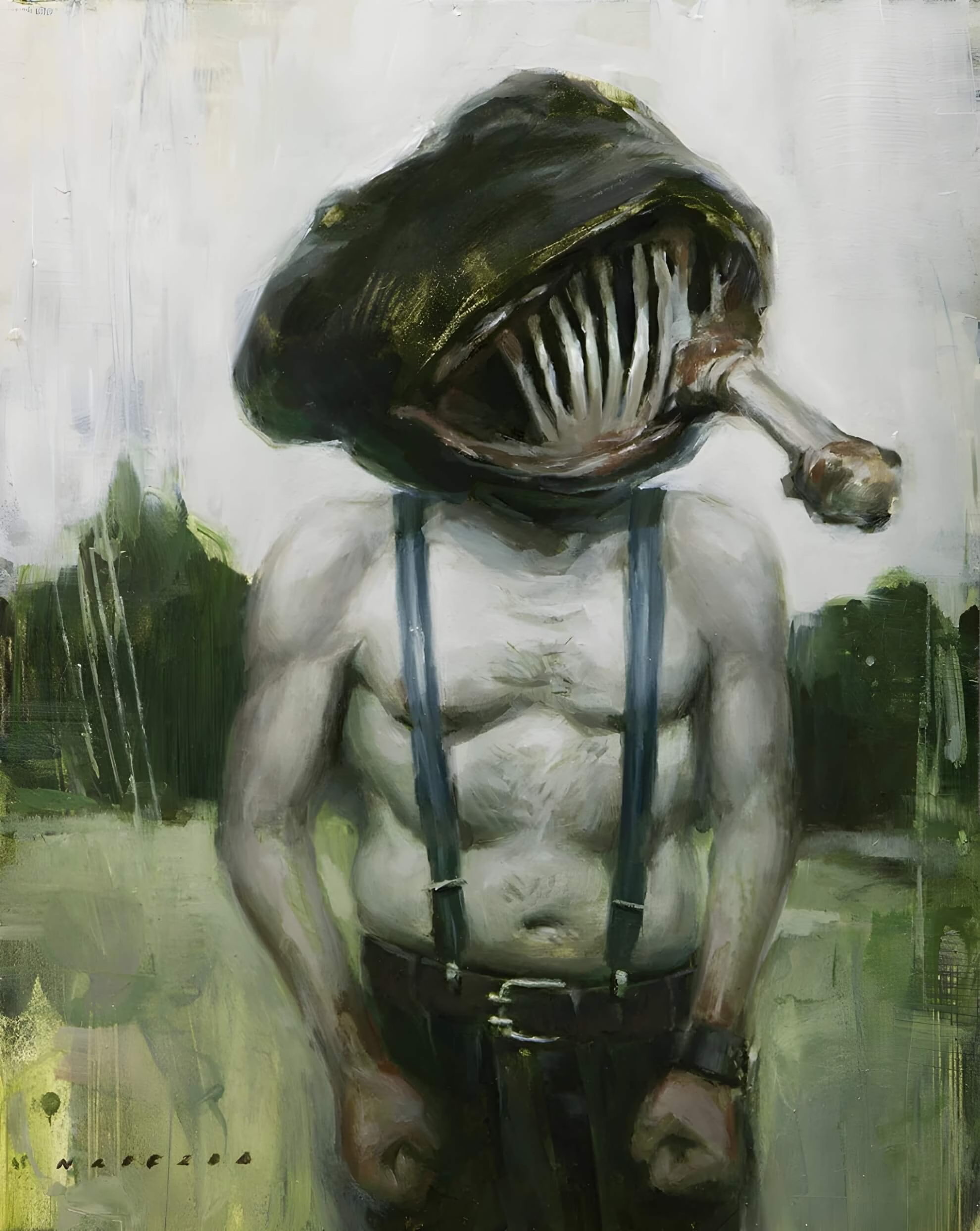
The transformation is not additive in the manner of classical hybrid mythology, where animal or vegetable elements are grafted onto an intact human body. The substitution is complete: there is no human head beneath the cap, no face, no gaze, no expression for the viewer to read. Behind the figure, a loosely painted green landscape — trees, pale sky, summer ground — places Fred outdoors, where the mushroom cap belongs in a way the body beneath it does not.
The name does considerable work alongside the image. “Fred” is an ordinary name, deliberately undistinguished — the name of someone unremarkable, someone who has always been there. “Meathead” is American vernacular for the dim, the thick, the unimaginative; it carries a specific register of working-class dismissal.
The painting gives this figure a name that demeans him and then treats him with a formal attention the demeaning name does not prepare for. He is centered, upright, painted with care. The bone held in the gill-cavity — the one element of personality the figure retains — reads with the practiced ease of a habit, something kept there always.
What ‘Fred the Meathead’ accomplishes, and what the gallery’s framing of ‘Hopscotch’ as playful cannot fully account for, is the specific uncanny quality of the named figure from whom identity has been removed. Fred has a name. Fred has no face. The tension between those two facts is not dissolved by the comedy of the title. It is the painting’s subject.
Admission to ‘Hopscotch’ is free at Modern Eden Gallery in San Francisco, through May 24th, 2026.
The Show the Title Cannot Summarize
What ‘Hopscotch’ reveals about Nadezda’s practice is that the “more playful and intuitive side” the gallery identifies is not a departure from what she has been developing across her exhibitions at Modern Eden so much as a test of what remains when the formal means are reduced. Some works here are genuinely light — the pencil drawings and smaller studies carry the spontaneity the title promises. The larger oils carry something the word “playful” was not constructed to hold.
The contemporary fantastical figuration tradition has consistently been undersold by the vocabulary its gallery contexts reach for. “Whimsy,” “dreamscape,” and “playful” are words that make work accessible without accounting for the psychological interior the imagery is actually charting.
Nadezda’s practice has moved across her exhibitions toward a point where that vocabulary is no longer sufficient for the work’s largest ambitions. ‘Hopscotch’ is a smaller show than her prior solo exhibitions at the gallery, and the gallery is not wrong that its register is lighter. But the lightness is a method, not a reduction.
Leave a Reply