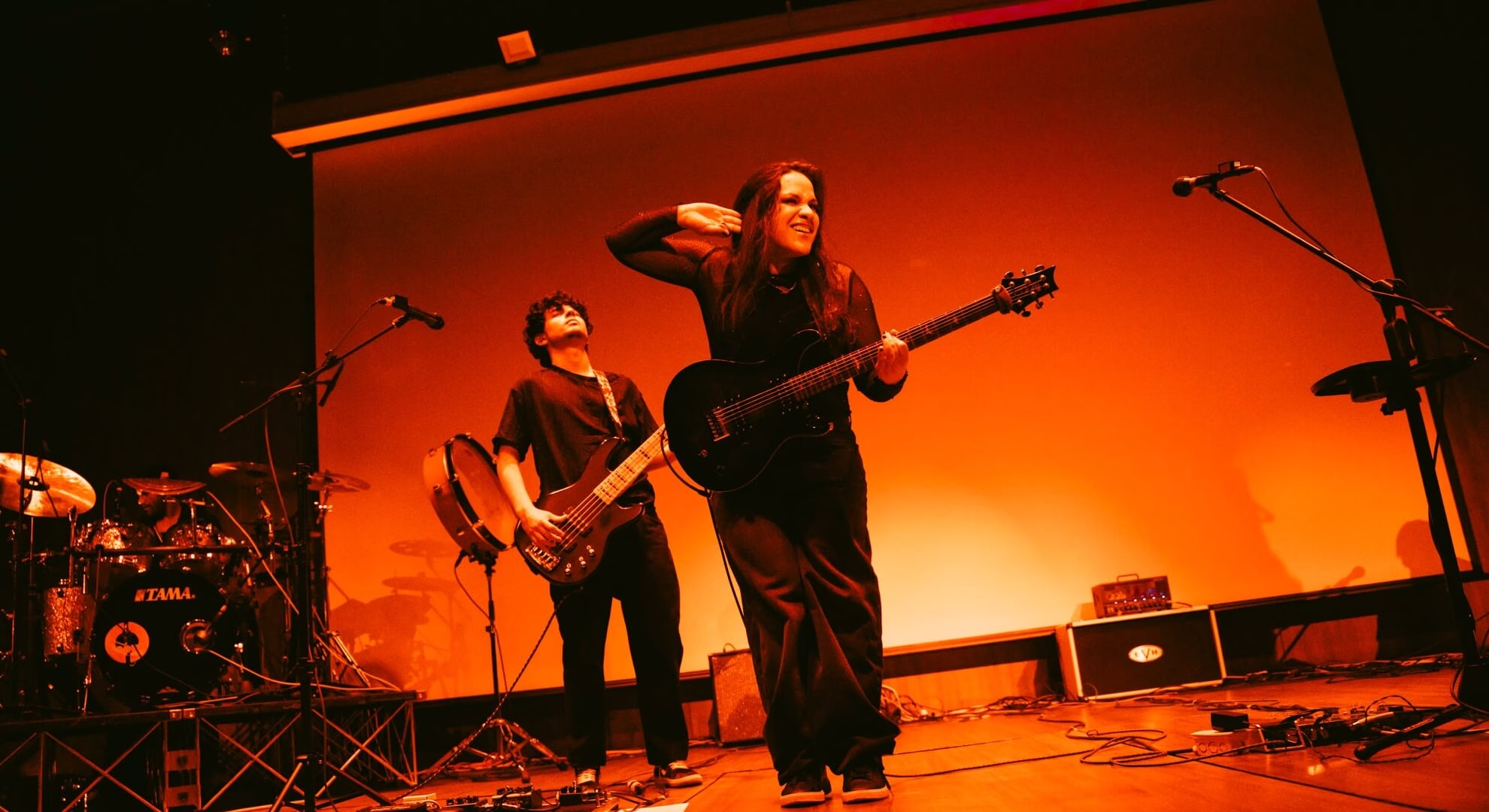


The chairs filled in slowly. By around 8:10 PM on April 11, the rows at Hall 74 had settled into their seated formation, a physical arrangement the audience chose rather than one the venue imposed. A standing space existed in front of the first row—space for a mosh pit, space for crowd surge, space for the physical expression progressive rock metal often demands. No one took it. The audience began the evening seated, though they would not remain still throughout—particularly during Argovia’s set, when they reacted energetically at specific moments.
Hall 74 occupies Calle 74 #14-25 in Bogotá’s Chapinero district. The venue announced its purpose through what was visible: a projection screen rising behind the stage, already cycling through ambient patterns before the first performance began. The lighting rig waited overhead. The seated configuration pressed perhaps 150 people into proximity with a low stage that barely cleared seated eye level. The event had sold out. The waiting room before doors had been cold enough to register as discomfort. The performance space offered relief.
Doors had been scheduled for 7:00 PM. The crowd entered after 8:00 PM. Colombian concert tradition asserts itself in this gap between posted time and actual start, a pattern familiar enough that no one arrived expecting punctuality.
The Opening Set
Ferales took the stage at 8:20 PM. The Medellín-based alternative rock quartet, formed in 2019, arrived with a documented lineage that traced through trip hop, indie, and art rock, drawing from influences as varied as Porcupine Tree, Björk, and Anathema’s later progressive period. Their self-titled debut album appeared in 2022. The band performed as a quartet without a bass player, the low end carried instead by synthesizers. For this performance, session drummer Sebastián Cardenas—known as Chevs—filled in on drums, as the band’s usual drummer could not travel to Bogotá.
Eliana Piedrahita held the microphone. Her vocal training showed immediately—a soprano lyric coloratura education at the Universität Mozarteum in Salzburg, Austria, documented through performances in Vienna, Munich, and Moscow. That operatic foundation surfaced in her phrasing and control, occasionally pulling toward the textural fragility of Björk’s more restrained moments, the ethereal register that characterized The 3rd and The Mortal’s work in the mid-1990s, or the melancholic atmosphere of The Gathering’s later albums with Anneke van Giersbergen.
Brief passages suggested Ataraxia’s neoclassical darkness or Antimatter’s introspective weight, though these were fleeting resemblances rather than sustained characteristics.
The male vocals, handled by Leo Sierra, stood in sharp contrast. Where Piedrahita’s voice occupied space through sustained control, Sierra’s contribution arrived as a disruption. The disparity was not subtle. In songs where both voices appeared, the shift felt less like call-and-response and more like structural discontinuity, as if two separate compositional ideas had been forced into the same frame without adequate reconciliation.
The synthesizers registered only intermittently. During full-band sections, they vanished beneath guitars and drums. When the instrumentation pulled back to mid-tempo passages or pauses, the synth lines emerged clearly, providing the atmospheric layer the songs appeared to be designed around. The mix favored the wrong elements.
Ferales deployed súper tambor—a large Colombian percussion instrument—at specific moments, adding tribal rhythmic weight that shifted the band’s sound temporarily toward something more grounded in Latin American musical practice. Those sections carried the most distinct energy in their 25-minute set.
The rest of the performance remained competent but constrained by the band’s limited stage movement. They performed toward themselves rather than the seated audience, maintaining professional execution while failing to bridge the physical distance the sitting arrangement had already imposed.
Their setlist moved through six songs: ‘Nada,’ ‘Amor,’ ‘Levedette,’ ‘Para Ella,’ ‘Canción de Cuna,’ and ‘Sue.’ By 8:20 PM, Ferales left the stage. The room applauded and cheered. The audience engaged with Ferales’ performance, though their response felt more restrained than what would emerge later during Argovia’s set, when the crowd seemed freer in their reactions.
The Release Performance
Argovia entered at 8:45 PM with the weight of their documented trajectory visible in the production choices before they played a note. The Colombian-Venezuelan progressive metal band, founded in 2013 by multi-instrumentalist Ani Guillén and keyboardist Carlos Arminio, arrived at this release show carrying 13 years of refinement.
Their debut EP ‘Lost Letters’ appeared in 2014, earning a nomination for EP of the Year at the Unión Rock Show awards. The full-length ‘Distant Present’ followed in 2017, mastered by Tony Lindgren at Fascination Street Studios, the same facility that has shaped releases from Opeth, Leprous, and Katatonia.
The band’s 2024 EP ‘Who We Are’ marked a deliberate sonic shift. Mixed by Alejandro Londoño, who has worked with Cultura Tres, Sepultura, and Delain, and mastered by Steve Kitch of The Pineapple Thief, the release moved away from symphonic digital elements toward a rawer, heavier progressive rock sound. That EP earned inclusion in Nación Progresiva’s Best EP of 2024 category, positioning Argovia as one of the more promising acts in Latin American progressive metal.
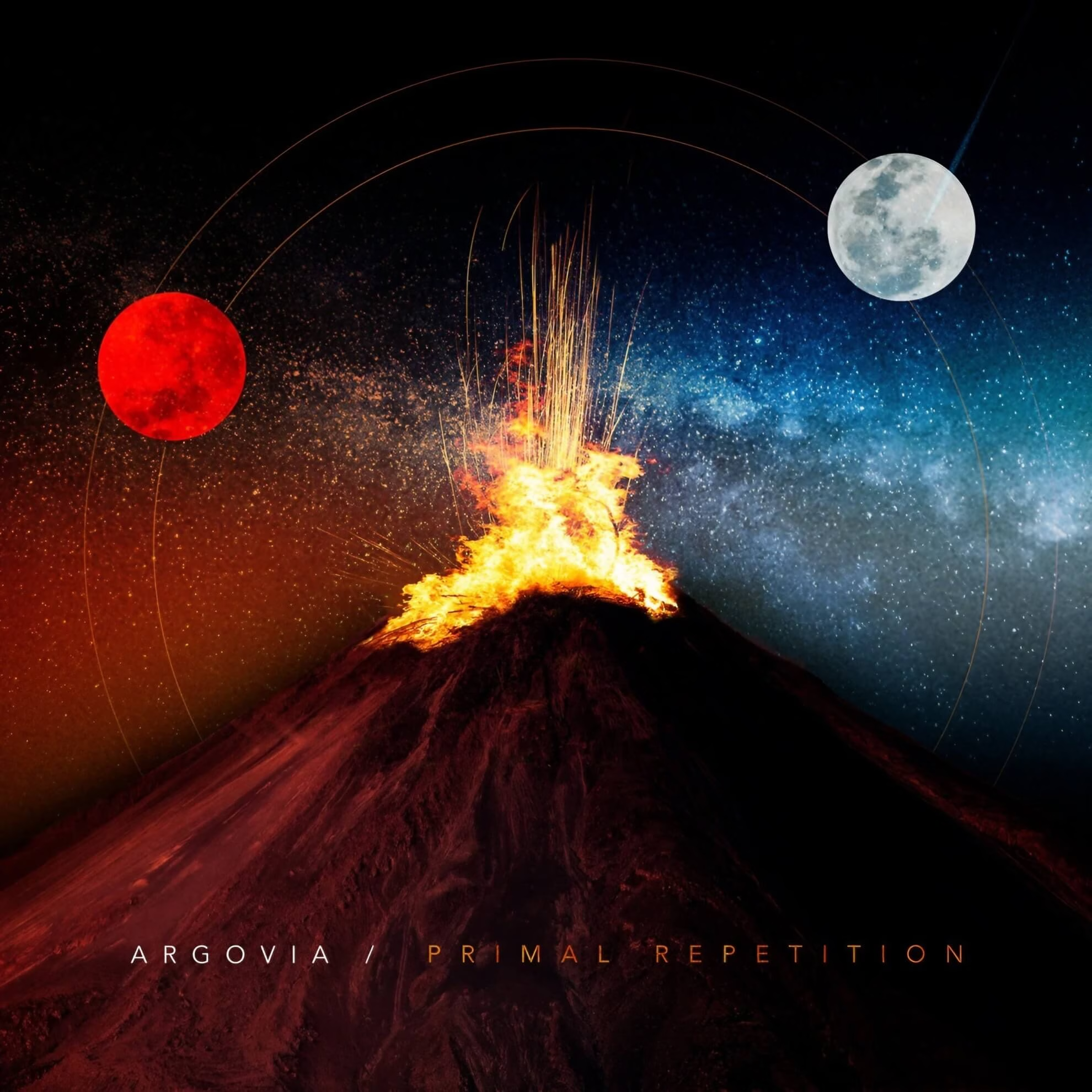
‘Primal Repetition,’ released officially the previous day on April 10, represented the culmination of this sonic evolution. Mixed by Fernando Cubillos and mastered again by Kitch, the album featured a guest vocal appearance from Ross Jennings of Haken on the track ‘Ebb & Flow.’ Jennings recorded his parts remotely while touring during Cruise to the Edge 2025, working from an improvised studio setup in his cabin. The collaboration positioned Argovia’s work within the international progressive circuit they had been pressing toward.
The current lineup—Guillén on vocals and guitar, Arminio on keyboards, Nicolás Paredes on bass, and Mauricio Sanabria on drums—took the stage with the projection screen already running. The visuals shifted from cosmic patterns to abstract imagery to water reflections, timed to the music’s emotional arc. The lighting alternated between warm orange-red washes and cool blue-teal tones, creating the passive-aggressive duality the notes had captured: light versus darkness, rendered through color temperature and projection content.
The Set Unfolds
The setlist documented the album’s emotional progression. ‘Oceanborn’ opened, establishing the melodic framework and electronic atmosphere that would define the evening. ‘Who We Are’ and ‘Disconnected’ followed, both from the prior EP, before ‘Mountains’ arrived with Guillén’s brief speech about hitting emotional bottom and finding connection through another person who reminds you who you are.
The performance moved through deeply emotional territory—powerful and energetic at moments, balanced with passages of serenity and tranquility. The contrast between these states was pronounced enough to suggest bipolarity, yet the band navigated these shifts with control.
The heavier sections registered with the seated audience. Heads nodded. Applause came between songs without prompting. The room had committed to active listening rather than physical response, and Argovia understood how to work within that contract. Their performance prioritized precision without abandoning showmanship, trusting the material’s construction to carry the engagement, even as they delivered a show that proved remarkable in its own right.
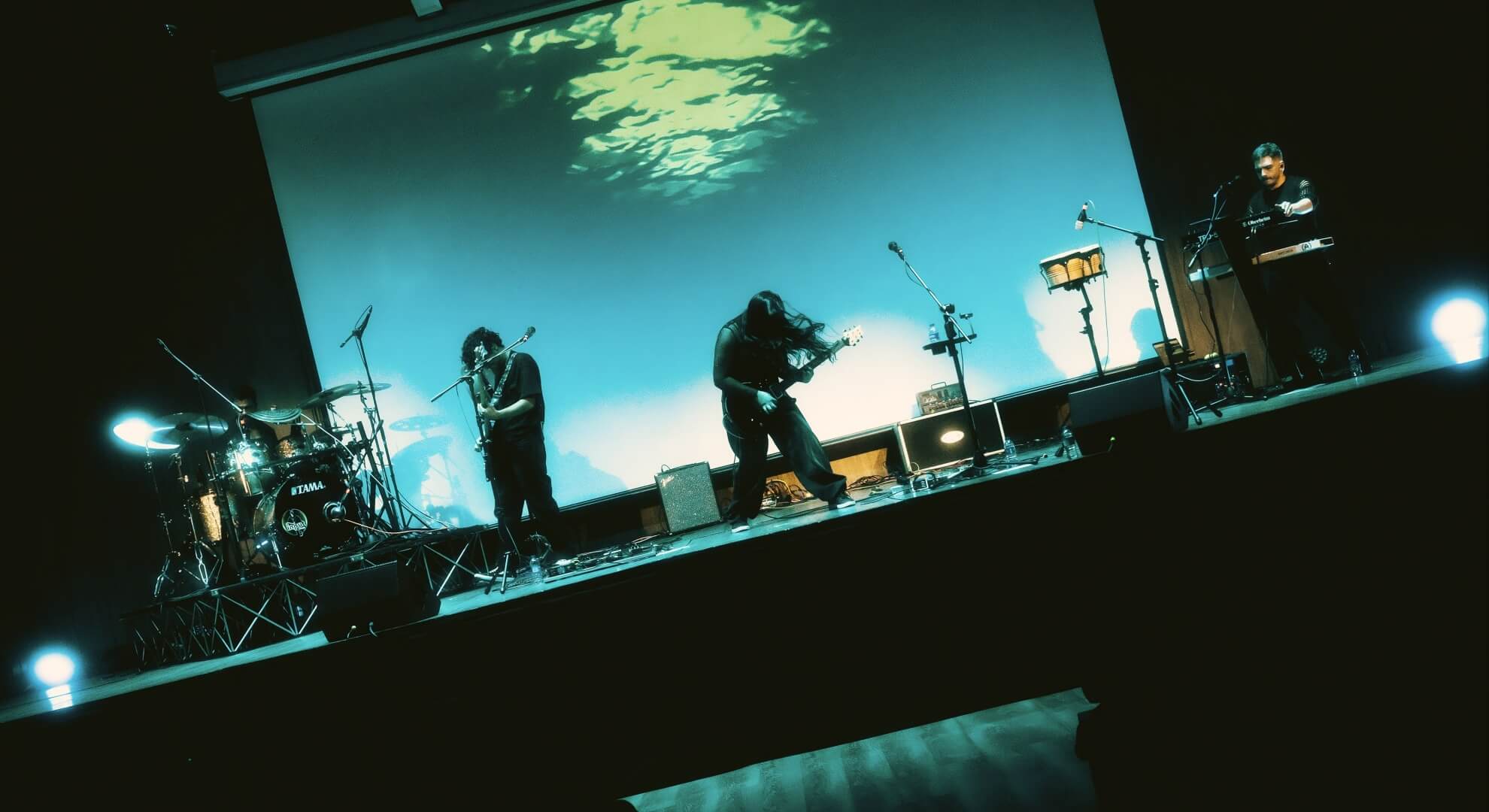
A child attended with his mother, headbanging to Argovia’s heavier passages with the unselfconscious enthusiasm that adult audiences have learned to suppress. The venue provided safe space for a young metalhead to experience a show among adults without constraint. That moment—a child fully engaged with progressive metal in a seated concert environment—will likely persist in his memory long after the specific setlist fades.
Guillén spoke again before ‘Ebb & Flow,’ addressing the pandemic period and depression’s presence during those years. The song arrived with Josué Medina, vocalist of Fatima Push, joining for guest vocals on ‘Crawling.’
His voice struggled against the mix. The sound production issues that had affected Ferales persisted. While Guillén’s vocals remained audible, Medina’s voice was pushed too low in the mix, shadowed by hers to the point where his contributions nearly disappeared. The bongos, shakers, and súper tambor that Argovia deployed throughout the set often failed to register clearly, their rhythmic contributions audible only when the full band pulled back.
The instrumental interlude between ‘Crawling’ and ‘Spark’ featured ‘Interstellar,’ giving the band space to demonstrate their technical control without vocal lines to balance. ‘Spark’ followed, then the Porcupine Tree cover ‘Open Car.’
The audience reacted immediately—recognition laughter, louder applause. Steven Wilson’s influence on Argovia’s recent work was no secret. The band had cited Porcupine Tree, Riverside, The Gathering, Vola, and Karnivool as touchstones for the sound they pursued after their 2022 revival. Covering ‘Open Car’ made that lineage explicit.
‘Crossroads’ arrived next, followed by another speech—this one about children as an important part of life, and the value of introducing them to this music. At least one child had been visible in the audience throughout both sets, moving and responding to the rhythm without the self-consciousness that constrains adult concert behavior. Guillén acknowledged that presence.
‘Age of Wonder’ and ‘Waves’ pushed toward the set’s conclusion. Then Susana Chvatal, vocalist of Volheid, a progressive death metal band and host of the radio show Distorsión Sin Filtro on Roll The Radio, joined for ‘Where Do We Go,’ providing the second guest vocal appearance. The collaboration added textural variety but suffered from the same mix issues that had affected Medina’s contribution. By the time ‘Unstoppable’ arrived as the encore, accompanied by its newly released video clip playing behind the band, the audience had already committed to the performance’s success regardless of technical shortcomings.
The Performance’s Specific Achievements
What Argovia accomplished on April 11 should be measured against what they attempted. The audience’s choice to remain seated despite available standing space created constraints that most progressive metal and rock bands avoid. While physical release occurred—headbanging, bodily movement responding to heavier sections—the seated configuration limited crowd movement compared to standing shows, channeling enthusiasm primarily through attention and applause while still permitting moments of physical expression.
The band responded by leaning into atmosphere, projection, lighting, and precise execution. They succeeded at creating contemplative space.
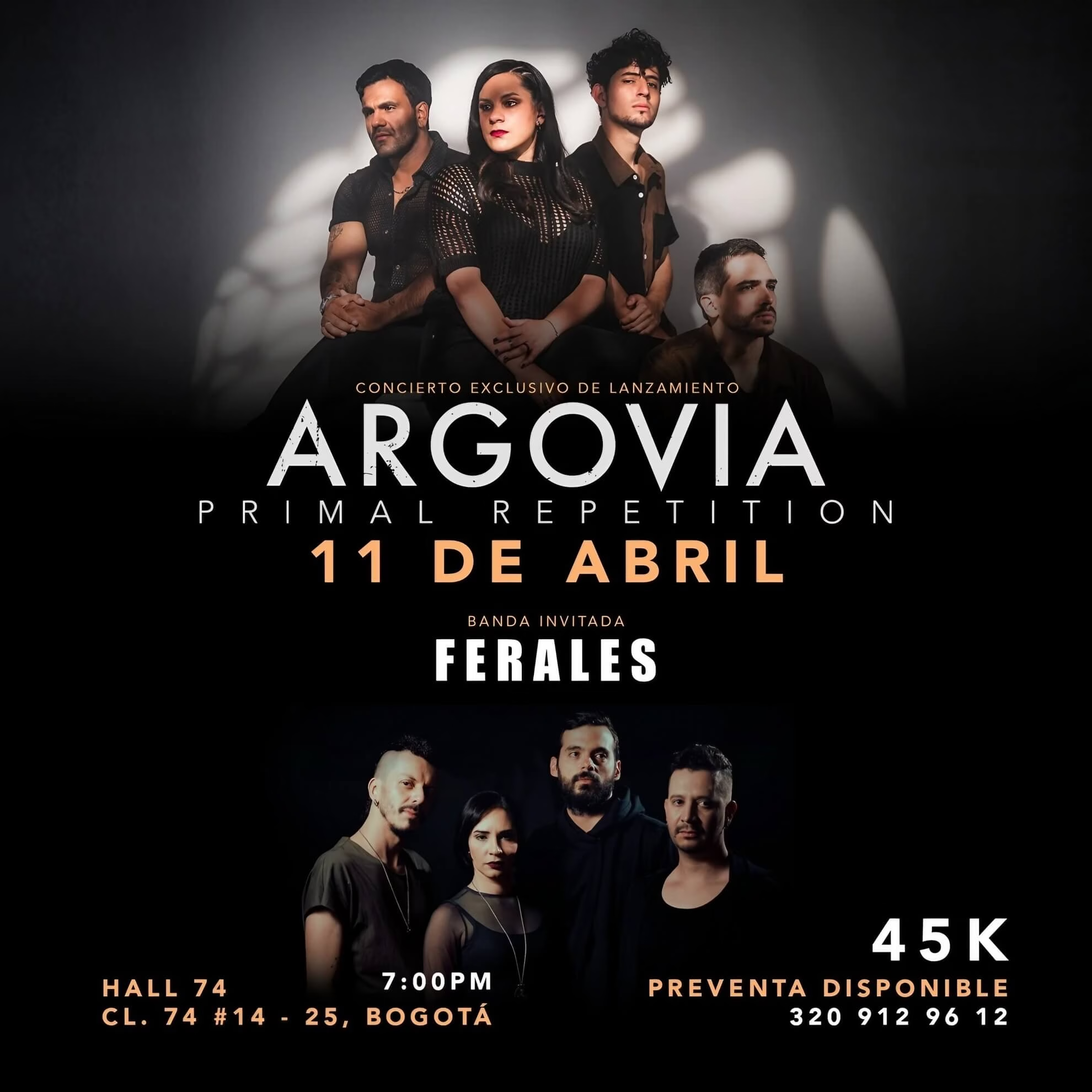
The sound production presented challenges: layered music occasionally struggled in the mix. Some percussion elements receded. Guest vocals sat lower than ideal. Yet these issues, while noticeable, did not fundamentally undermine the performance. The mix served the material adequately, even if it fell short of the precision such layered progressive rock demands.
Guillén’s stage presence carried authority. Her vocal performance demonstrated why Leprous invited her to participate in the choral recording of ‘Faceless’ for their ‘Melodies of Atonement’ album. Arminio’s keyboard work provided the electronic atmosphere the songs were constructed around. Paredes and Sanabria held the rhythmic foundation. The band earned their position within the Latin American progressive scene through competence and consistency.
The Porcupine Tree cover revealed both strength and limitation. Argovia performed ‘Open Car’ competently, demonstrating their ability to inhabit Wilson’s compositional language. But the choice also exposed how much of their current sound remains derivative of the British progressive tradition they admire.
The original material on ‘Primal Repetition’ shows movement toward a more distinct voice—the Latin American rhythmic elements, the Spanish-language lyrics, the specific emotional territory the album explores. The challenge for Argovia is whether they can push further into that distinctiveness or whether they remain content operating within established progressive frameworks with moderate regional variation.
The Album’s Place in Bogotá’s Progressive Scene
‘Primal Repetition’ represents Argovia’s most accomplished work to date. The album’s thematic exploration of cycles, repetition, and emotional memory finds sonic expression through the balance they have struck between progressive complexity and emotional accessibility. The Ross Jennings collaboration positions them within international circuits. The Steve Kitch mastering gives the recorded work the polish that the live mix could not deliver.
Hall 74’s configuration allowed the audience to choose their engagement mode. That they chose contemplation over physical expression speaks to both the music’s character and the progressive rock audience’s expectations in Bogotá. The city’s progressive scene, smaller than its metal or alternative communities, nevertheless supports artists who work within this tradition.
Argovia has earned their position through 13 years of documented growth. Whether ‘Primal Repetition’ propels them beyond regional recognition into the broader progressive circuit they are clearly pursuing remains to be determined by festival bookings, international reviews, and the album’s reception outside Latin America.
What is certain is this: on April 11, 2026, at Hall 74 in Bogotá’s Chapinero district, Argovia demonstrated their understanding of how to translate recorded work into live performance. They engaged an audience that chose stillness over movement, and they held that engagement for 83 minutes.
When ‘Unstoppable’ concluded and the video faded from the projection screen, the seated crowd rose to its feet. The standing ovation that followed was not protocol but conviction—the room’s final acknowledgment that the band had earned the evening’s success. The album had been properly launched.
For those who have attended progressive rock performances where standing space exists but audiences choose to remain seated, what factors determine that collective decision, and how does it shape the band’s performance approach compared to shows where physical movement dominates?

Leave a Reply