


In 1824, Heinrich Heine wrote the poem that would permanently bind the Lorelei to German Romantic imagination — a figure combing golden hair on a Rhine clifftop whose song drew passing sailors toward the rocks, not by design, but because that was what the song did. The name Heike Langhans gave her dark electronic solo project — a typographic cipher reading LOR3L3I — reaches directly into that figure.
Born in Cape Town, South Africa, of German descent and now settled in Dunedin, New Zealand, Langhans has spent two decades as the defining voice of other people’s projects. The debut album she made entirely herself arrived on May 1st, 2026.
The Long Arc Before Solo
LOR3L3I began around 2004 — before Draconian, before Ison, before Remina, before any of the international profile Langhans would accumulate through collaboration.
The project’s earliest material was compiled and remastered in ‘The Demo Collection,’ released digitally on February 7th, 2020, documenting compositions from 2004 to 2014. The electronic sensibility audible there — darkwave, EBM, and the diffused affect of dream-pop rather than the amplified grief of gothic doom — belongs to a British and European post-punk electronic tradition that developed through the late 1970s and 1980s as a deliberate departure from rock-derived expressionism.1
The solo work was never abandoned. It accrued and waited.
The Draconian Decade
In 2012, Langhans relocated to Sweden to join Draconian as the band’s second female vocalist following Lisa Johansson’s departure the previous year. The two records she made with the band — ‘Sovran’ (2015, Napalm Records) and ‘Under a Godless Veil’ (2020, Napalm Records) — mark a distinct phase in Draconian’s creative history, characterized by the shift toward Gnostic cosmology and science fiction inflection that Langhans brought from her own electronic practice.

Her departure in 2022 concluded at Hellfest, where both Langhans and Johansson shared the stage for what the band described as a passing of the torch — a public transfer of roles documented and widely observed in the metal press.
That decade of geographic and creative relocation — from Cape Town to Gothenburg to Dunedin — traces a trajectory that is simultaneously musical and biographical.2 The global circulation of artists across contexts of different cultural weight is not merely a career fact; it is a constitutive element of the work itself.
The Satellite Orbits
The years adjacent to Draconian produced a sequence of collaborative projects that chart the full range of Langhans’s sonic preoccupations. Ison, the cosmic drone duo she co-founded with Daniel Änghede in the outskirts of Gothenburg in 2015, released three records before her 2019 departure: ‘Cosmic Drone’ (2015), ‘Andromeda Skyline’ (2018), and the full-length ‘Inner-Space’ (2019, Avantgarde Music).
Remina, formed alongside Mike Lamb — best known as the founding force behind atmospheric black metal project Sojourner — moved into what the project calls cosmic doom; the debut ‘Strata’ (2022, Avantgarde Music) was followed by ‘The Silver Sea,’ released October 24th, 2025, on Avantgarde Music, a record whose thematic center was the lived experience of migration and relocation.
Light Field Reverie, Langhans and Lamb’s gothic doom vehicle, returned in January 2026 with the single ‘Ender’ (January 25th, 2026) after a five-year absence, with a second full-length announced for the second half of 2026. Sojourner, the atmospheric black metal project Lamb co-founded in 2014, extended that orbit further when Langhans joined as vocalist in 2024, with a new album already in development. Each project occupied a distinct register. None of them was LOR3L3I.
Ghost Bird and the Record at Hand
‘Peace by Proxy’ was recorded entirely by Langhans and mixed and mastered by Lamb at Ghost Bird Studios, Dunedin — the same facility that has served as the production home for Remina and Light Field Reverie. The studio credit situates the record within a tight creative geography: the same hands that co-authored the orchestrated doom of Remina’s catalog here take a technical support role while Langhans assumes complete creative authority.
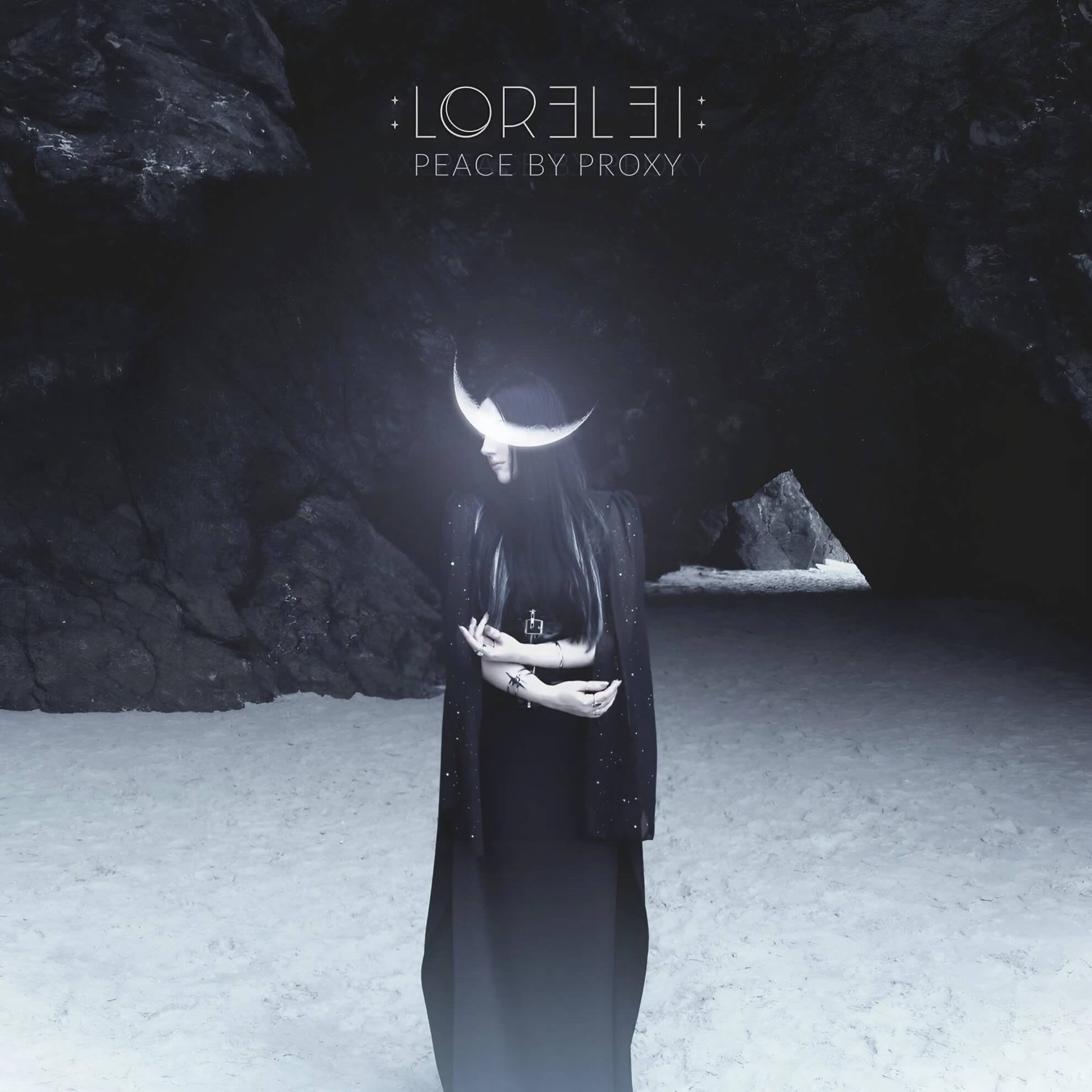
Every lyric, every synthesizer line, every piece of artwork on the release is hers. The cover photography was taken at Doctor’s Point Reserve, Dunedin, New Zealand.
The advance single ‘Cloak of Stars,’ released May 1, 2026, introduced the record’s sonic register — electronic textures layered beneath vocals that carry the restrained precision of the darkwave tradition rather than the theatrical expressionism of gothic metal. The closing track, ‘Opaline Tears,’ carries a dedication in memory of two named individuals, Delene and Poyin, situating the album’s emotional scope in private loss rather than collective mourning.
That distinction — intimate, domestic, unshared — runs through the record as a structural argument. ‘Peace by Proxy’ is released independently, without label affiliation, and is available through Bandcamp.
Peace Without a Proxy
‘Peace by Proxy’ is the record LOR3L3I had been accumulating since 2004. A compilation of deferred demos in 2020 was a marker, not a resolution. The full-length, released independently on May 1st, 2026, is the resolution — a record in which Langhans exercises the same solitary creative control over dark electronic music that she has exercised over visual art since she began designing under the Solar Siren moniker, a practice that fuses cosmic art nouveau and art deco with gothic influences drawn from astrophysics and dark fantasy.
The Lorelei of the project’s name is a figure of displacement, of voice separated from its native territory. What ‘Peace by Proxy’ does — quietly, without announcement, from a city at the edge of the Pacific — is place that voice at the center of its own record for the first time.
For those who followed Heike Langhans’s voice through Draconian, Remina, Ison, or Sojourner: where does ‘Peace by Proxy’ sit relative to the collaborations that preceded it, and does the record’s solitary form change how you hear the voice that has always been its most distinctive element?
References
- Simon Reynolds, ‘Rip It Up and Start Again: Postpunk 1978–1984’ (London: Faber and Faber, 2005), 327–331. ↩︎
- Arjun Appadurai, ‘Modernity at Large: Cultural Dimensions of Globalization’ (Minneapolis: University of Minnesota Press, 1996), 48–52. ↩︎


Leave a Reply