

In 1972, Klaus Schulze — recently departed from both Tangerine Dream and Ash Ra Tempel — recorded his first solo album, ‘Irrlicht,’ without a single synthesizer: a broken electric organ, a classical orchestra rehearsal recorded and played back in reverse, and a damaged amplifier used to filter and alter sounds mixed on tape into three movements.
The German electronic tradition he and Tangerine Dream established through the seventies — what came to be called the Berlin School or Kosmische Musik — operated on the premise that genre, in the received sense, was a constraint worth discarding. Fifty years later, that premise surfaces as the central logic of a record by a Norwegian artist who has spent thirty years making music he consistently refuses to repeat.
Thirty Years Without Ending
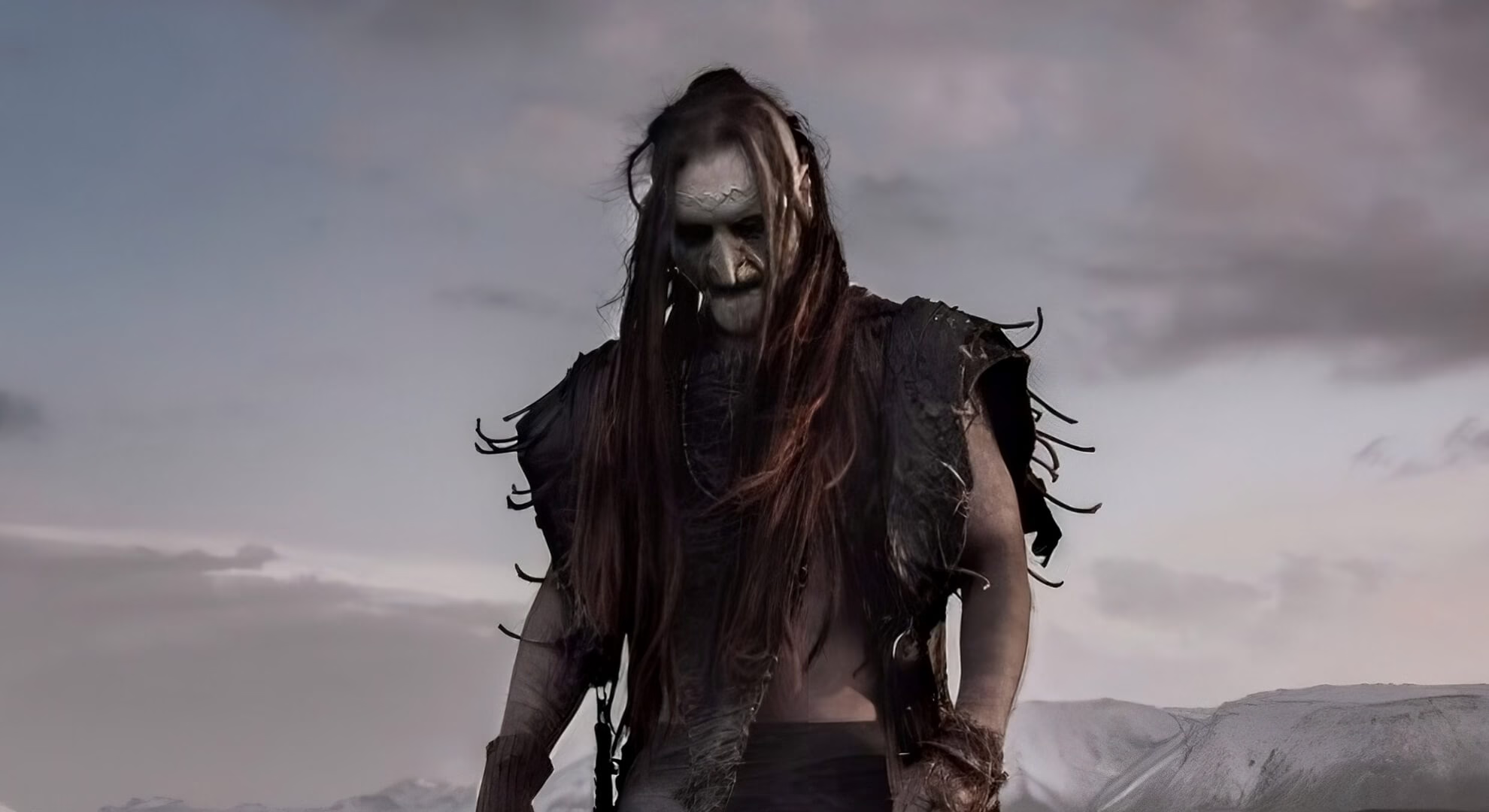
Håvard Ellefsen first disappeared into the mask and the synthesizer in 1993, the year after his departure from Emperor, the Norwegian black metal ensemble whose debut full-length would define the sound of an entire movement.
What he built under the name Mortiis — five solo albums across what he termed “Era I,” composed entirely on keyboards and released between 1993 and 1999 — was something the genre taxonomists would only later name dungeon synth: vast, unbroken synthesizer compositions rooted in Northern European folklore and the contemplative severity of isolation.1
Those records were distributed on cassette and limited vinyl, never designed for mass consumption. They were documents of solitude and imagined territory.
That Ellefsen remade himself across a succession of further eras — through industrial rock, gothic electronics, and back toward his origins — speaks to a restlessness no single audience has ever fully contained. ‘The Great Deceiver’ (2016), heralded by the lead single ‘Doppelganger’ released October 4th, 2015, confronted Ellefsen’s divided psychology with the frank aggression of the industrial rock phase he had inhabited since ‘The Smell of Rain’ (2001). ‘Spirit of Rebellion’ (2020) pushed into rawer territory. ‘Ghosts of Europa,’ scheduled for June 26th, 2026, on Prophecy Productions — his debut for the German label — represents neither retreat nor sequel.
Berlin Without Borders
The album began, obliquely, as something else. Ellefsen had originally conceived of a collaboration with Stephan Groth of Apoptygma Berzerk — the Norwegian EBM and synthpop act — grounded in their shared admiration for Tangerine Dream and Klaus Schulze.2
That partnership dissolved before any recordings were completed. What remained were the early materials: the sonic residue of the Berlin School’s influence, long sequencer patterns, desolate amplitude, the kind of time that refuses resolution. “Relics of this early stage remain in hints of the influences from Berlin,” Ellefsen noted in press materials. “Visions of bleak, desolate, and timeless alien landscapes warped and mutated the songs.”
Thorsten Quaeschning — the current leader of Tangerine Dream following Edgar Froese’s death in 2015 — contributed additional synthesizers and sequencers to the title track, giving ‘Ghosts of Europa’ a direct material link to the tradition it invokes rather than merely citing it.
Strange, Mysterious, and Choral
The title track, released March 24th, 2026, as the first advance single, features vocals from Sarah Jezebel Deva — known for her work with Cradle of Filth and The Kovenant — and Laurie Ann Haus of Blizzard Games and Todesbonden.
The music video, written and directed by Claudio Marino, sets a narrative of ceremonial weight against desolate interior spaces. “This song has tried many shapes and forms, until it finally sort of found itself,” Ellefsen said. “Strange, mysterious, and choral. It started out as a simple thing, a different song, with a different title, which got slowly de-constructed and altered.”
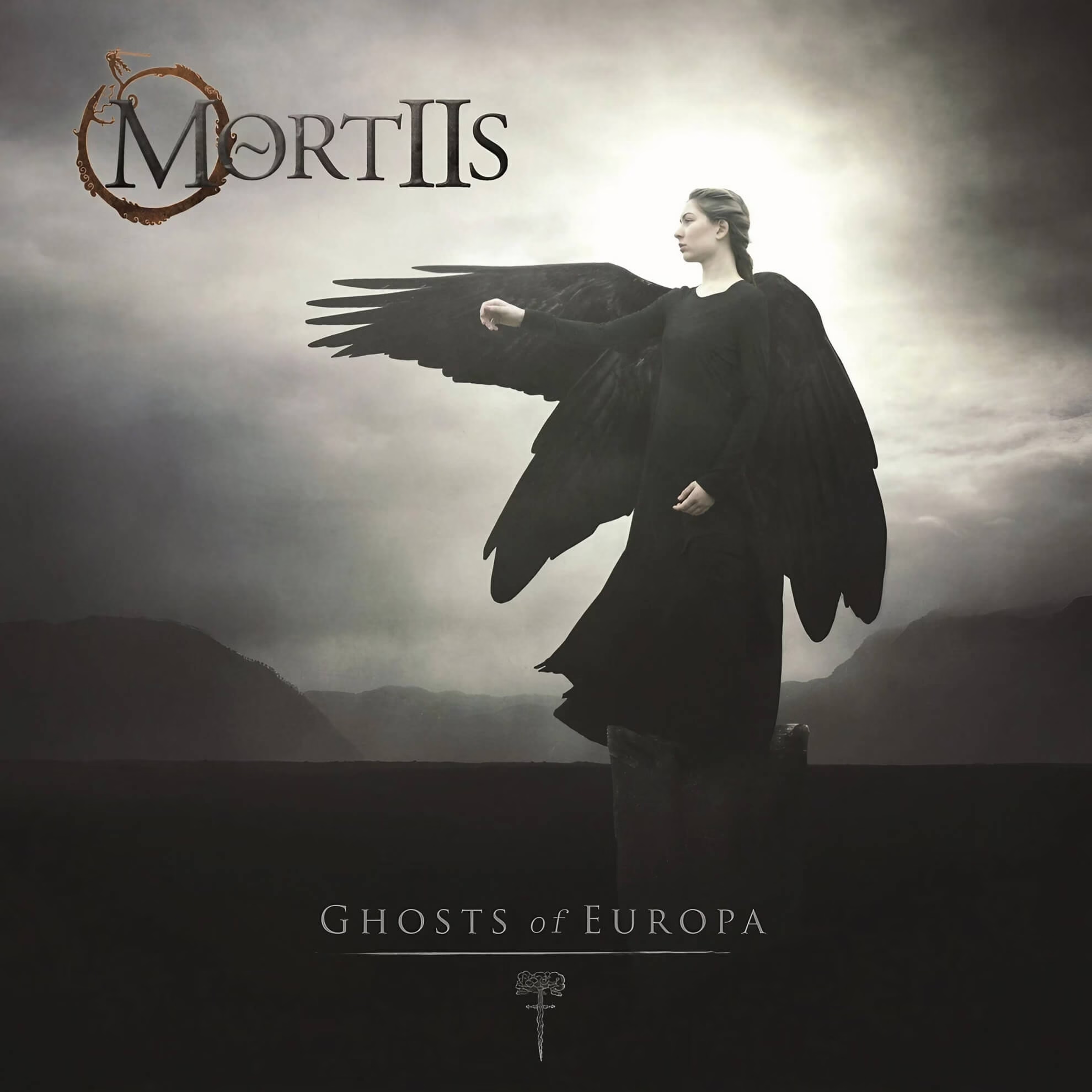
The choral quality Ellefsen describes is audible in the published track: the two featured vocalists work in harmonic tension rather than unison, producing a quality that does not resolve. The title itself, he acknowledged, “feels slightly, and sadly, prophetic — although that was never my intention.”
What that admission suggests about the record’s emotional orientation — inward, unresolved, mourning something not yet named — positions the album’s opening statement closer to elegy than declaration.
The Gut-Wrenching Grammar of Guilt
The second advance single, ‘Violent Silence,’ released April 21st, 2026 — again with a Claudio Marino video continuing the narrative arc of the title track — arrives at a different emotional register entirely. Lyrically, Ellefsen described its origins as an apology to his wife, drawn from a long text message written during a moment of personal failure. “The gut-wrenching sensation of guilt never goes away fully,” he observed, noting that the track builds through distorted fuzz and echo guitars toward an accumulated finale.
The confessional directness of ‘Violent Silence’ sits in deliberate contrast to the choral expansiveness of ‘Ghosts of Europa’: where the title track opens outward toward ceremony and collective mourning, this second single turns inward, raw and unmediated. Together, the two advance singles position the record across two distinct emotional registers — neither of which offers resolution.
Beavan at the Console
The choice to engage Sean Beavan as mixing engineer positions ‘Ghosts of Europa’ within a specific American industrial production lineage.3 Beavan’s career began in Cleveland, where a meeting with Trent Reznor at The Right Track Studio led to him mixing Nine Inch Nails’ ‘Pretty Hate Machine’ (1989) and later ‘The Downward Spiral’ (1994).
His subsequent credits — Marilyn Manson’s ‘Antichrist Superstar’ (1996), Guns N’Roses’ ‘Chinese Democracy’ (2008), and work with System of a Down, Depeche Mode, and Slayer — span the stylistic range from abrasive psychodrama to synthetic precision.
For a record that Ellefsen describes as a “creative liberation,” made without genre constraints, a mixing engineer with Beavan’s documented range is a structural argument, not an incidental hire.
The Underground It Arrives Into
Prophecy Productions has spent three decades cultivating an audience that cannot be mapped onto any single genre. Its roster — spanning Empyrium, Alcest, Fen, and Der Weg einer Freiheit — represents a listener accustomed to music that refuses categorical comfort.4
Within that context, the formal restlessness of ‘Ghosts of Europa’ requires no translation. The label’s European network, particularly strong in Germany, France, and the Nordic countries, positions this release within a listenership already oriented toward the Berlin School’s temporal expansiveness and the introspective severity of the neofolk tradition.
The Mortiis catalog has historically circulated through Bandcamp as the primary direct access point for the international underground, a distribution logic that suits a record whose formal ambitions are more legible to dedicated listeners than to algorithmic recommendation.
What the Ghost Carries
‘Ghosts of Europa’ is not the record Ellefsen set out to make. The planned collaboration dissolved, the direction shifted, and the materials were transformed across a long process that cost him, in his own accounting, friendships and relationships. What remains is a record that carries its own making as visible content, every formal transformation a documented fact.
Prophecy Productions, a German label whose roster spans neofolk, post-metal, and dark ambient, offers ‘Ghosts of Europa’ a context in which its formal ambitions require no justification. On June 26th, 2026, the record arrives with the accumulated weight of a career that has never resolved into a final form. That irresolution is not failure. It is the condition of the work.
What does the shift between the choral, outward-facing mourning of the title track ‘Ghosts of Europa’ and the intimate, inward guilt of ‘Violent Silence’ — two emotional registers held in unresolved tension — suggest about what an audience accustomed to music that refuses genre will make of a record that began as one thing and arrived as something else entirely?
References
- Robert Walser, ‘Running with the Devil: Power, Gender, and Madness in Heavy Metal Music’ (Hanover: Wesleyan University Press, 1993), 2—6. ↩︎
- Mark Prendergast, ‘The Ambient Century: From Mahler to Trance: The Evolution of Sound in the Electronic Age’ (New York: Bloomsbury Academic, 2000), 134—139. ↩︎
- Paul Hegarty, ‘Noise/Music: A History’ (New York: Continuum, 2007), 107—112. ↩︎
- Néstor García Canclini, ‘Consumers and Citizens: Globalization and Multicultural Conflicts,’ trans. George Yúdice (Minneapolis: University of Minnesota Press, 2001), 57—63. ↩︎



Leave a Reply