

In the cosmology of the pre-Christian Slavic world, the Milky Way was not merely a feature of the night sky. It was a road — the Zorny Shliach, the starry path — by which the souls of the dead traveled toward Vyraj, the mythological beyond located at the edge of the known world, beyond the sea, at the crown of the cosmic tree, where birds wintered and departed spirits found their place.1
The same road guided the autumn migration of birds, whose departure from the northern lands the ancient Slavic imagination understood as a procession of souls. This is not an abstraction. For Belarusians forced from their homeland by the Lukashenka regime — who now live in borrowed cities, working in studios that are not their own — the question of whether one is in a strange land or a different realm is not a poetic device. It is a daily condition.
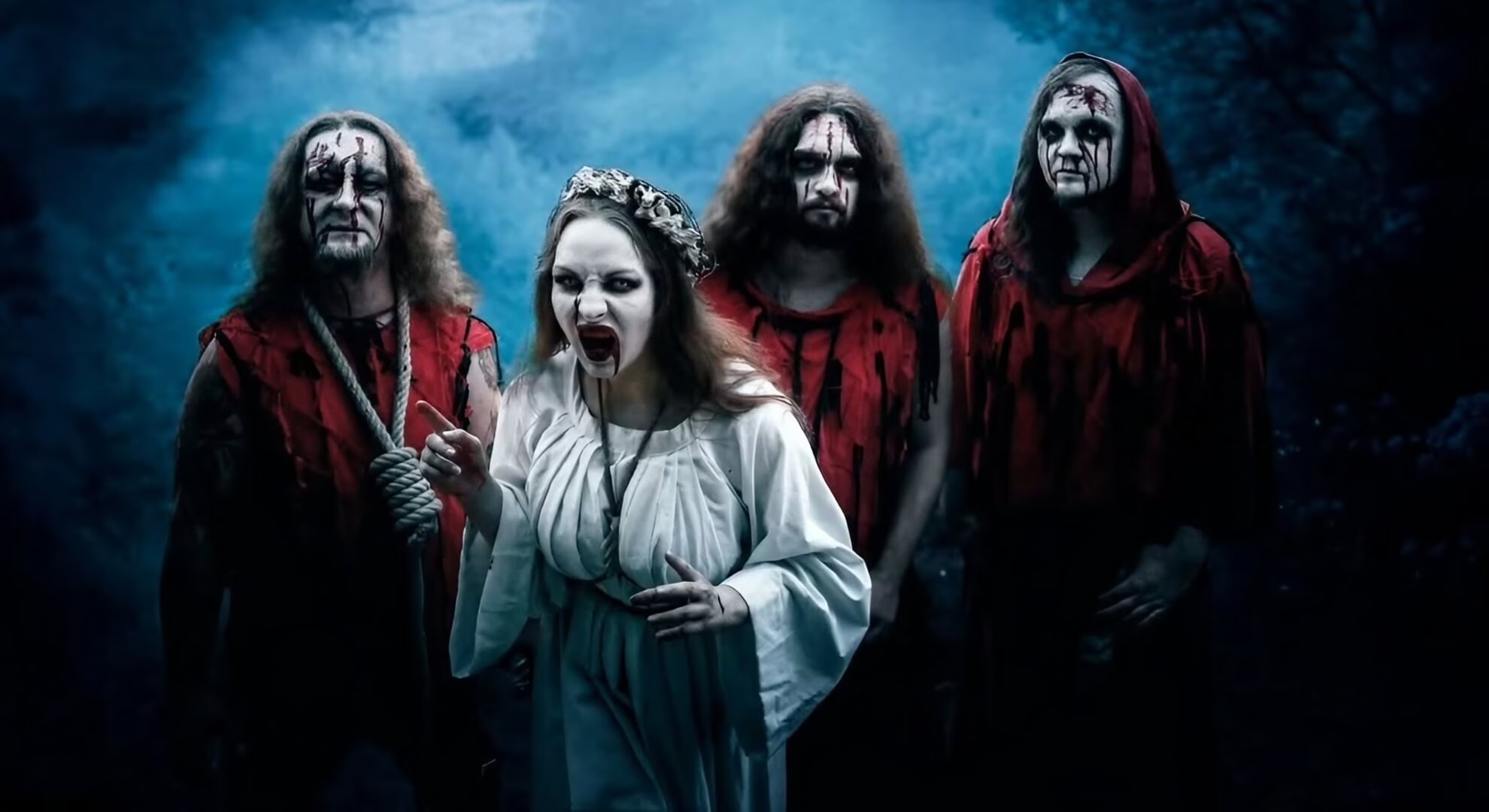
‘Zory’ — Belarusian for “stars” — is the opening track and lead single from ‘Vyraj,’ the fourth studio album from Belarusian post-black metal act Dymna Lotva, due August 7th, 2026 via Prophecy Productions. The single premiered as an official music video on May 13th, 2026. It opens with displaced grief and ends with transformation: the body dissolves into stardust that takes root as pasqueflower, the so-called son-trava — “dream grass” — of Slavic folk tradition, which blooms in the first fragile days of a spring that the dead can no longer witness.
A Name That Carries the Land
The name Dymna Lotva translates as “Swamp in Smoke,” a direct reference to the burned villages of Paliessie, the marshy region along the River Pripyat that has been the site of repeated mass violence. Composer Jauhien Charkasau and vocalist Katsiaryna “Nokt Aeon” Mankevich dated the band’s inception precisely to November 8th, 2015, drawn by the Nobel Prize in Literature awarded to Belarusian author Svetlana Alexandrovna Alexievich the previous October.
Their first song drew from accounts of the Chernobyl liquidators, published by Alexievich in her documentary prose, and the trajectory they established that day — grounding metal in the specific testimony of Belarusian historical experience, singing in Belarusian at a time when the regime was working to suppress the language — has held across all four albums. The band expanded to a four-piece, adding guitarist Mikita Stankevich and drummer Wojciech “Bocian” Muchowicz, but the compositional core remained Charkasau and Mankevich.
In 2020, the band publicly supported the mass protests that swept Belarus following the disputed presidential election, adding their name to a list of cultural figures calling for Lukashenka’s resignation. The consequences came the following year. In 2021, following a politically motivated trial of fellow musician Lesley Knife — the guest vocalist on the band’s single ‘To Freedom’ — all of the band’s scheduled concerts in Belarus were officially banned. The live lineup was disbanded.
Both founding members fled Belarus. Mankevich left to avoid arrest and sought refuge in Ukraine; Russia’s invasion found her in the city of Irpin. Two weeks into the full-scale war, she escaped the fighting. Charkasau likewise left the country. The two reunited in Poland, where the expanded band has been based ever since. The fourth album is named for the paradise these exiles cannot enter.
In a Warsaw Studio With the Stars
The video for ‘Zory’ was directed by Ryncuk Vystarobski — a Belarusian videographer who had previously collaborated with Dymna Lotva on at least one prior music video — and filmed at Astra Studio in Warsaw.
What is established is that the approach he and the band have developed together is rooted in symbolic staging rather than narrative illustration, a working method Mankevich has described in direct terms: the video is built from the lyrics outward, designed to “contain all the needed emotions and senses.”
The visual tradition this video operates within reaches back through a specific lineage of Belarusian and East Slavic artistic testimony. Dymna Lotva has cited the influence of Elem Klimov’s 1985 film ‘Come and See’ (Idi i smotri) — the Belarusian-set account of Nazi village destruction, which the band sampled for the opening of their third album — and of the documentary literary tradition of Ales Adamovich, whose archival interviews with survivors of wartime massacres Klimov’s film drew from directly.
This lineage of testimony-as-image, in which historical documents and folk imagery are combined without sentimentality into spare visual environments, establishes the frame within which Vystarobski and the band approach ‘Zory.’
The studio environment, by repeated use across Dymna Lotva’s video history, has functioned as a liminal space: stripped of documentary specificity, it becomes a surface onto which the symbolic imagery of the songs takes physical form. The videos for earlier tracks — including ‘Buried Alive’ and ‘Hell’ — were each dense with specific symbols drawn from Belarusian folk ritual and cosmology. ‘Zory’ continues in that mode, translating pre-Christian cosmological imagery into material presence.
What the Orphan’s Milk Becomes
The lyrics of ‘Zory’ open with a cosmological image: “Orphan spilled the milk.” In Belarusian folk tradition, this phrase encodes the myth of the Milky Way’s origin — understood as spilled milk marking the celestial road toward the afterlife — and the orphan who spills it is already unmoored from home.2
What follows is a procession: souls traveling “along the river, upside down,” which draws from a specific Slavic folk belief that the dead appear as inverted reflections in water, visible to the living who know how to look. The prohibition “Don’t drink the river’s water” carries centuries of folk warning: the river that borders the realm of the dead is not safe to consume. We are so near, the lyrics say, and so far.
Vocalist Mankevich framed the song’s central question in the band’s own statement: “For millennia, the stars have guided us through the night,” she noted. “According to Belarusian legends, the Milky Way guides migrating birds to warmer climes at the end of summer and its stars also lead the souls of the dead to another world. So where are we now? Is this a strange land or a different realm? Maybe we have already died and just didn’t realise it yet?” The question does not resolve. The song does not answer it.
The necklace of serpent heads worn in the song’s final images belongs to a pre-Christian Slavic tradition in which serpents, as threshold creatures that move between the surface world and the underground, were associated with the passage between life and death. The dissolution of the singer’s body into stardust that “will sprout as pasqueflower” completes a cycle: the pasqueflower blooms in the earliest days of spring, before the ground is fully thawed, one of the first signs that the season of the dead’s flight has turned toward return.
Eight Tracks Toward ‘Vyraj’
‘Vyraj’ is Dymna Lotva’s fourth studio album and their second under Prophecy Productions. The album’s eight tracks extend well beyond the post-black metal foundation of the band’s earlier work, drawing from doom, heavy and progressive metal, electronic music, goth, and Belarusian folk tradition.
The tracklist is anchored at both ends by departure and non-return: the opening ‘Zory’ asks whether the singer has already crossed over; the closing track, ‘Return My Coffin Home,’ states the destination that exile has foreclosed.
Guest contributions across the album include Aaron Stainthorpe, formerly of the British gothic doom outfit My Dying Bride, who contributes vocals to the third track, ‘The Boat of Despair’; the Belgian multi-instrumentalist Dehà (Wolvennest, Silver Knife, Slow), who plays fretless bass on the final track; and harpist Deanna F., whose instrument appears on ‘Veha.’
The Balbuta Choir contributes to the sixth track. The breadth of collaboration reflects a band in expansion, moving from the core duo of Charkasau and Mankevich toward an ensemble capable of carrying the album’s wider emotional range.
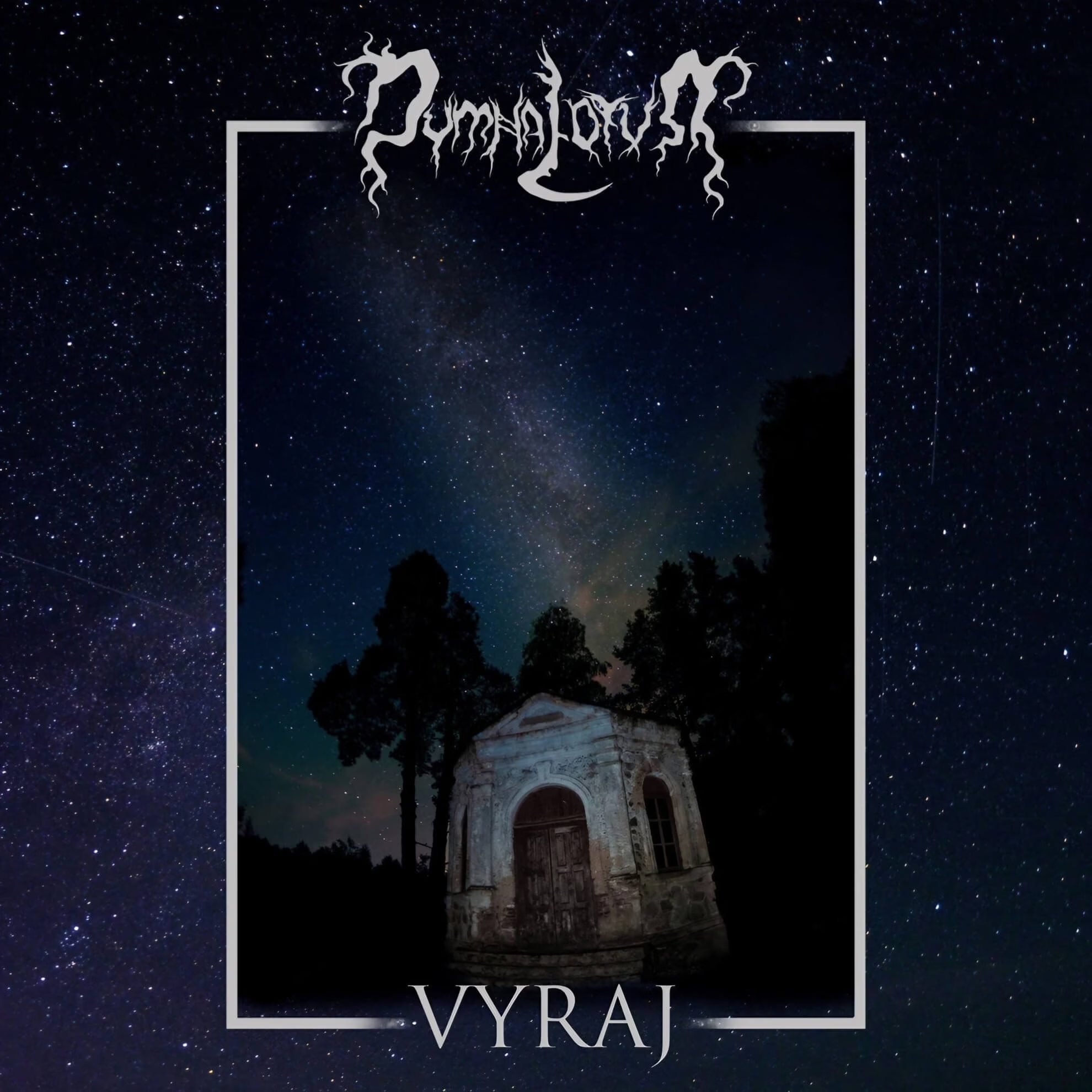
The cover art for ‘Vyraj’ was produced during the Perseid meteor shower, when a group of the band’s friends spent an entire night photographing the sky from a small family cemetery in a dying Belarusian village from which Mankevich’s ancestors hail. The Perseid shower peaks in August — the same month that migrating birds begin gathering for departure, the same movement of souls that ‘Zory’ encodes. The stardust in the song’s final lines and the meteor trails in the album’s photographs are the same thing.
A Path That Runs Upside Down
The question at the center of ‘Zory’ is not rhetoric. For Dymna Lotva, the condition it describes is biographical: these are musicians who live in Poland because they cannot live in Belarus, whose homeland has been made inaccessible by the regime that banned their concerts and forced their vocalist into flight through a war zone. The video does not resolve the question. The river flows upside down, the stars mark the path, and the band films in a borrowed studio in a city that belongs to someone else.
What ‘Zory’ offers is not comfort. It offers precision: a map of the specific mythological and emotional terrain that exile occupies, drawn from the folk traditions of a country the band cannot enter. For an audience that encounters this music at a distance — without having lived in Paliessie, without knowing what the Milky Way meant to Belarusian ancestors who watched the birds leave every August — the video and song together make that distance part of the argument. You are, like the singer, near and far at once. The album ‘Vyraj’ arrives August 7th, 2026.
When a band’s music is inseparable from the conditions of its making — exile, displacement, the foreclosure of return — how do you locate yourself as a listener in relation to that experience, and does the geographic distance from which you encounter the work change how you hear the question it refuses to answer?
References
- Linda J. Ivanits, ‘Russian Folk Belief’ (Armonk: M. E. Sharpe, 1989), 12–15. ↩︎
- W. F. Ryan, ‘The Bathhouse at Midnight: An Historical Survey of Magic and Divination in Russia’ (University Park: Pennsylvania State University Press, 1999), 67–70. ↩︎


Leave a Reply