


The house at the center of Carlos Mayolo’s ‘Carne de tu carne’ (1983) is not a set. It is an inheritance. The Valle del Cauca’s colonial haciendas — thick-walled structures built to manage the labor of enslaved Africans on sugar plantations, their interior courtyards designed to trap what little air moved through the valley’s perpetual heat — had never been decommissioned.
By the late 1970s, these structures still stood in Cali and its surrounding municipalities, occupied by families who had inherited them along with the social logic that had originally designed them: distance from the street, hierarchy of rooms, the servants’ quarters still distinct from the family’s.
Mayolo did not import Gothic conventions into this built environment. He observed what was already there.
Cali in the 1970s was a city in a particular condition of suspended transformation. The sugar cane economy of the Valle had generated wealth concentrated in a landed oligarchy whose social habits had changed little since the colonial period, while the city itself was swelling with internal migrants from the Pacific coast and the Andes, bringing Afro-Colombian communities and their ceremonial traditions into proximity with a class structure designed to make them invisible.
The city had been declared a model of urban modernity — it had hosted the Pan-American Games in 1971 — yet its oldest neighborhoods retained the spatial logic of a plantation economy. The heat was not incidental to any of this. In the Valle del Cauca, the climate is not a backdrop; it is a pressure system.
It was in this city, in the early 1970s, that a group of young filmmakers, writers, and cinephiles — the nucleus of what would become known as the Cali Group — identified a specific aesthetic vocabulary that could hold these contradictions without resolving them. They called it Gótico Tropical.
The Pornomiseria They Refused to Make
In 1978, Luis Ospina and Carlos Mayolo released ‘Agarrando pueblo,’ a short mockumentary in which two filmmakers are observed capturing images of Cali’s poor for a European documentary market hungry for Third World suffering. The film is a trap: it enacts the very aesthetic it critiques, filming misery while filming people filming misery, until the layers of complicity become impossible to separate.
The “pornomiseria” charge, as Ospina and Mayolo deployed it, was directed at Colombian filmmakers and their international distributors who had discovered that images of barefoot children and flooded neighborhoods could be packaged as social conscience for European festival audiences.
The charge was precise: exploitation dressed as solidarity, poverty rendered aesthetically consumable, drained of its political content, turned into an image of feeling rather than a fact of structural violence.
The decision embedded in ‘Agarrando pueblo’ was foundational for what followed. Gótico Tropical would not document poverty. It would take the social structure that produced the suffering — the plantation logic, the inherited built environment, the oligarchic bloodline — and reveal it as a horror system. The monster in Gótico Tropical is not located in the barrio. It lives in the hacienda.
The Cine Club and the Writer Who Died Young
The Cine Club de Cali, co-founded in 1971 by Ospina and Andrés Caicedo Estela, was the institutional form of this aesthetic project before the aesthetic had a name. Caicedo — born in Cali in 1951, a novelist and film critic whose obsessions ran from Salsa music to the horror films of Roger Corman — operated the Cine Club as a screening space, a fanzine publishing operation, and an archive of critical correspondence with filmmakers across Latin America and Europe.
His novel ‘Que viva la música,’ completed in 1977, is the literary document of the same cultural moment ‘Carne de tu carne’ would later put on screen: young people from Cali’s middle and working class navigating a city where Salsa and violence and the residue of the colonial past occupied the same emotional frequency.
The novel’s narrative disintegration — its protagonist moving from controlled suburban order into the Salsa-drenched violence of Cali’s popular neighborhoods, her self-destruction narrated with a precision that refuses sentimentality — established in prose the same formal logic that Gótico Tropical would apply to cinema.
On March 4, 1977, the day he received the first printed copies of ‘Que viva la música,’ Andrés Caicedo died of a self-administered overdose of barbiturates. He was 25 years old.
The simultaneity — the arrival of the book and the departure of the author — has shaped his reception so completely that it is now nearly impossible to read ‘Que viva la música’ as a novel rather than as a final statement. Caicedo did not intend it to function as one, which is precisely why the critical tendency to read it that way should be resisted. The novel is not a last word; it is a work of literature, and its relationship to the Gótico Tropical vocabulary it anticipates is formal, not biographical.
The Cine Club continued after Caicedo’s death, sustained by Ospina and by the overlapping community of filmmakers and critics that the two had assembled across the 1970s.
Two Films, One Vocabulary
The Industrialist and His Requirement
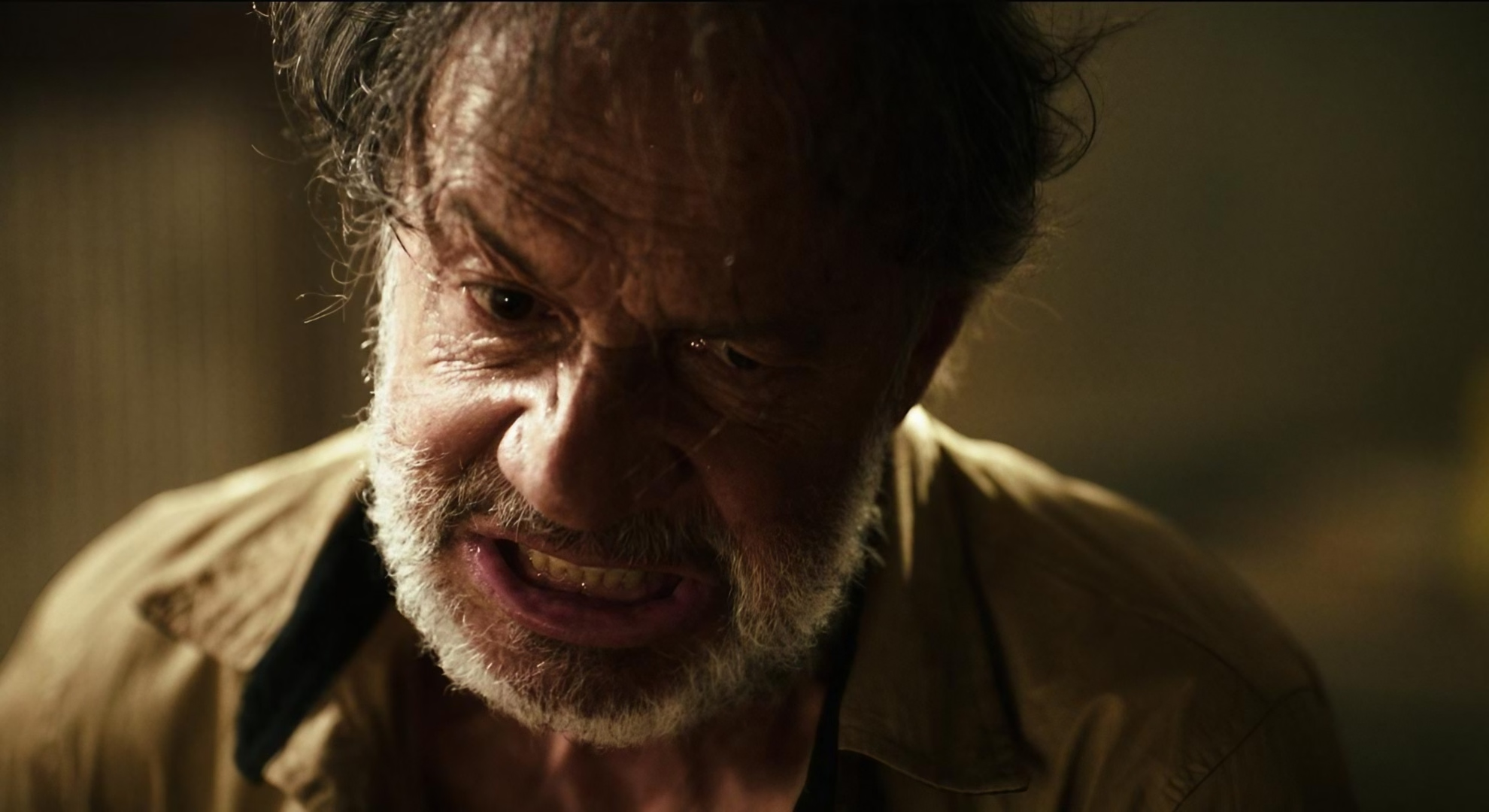
‘Pura sangre,’ released in 1982 and directed by Ospina, is a vampire film in which the bloodthirsty figure is not a foreign aristocrat but a Cali industrialist, a sugar patriarch whose aging body requires transfusions of young blood extracted from the city’s poor.1
Ospina presents it as a genre narrative, maintaining the conventions of the horror film while ensuring that the social mechanics of the Colombian plantation economy are visible in every exchange: the industrialist’s wealth, his social insulation, the expendability of the young men whose blood he requires.
The vampire as oligarch is the central formal discovery of Gótico Tropical. It is a move that the genre had not made in quite this way in European or North American horror, because the social structure it required — a landed class whose wealth derived directly and continuously from the controlled exploitation of Black and mixed-race labor — was not the social structure those traditions had inherited. In Cali, it was.
The House That Remembers
Mayolo’s ‘Carne de tu carne’ (1983) enters the colonial hacienda directly. The film follows a young couple from Cali’s elite who discover, through the recovery of suppressed family history, that they are blood relatives.
The incest narrative is not the film’s subject; it is its vehicle. What Mayolo examines is the way Colombian elite families had maintained their social position across generations through the same mechanisms — the controlled circulation of property and bloodline, the management of who could enter the house and who remained outside it — that had organized the plantation.
The supernatural elements of the film — spectral presences in the hacienda, ancestral voices — are not horror conventions imported from outside. They are the repressed returning through the built environment that contained it.
Both films share a specific visual grammar: long takes in colonial interiors, the quality of Andean afternoon light falling through thick walls, heat rendered as a character through the stillness of frames. This grammar is a deliberate use of cinematic form to argue that the physical structure of the house and the social structure of the family that inhabits it are inseparable.
Against the Cold Gothic of the North
The comparison that clarifies Gótico Tropical most precisely is not with Latin American horror — which had not yet developed as a coherent tradition at the time — but with the Northern European Gothic that Ospina and Mayolo had studied at the Cine Club.
Friedrich Murnau’s ‘Nosferatu’ (1922), Carl Theodor Dreyer’s ‘Vampyr’ (1932), the tradition of British Gothic literature from Horace Walpole through Bram Stoker: these were the formal vocabulary Ospina and Mayolo had assimilated and were consciously working against.
Northern Gothic requires specific material conditions to generate dread: cold, darkness, decay associated with the absence of light and warmth, the castle or monastery as a space of isolation. The emotional register of European Gothic is fundamentally one of deprivation — horror arrives when normal warmth, safety, and order are stripped away, revealing what lies beneath.
In the Valle del Cauca, deprivation is not the condition. Excess is. The sugar cane grows in abundance. The heat is never absent. The colonial haciendas are not ruins — they are entirely functional, occupied, generating wealth. The horror in ‘Carne de tu carne’ and ‘Pura sangre’ arrives not from the stripping away of warmth but from its saturation: the heat that makes the house impossible to leave, the abundance that makes the predator powerful rather than desperate, the afternoon sunlight that illuminates the social structure in full visibility rather than concealing it in northern shadow.
This is the formal inversion that constitutes Gótico Tropical as a distinct vocabulary: where European Gothic uses darkness and cold to make the familiar strange, Gótico Tropical uses heat and light to make the familiar unbearable. The monster is not hidden. It is on the terrace, having lunch.
What the Vocabulary Survived
Carlos Mayolo continued working as a filmmaker and television director after ‘Carne de tu carne,’ his career extending through the 1990s and into the early 2000s. He died in Bogotá on May 20, 2007, at the age of 61. Luis Ospina has remained active as a filmmaker and essayist, producing the documentary ‘Todo comenzó por el fin’ (2015), which reconstructs the Cali Group’s shared history through their own archive.
The Cali Group never institutionalized. There was no manifesto signed by a fixed membership, no gallery representation, no festival circuit positioning that would have given the vocabulary a stable international platform at the moment of its formation.
This absence of institutional form is precisely what allowed the work to be absorbed, misread, or simply overlooked by the critical machinery that was identifying “Latin American cinema” in the 1970s and 1980s primarily through the lens of political film — Glauber Rocha’s Cinema Novo in Brazil, the revolutionary documentary traditions of Cuba and Chile.
Gótico Tropical did not fit those expected categories. It was using genre — horror, the vampire film, the Gothic family drama — rather than rejecting it. The international critical apparatus of the period had not yet developed the tools for understanding genre as a form of political argument rather than its evasion.
The Delayed Arrival
The international critical moment now attaching itself to Gótico Tropical is not the discovery of something new. It is the belated assembly of a vocabulary that has been present in the documentary record since 1978, when ‘Agarrando pueblo’ defined what Gótico Tropical was by demonstrating what it refused to be.
The Colombian dark art and darkwave scene that has emerged from Bogotá, Manizales, and Cartagena over the past decade draws on this vocabulary in ways that are sometimes conscious and sometimes structural. The colonial centers of these cities — Bogotá’s Candelaria neighborhood, the stone-walled old quarters of Cartagena, the faded grandeur of Manizales’ Eje Cafetero districts — provide the same logic of inherited stone and contained pressure that the Cali hacienda provided for Mayolo. The formal argument is identical: the horror is not imported from outside the social structure. It is the social structure, made visible.
What this current scene has not yet fully received is the critical framework that would connect it explicitly to the Cali Group’s formal vocabulary. The international attention now being directed at Gótico Tropical risks the same misreading that obscured the original work: treating the aesthetic as a colorful Latin American addition to a global genre conversation, rather than recognizing it as an independently developed critical vocabulary that arrived at its conclusions through a specific analysis of Colombian colonial history.
The fifty-year gap between ‘Agarrando pueblo’ and the current critical moment is not evidence that the vocabulary was developing slowly. It is evidence that the critical infrastructure required to receive it — outside Colombia, and to a significant degree inside it — took fifty years to assemble.
What the Cali Group produced between 1978 and 1983 was not a contribution to global horror cinema. It was the first systematic articulation of a specifically Colombian visual grammar for confronting the social structure inherited from the colonial period — a grammar in which the plantation hacienda replaced the northern castle, in which the vampire was not imported from Eastern Europe but was already on the terrace, and in which the horror of abundance proved more persistent than any horror of deprivation.
Gótico Tropical is not a trend that arrived from outside. It is the name the Cali Group gave to something they had identified from within, and it has been waiting in the archive — in ‘Agarrando pueblo,’ in ‘Pura sangre,’ in ‘Carne de tu carne,’ in the pages of Andrés Caicedo’s novel — since the decade in which it was made.
The current moment is not a discovery. It is a reckoning.
The Andean functions as a living archive, and its continued relevance relies on identifying the narratives that have been obscured by the passage of time. We invite our readers to contribute to this ongoing excavation. Whether referencing a seminal yet forgotten album within the spectrum of extreme music, a neglected chapter of art history, or a paranormal event that has imprinted itself upon the local consciousness, we seek to document the stories that official histories have omitted.
Which films, visual works, or documented performances from the Colombian dark art and darkwave scene of the past two decades carry this vocabulary forward — and which have yet to receive the critical framework that would connect them to the Cali Group’s original work?
Reference
- Paulo Antonio Paranáguá, ed., ‘Tradición y modernidad en el cine de América Latina’ (Madrid: Fondo de Cultura Económica de España, 2003), 167–172. ↩︎



Leave a Reply