

Latin American fantastic cinema’s institutional infrastructure has been assembled festival by festival, decade by decade — in Buenos Aires from 2000, Porto Alegre from 2005, Mexico City from 2008. Colombia’s entry into that circuit was never guaranteed. When the Bogotá Horror Film Festival announces its eighth edition for October 21st through October 31st, 2026, at the Cinemateca de Bogotá, the announcement confirms not only that the Colombian position has been secured but that it rests on public cultural infrastructure in a way that distinguishes it from every preceding node in the regional circuit.
The Cinemateca de Bogotá has operated since 1971 — first as the Cinemateca Distrital, and since 2010 under the management of IDARTES, the Instituto Distrital de las Artes, established by the Bogotá city council to execute cultural policy for the capital’s inhabitants.
The institution’s new facility, opened in June 2019 at Carrera 3 No. 19-10, is the largest cinematheque in Colombia and one of the most technically complete audiovisual cultural centers in Latin America. IDARTES’s mandate is not programming; it exists to ensure the effective exercise of cultural rights.
When BHFF occupies the Cinemateca for ten days each October, it is programming within a venue whose operating body carries an institutional obligation to culture. This is not equivalent to booking a commercial multiplex or a privately owned art-house screen.
The Cinemateca’s continued partnership with BHFF is a statement by the state cultural apparatus of the Colombian capital that horror and fantastic cinema are legitimate subjects of cultural policy. That may appear obvious; it is not. In most of Latin America, genre cinema still negotiates its access to public-sector venues edition by edition, without institutional security. BHFF’s repeated presence at the Cinemateca suggests that negotiation has resolved into something more durable.
BHFF is also a member of ANAFE — the Asociación Nacional de Festivales, Muestras y Eventos Cinematográficos y Audiovisuales de Colombia — the national framework for film festivals and audiovisual events. Membership in ANAFE places BHFF within the formal national cultural sector, not merely the underground or alternative circuit. That classification matters for funding access, institutional credibility, and the capacity to form partnerships with venues like the Cinemateca itself.
What Arrived Fifty Years Late
Buenos Aires Rojo Sangre was founded in 2000 and recognized as the oldest fantastic film festival in Latin America; it received National Institute of Cinema and Audiovisual Arts (INCAA) sponsorship and was declared of cultural interest by the Buenos Aires city legislature. Fantaspoa launched in Porto Alegre in 2005 and became the largest genre festival in South America within two decades. Mórbido Film Fest began in Mexico City in 2008, drawing on a national tradition of fantastic cinema production whose roots extended to the forties and fifties of the last century. In each case, the national genre infrastructure recognized these festivals within the first decade of their existence.
Colombia had no comparable institutional development. The production infrastructure for genre cinema that Argentina assembled in the nineteen-forties and Mexico sustained from the fifties onward had no Colombian equivalent. The first edition of the Bogotá Horror Film Festival was staged in 2019 — not because Colombian audiences were indifferent to horror but because the institutional conditions for presenting that cinema with state cultural backing had not coalesced until 2018. The eighth edition does not erase that gap; it demonstrates that the work of closing it is well advanced.
The ninety-fifth year since George Melford’s Spanish-language ‘Drácula’ — produced by Universal Pictures in 1931 for distribution in Latin American and Spanish-speaking markets — sharpens the historical argument considerably. The ninety-fifth year since George Melford’s Spanish-language ‘Drácula’ — produced by Universal Pictures in 1931 for distribution in Latin American and Spanish-speaking markets — sharpens the historical argument considerably. The film was made on the same sets as Tod Browning’s English-language version, shot at night after the American cast had wrapped for the day. Its production was driven by the commercial calculation that Spanish-speaking Latin America represented approximately thirty percent of American studios’ foreign market revenues.
Colombia was treated as a consumer of exported horror, not as a participant in its production or curation. The distance between that transaction and BHFF’s current role in formally awarding and exhibiting Colombian horror cinema is the measure of what has shifted in ninety-five years.
The Open Call and What It Signals
The call for international submissions for the eighth edition opened April 28th, 2026, with a single deadline of July 26th, 2026, across both FilmFreeway and Festhome.
Competition categories cover Best National Fiction Short Film, Best National Fiction Feature Film, Best Latin American Fiction Feature Film, Best International Fiction Feature Film, and a Best Transgressive Fiction Film section accommodating extreme and boundary genres. That range reflects a curatorial argument: horror is not a single register but a spectrum extending from Colombian short-form work through pan-Latin American feature production to international extremity.
The seventh edition, held October 21st through 31st, 2025, received more than 800 submissions from 25 countries, selecting 60 for the official programme.
Prizes for Colombian productions in prior editions included entry into the FANLATAM promotional circuit — practical exhibition access at member festivals across Latin America, not symbolic recognition. That structural reward ties BHFF’s national competition directly to a regional platform.
BHFF’s membership in FANLATAM (the Latin American Fantastic Film Festival Network), Apocalipsis al Sur del Mundo, and the Ibero-American Network of Genre Film Festivals positions the festival at the intersection of at least three overlapping genre cinema frameworks simultaneously.
FANLATAM’s statute specifies that member festivals commit to shared programming intelligence and a regional Grand Prix structure. For a festival in its eighth year, that degree of integration signals established institutional standing rather than consolidation still in progress.
A Mexican Icon for a Colombian Festival
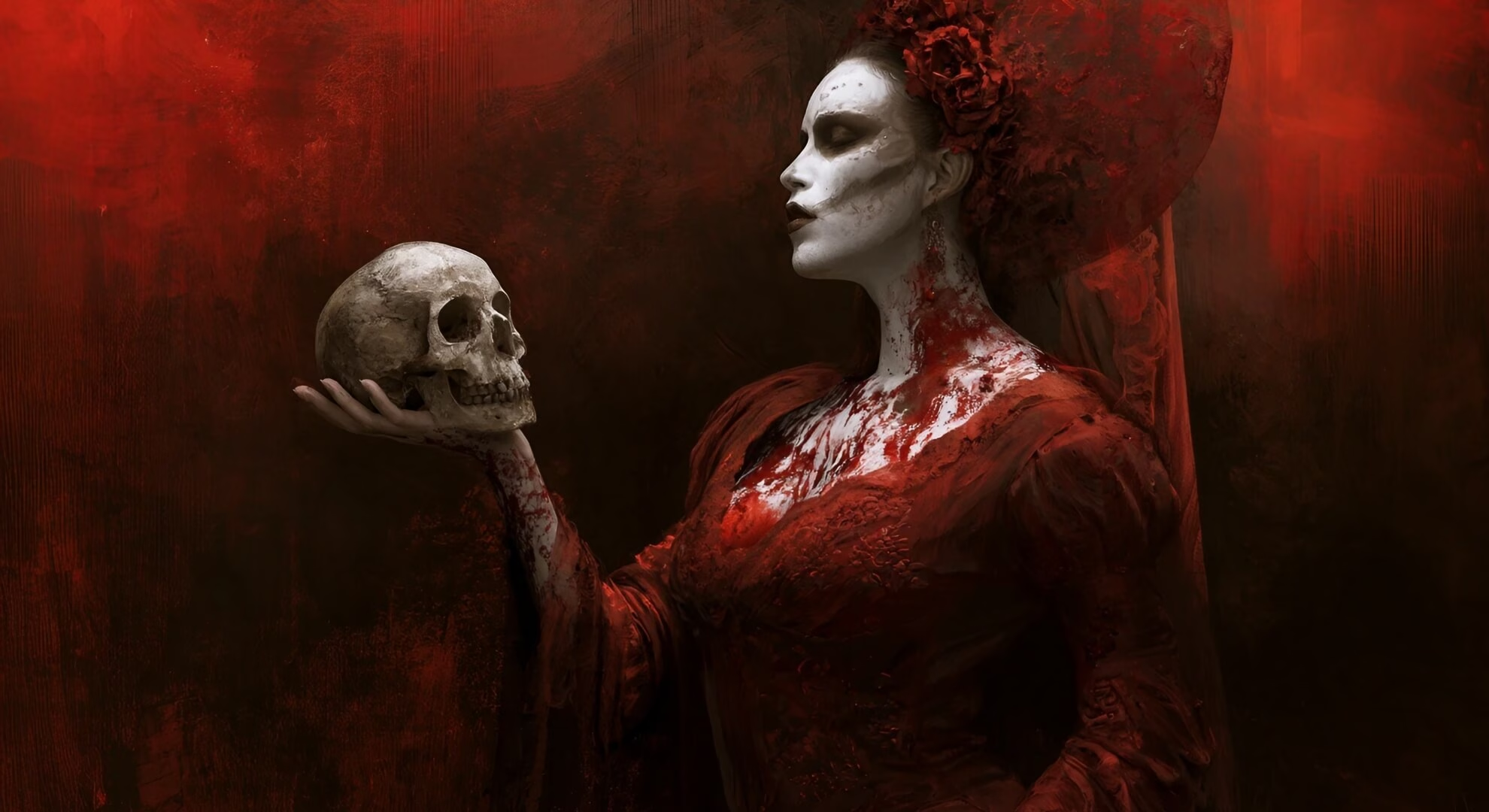
The official image for the eighth edition, released April 28th, 2026, presents a model in sugar skull face paint, a corseted black lace dress, and a headdress of spiked metal spines and red roses, photographed against a deep red background.
The makeup belongs to the tradition of La Catrina — the skull figure created as a zinc etching by Mexican illustrator José Guadalupe Posada around 1910 and later named by Diego Rivera in his 1947 mural ‘Sueño de una tarde dominical en la Alameda Central’ — one of the most recognizable figures in Mexican cultural iconography.
The Catrina is a specifically Mexican figure. The Día de los Muertos tradition she represents is pre-Hispanic Mexican in origin, codified across the twentieth century in Mexican popular culture, and globally disseminated — most recently through animated film — in ways that have separated her from that context and rendered her a generic signifier of stylized death.
Colombia has its own relationship with mortality and its own visual traditions; the decision to bypass them in favor of a widely reproduced, decontextualized Mexican iconography is a significant curatorial absence.

Colombia’s own visual traditions of death are specific, documented, and available. La Patasola — a one-legged vampiric female figure from Andean and Pacific coastal folklore, who appears as a beautiful woman luring men into the jungle before revealing her true form — is an entirely Colombian horror figure, female, with direct genre credentials and a visual logic as commanding as any imported iconography.
The hooded nazareno of the Popayán Holy Week procession, recognized by UNESCO as Colombian Intangible Cultural Heritage, carries four centuries of New Granadan Catholic mortality culture in a single, immediately legible image: a shrouded figure, a skull, a candlelit passage between the living and the dead. And the funerary gold work of the Muisca — the culture of the Bogotá savanna — constitutes one of the pre-Columbian world’s most articulate visual engagements with death and the afterlife, held at the Museo del Oro within walking distance of the Cinemateca itself.
Any of these would have placed the festival’s visual identity inside the institutional and historical argument its programming already advances.
The figure in the poster is photographed in a pose — three-quarter turn, hand on hip, gaze directed away from camera — that belongs to fashion editorial photography, not to horror cinema’s visual tradition. The Catrina makeup, already aestheticized well beyond its ritual origins, is here further softened by the styling: a model whose hair is visibly dyed to a lighter shade, a corseted lace dress, a smooth crimson gradient.
The image could announce a cosmetics campaign or a fashion lookbook. Nothing in it references cinematic horror, Colombian visual culture, or the institutional context the festival has spent eight editions working to establish.
That the Bogotá city government’s “Aquí Sí Pasa” promotional campaign — a direct city cultural endorsement — appears in the upper left corner of the same image makes the disconnect sharper rather than resolving it. The city’s backing confirms BHFF’s institutional position; the image it endorses makes no corresponding argument about what Colombian horror cinema looks like, where it comes from, or why it belongs in a public cultural venue.
Dates, Venues, and Submissions
The eighth edition of the Bogotá Horror Film Festival runs from October 21st through October 31st, 2026. The Cinemateca de Bogotá serves as the primary venue; in the seventh edition, programming extended across nine sites including the Colombo Americano, Biblioteca Pública de Fontibón, Centro Cultural del Tunal, Fontanar del Río, Orishas Cine Art, El Séptimo Parche, Café Magenta, and Maraña Café in Zipaquirá — a decentralized model that has characterized BHFF’s approach since its third edition. Specific secondary venues for 2026 had not been confirmed at the time of writing.
International submissions remain open through July 26th, 2026, via FilmFreeway and Festhome. The festival is directed by Carlos Ortiz Alarcón, with Laura Liscano as general producer. The curation team includes Daniel Rey Chaves, Natalia Hernández, Jeniffer Páez, Gabriel Barrios, Jean Lagos, Felipe Bogotá, and Jhon Jatenjor. Ticket pricing for the 2026 edition had not been confirmed at the time of writing.
What the Eighth Edition Requires
Buenos Aires Rojo Sangre required sustained state advocacy across its first fifteen years to consolidate INCAA recognition. Fantaspoa took a comparable period to establish itself as South America’s primary genre festival. Mórbido grew from a small-town celebration in Michoacán to a Mexico City industry hub across more than a decade of programming development.
BHFF has moved through seven completed editions — with an eighth now programmed — in seven years, with a multi-network affiliate structure and a primary venue inside the Colombian state cultural apparatus. The pace of that consolidation owes something to the regional infrastructure that predated BHFF’s founding: Ortiz Alarcón was not establishing an isolated institution but joining a circuit that had been in formation for more than two decades.
What the eighth edition requires is not celebration but continuation. A Colombian horror cinema infrastructure is now institutionally visible. Making it institutionally durable — ensuring that BHFF at fifteen operates with the same institutional authority it holds at eight — is the harder argument that each October programme must continue to advance.


Leave a Reply