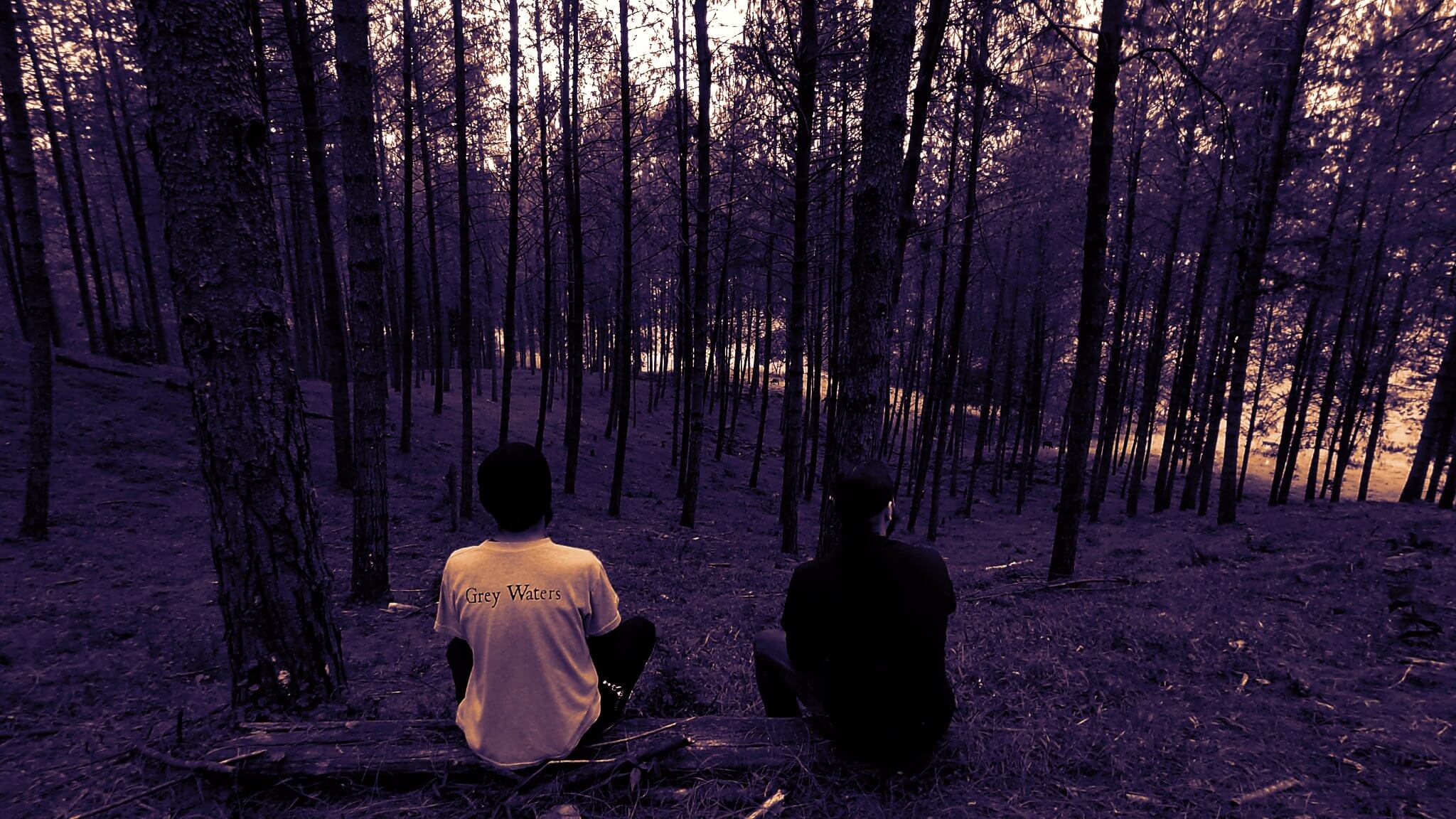


The highland plateau east of Medellín does not generate the music most people associate with Colombian extreme metal. At roughly 2,100 meters above sea level, Marinilla — a municipality in the Altiplano del Oriente Antioqueño — sits geographically close to one of the Southern Hemisphere’s most historically significant extreme scenes yet occupies a distinctly different cultural register from it.
My encounter with Everything Dies came through the ‘In Colombia… Sometimes Doom Is Better’ compilation series, a multi-volume document of Colombian doom that began circulating in 2022. The series maps a circuit of projects with little interest in the aggression and violence that defined the Medellín underground’s founding generation. Two names recurred from within the Marinilla scene: Héctor Achurri, whose project HiaR contributed to that series, and Luis H. Orozco, whose doom project Nihil appeared on it with the track ‘Beyond the Hatred and Pain.’
Their joint venture, Everything Dies, released its first two recordings simultaneously in February 2026. The central argument I want to make: ‘Lost and Empty,’ the two-track EP that forms the band’s primary debut statement, is the most formally disciplined articulation of existential death-doom produced by the Oriente Antioqueño’s underground to date — and it achieves that precision through a compositional structure that forces its two creators into uncommon dialogue.
The Altiplano and Its Quieter Inheritance
Marinilla belongs to the eastern Antioquia highlands — a zone that Colombian cultural discourse associates less with industrial or cartel-era violence than with the quiet of high-altitude municipalities and a tradition of literary production. The metal generated here operates without the survival imperative that gave Parabellum and Reencarnación their rawness.
Everything Dies operates as a strict duo: Orozco writes all lyrics and produces all visual art; Achurri writes all music and handles mixing and mastering. This division of creative roles — unusual in metal, where lyrics and music are typically produced by the same hand or through collective improvisation1 — places an additional formal demand on the work. When the music and the words converge, as they do most completely in ‘Lost and Empty,’ that convergence is a deliberate compositional choice by two separate minds.
Both musicians carry significant underground pedigree. Orozco and Achurri share prior membership in Exilio; Orozco’s Nihil and Achurri’s HiaR each have independent histories within the regional doom underground. Everything Dies is not a casual side project — it represents the intersection of two already-developed creative visions.
Ten Minutes in the Firmament
‘Lost and Empty’ contains two tracks. The first, ‘Empty,’ runs ten minutes and sixteen seconds — a runtime that places it formally within the funeral doom tradition of extended single-theme development, where a core harmonic idea is not resolved but deepened through sustained repetition.
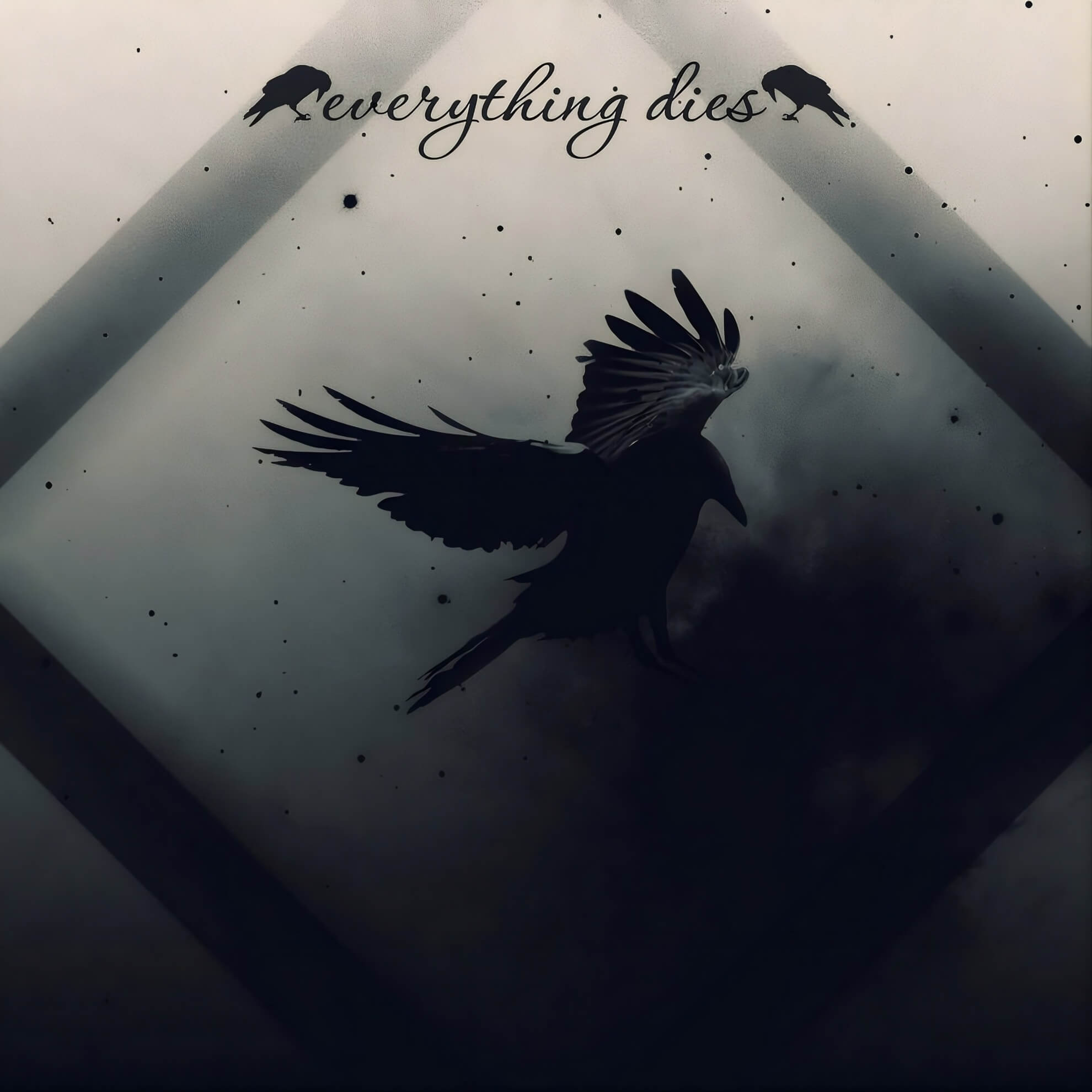
Achurri’s instrumentation in ‘Empty’ works in slow, downward-resolving guitar lines against a minor-key harmonic center, the melodic motion cycling without arriving at consonant resolution. This is not a failure of development but a structural argument: doom’s most formally rigorous practitioners have always used harmonic suspension as an active device, a way of making the music argue stasis rather than merely exemplify it. At ten minutes, the track insists on the listener’s full investment in that suspension.
Orozco’s lyrical material maps directly onto this formal approach. His speaker identifies with the universe through the act of contemplating stars from within four walls, and the text ends not with resolution but with a restatement of its opening weight in cosmological terms. The combination of Achurri’s unresolved harmonic motion and Orozco’s refusal to close the lyrical argument produces a track that earns its length.
‘Lost’ (7:03) operates at a different register — more immediate in tempo, closer to melodic death metal’s pacing than to funeral doom’s. The second track declares social displacement — “I don’t belong anywhere” — where the first had declared cosmic identification. Together they define the band’s dual temperament: the inward and the outward expression of the same pressure.
The Tradition That Chose Grief Over Fury
The ‘In Colombia… Sometimes Doom Is Better’ compilation series documents something the international narrative about Colombian metal has consistently neglected: the existence of a substantial doom underground that traces its debt not to Parabellum or Reencarnación but to the introspective, slow-tempo traditions of European death-doom and funeral doom. This is a generational and philosophical departure from the founding mythology.
The Medellín ultra-metal scene was defined by external pressure — a city in crisis, musicians for whom extremity was not an aesthetic choice but a survival response.2 The Oriente Antioqueño doom scene inhabits different coordinates: its pressure is internal, its tempo is slower, and its formal ambitions lean toward sustained contemplation rather than cathartic discharge.
Everything Dies enters this tradition with a considered rather than impulsive debut. Their Bandcamp notes the project’s founding in April and May 2022 as a response to “the suffocating weight that lies within every individual’s soul.” The music’s specificity gives this general framing local force: the slow descent of the melodies in ‘Lost and Empty,’ the unresolved harmonic suspension at the track’s end, and the visual austerity Orozco brings to the artwork all belong to a specific scene and a specific geography.
The Reckoning of February 2026
The dual release of February 2026 pairs work from distinct creative periods. ‘Karma’ carries a 2022 composition date in its credits — an early statement from the project’s founding months, offered to the public four years later. ‘Lost and Empty’ is dated 2026, arriving as current work alongside rather than after the older single.
This pairing is itself a critical gesture: it invites comparison between where the project started and where it now stands. ‘Karma,’ at four minutes and one second, is tighter and more constrained by genre convention, its lyrical theme of karmic return providing a formal counterpoint to the unresolvable weight that ‘Lost and Empty’ insists upon. The four years between composition dates are audible in the EP’s expanded formal ambitions.
A Question of Formation
I have spent time with both February 2026 releases from Everything Dies, and what I find most persuasive about ‘Lost and Empty’ is not the quality of any individual musical passage — though the slow harmonic development in ‘Empty’ is precisely executed within its tradition — but the structural argument the EP advances through its dual-creator methodology.
The assignment of word to one intelligence and sound to another, both already formed by independent underground careers, produces a friction that most comparable doom records avoid. That friction is productive: it refuses the easy merger of mood and music that allows a lesser death-doom record to feel coherent without actually saying anything.
Whether this approach will sustain across a longer release remains an open question. As a statement of intent from two musicians with deep roots in the Oriente Antioqueño underground, it is, for now, sufficient.
The strict separation of lyrical and musical authorship in Everything Dies — each element committed before the other can respond — is unusual in extreme metal. Does this structural constraint produce the kind of creative tension that deepens a recording, or does it risk making the musical and verbal elements argue different arguments entirely?
References
- Robert Walser, ‘Running with the Devil: Power, Gender and Madness in Heavy Metal Music’ (Hanover: Wesleyan University Press, 1993), 26–31. ↩︎
- Forrest Hylton, ‘Evil Hour in Colombia’ (London: Verso, 2006), 73–78. ↩︎

Leave a Reply