

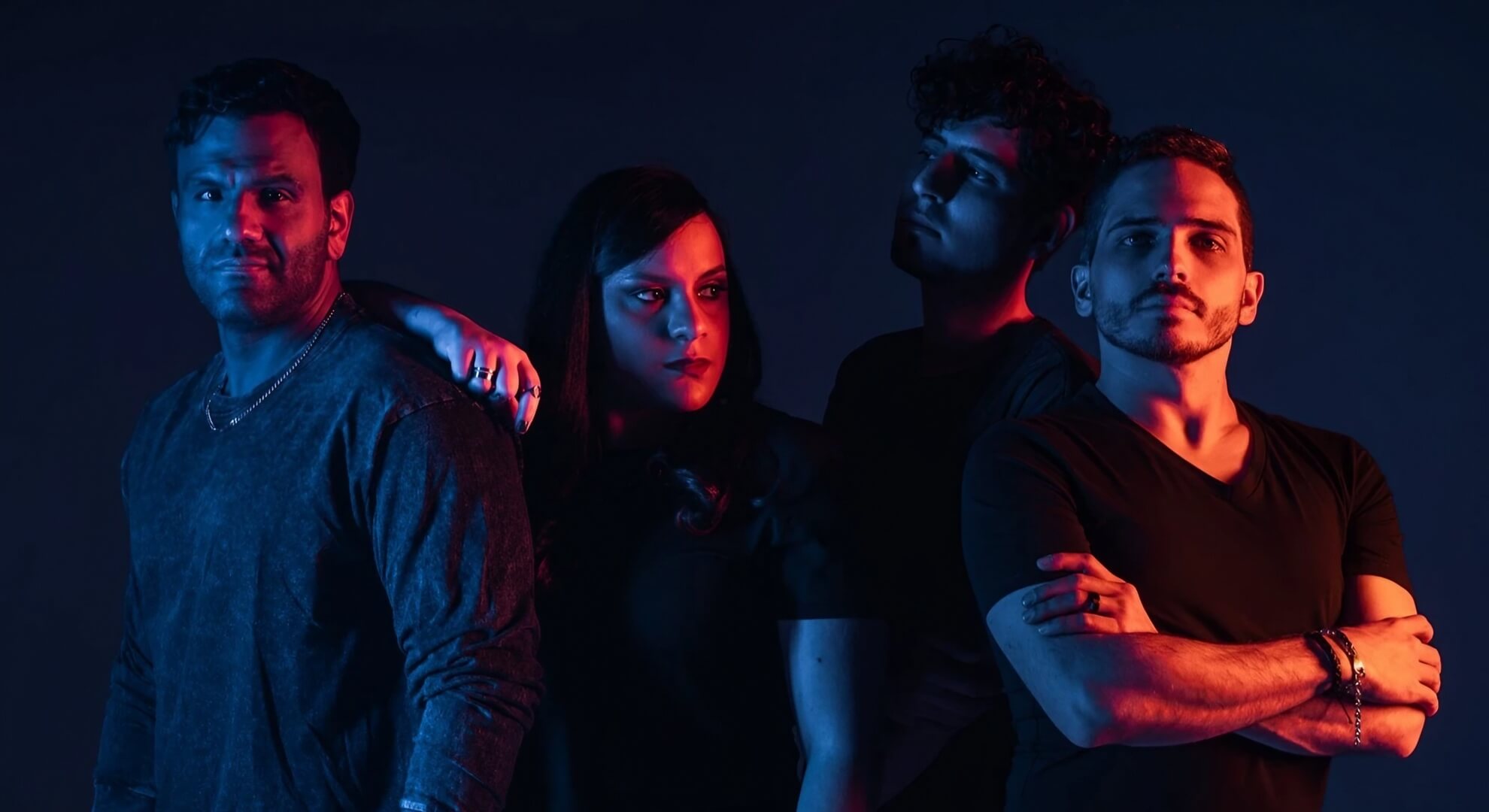

There is a sentence in Ross Jennings’ public statement about ‘Ebb & Flow’ that warrants closer attention than it has received: “Argovia deserve more attention than they are currently getting.” Jennings sings for Haken. He has performed at the Hammersmith Apollo. He is not in the habit of directing the international progressive community toward bands that require sympathy. That sentence is a professional assessment from someone who has heard the work and found it wanting a larger room.
The Periscope exists for precisely this gap — between what a band has earned and what the wider circuit has yet to grant them. Argovia have spent 13 years building an unsupported international presence: covered by Prog Magazine, Distorted Sound, and Hold Tight; cited by Nación Progresiva; recorded by engineers whose other credits read across InsideOut Music’s roster — all without signing once. ‘Primal Repetition’ is the record that makes the case.
Progressive rock has always had geography. The genre’s critical narrative placed Stockholm and London and Warsaw at its centre, and accorded to everything else the provisional dignity of a regional scene awaiting metropolitan validation. That narrative is both persistent and, in 2026, increasingly indefensible—and few bands in the Latin American hemisphere make the case against it as pointedly as Argovia, the Bogotá-based quartet preparing to release their second full-length, ‘Primal Repetition,’ on 10 April—without a record label behind them.
A Voice Outside the Template
The genre’s dominant model for female-fronted progressive rock locked into place during the nineties: the operatically trained soprano elevated above the mix, deployed in symphonic arrangements that owed as much to film scoring as to rock. It is a template with commercial logic behind it and artistic merit within it—but it has also narrowed the range of what listeners expect a woman’s voice to do inside progressive music.1
Guillén’s voice refuses that template at every turn. Her references—The Gathering, Porcupine Tree, Riverside, Vola—are bands in which the vocal functions as a presence within the sound’s fabric rather than a display placed above it. The closest European antecedent is Anneke van Giersbergen at her most introspective: confessional, grain-forward, written into the emotional argument of the song rather than onto its surface.
The Van Giersbergen comparison captures the vocal posture; the sonic world it inhabits draws from a second, distinct tradition. The late Anathema—from ‘Weather Systems’ through ‘Distant Satellites’—built records out of careful, unhurried melodic development: mid-tempos that applied no pressure, arrangements that allowed space to accumulate weight rather than volume, melodies that carried the quality of something already half-remembered. The three advance singles from ‘Primal Repetition’ move within that same territory. Nothing is accelerated toward an effect. The emotional argument is made at the pace the material requires.
This distinction is not peripheral. On ‘Ebb & Flow,’ the third advance single from ‘Primal Repetition,’ it determines the entire shape of the piece.
Guillén’s voice and that of guest vocalist Ross Jennings of Haken must meet as equals; one cannot decorate the other without destroying the conceptual premise—a vocal dialogue that begins as an apparent confrontation with an external voice and resolves into self-recognition. That the collaboration works depends entirely on the kind of singer Guillén is.
From Caracas to Bogotá to Santiago
Argovia began in 2013 as a project shaped by an unusually wide field of influence: Ayreon, Lacuna Coil, Dream Theater, and The Gathering. Their debut EP ‘Lost Letters’ earned a nomination for EP of the Year at Caracas’s Unión Rock Show awards. Their first full-length, ‘Distant Present,’ mastered by Tony Lindgren at Fascination Street Studios, was released in 2017 and enabled the band to tour Cali and Medellín and perform at Prog in Motion 2017—then Colombia’s only dedicated progressive rock festival.
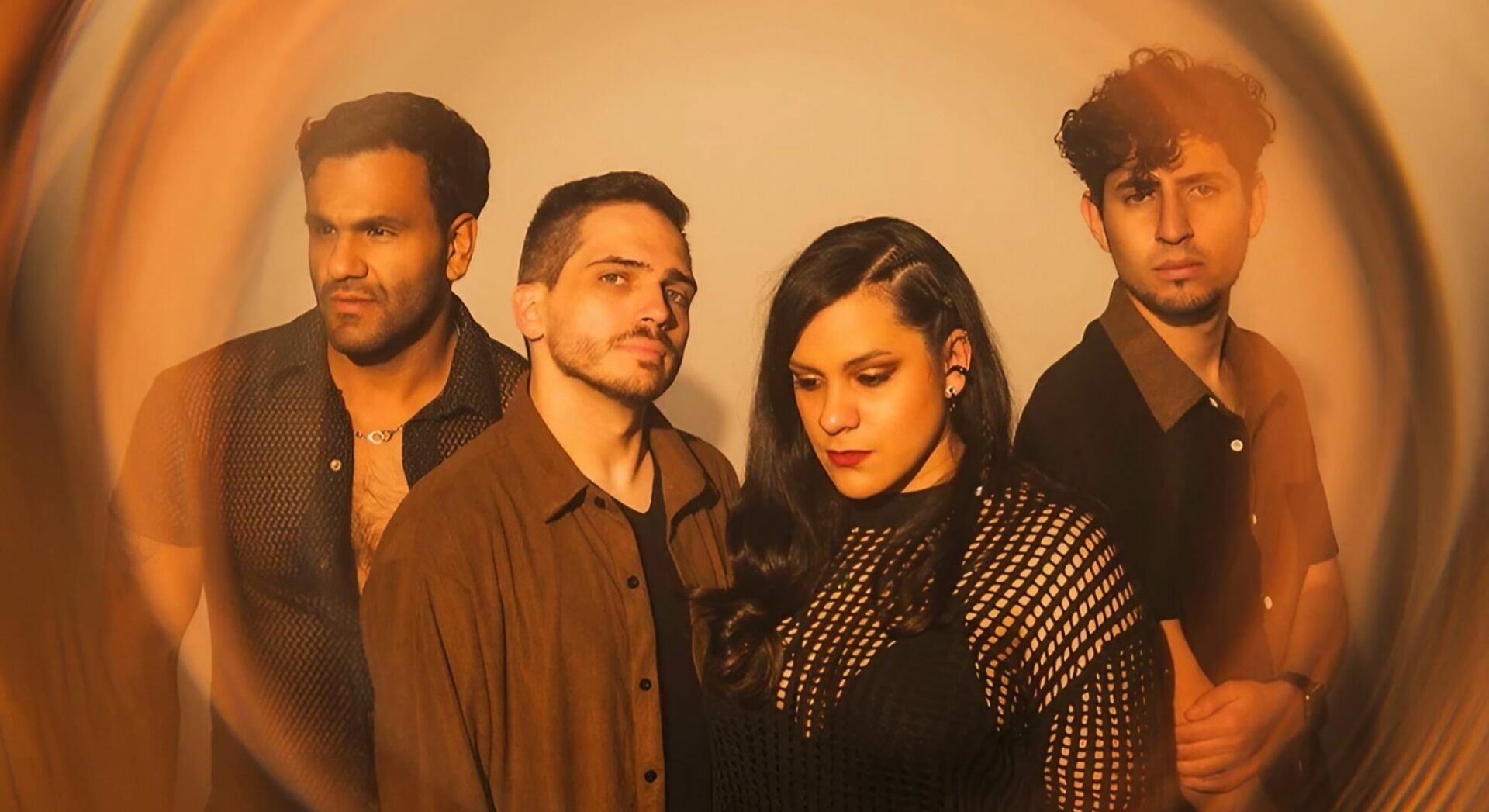
The band went dormant in 2019, a rupture compounded by the disruptions of the following years. Their return in late 2022 came with a deliberate aesthetic revision: away from symphonic and digital production, toward what the band themselves described as a “more mature, raw rock sound,” drawing from Porcupine Tree, Riverside, Vola, Steven Wilson, and Karnivool.
The 2024 EP ‘Who We Are’ confirmed the direction: it reached Nación Progresiva’s Best EP of 2024 list, earned a nomination for Best Ibero-American Single of 2023 for its title track, and brought an invitation to open for Circus Maximus in Bogotá in September 2024.2
Guillén’s international profile extended further still. She contributed a solo performance to the 170-voice fan choir assembled for ‘Faceless,’ the centrepiece of Leprous’s 2024 album ‘Melodies of Atonement’—a recording that placed her voice within one of European progressive rock’s most critically attended releases of that year.
For ‘Primal Repetition,’ Argovia expanded the production axis already established on ‘Who We Are.’ The record was produced alongside Germán Vergara, founding guitarist of Aisles—whose catalogue sits on Presagio Records, the Chilean label that manages Argovia’s digital distribution for this release—and mixed by Fernando Cubillos, whose credits include Aisles, Helloween, and Mark Farner. Steve Kitch of The Pineapple Thief returns for mastering; the recording studio’s identity had not been confirmed at the time of publication.
The Total Practice
There is a persistent tendency to treat an independent band’s visual presentation—photography, artwork, video production—as secondary evidence. With Argovia, it is primary.3 Their promotional materials for ‘Primal Repetition’ could be placed beside releases from InsideOut Music or Century Media Records without drawing any geographic distinction.
The cover places a volcanic eruption at the precise centre of a near-square composition. The volcano occupies the lower two thirds; its summit is the sole source of ground-level light—an intense orange-gold fire with fine luminous sparks thrown upward in tight vertical lines. The sky is split along a hard vertical axis: the left half saturated in amber atmospheric glow, the right half a deep-blue star field with a visible diagonal Milky Way band.
Two celestial bodies sit in the upper register—a fully saturated blood-red orb at the upper left, a photorealistic full moon at the upper right—both enclosed within concentric orbital arcs that sweep the full width of the image and frame the eruption from above.
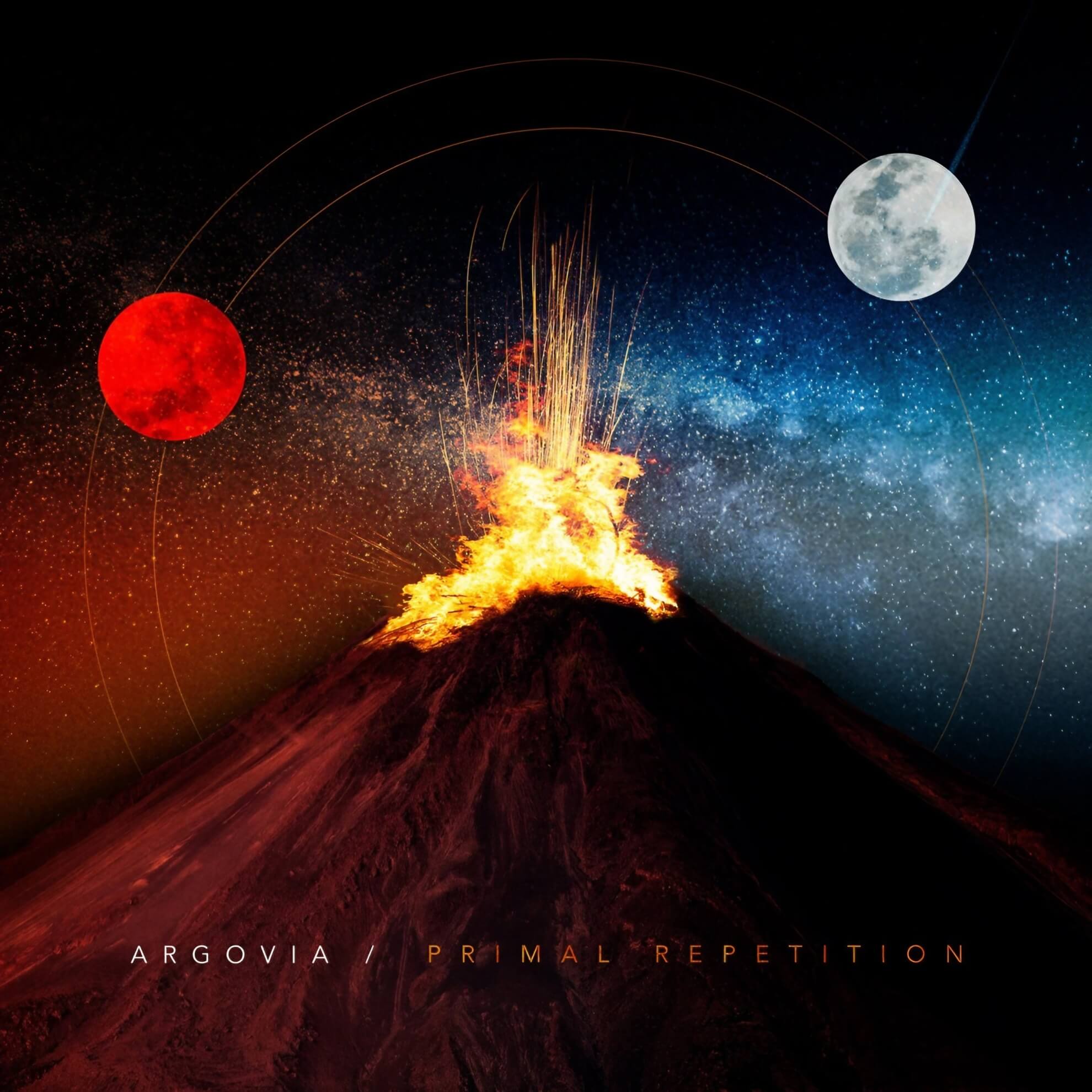
What the image transpires is not catastrophe. The volcano is not collapsing or destroying; it is simply in its condition, as it has always been, as it will continue to be. The orbital arcs confirm this: the two celestial bodies are locked in permanent motion around a centre that perpetually erupts. There is no exit point in the composition—no implied before or after. It is a system in a state it does not intend to leave.
The band’s own description of the album’s argument—that it “does not propose a definitive way out of the cycle, but rather the acceptance that this repetition is part of the human experience”—is rendered exactly here, before the first note is heard.
The image is also, deliberately, open. The two celestial bodies admit multiple readings: the internal and external voices of ‘Ebb & Flow,’ the light and shadow the lyrics ask the listener to accept simultaneously, or simply the irreconcilable pulls that constitute ordinary psychological life. The amber-blue vertical split may be warmth against reason, the known against the unfamiliar, or nothing more specific than the fact that opposing forces coexist without resolving. The artwork does not instruct. It presents a condition and withholds the label. That restraint is consistent with everything the three singles have established about how this band chooses to work.
This is not cosmetic. Independent bands operating without major label infrastructure must establish international credibility through every available signal.4
Photography, artwork, and video production are among the signals the specialist press and streaming platform curators respond to before a single note has been played. That Argovia have addressed all of them at the same level is part of why ‘Primal Repetition’ arrives as a fully formed artistic statement rather than a promising regional release. That they have done so without a label’s resources—funding visual production and promotional materials independently—makes the standard they have set considerably more deliberate.
Three Signals, One Argument
The three advance singles from ‘Primal Repetition’ constitute a coherent emotional sequence. ‘Where Do We Go,’ released in September 2025 and produced by Germán Vergara, addresses mental health with directness: Guillén described it as a song about “someone battling to find a reason to keep going while holding on to their sanity.”
‘Mountains,’ released in November 2025, shifts the coordinates slightly—hitting rock bottom, Arminio noted, as the precondition for the human connection that rescues. The track’s 80s-influenced production, “approached from a modern perspective,” points toward the record’s wider stylistic range.
‘Ebb & Flow,’ released on 6 February 2026, closes the arc without resolving it. The song presents a fragile, defeatist inner voice as externally originating; the dialogue is eventually revealed to be internal. The band’s stated position is exact: the record “does not propose a definitive way out of the cycle, but rather the acceptance that this repetition is part of the human experience.”
The production—synthesizer layers and a prominent bass line leading to a tribal climax driven by Afro-Latin percussion—is the most compositionally complete work Argovia have released to date. Jennings, who recorded an initial demo from an improvised cabin studio during Cruise to the Edge 2025 before completing final takes in the United Kingdom, noted that Argovia “deserve more attention than they are currently getting.”
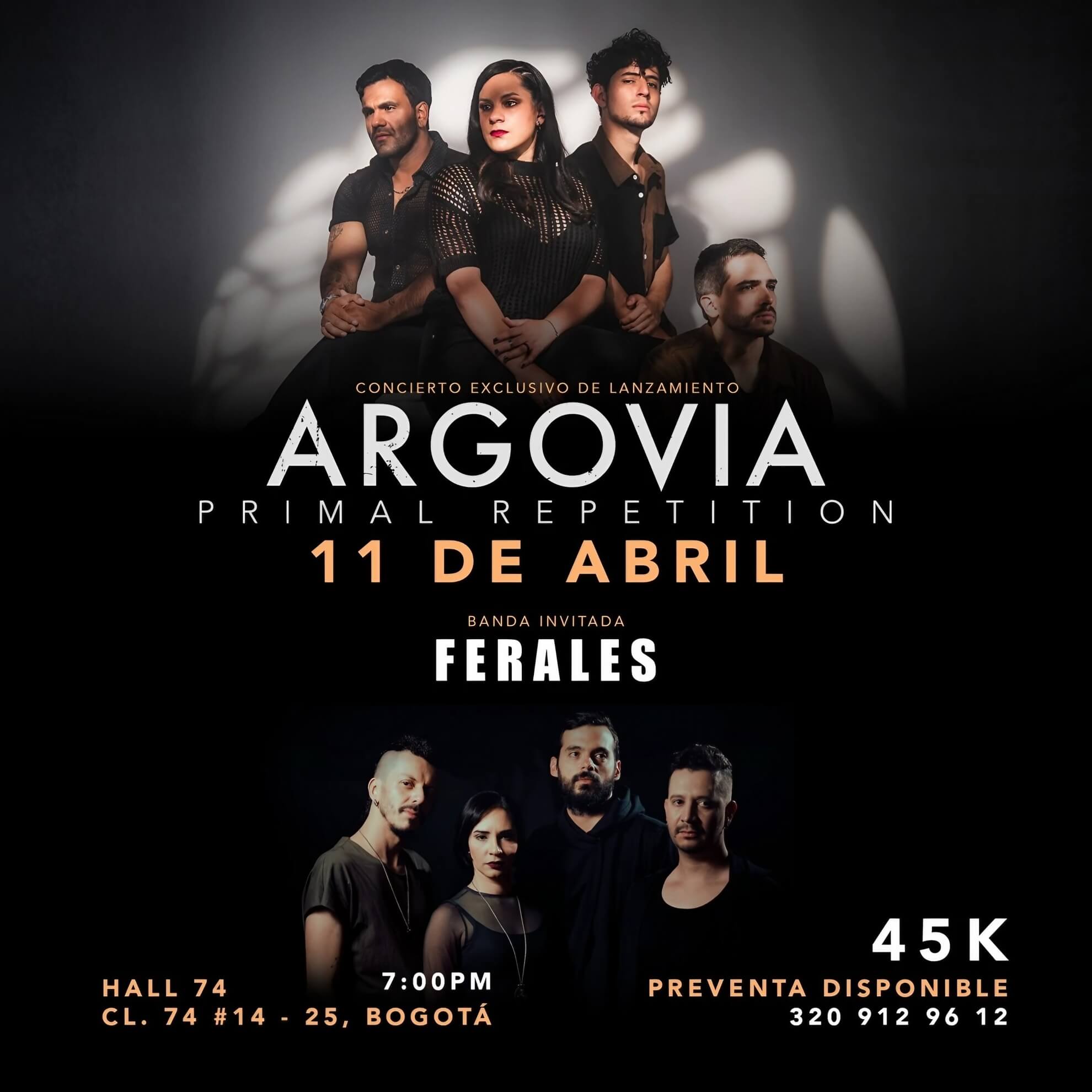
‘Primal Repetition’ is available from April 10, 2026 across all major streaming platforms, with digital distribution handled by Presagio Records. The band manages their physical release independently, without label involvement. A launch concert takes place at Hall 74, Bogotá, on April 11, with Ferales as support, with pre-sale tickets at 45,000 COP (approximately $12 USD at current exchange rates).
What ‘Primal Repetition’ represents within the Bogotá progressive scene is harder to name than it is to hear: a complete artistic practice, one in which the vocal identity, the visual presentation, the production network, and the conceptual argument are all working in the same direction at the same time. The cycle the album proposes—not transcended, not escaped, but inhabited more consciously—turns out to be an accurate description of where the band themselves have arrived after 13 years.
Holding Without a Label
What makes this worth stating plainly is what it required to get here. Every decision in the ‘Primal Repetition’ campaign—the choice of Germán Vergara as co-producer, the commissioning of artwork that holds its own against any major European release, the sequencing of three thematically coherent singles, the securing of Ross Jennings as a guest—was made and financed by four musicians in Bogotá without the structural support that most bands at this level take for granted. The record does not sound like an achievement despite those constraints. It sounds like a consequence of them.
If Ross Jennings says they deserve more attention than they are currently getting, we are inclined to agree — and we rarely agree so readily. Argovia are among the most complete bands to have crossed our radar from Colombia in recent memory: self-managed, visually deliberate, sonically precise, and operating at a level that has nothing to apologise for on any international stage. ‘Primal Repetition’ arrives on April 10. Seek it out, support it, and pass it on. Bands that sound this different from what surrounds them do not come along often enough to ignore.
If you have followed Argovia from ‘Distant Present’ or discovered them only through ‘Ebb & Flow,’ what is it about their sound that holds your attention — and what do you think it would take for a band at this level, working entirely without label infrastructure, to reach the audience they have clearly already earned?
References
- Mavis Bayton, ‘Frock Rock: Women Performing Popular Music’ (Oxford: Oxford University Press, 1998), 45–48. ↩︎
- Jesús Martín-Barbero, ‘Communication, Culture and Hegemony: From the Media to Mediations,’ trans. Elizabeth Fox and Robert A. White (London: Sage, 1993), 187–191. ↩︎
- David Hesmondhalgh, ‘The Cultural Industries,’ 3rd ed. (London: Sage, 2013), 252–256. ↩︎
- Néstor García Canclini, ‘Hybrid Cultures: Strategies for Entering and Leaving Modernity,’ trans. Christopher L. Chiappari and Silvia L. López (Minneapolis: University of Minnesota Press, 1995), 117–121. ↩︎
Leave a Reply