


Few independent metal records set themselves a task this size. To write the harmonic language of the Romantic, Modern, and Impressionist concert hall into heavy metal is already a steep ambition; to then aim that combined weight at the history of a single country, and to do it with no label underwriting the attempt, moves the whole undertaking into rarer territory.
A symphonic progressive metal band from the Colombian Caribbean did precisely this in 2018, on a ten-track debut that folds literary myth together with the national catastrophes its song titles half-bury. The record has spent the years since its release waiting for the wider hearing it was engineered to reward, and that gap — between what it attempts and how far it has actually traveled — is the reason it belongs in this column.
A Classical Spine Under the Distortion
Most metal bands that reach for orchestration reach for a preset. A keyboard patch labeled “strings,” a choir sample, a cinematic swell borrowed wholesale from film scoring — the gestures of the symphonic without its grammar. What separates this Barranquilla group from the crowd of sample-driven peers, and what makes the case for their place here, is a stated compositional foundation that is far more specific and far more demanding than atmosphere.
The band grounds its writing in the academic music of the Romantic, Modern, and Impressionist periods, folded together with progressive rock and jazz. That is not a line thrown at a press kit. It is a claim about where the writing comes from — about harmonic language, voice-leading, and the developmental logic that separates a piece with an orchestra behind it from a piece that actually thinks in orchestral terms.
An act that leans on symphonic presets is measured against other preset-driven acts. An act that names Debussy-era harmony and the long-form thinking of the nineteenth-century symphony as its starting point has quietly set its own bar at the level of the tradition it invokes, and either meets that bar or does not.
Septon set that bar in public, on a self-released debut, with no label to absorb the risk of the claim. The choice to front the music with a trained lyric soprano rather than a shouter belongs to the same logic. A soprano lead is not a decoration here; it is a commitment to a specific vocal tradition, one that asks the rest of the band to write around a voice built for sustained melodic line rather than percussive attack.
That commitment raises the degree of difficulty across every arrangement, because the guitars, keys, and rhythm section must leave room for a voice that carries in a register most metal is designed to bury.
The novelty this column exists to identify is not that a Colombian band plays symphonic metal; several do. It is that this one anchored an entire debut to a demanding compositional premise and then pointed that premise at its own country’s past. The ambition is legible in the premise itself, before a single note is judged. What follows is an attempt to weigh how far the record carries it.
A Composer’s Band Out of Barranquilla
Septon formed in 2016 in Barranquilla — a detail worth pausing on, because the shorthand story of Colombian metal is an Andean and Medellín story, and Barranquilla sits on the Caribbean coast, outside that lineage.
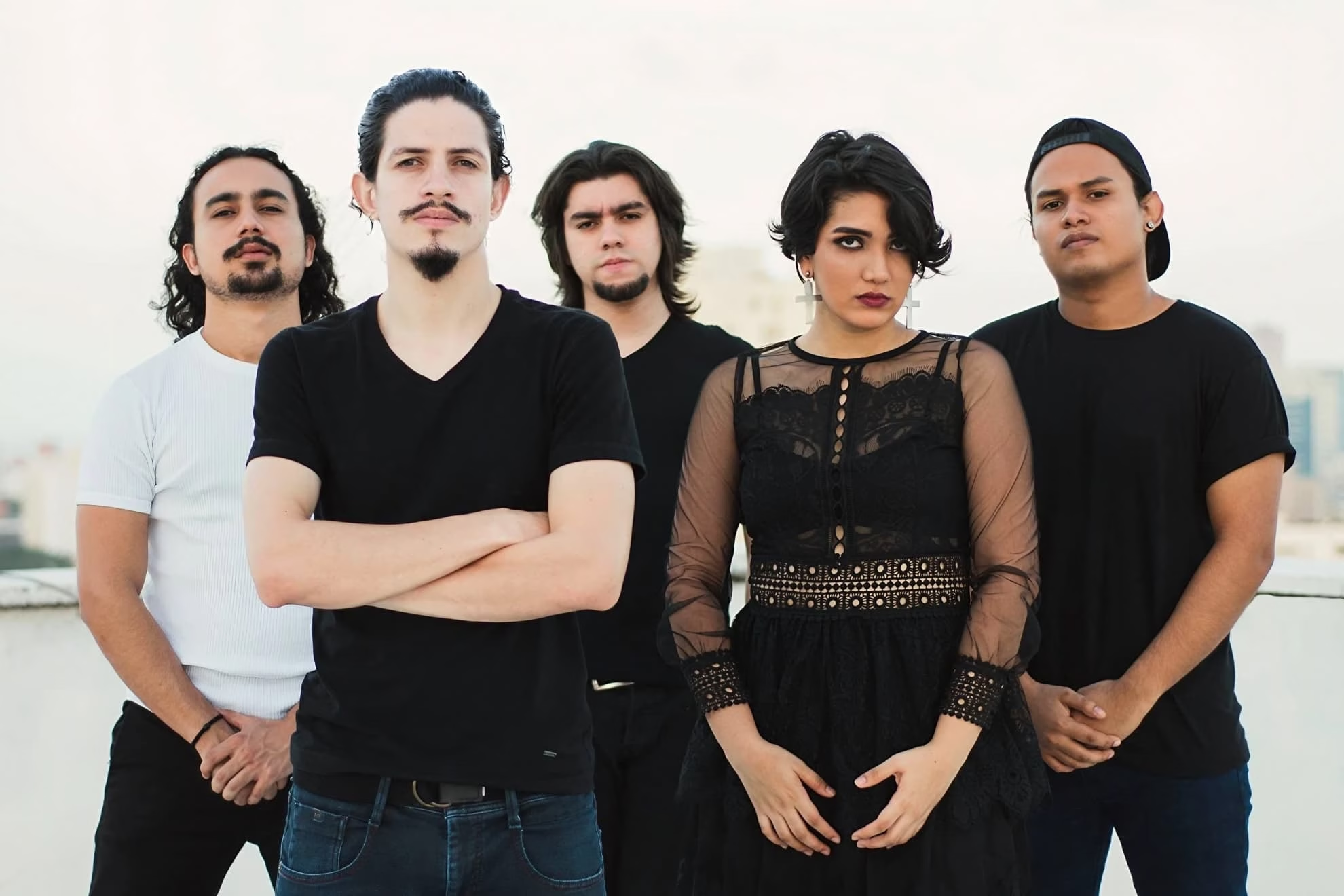
The band came together around composer and guitarist Leonardo Utria, with Angie Bula on soprano vocals, Augusto Garavito on keyboards, Dave Arango on bass, and Juan Camilo Bertel on drums.
Accounts differ slightly on origin — the band’s own channel credits Utria as the founding composer, while at least one scene profile names Bertel as the drummer who set the group in motion — a discrepancy worth resolving before any definitive history is written, but not one that changes the shape of the project.
Two facts about the lineup carry real weight for the argument. The first is that the group contains its own producer: Dave Arango engineered the debut, which means the band’s independence is not merely a matter of lacking a label but of holding the means of production in-house. A self-releasing band that also records itself controls its own timeline and its own sound, and answers to no external schedule.
The second is the presence, across the band’s festival history, of a university-festival circuit tied to the Universidad del Norte in Barranquilla, an academic setting consistent with the classical vocabulary the writing claims. A band steeped in a conservatory-adjacent milieu is exactly the kind of act that would reach for Impressionist harmony as a first language rather than an afterthought.
What the public record does not yet establish is the deeper lineage — the prior bands or projects the members came from, and what each carried forward or deliberately left behind. That history exists somewhere; it simply has not been documented in a form a reader can verify.
Where the record is silent, this piece stays silent rather than filling the gap with invention. The confirmed facts are enough to place the band: a coastal, self-producing, composer-led group that treats the symphonic not as a coat of paint but as a discipline.
The Anthology of ‘Cradle of Deception’
The evidence is one record. ‘Cradle of Deception’ was self-released in 2018 — dated the 6th of July on the major streaming services and the 9th of August on the band’s own Bandcamp page, ten tracks, produced by Dave Arango at Conqueror Studios, with a guest vocal from Luis Velez on ‘Revenge’ and cover art commissioned from Matt Ozorio.
That single album has to carry the whole case, which concentrates rather than dilutes it: everything the band claims to be is either present in these ten tracks or it is not.
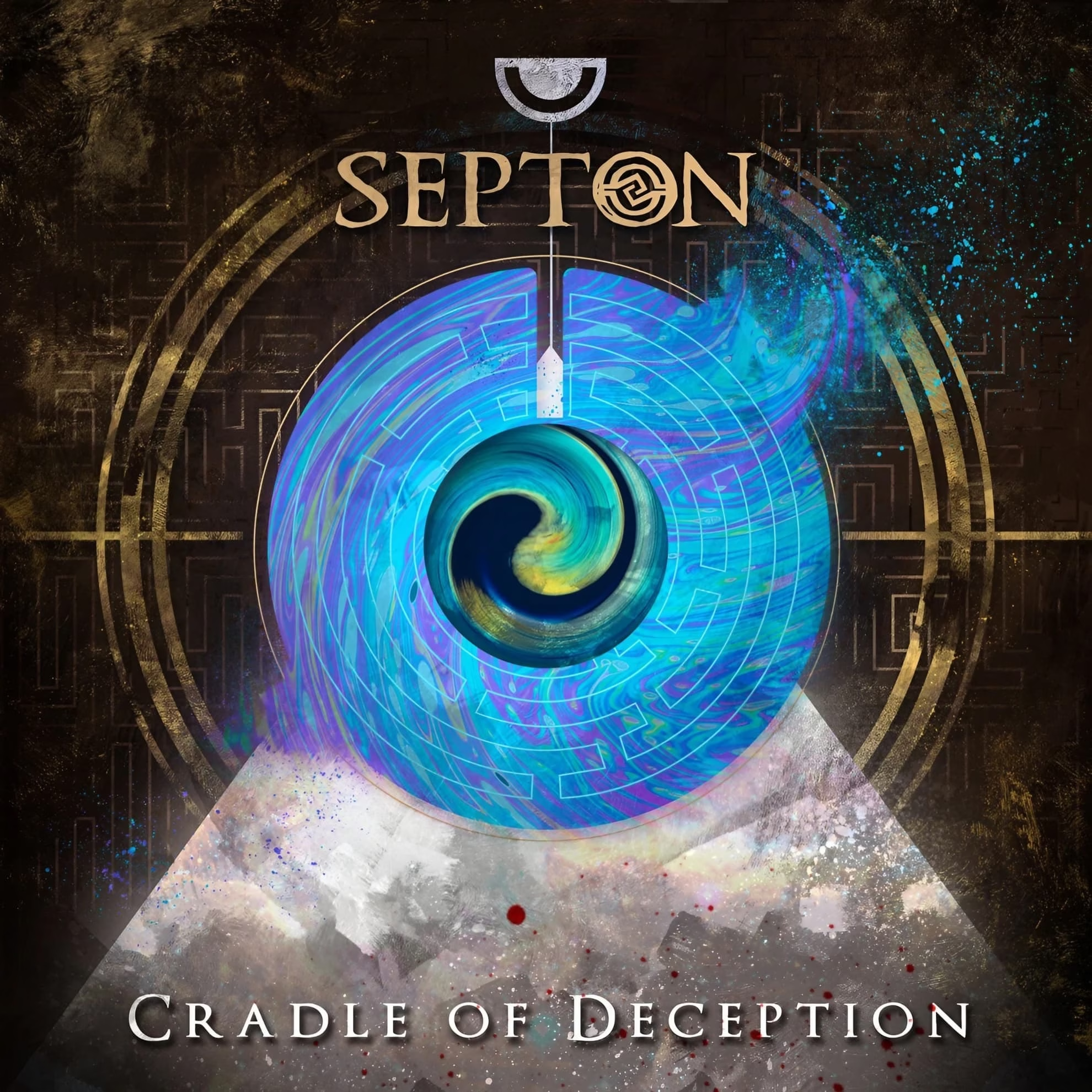
The record is best understood as an anthology rather than a single unbroken arc. The band’s own framing describes it as a compilation of experiences drawn from the history of Colombia, and the track titles bear that out as a deliberately mixed set rather than one continuous narrative.
‘Medea’s Chant’ reaches into Greek myth; ‘The North Remembers’ borrows a phrase that has traveled a long way from wherever it started; ‘Lahars’ and its neighbors point homeward, toward the ground the band actually stands on. The anthology form is itself a choice, and a revealing one. A debut that gathers many subjects under a single title is a band saying it has more than one thing to prove and refuses to wait for a second record to prove them.
Engaged as a sequence, the titles sketch a program of dread and aftermath. ‘Dying Lad,’ ‘Omen Whispers,’ ‘The Dark Command,’ ‘Hellish Dome,’ ‘Revenge,’ ‘Last Living Witness’ — the vocabulary is one of foreboding, violence, and survival, the register of a band interested in catastrophe and what remains after it.
That thematic gravity is where the symphonic ambition earns its keep: an orchestral palette exists precisely to render scale and consequence, and a band that has chosen catastrophe as its subject has chosen material that its stated compositional grammar is equipped to carry. Whether every track lands is a separate question from whether the pairing of means and subject is sound; the pairing is sound.
It should be said plainly that this is the band’s only full-length to date. That fact cuts two ways. It limits the body of work available to weigh, and it raises the stakes of the one statement on offer. A group that has released a single record and then held its position — rather than diluting the claim across a run of lesser releases — has left this debut standing as the whole of its argument. The column revisits it on those terms.
The Weight Carried by ‘Lahars’
One track title on this record does more work than any other, and it is worth slowing down over. A lahar is a volcanic mudflow — a fast, dense slurry of meltwater, ash, and debris that a heated volcano can send down its own flanks. For Colombia the word is not neutral.
On the 13th of November 1985, the Nevado del Ruiz volcano erupted and its heat melted the summit ice, sending lahars down the river valleys onto the town of Armero in Tolima. Roughly twenty-three thousand people died. It remains the deadliest natural disaster in the country’s history and one of the worst volcanic catastrophes anywhere in the twentieth century, remembered as much for the slowness of the dying as for its scale.
A track called ‘Lahars’ on a record explicitly concerned with the history of Colombia is most reasonably read against Armero. The reading is an interpretation, not a caption the band has confirmed, and it is offered as such — but it is the interpretation the evidence invites, and it is where the album’s two ambitions meet most directly.
Here the symphonic apparatus and the national subject are not running on separate tracks; they converge on a single event whose horror is a matter of documented fact rather than invented drama. This is the point at which the record stops being an accomplished genre exercise and becomes something the wider circuit has reason to notice.
It matters, too, that the band did not reach abroad for its darkness. The easy path for a Latin American symphonic act is to borrow European fantasy or generalized gothic gloom — dragons, castles, and imported medievalism. Septon, at least on the evidence of this title and the band’s own account of the album’s theme, reached instead into ground beneath its own feet, toward a wound in living memory.
A self-releasing band choosing national catastrophe over borrowed fantasy is making an artistic decision about what its music is for, and that decision is precisely the kind of specific, defensible claim to significance this column looks for.
The Cover and the Commissioned Image
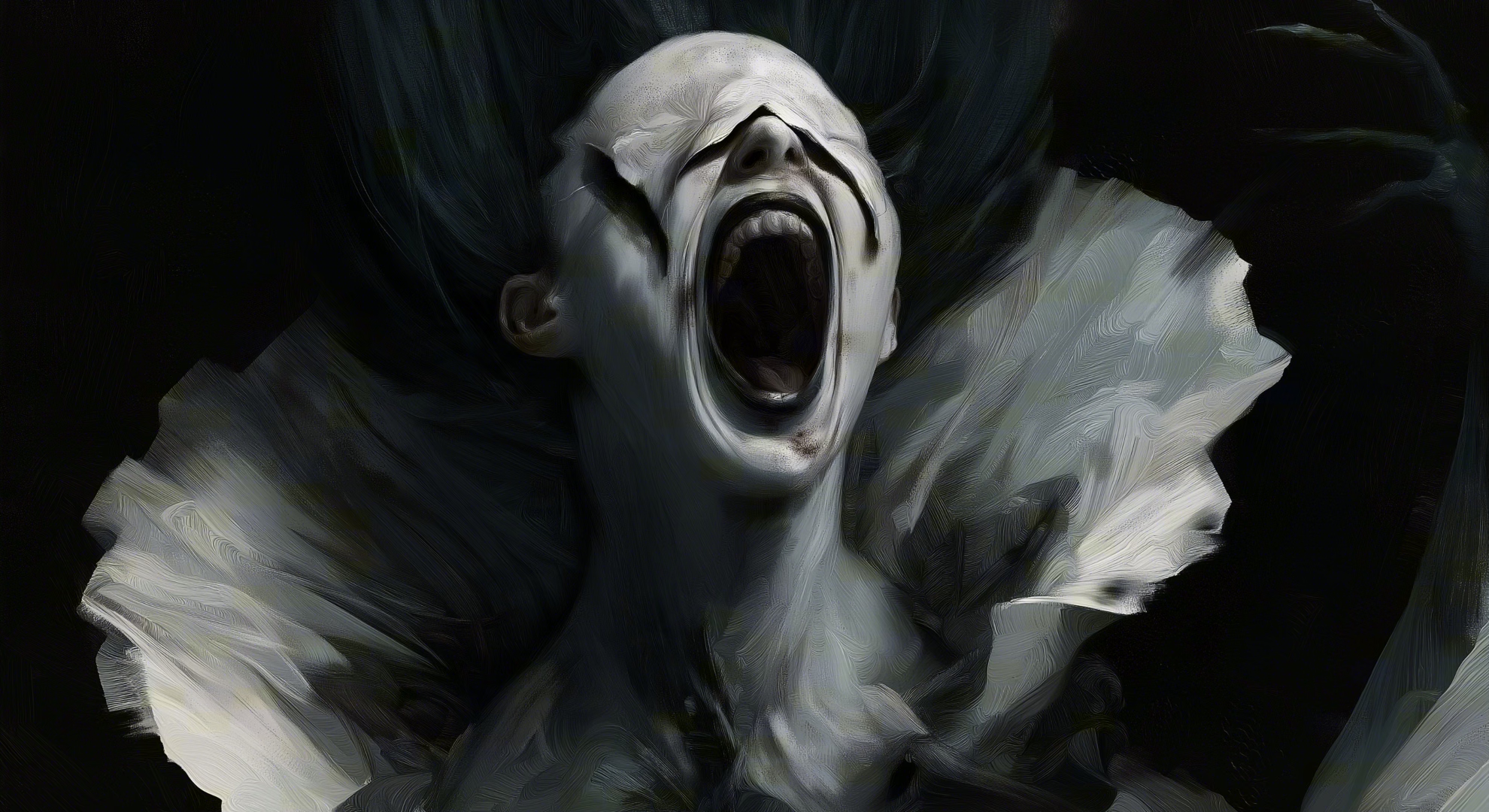
The album’s presentation centers on a cover commissioned from the artist Matt Ozorio rather than assembled from stock imagery. For a self-funded band, that distinction carries meaning: bespoke cover art is a cost a group takes on when it regards the packaging as part of the work rather than an afterthought, and commissioning a single dedicated image to unify an anthology of otherwise disparate subjects is a deliberate act of framing.
The soprano-fronted symphonic format implies, in turn, a staged and dramatic mode of presentation — a lyric voice at the center is a theatrical proposition as much as a musical one.
Honesty requires marking the limit of what can be argued here. Beyond the commissioned cover and the staging implied by the band’s format, the documented visual record available for study is thin, and this piece will not manufacture a reading of imagery it cannot verify.
Where a band’s claim to significance lives primarily in its compositional and thematic ambition — as Septon’s does — the visual account can stay honest and brief without weakening the case. The commissioned image confirms an intent; the fuller visual and staged dimension is the part of this story still waiting to be told in detail.
Standing Beside Rhapsody and Beyond
The strongest piece of documented context is a booking. In 2018 Septon won a public call to play the alternate stage at Metal Millennium in Bogotá, the festival headlined by Rhapsody and Hammerfall, traveling inland from the coast to do so, and had already placed at a series of local festivals across the preceding years.
Earning that slot through an open call is not a critical endorsement, and it is not presented as one; it is a selection fact. But it is a meaningful one, because a festival that headlines established international names and then admits a coastal newcomer through a public call is making a judgment about which local acts can stand in that company, and that judgment placed Septon there.
The compositional kinship is a separate matter, and here the reference points are this writer’s own rather than any borrowed verdict. Septon works within a lineage that runs from Therion’s insistence on treating the orchestra as a compositional partner rather than a garnish, through the paired lyric-soprano-and-growl template that Epica and early Nightwish made a genre standard, to the long-form developmental writing of progressive-minded acts such as Dream Theater and the studio-opera scale of Ayreon.
Naming that lineage is not to claim Septon has equaled it. It is to identify the standard the band has chosen to be measured against — the same move the band made when it named the Romantic and Impressionist repertoire as its foundation. A group that invites comparison to that company on a self-released debut is either overreaching or genuinely operating at that level of intent, and the ambition alone distinguishes it from the far larger number of acts content to sound competent within a single subgenre.
What the comparative case cannot yet include, by the standards this column holds itself to, is the kind of documented critical reception — sustained engagement from recognized figures in the tradition — that would move the argument from ambition demonstrated to influence confirmed. That is a gap in the record, not a verdict on the music, and it is exactly the gap a wider hearing would close.
An Active Band, Still Self-Releasing
Septon remains an active, independent concern, maintaining its own channels and its own presence in the Barranquilla scene rather than having dissolved after a single statement. That fact reframes the retrospective entirely.
Revisiting a 2018 record is not, in this case, an obituary for a band that came and went; it is a return to a record that has outlasted the moment of its release while its makers keep working. The column exists precisely for releases whose quality refuses to stay buried, and a still-active band is the best argument that the burial is a matter of reach rather than relevance.
The open question is forward-facing and honest: whether a second full-length will extend the classical-and-historical program the debut laid out, or revise it. This piece will not invent a release that has not been announced, nor put dates in the mouth of a band that has not confirmed them.
What can be said is that the premise established in 2018 remains unfinished business — a single record is a thesis, not a body of work — and that the most interesting version of Septon’s story is the one still being written. The retrospective is offered here not to close the case but to reopen it for an audience that missed it the first time.
The Hearing It Was Built For
Set the pieces side by side and the shape of the thing is clear. A coastal Colombian band, self-producing and self-releasing, grounded its writing in the harmonic language of the concert hall, fronted it with a lyric soprano, and aimed the whole apparatus at its own country’s history — including, on the evidence of a single unambiguous title, one of the worst catastrophes in that history’s modern record.
It did all of this on one album, in 2018, and then held its ground rather than retreating into easier material. The ambition is not in question. What is in question is only whether the record has reached the ears equipped to weigh it, and on that count the answer, for years, has been no.
That is the exact condition this column was made for: not to hand out attention as a favor, but to argue, on specific evidence, that a body of work has earned a wider hearing than circumstance has granted it. ‘Cradle of Deception’ makes that argument on its own terms, in its premise and its subject, and the case for it does not depend on charity. It depends only on someone with the range to recognize what the band set out to do, and the willingness to listen closely enough to judge how far they got.
If a self-released album can carry the harmonic language of the concert hall into metal and set it against the wounds of a single country, and still go largely unheard for the better part of a decade, what does that say about how we go looking for music — and about what we quietly demand an independent band accomplish before we agree to listen?
Leave a Reply