


A gathering of inscrutable presences convenes each winter at a lodge that does not stay in one place, hidden from ordinary people by a host who keeps it in fluid ground. The bargain offered there is old, a winter of service exchanged for a single wish, and the young woman who signs it does so without reading what she surrenders.
That contract, and the decades of exile that follow it, form the center of a novel that treats the Faustian pact not as borrowed decoration but as inherited mountain knowledge.
A Second Novel from the Mountains
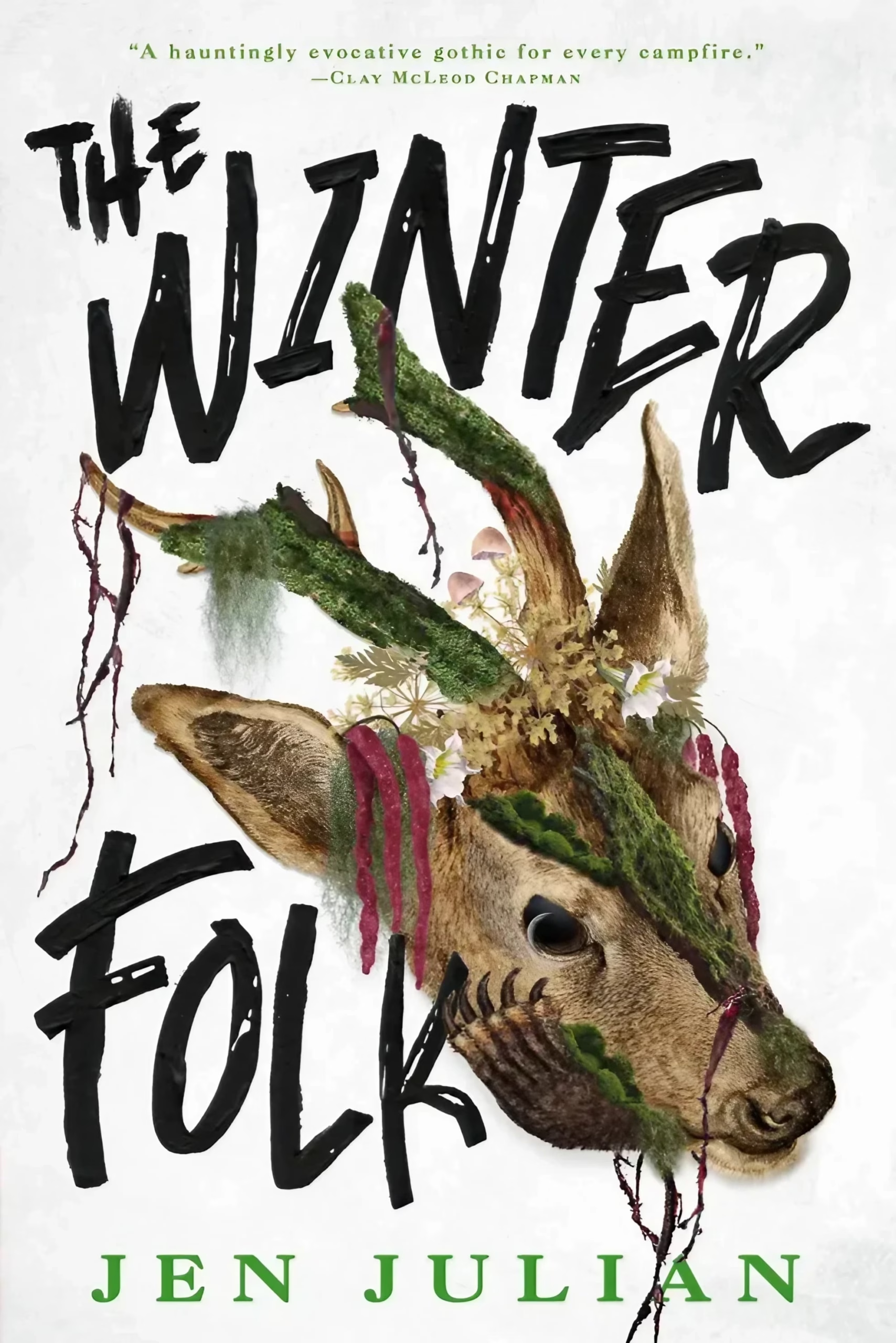
Run For It, the horror imprint within Orbit at Hachette Book Group, publishes ‘The Winter Folk’ on July 21st, 2026, a 384-page trade paperback and the second novel by Jen Julian.
It follows her 2025 debut, ‘Red Rabbit Ghost,’ issued by the same imprint, a Southern Gothic set in a small town whose desolate edge holds a place known only as the Night House. Before either novel, Julian had established herself in shorter forms: her collection ‘Earthly Delights and Other Apocalypses’ (Press 53, 2018) won the Press 53 Short Fiction Prize, and her short fiction was recognized as notable in ‘The Best American Short Stories 2023.’
Julian holds a doctorate in English from the University of Missouri and a master of fine arts in fiction from the University of North Carolina at Greensboro, and she completed the Clarion workshop in 2016. She now teaches creative writing at Young Harris College in the North Georgia mountains and edits fiction for storySouth. That rootedness matters to the book: the Appalachian setting reads as lived familiarity rather than atmosphere applied from outside.
The Antlered Host and His Kin
The figure at the center of Deerhaven is its host, Mr. Oslin, beautiful, mild-mannered, antlered, and entirely inhuman. He belongs to one of the most widely distributed images in pre-Christian European belief, the horned male divinity.
Celtic iconography preserves the antlered Cernunnos on the Gundestrup cauldron; Norse and Germanic tradition carried the horned lord of the wild hunt; and the modern Wiccan Horned God gathered these strands into a twentieth-century synthesis that Ronald Hutton has documented as a construction of the modern pagan revival rather than an unbroken ancient survival.1
Julian’s contribution is to render this force without moralizing it. Mr. Oslin is not a devil in the Christian sense and not a monster in the creature-feature sense. He is older than either category, and the dread of the book comes from his indifference, the sense that a being of his kind grants wishes the way weather grants rain, without concern for the person who asked.
Where Two Folk Traditions Meet
The mountains Julian writes are a meeting ground of two folk inheritances. Scots-Irish settlers carried their own supernatural grammar into the southern highlands, where it came into long contact with Cherokee spiritual geography, a merging that folklore scholarship of the Blue Ridge has traced through generations of story, remedy, and belief.2 The result is a regional supernatural vocabulary distinct from both of its sources.
The haint belongs to that vocabulary. Across the American South, the haint names the lingering dead who cannot cross running water, and the protective blue-gray paint applied to porch ceilings, haint blue, is most strongly documented within Gullah Geechee practice on the Lowcountry coast, with the broader belief present throughout the southern highlands.
Julian keeps such presences at their most domestic. Her narrator recalls the possum-shaped ghosts of the mountains being shooed off decks and away from trash cans, recognizable as vermin only to those paying close attention to the wrong shape of an eye socket or the clink of scales. The horror is folded into the ordinary, which is precisely where southern folk belief has always kept it.
The One-Wish Contract
The one-wish contract that binds the protagonist to Deerhaven has deep precedent in the folk record. The fairy bargain, service or a promise exchanged for a gift whose true cost is concealed, runs through the ballad of Tam Lin, through the naming trap of Rumpelstiltskin, and through the Irish geis, the binding obligation whose violation carries ruin. In each, the danger is not the supernatural agent alone but the terms the mortal accepts without full knowledge.3
‘The Winter Folk’ gives that structure a specifically American setting and, more unusually, a specifically feminine interiority. Moth, born Vera Stoker and renamed by the host she serves, is not a passive victim of the bargain. She wanted what she signed for.
The novel frames her long banishment from Deerhaven as partly self-inflicted, an exile she cannot stop reaching back toward. The contract becomes a study of desire rather than mere entrapment.
Moth and the Cost of Wanting
The construction of the novel is a doubled timeline. One thread follows Moth through her winters of service at Deerhaven, learning its exacting rules and the consequences of breaking them; the other, set decades later, follows an older Moth who returns to the North Georgia mountains with a husband and teenage daughter and cannot shake the pull toward a place that banished her 20 years earlier.
Suspense in the earlier thread does not depend on whether she reaches the lodge, since the later thread already reveals that she served there, but on the distance between what she wanted then and what that wanting made of her.
Julian’s prose carries the cadence of told story. The opening pages establish a first-person voice that speaks directly and plainly, describing the biting, scaled ghosts of the mountains in the same even register it gives to burning thighs and the smell of wet leaves on a hard climb.
That evenness is the central technique of the book: the mundane and the mythic share one tone, so that the supernatural does not announce itself but settles in beside the physical world as though it had always been there. The effect places the novel within the dark fairy tale as practiced by writers who treat the marvelous as fact rather than metaphor, and within the Appalachian Gothic that reads the mountains themselves as a store of what will not stay buried.
The Door in the Dark of the Woods
What the Faustian bargain has always asked is whether a person can be trusted with the thing they most want. Julian relocates that question from the study and the crossroads to a mountain lodge that drifts through the valley and beyond it, and hands it to a woman who knew the price and paid it anyway.
In doing so she joins a line of contemporary writers returning the dark fairy tale to its older function, not consolation but a warning about the cost of longing, and she grounds that return in a specific American geography whose folk belief has never needed to be invented. ‘The Winter Folk’ asks its reader to sit with the possibility that the most dangerous bargains are the ones a person would strike again.
Among the folk figures Julian draws on, the antlered host, the water-bound haint, and the fairy contract with its hidden cost, which do you expect to carry the most weight in a novel that roots the Faustian bargain in the specific belief of the North Georgia mountains, and what in the tradition leads you to that expectation?
References
- Ronald Hutton, ‘The Triumph of the Moon: A History of Modern Pagan Witchcraft’ (Oxford: Oxford University Press, 1999), 32-36. ↩︎
- Ted Olson, ‘Blue Ridge Folklife’ (Jackson: University Press of Mississippi, 1998), 3-14. ↩︎
- Katharine Briggs, ‘An Encyclopedia of Fairies: Hobgoblins, Brownies, Bogies, and Other Supernatural Creatures’ (New York: Pantheon Books, 1976), 449-452. ↩︎


Leave a Reply