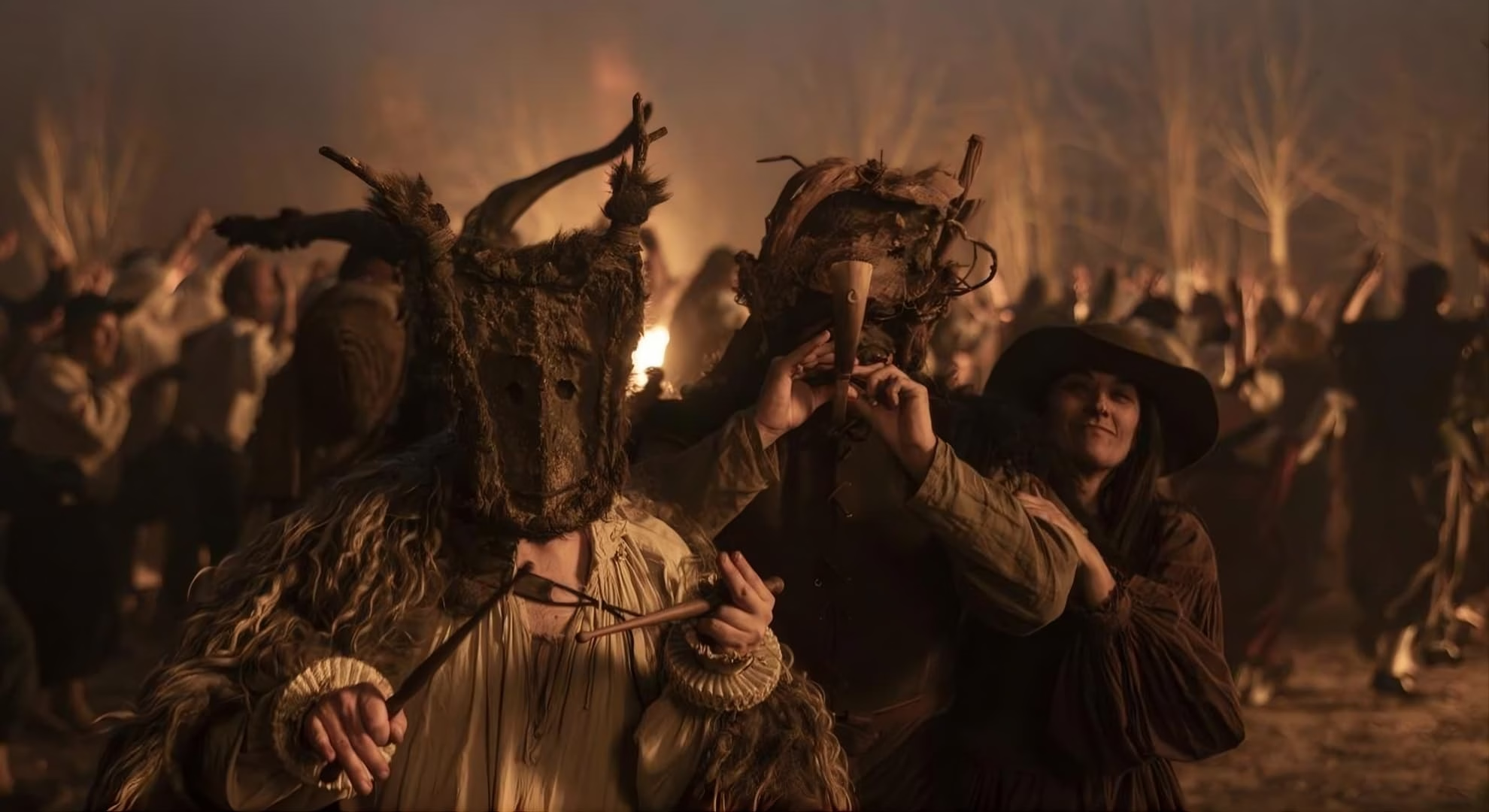


The witch and the shapeshifter belong to a history far older than cinema. Each is a figure that a dominant church once worked to define out of existence, and each survived in the vernacular tongues and rural memory that orthodoxy never fully reached. Over the past decade, genre filmmakers on both sides of the Atlantic have turned back toward these figures, treating regional belief as primary material rather than local color.
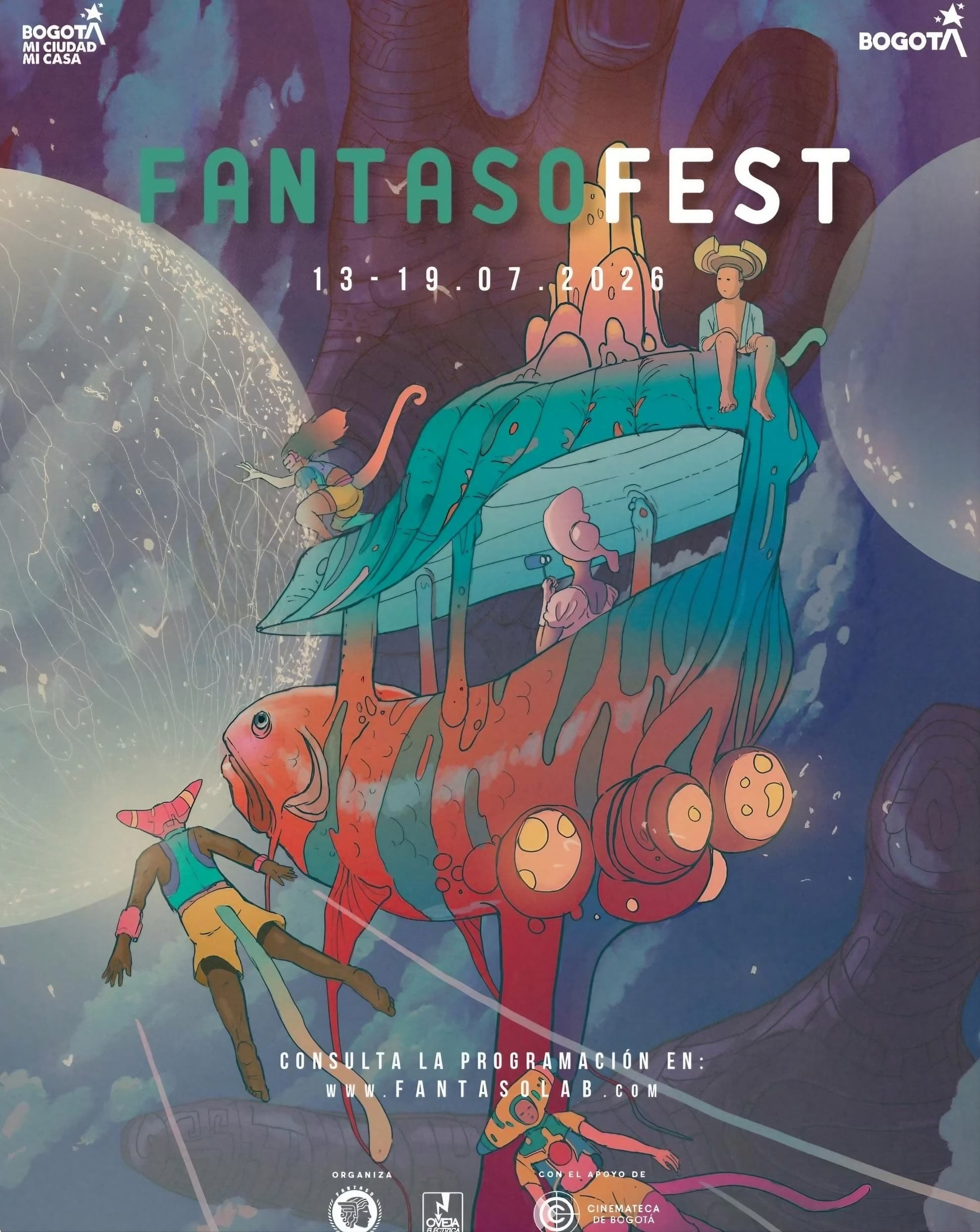
That turn now has a fixed address in the Colombian capital each July. The fifth edition of FantasoFest, the Muestra Iberoamericana de Cine Fantástico, runs from July 13th to 19th, 2026, at the Cinemateca de Bogotá, the city’s public cinematheque. Organized by the labs FantasoLab and Oveja Eléctrica, the edition gathers five features across nine screenings and ten Iberoamerican shorts under one premise: that the fantastic in Spanish and its neighboring tongues is a single conversation, not several.
A Showcase Across Two Shores
FantasoFest grew out of the Laboratorio Iberoamericano de Cine Fantástico, and that origin still governs its selection. Since its first edition in July 2022, the showcase has placed Spanish productions beside Latin American ones as a matter of principle, insisting on Iberoamerica as a single field of genre production. Prior years brought Mexico’s ‘Huesera,’ Uruguay’s ‘Virus 32,’ Ecuador’s ‘Chuzalongo,’ and Guatemala’s ‘Rita’ to the same screens that hosted Spanish and Cuban work.
The 2026 selection sharpens that principle into an argument. Its two confirmed marquee titles are folk horror in the strict sense — cinema that draws its terror from a specific place, a closed community, and an inherited belief that refuses to die.1 One comes from the Basque Country, the other from the forests of San Luis Potosí, and together they read as a deliberate pairing rather than a coincidence of programming.
The Night in a Basque Tongue
‘Gaua’, the opening film, is the third feature by Paul Urkijo Alijo, following ‘Errementari’ in 2017 and ‘Irati’ in 2022. Shot entirely in Basque, it is set in the seventeenth century at the height of the witch hunts and follows Kattalin, a woman who flees her husband into a night forest and falls in with three women who trade in stories. Urkijo drew the film from the ethnographic collections of the priest José Miguel Barandiarán and from the visual memory of Goya’s late paintings.
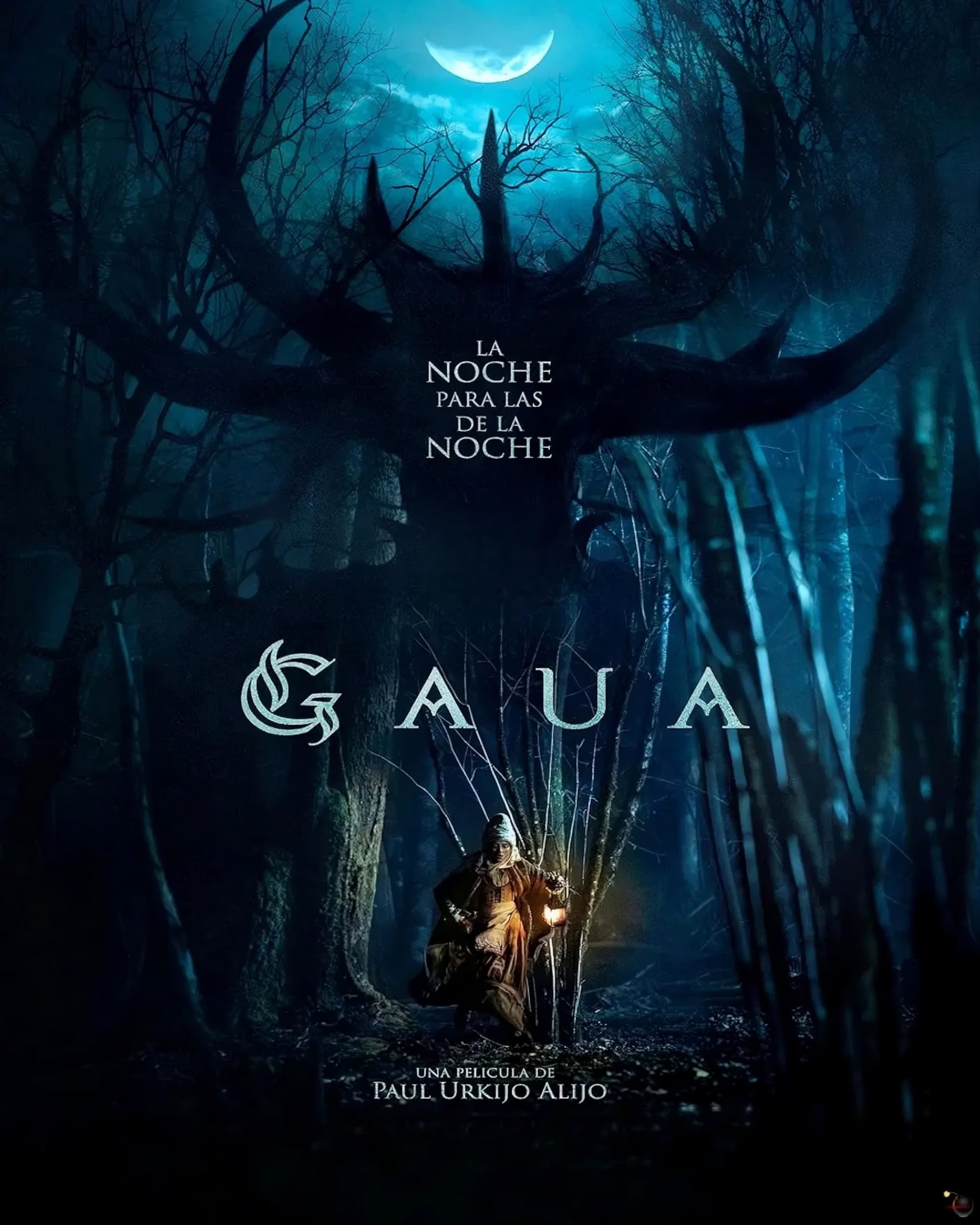
The persecutions that frame ‘Gaua’ were not metaphor. The Basque trials centered on Zugarramurdi and adjudicated at Logroño between 1609 and 1614 remain the largest single witchcraft proceeding in European history, and the inquisitors who ran them coined the term akelarre for the gatherings they imagined.2
Urkijo’s achievement is to return that machinery of fear to the point of view of the women it consumed, and to do so in the language those women actually spoke.
A Shapeshifter from the Huasteca
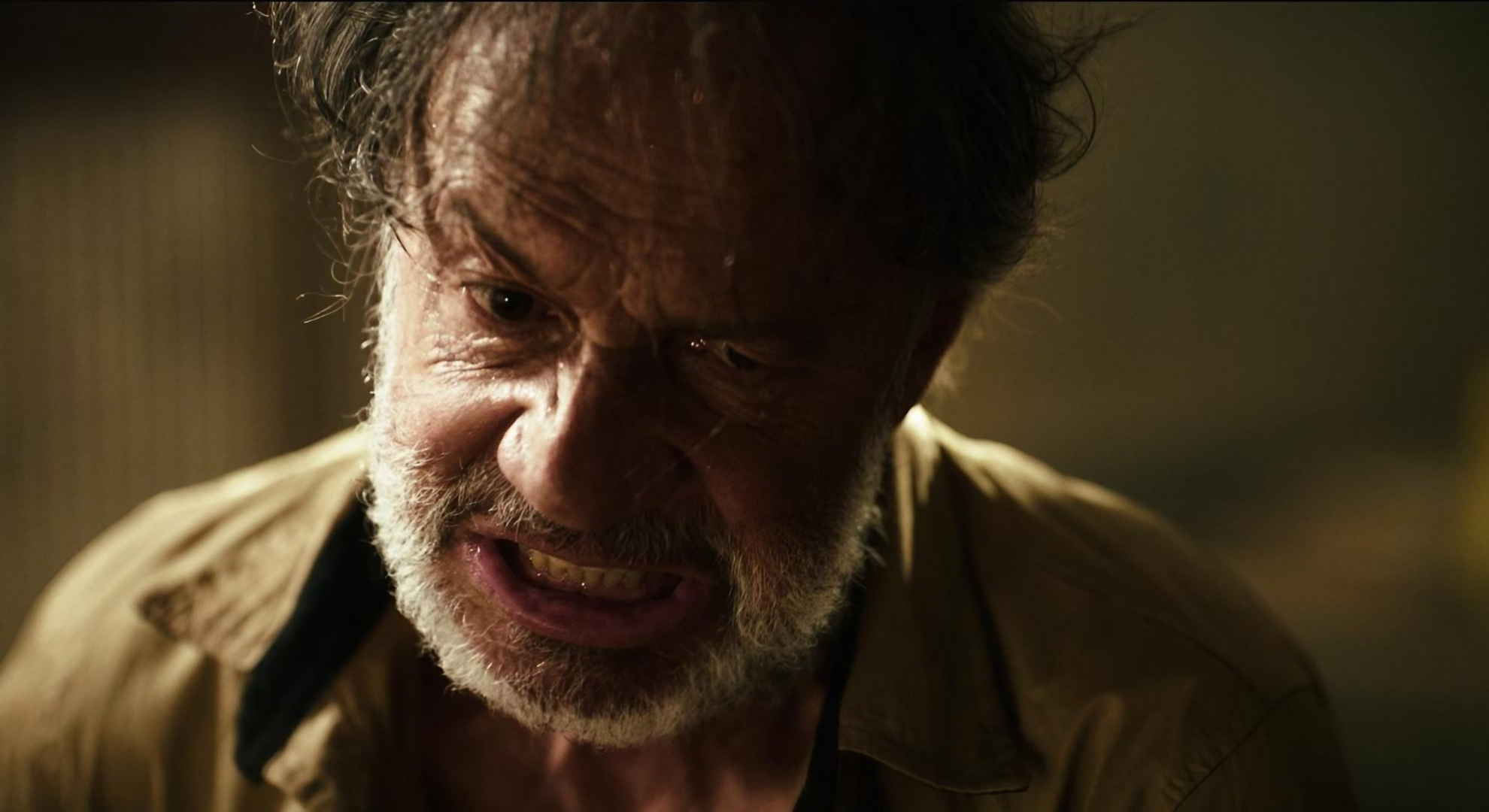
Against that Iberian night, FantasoFest sets ‘Tekenchu: El ritual de los nahuales,’ released commercially as ‘El ritual del nahual,’ the debut feature of the Potosino director Carlos Matienzo Serment. Expanded from his 2020 short ‘Tekenchu,’ the film follows a federal investigator through a series of child killings in the forests of San Luis Potosí, where two healers shelter a wounded stranger and an older power stirs. It is spoken partly in tének, a language of the Huasteca, and its monster is realized through practical effects rather than digital ones.
The nahual is a Mesoamerican figure of long standing — a person able to cross the boundary between the human and the animal, recorded in colonial accounts and still living in Indigenous cosmology across Mexico.3
Matienzo Serment treats that inheritance as a working belief rather than a curiosity, anchoring the film’s justice not in the state investigator but in the older law the creature enforces. Placed beside ‘Gaua,’ the film completes a single gesture: two societies once told to abandon their night figures, filmed by descendants who refused.
The Laboratory Behind the Screen
The screenings are only half of what FantasoFest does. Running in parallel is the fifth Laboratorio Iberoamericano de Proyectos de Cine Fantástico, split into its LAB and Incubadora sections, which shepherds new genre features from across the region through development. This component lets the festival claim to shape the cinema it later exhibits, not merely collect it.
That ambition sits inside a longer regional story. Latin American genre film has spent decades moving its monsters from the margins toward the center of national film cultures, and the festivals that program them have become the circuits through which those monsters travel.4
FantasoFest’s ten-short selection — titles such as ‘Chaika,’ ‘Mutante,’ ‘El Chucur,’ and ‘La prueba de los ancestros’ — is where that traffic is most visible, and where next year’s features are already taking shape.
Seven Nights at the Cinemateca
The fifth edition occupies the Cinemateca de Bogotá, at Carrera 3 No. 19-10 in the historic center, from Monday July 13th through Sunday July 19th, 2026.
The full programme and session times are published by the organizers on the official website, and tickets are sold at the Cinemateca box office. Prior editions priced individual functions modestly, from 6,000 COP, with some sessions free of charge; tariffs for 2026 had not been confirmed at the time of writing.
The Cloister of Santa Clara
A few blocks from the Cinemateca, on Carrera 8, stands the Iglesia Museo Santa Clara, the church of a Poor Clares convent begun in 1619 and consecrated in 1647. For most of its history it was a place of enclosure, where families placed daughters they could not afford to marry and where those women remained until death; a crypt sits beneath its main altar, from an age when the city buried its dead inside its churches.
The building answers the films with unusual precision. Its walls carry more than a hundred colonial paintings and a series of portraits of dead abbesses, crowned in flowers at their profession and again at their passing — the same seventeenth-century Catholic order whose counterparts, in ‘Gaua,’ hunt the women of the forest.
As recently as 2014, the exhibition ‘Mujeres Ocultas’ by the artist María Eugenia Trujillo was suspended here by a religious injunction before the courts overturned the ban and let it open — a reminder that the clash the festival’s films dramatize still returns, and is still contested.
The register the two features share — nocturnal, feminine, bound up with what a church declared forbidden — has a real address in Bogotá, and it is open to the public two streets from the screen.
The Return of the Vernacular
What the fifth edition puts on screen is not two national curiosities but a single claim about where the fantastic now finds its power. When a Basque witch and a Mesoamerican shapeshifter share a week at a public cinematheque in Bogotá, the point is not exoticism but continuity: the belief systems that outlived suppression are the ones genre cinema has learned to trust.
FantasoFest at five is old enough to make that case deliberately and small enough to make it precisely — a festival that treats the vernacular night not as a set of local myths but as the common ground of an entire film culture.
If the shared source of Iberoamerican folk horror is the belief a church once tried to erase, which of Colombia’s own night figures is still waiting for the festival to place it on the same screen?
References
- Adam Scovell, ‘Folk Horror: Hours Dreadful and Things Strange’ (Leighton Buzzard: Auteur, 2017), 17–19. ↩︎
- Gustav Henningsen, ‘The Witches’ Advocate: Basque Witchcraft and the Spanish Inquisition, 1609–1614’ (Reno: University of Nevada Press, 1980), 19–24. ↩︎
- Daniel G. Brinton, ‘Nagualism: A Study in Native American Folk-lore and History’ (Philadelphia: MacCalla & Company, 1894), 6–9. ↩︎
- Gabriel Eljaiek-Rodríguez, ‘The Migration and Politics of Monsters in Latin American Cinema’ (Cham: Palgrave Macmillan, 2018), 44–48. ↩︎



Leave a Reply