


The Ediciones Vestigio, Bogotá’s independent press founded by editors Diego Cepeda and Rodrigo Bastidas Pérez, has never presented itself as a mainstream proposition. Its catalog — built on bizarro fiction, speculative literature, and what it terms the Colombian weird — has operated since its founding in deliberate opposition to the commercial canon: publishing work, as Cepeda has described it, for readers who are not part of a conservative market and who seek alternatives to what they routinely find on bookstore tables.
That orientation has generated a list of unusual precision. Alongside its translations of Carlton Mellick III and work produced in collaboration with the Spanish speculative press Orciny Press, Vestigio has issued titles by Luis Carlos Barragán and Bastidas Pérez himself — writers whose fiction sits at the intersection of Colombian historical trauma, body horror, folk cosmology, and theory-inflected speculation.
The press’s Rubedo collection, the imprint that carries its most formally ambitious titles, now extends to five works. ‘Eidolónica’ is the fifth.
Barragán and the Colombian Weird
Luis Carlos Barragán — born in Bogotá in 1988, trained in plastic arts at the Universidad Nacional de Colombia and in Islamic art history at the American University in Cairo — has over the course of four previous books established himself as one of the central figures in what critics of Latin American speculative fiction have taken to calling the Colombian weird.
His first novel, ‘Vagabunda Bogotá’ (Angosta Editores, 2017), won the tenth Premio de la Cámara de Comercio de Medellín and was nominated for the Premio Rómulo Gallegos. His second, ‘El Gusano’ (Vestigio, 2018), earned an honorable mention at the Isaac Asimov Science Fiction Prize at the Ateneo de Puerto Real, Spain, in 2017, and has accumulated endorsements from critics across Latin America as a before-and-after event for the region’s speculative fiction.
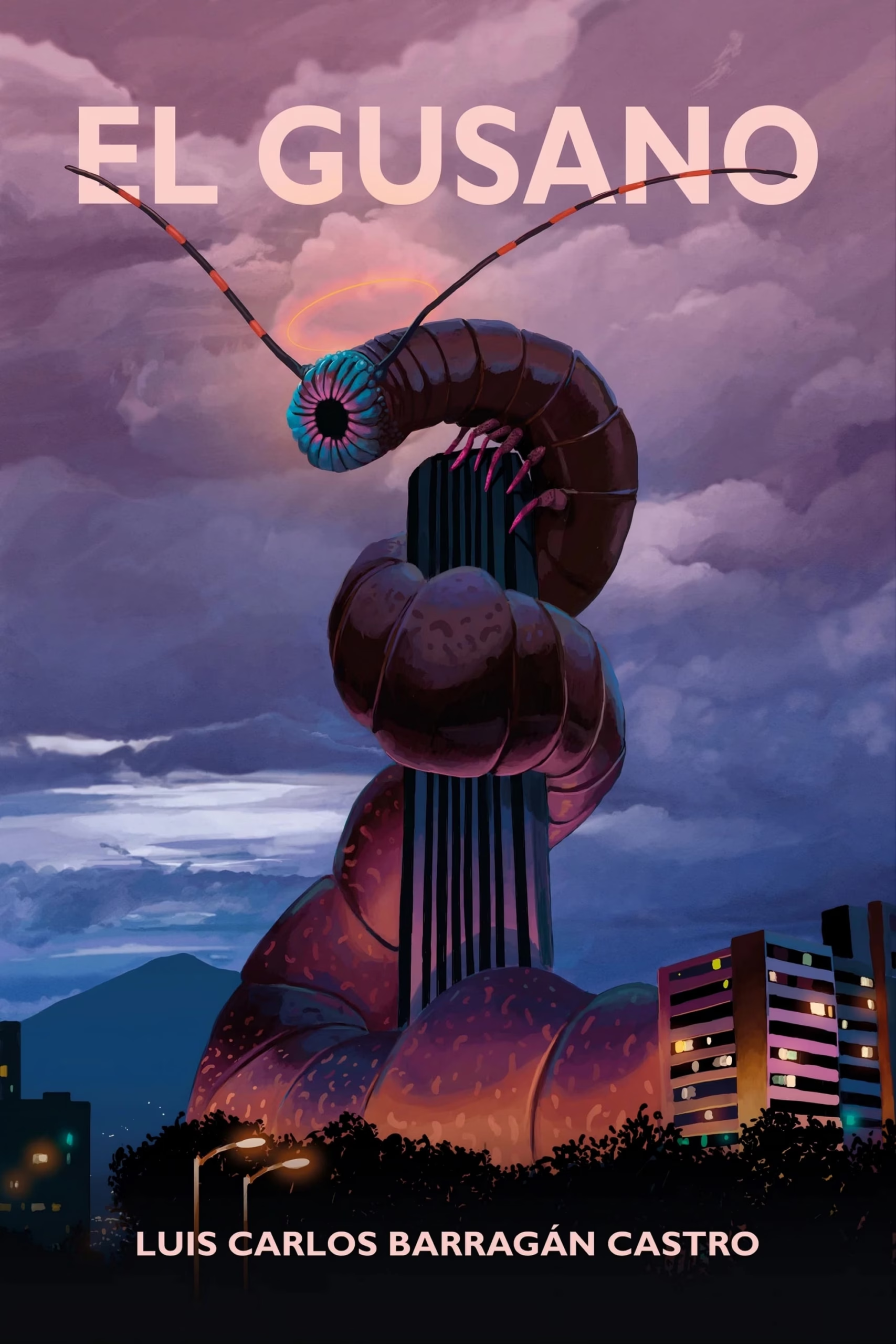
‘El Gusano’ is the work that most clearly established Barragán’s particular method: a world in which the limits of skin no longer hold, in which bodies interpenetrate and fuse across geographies, and in which Colombian guerrilla violence, underground culture, hallucination, and religious feeling occupy the same narrative plane.
Ramiro Sanchiz, the Uruguayan writer and critic, has called it a work that appears to have come back from the future to make visible a weird literature that seemed always to have existed. Alberto Chimal, the Mexican novelist, described it as essential to the new Latin American imagination.
His short fiction collection ‘Parásitos perfectos’ (Vestigio, 2021), issued with support from the Idartes publication fund, extended that method into shorter form: biopunk subcultural Bogotá, human-insect transplants, castrated pilots, psychic parasites unleashed by synthetic psychedelics.
The novel ‘Tierra Contrafuturo’ (Minotauro, 2021), issued by a major Spanish imprint, broadened his reach without altering his register. ‘Eidolónica’ is the work that, by every account of its premise, synthesizes and extends all of those concerns at the greatest scale he has yet attempted.
Five Hundred Pages, Four Figures
Published in April 2026 by Ediciones Vestigio as the fifth title in the Rubedo speculative fiction collection, ‘Eidolónica’ arrives in Colombian bookstores in July 2026, following its limited pre-order delivery in the second week of June.
The novel spans three geographies: La Guajira, the arid northern peninsula that runs to the Caribbean and the Venezuelan border; Medellín’s peripheral barrios, the peripheral zones that colonial maps and narco topography have defined and redefined for decades; and the Casanare llanos, the vast eastern plains where the Colombian state has historically been either absent or violent.
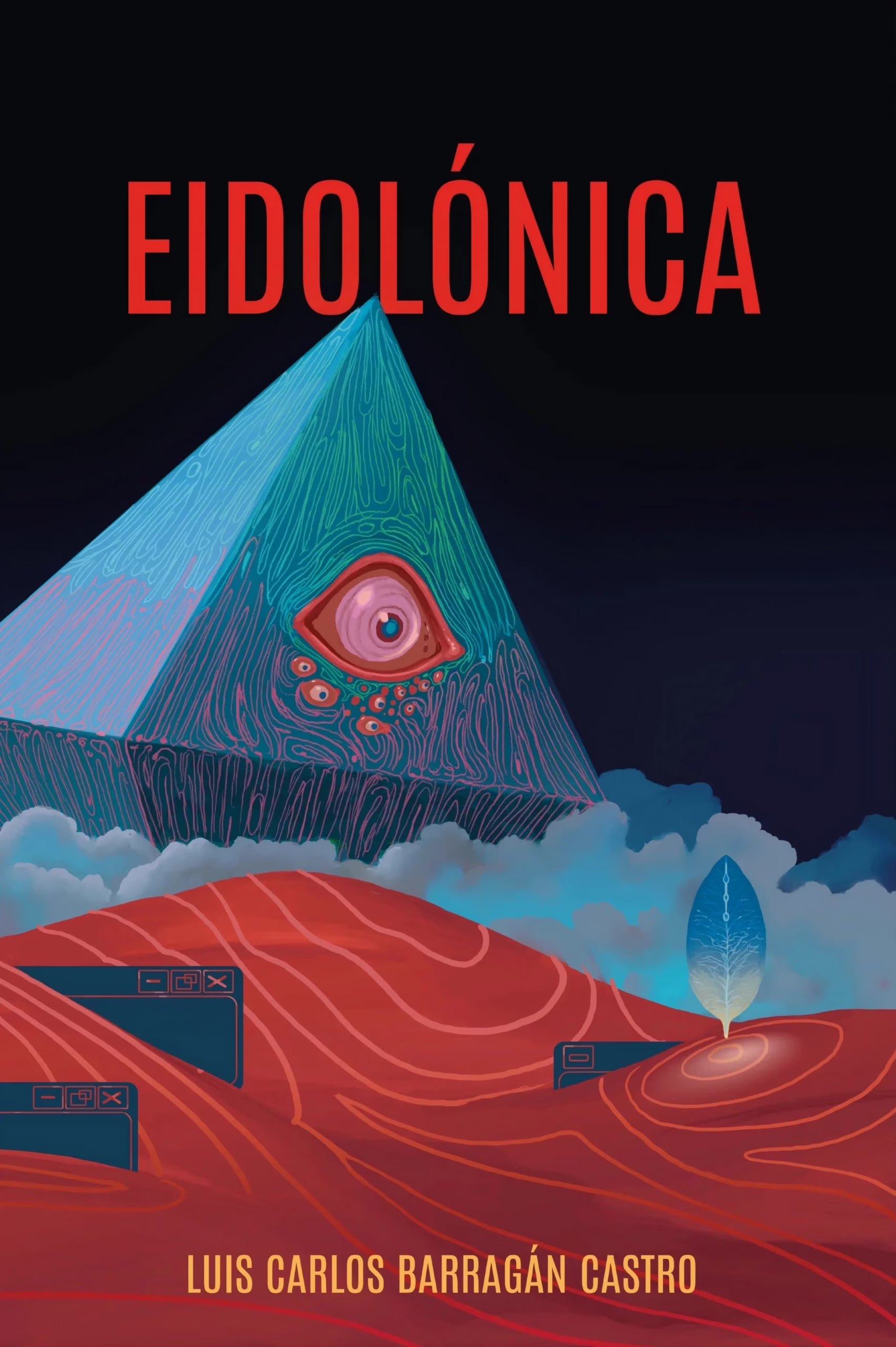
Four central figures hold the narrative: a mystical DJ in decline, an academic specializing in ethnobotany, a nihilist shamanic elder, and a novice hitman carrying unresolved violence. Around them, the world Barragán builds is one in which psycho-sicarios study medieval ceremonial magic guided by occultist orders, kaiju-scale titans destroy dams, and gorgs on motorcycles execute massacres framed as ritual acts.
The publisher’s endorsement invokes Reza Negarestani’s ‘Cyclonopedia’ (re.press, 2008) and the cultural criticism of Mark Fisher as ‘Eidolónica’s’ nearest coordinates — two reference points that, taken together, locate the novel within a specific international tradition of theory-fiction in which philosophical argument and dark narrative do not merely coexist but are structurally inseparable.
Theory-Fiction and Its Colombian Form
The theory-fiction genre, as Negarestani’s ‘Cyclonopedia’ established it, is not a novel with philosophical footnotes. It is a form in which the fiction’s narrative events are the argument — in which what happens is inseparable from what is being claimed about the world in which it happens.
Negarestani’s book, published by the Australian press re.press in 2008 as part of its Anomaly series, built a speculative cosmology around the Middle East — petroleum as sentient geological agent, oil as the lubricant of war and political theology simultaneously — and presented it as part horror fiction, part philosophical treatise, part occult atlas, with no stable generic hierarchy among the three.
Fisher’s contribution to this lineage is different: less the invention of a formal mode than the articulation of a diagnostic vocabulary — hauntology, capitalist realism, the weird and the eerie — that gave culturally disoriented fiction a theoretical frame and gave theoretical critics a permission to take dark cultural production seriously on its own terms.
What Vestigio’s endorsement implies, in placing Barragán’s novel alongside both names, is that ‘Eidolónica’ belongs to a tradition in which the dark and the philosophically serious are not competing registers but the same register viewed from two positions.
Within Latin American writing, this tradition has documented precursors that the Anglo-American reception of theory-fiction tends to overlook. Bastidas Pérez’s own ‘Las dimensiones absolutas’ (Vestigio, 2025), the immediately preceding Rubedo title, enacted a comparable hybridization in which the ascent of a Colombian volcano is simultaneously a geological epic, a cybernetic theory, and a reckoning with the Colombian conflict’s violence in natural-world form.
Barragán’s work in ‘Eidolónica’ extends this by installing the structure of theory-fiction inside a Colombian geography — La Guajira, the llanos, the urban barrios — whose darkness is historically documented rather than cosmologically imposed.
Colonial History and Pre-Columbian Cosmology
What separates Barragán’s fictional method from either a narco-thriller or a conventional speculative novel is the way he treats Colombian colonial history and pre-Columbian spiritual traditions as continuous rather than sequential. In ‘El Gusano’ and ‘Parásitos perfectos,’ the interpenetration of bodies was also the interpenetration of timelines: ancestral knowledge and biocapitalist technology occupying the same flesh without resolving into a stable hierarchy.
‘Eidolónica’ applies this logic to a wider geography and a more violent history. La Guajira carries the Wayuu people, the salt trade, the contraband routes that colonial administrators documented and that narco networks later traced along the same terrain. The Casanare llanos were the site of significant paramilitary violence in the late twentieth century, and Medellín’s peripheral barrios bear the physical and social marks of the narco era’s spatial reorganization of the city.
Barragán does not treat these as backdrop. The publisher’s description positions the novel as a synthesis that threads Colombian colonial history, Andean and Amazonian entheogens, and pre-Columbian spiritual traditions into a single cosmological framework.
That synthesis connects — without repeating — the counter-cultural literary experimentation of the Nadaísta movement, the Colombian avant-garde that emerged from Medellín beginning in 1958 under the leadership of Gonzalo Arango. Nadaísmo drew its radicalism from existentialism, surrealism, and the Beat Generation, and it directed that radicalism against the conservative Catholic academic culture that Colombian literature had largely endorsed.
Barragán’s fiction belongs to no such school, but it extends the Nadaísta refusal of a Colombia narrated from within its own conservative self-image — here into territory that neither Nadaísmo nor the magical realist tradition ever fully inhabited: dark theory-fiction rooted in the specific violence and spiritual inheritance of Colombian geography.
Vestigio and the Rubedo List
Ediciones Vestigio has described its founding impulse in terms of an absence: the lack, within Colombian literary culture, of a publishing space for narrators who do not fit the market’s conservative mainstream. The press drew explicit inspiration from Orciny Press, the Spanish publisher that first translated bizarro fiction into Spanish, and from the American Eraserhead Press, the longtime motor of bizarro’s commercial and aesthetic expansion.
That lineage places Vestigio in a relationship with Anglo-American underground publishing that is one of parallel development rather than derivation: a press that recognized the same gap in its own cultural market and built a list designed to fill it.
The Rubedo collection’s published titles — Barragán’s ‘El Gusano,’ Bastidas Pérez’s ‘Las dimensiones absolutas,’ and now ‘Eidolónica’ among them — constitute a coherent argument about what Colombian speculative fiction can be when it refuses both magical realist continuity and the narco-realist mode that international publishers have historically found easier to promote.
Each Rubedo title is an object with its own internal logic; together they accumulate into something the individual title cannot be: a body of work that does not fit the available international category of Latin American dark fiction but that demands a category of its own.
The Genre Argument of the Novel Itself
The brief description of ‘Eidolónica’ that Vestigio has circulated is at once a publisher’s claim and a serious generic argument. The coordinates it offers — occultism, kaiju, massacre-as-ritual, entheogens, a decline-arc DJ and a nihilist elder — do not name a recognizable subgenre.
They name a specific collision of materials that no existing convention houses simultaneously: the kaiju, which belongs to the Japanese tokusatsu tradition but has been absorbed into global speculative fiction as an image of catastrophic nonhuman scale; the narco-sicario, which Colombian fiction has documented in realist mode since the nineteen eighties; and the ceremonial magician, whose presence in dark fiction runs from Dennis Wheatley through Negarestani’s Middle Eastern occultists.
To install all three inside the same 500-page novel — grounded in Colombian geography, anchored in Colombian colonial and pre-Columbian history, and connected to the international theory-fiction tradition — is to make a claim about scale. A novel of this kind asks whether Colombian dark fiction can sustain not just local specificity but the kind of cosmological ambition that Negarestani’s ‘Cyclonopedia’ exercised on Middle Eastern material. The publication of ‘Eidolónica’ is, among other things, the assertion that it can.
Dark Fiction’s Colombian Archive
For international readers of dark fiction, the Colombian dark literary tradition remains largely inaccessible — a combination of distribution geography, language, and the international publishing industry’s tendency to funnel Latin American writing through the same recognizable categories regardless of what the writing is actually doing. Vestigio’s own distribution model, which makes titles available to international readers primarily through Amazon and Bookshop, operates at the margins of that system rather than through it.
‘Eidolónica’ arrives in Colombian bookstores as the July 2026 dark fiction event of greatest local significance — a 500-page theory-fiction from the country’s most formally ambitious speculative press, written by the writer who has done more than any other to establish what a dark Colombian weird might be. For Spanish-language readers of speculative dark fiction anywhere in Latin America, and for the international community of readers for whom Negarestani and Fisher mark a serious tradition of dark philosophical fiction, the novel’s existence demands attention that its current distribution reach does not yet guarantee.
That gap between the work’s scale and its access is, for now, part of the condition ‘Eidolónica’ occupies — and Vestigio, whose catalog has always operated in advance of its available audience, has navigated that condition before.
A Dark Fiction Geography All Its Own
Dark fiction produced at the margin of its own distribution system has a documented history of eventually forcing the system to adjust. The three Sourdough collections A.G. Slatter published with Tartarus Press in editions of three hundred copies each are now gathered in a 688-page Titan Books paperback; the limited-edition pressings of ‘Cemetery Dance’ have become reference points that shaped the field’s critical conversation.
Barragán’s work has already crossed into Spanish-language readership outside Colombia — translations of ‘El Gusano’ are documented in process for Portuguese, Persian, French, and English — and the theoretical-critical apparatus with which Vestigio frames ‘Eidolónica’ speaks a language that international dark fiction criticism already uses.
The Rubedo collection’s fifth title does not arrive as an anomaly. It arrives as the latest installment in a body of work that has been making a sustained, verifiable argument about what Colombian dark fiction is capable of producing. The kaiju titans, the occultist sicarios, the shamanic nihilist and the declining DJ do not require a Colombian reader to carry their darkness.
They require only a reader who takes seriously the proposition that the specific violence of a specific geography — La Guajira, the barrios, the llanos — is cosmological material of the first order, and that a tradition of theory-fiction that has addressed the Middle East and the British cultural crisis has been waiting, without knowing it, for someone to address Colombia the same way.
Among the four narrative figures Barragán places at ‘Eidolónica’s’ center — the mystical DJ in decline, the ethnobotany academic, the nihilist shamanic elder, the novice hitman — which carries, in your view, the greatest potential to concentrate the novel’s dark philosophical argument, and what in Barragán’s prior fiction leads you to that expectation?


Leave a Reply