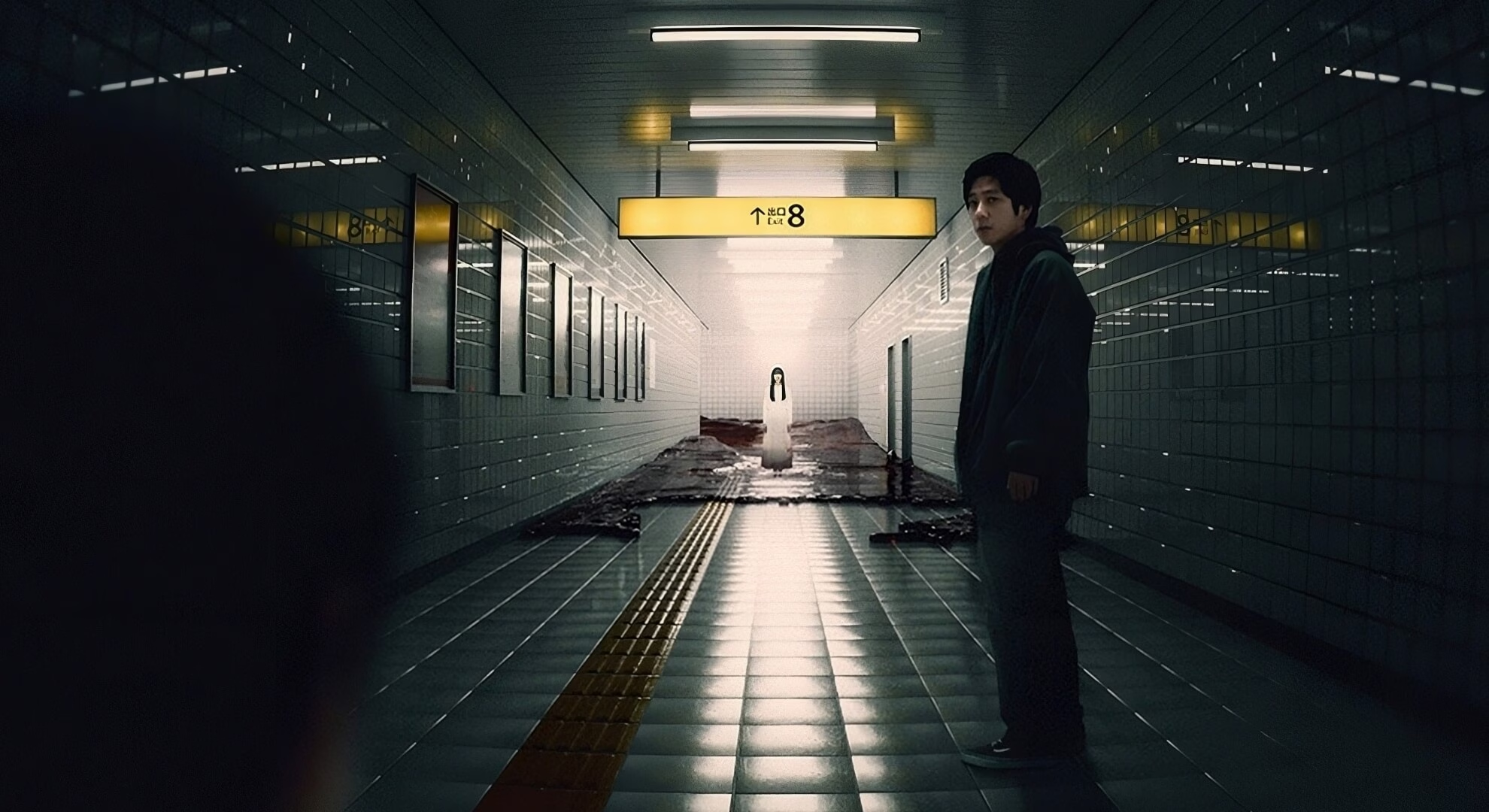


The loop structure — a character condemned to repeat the same passage, accumulating knowledge with each failed attempt at exit — carries a specific lineage in horror and adjacent genre cinema. Vincenzo Natali’s ‘Cube’ (1997) placed its characters inside a spatial trap governed by abstract, lethal rules they had to deduce in order to survive; Christopher Smith’s ‘Triangle’ (2009) collapsed time into a recursive imprisonment whose dread resided not in a revealed monster but in the slow recognition of what was repeating, and why.
These films share not a premise but a formal concern: the loop as a mechanism for extracting psychological terror from spatial confinement, the rules of the trap as a mirror for the psychology of the trapped. Genki Kawamura’s ‘Exit 8,’ which opens in U.S. theaters today via Neon, arrives from within this tradition — though its immediate source is not cinema but a Japanese indie game released in November 2023.
A Game Designed Around Absence
Kotake Create’s ‘The Exit 8’ is, by conventional measures, a minimal object: a first-person walking simulator in which the player traverses a looping underground corridor modeled on a Tokyo subway underpass, identifying visual anomalies in order to advance toward the titular exit. The game contains no story, no dialogue, and no explanation of its own mechanics beyond what the player infers from the consequences of each pass through the corridor.
What the game understands — and what makes it an unusual source text for a feature film — is that the horror of anomaly detection operates at the perceptual level rather than the narrative one. The threat is not a monster or a backstory; it is the sudden wrongness of a familiar space, a formal preoccupation that stretches in horror cinema from the distorted interiors of Robert Wiene’s ‘The Cabinet of Dr. Caligari’ (1920) to the fluorescent-lit suburban dread of Ari Aster’s ‘Hereditary’ (2018).
The game sold over two million copies across platforms and generated a documented subculture of fan content, anomaly catalogues, and speedrun archives. Its viral reach established both the source material’s cultural footprint and the psychological terrain Kawamura would need to translate into a passive viewing experience.
Kawamura’s Route into the Passage
Genki Kawamura’s filmmaking credentials are primarily those of a producer. His production record spans Mamoru Hosoda’s ‘Mirai’ (2018) and ‘Belle’ (2021) and Makoto Shinkai’s ‘Suzume’ (2022) — animations defined by emotional interiority and formally controlled visual worlds whose relationship to genre horror is oblique at best.
His sole prior directorial feature, ‘A Hundred Flowers’ (2022), was a subdued drama about a son managing his mother’s descent into dementia — a work concerned with memory, guilt, and the experience of watching someone recede from the world, but entirely removed from horror as a formal register. The path from there to ‘Exit 8’ ran through the game itself; Kawamura has stated in interviews that he played ‘The Exit 8’ shortly after its release and was drawn immediately to its design logic.
The screenplay, co-written with Kentaro Hirase, grafts a narrative onto the corridor’s empty grammar: Kazunari Ninomiya’s character, credited only as The Lost Man, is a commuter navigating an underground passage while simultaneously avoiding processing a phone call from his girlfriend, who has told him she is pregnant and needs his decision.
Ninomiya — an Arashi member with an extensive dramatic filmography but no prior horror credits — was involved in the script from early stages, contributing directly to the process of converting a dialogue-free game into a story with moral stakes.
The Practical Corridor and Keisuke Imamura’s Camera
The production team constructed two identical physical corridor sets in Tokyo, replicating the game’s underground passage in practical materials: tiled walls, glossy floor surfaces, and the ambient overhead lighting that renders the space flat and undifferentiated.
The intention, as Kawamura has described, was to achieve through physical construction what the game achieved through Unreal Engine rendering — the specific uncanny quality of a space that looks like a space but reads as a simulation of one.
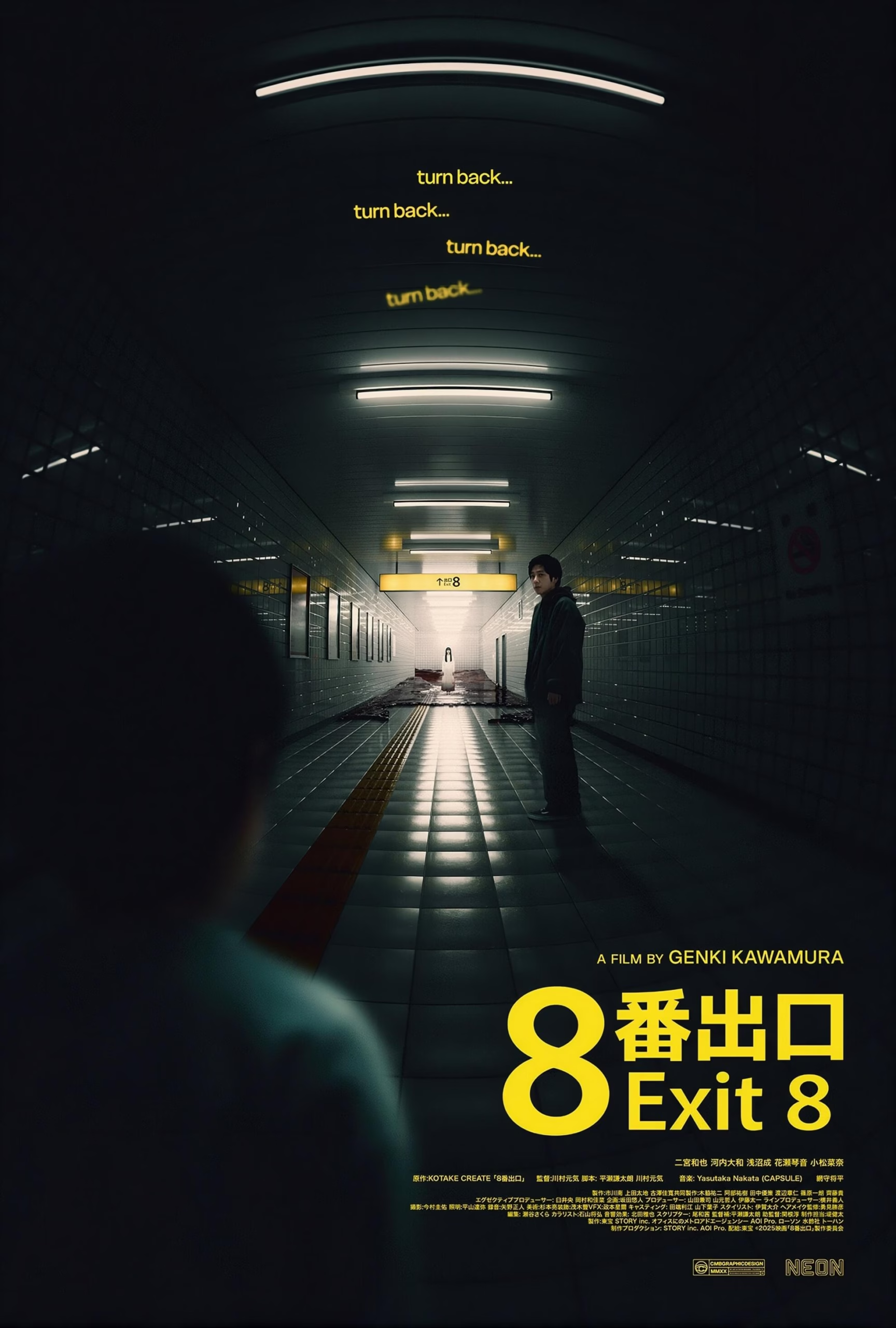
Cinematographer Keisuke Imamura’s approach begins in a first-person perspective that directly echoes the game’s point-of-view structure, then migrates into a more conventional third-person framing as Ninomiya’s interiority takes precedence over the corridor’s rules. The effect is a formal argument about the transition from player to character: when The Lost Man is still operating on game logic, the camera treats him as an avatar; as the psychological stakes accumulate, the frame contracts around him as a person.
The two-corridor setup allows Imamura to conceal the edit point between identical spaces, maintaining the illusion of unbroken locomotion through a loop that should be impossible to film in continuous motion. Multiple critical accounts of the film describe the resulting viewing experience as disorientation produced by extended takes interrupted by cuts that are difficult to locate — a technical solution to the formal problem of making a loop feel both repetitive and, at the same time, subtly different with each pass.
Sound, Silence, and the Score
The film’s sound design establishes a baseline of ambient white noise — ventilation systems, distant footfall, the muted acoustics of an underground passage — whose primary function is to make audible, through contrast, the anomalies that violate it. The presence of an unseen crying infant in the corridor functions as a specific intrusion of the domestic into the institutional, an auditory parallel to the pregnancy the protagonist is simultaneously refusing to process.
The film’s use of Maurice Ravel’s ‘Boléro’ has been noted by multiple critics as among the more precisely motivated formal decisions in recent Japanese genre cinema. ‘Boléro’s structure — a single melodic phrase repeated through an incrementally expanding orchestration, advancing by accumulation toward a predetermined conclusion — is a direct structural parallel to the loop logic the film inhabits.
That the same piece had been most recently associated in Japanese genre cinema with Sion Sono’s ‘Love Exposure’ (2008) — where it served an ecstatic, maximalist register entirely opposed to ‘Exit 8’’s controlled compression — places the reuse in deliberate dialogue with the history of the piece in Japanese film.
The Loop as Confession
The critical tradition of Japanese horror associates the horror entity with unresolved guilt rather than external threat. In Hideo Nakata’s ‘Ringu’ (1998) and Takashi Shimizu’s ‘Ju-On: The Grudge’ (2002), the horror that pursues is not a monster with a motive but a condition with a cause: the loop persists because the original wound was never acknowledged and propagates outward to those who encounter it without understanding its origin.
‘Exit 8’ secularizes this template. The corridor’s recursion has no supernatural cause; it operates as a psychological condition externalized into a spatial form, which is a different horror grammar than the J-horror tradition it inherits without replicating. Clarence Tsui, reviewing for the South China Morning Post, described the film as a psychological thriller that turns a man’s guilt and indecision into the corridor’s organizing logic.
What Kawamura finds in the game’s mechanics and translates into the screenplay is the specific dread of a situation that will not resolve until the person inside it acknowledges what it is asking. The loop does not punish its occupant for ignorance; it holds him in place until he decides — a horror logic closer to existential confinement than to anything in the documented J-horror canon, which is part of what makes ‘Exit 8’ an unusual object within Japanese genre cinema.
From Cannes Midnight to North American Theaters
‘Exit 8’ had its world premiere in the Midnight Screenings section of the 2025 Cannes Film Festival on May 19, 2025, where it received an eight-minute standing ovation and was awarded the festival’s prize for Best Poster Design. The Midnight section at Cannes functions as the festival’s designated space for genre and high-concept cinema — a programming context that has historically produced uneven critical traction for horror, given the section’s susceptibility to the enthusiasms of collective late-night viewing.

Subsequent screenings at the Toronto International Film Festival, the 58th Sitges Film Festival, the 30th Busan International Film Festival, the International Film Festival Rotterdam, and the Overlook Film Festival in New Orleans expanded the film’s critical footprint across multiple festival cultures.
Sitges carries particular authority here: the Catalan festival has served for decades as the European bellwether for Japanese genre cinema, and its selection of ‘Exit 8’ placed it within a critical tradition extending back to the J-horror programming that defined the festival’s international reputation in the early years of this century.
On Rotten Tomatoes, 95% of 81 critics’ reviews are positive; on Metacritic, the film holds a score of 64 out of 100 from 17 critics, described as “generally favorable.” The gap between these two scores is a familiar product of aggregation method — consensus positivity versus qualified critical engagement — and suggests a film widely admired as a formal exercise while raising genuine questions about its narrative ambitions.
Neon and the Question of Distribution
Neon acquired North American distribution rights to ‘Exit 8’ in August 2025, following its Japanese theatrical release by Toho, where the film set the year’s highest three-day opening for a live-action title — selling 672,000 tickets in its opening weekend and ultimately accumulating more than ¥5.2 billion at the Japanese box office.
Neon has established itself as the distributor most willing to commit to wide North American theatrical releases of foreign-language acquisitions, a record that includes its handling of Bong Joon-ho’s South Korean ‘Parasite’ in 2019.
The April 10, 2026 United States opening positions ‘Exit 8’ against several studio releases in the same theatrical calendar, a decision that signals Neon’s confidence in the film’s crossover potential beyond dedicated genre audiences. For United Kingdom audiences, the film opens on April 24, 2026 through Vertigo Releasing; the rating had not been confirmed for the North American release at the time of publication.
What the Corridor Asks
‘Exit 8’ represents something specific in the current state of Japanese genre cinema: not a revival of J-horror grammar, not an attempt to recapture the international penetration of ‘Ringu’ or ‘Ju-On,’ but a formally new object that takes its organizing logic from a medium Japanese horror cinema has not previously engaged with at this level of seriousness.
It applies that logic to the particular psychological condition of adult male paralysis — the man who cannot make a decision and is therefore unable to leave — that the J-horror tradition, with its documented preference for female protagonists and maternal horror, has largely left unaddressed.
Whether Kawamura’s decision to foreground that psychological content at the cost of the game’s formal severity constitutes the film’s strength or its principal limitation is the question ‘Exit 8’ poses rather than answers. That a film adapted from a two-dollar indie walking simulator can arrive at Cannes, tour the major genre festivals, and open in North American theaters asking that question at all is a development worth taking seriously.
Genki Kawamura’s previous directorial work — the dementia drama ‘A Hundred Flowers’ (2022) — was entirely outside horror as a formal category. Does a filmmaker’s relative distance from genre convention produce a more rigorous engagement with genre rules, or does the absence of genre fluency create structural blind spots that a more experienced genre director would recognize and address?



Leave a Reply