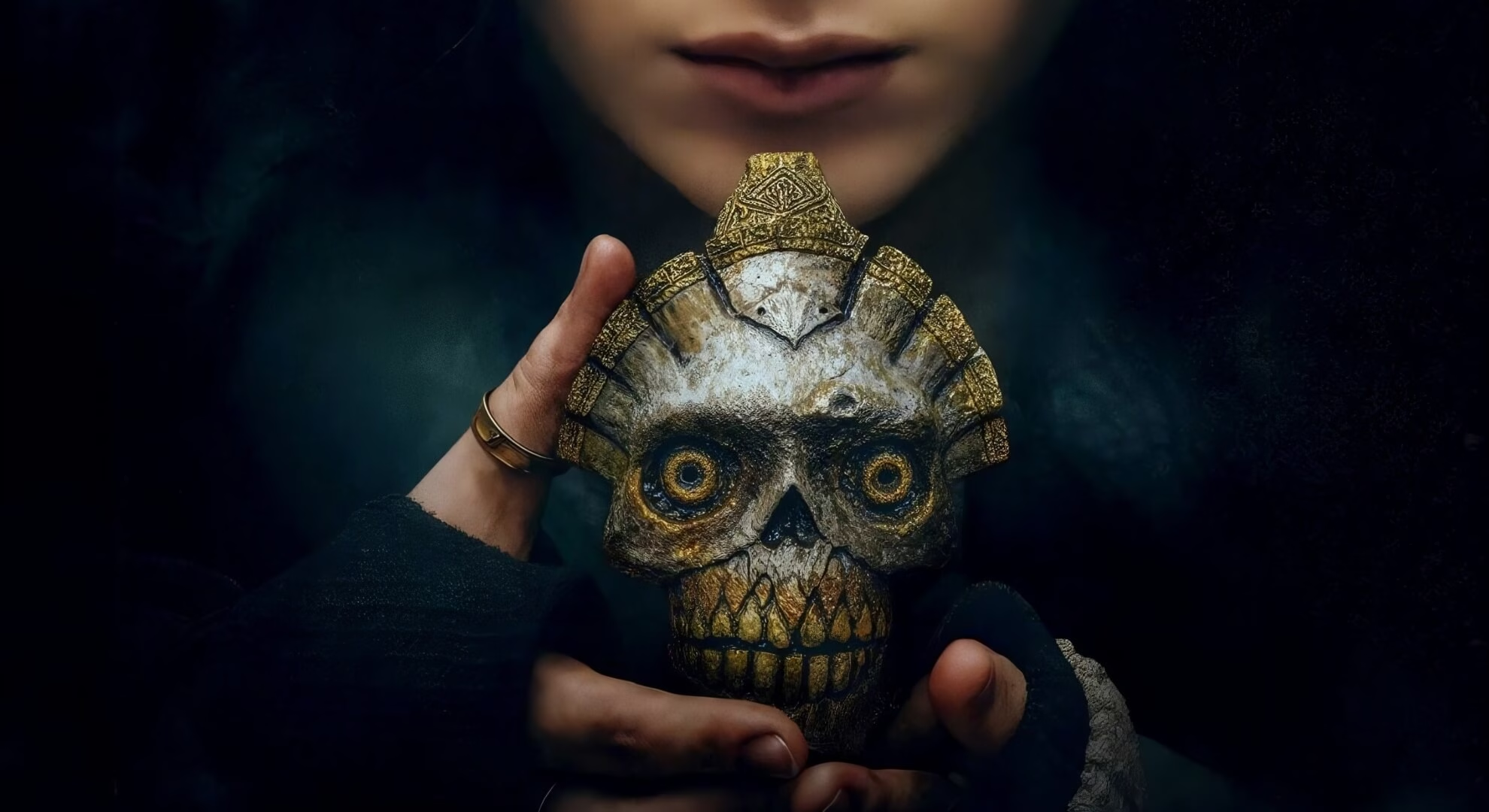


The cursed object has always been horror cinema’s most formally honest mechanism — more honest than the haunted house, more honest than the monster — because its logic admits no ambiguity about cause and effect. Something is picked up, something is activated, and the chain of consequence is irreversible.
The tradition runs from W. W. Jacobs’ monkey’s paw through Clive Barker’s puzzle box in ‘Hellraiser’ (1987) through the videocassette in Hideo Nakata’s ‘Ringu’ (1998), and in each case the object contains not a supernatural entity but a system — a set of rules that operate independently of the agent’s will or the victim’s innocence.
Corin Hardy’s ‘Whistle’ premiered on Shudder and AMC+ on May 8th, 2026, completing a distribution journey that had begun with a world premiere at Fantastic Fest in Austin, Texas on September 25th, 2025, proceeded through a limited US theatrical run via Independent Film Company from February 6th, 2026, and reached British and Irish audiences through Black Bear Pictures on February 13th.
Canadian subscribers accessed the film through Crave simultaneously with the Shudder debut. Adapted by Owen Egerton from his own short story, the film places one of the documentary world’s most genuinely unnerving artifacts at the center of an American high school horror narrative: the Ehecachichtli, the Pre-Columbian skull-shaped clay instrument known since the late 1990s as the Aztec death whistle.
The Object Before the Film
The artifact that ‘Whistle’ places in its protagonist’s hands has a documented existence that predates any horror mythology.
In the late 1990s, archaeologist Salvador Guilliem Arroyo’s excavation at the Tlatelolco site in Mexico City — at a temple dedicated to the Aztec wind deity Ehecatl — recovered the skeletal remains of a sacrificed young man buried with two small ceramic instruments in the form of human skulls.
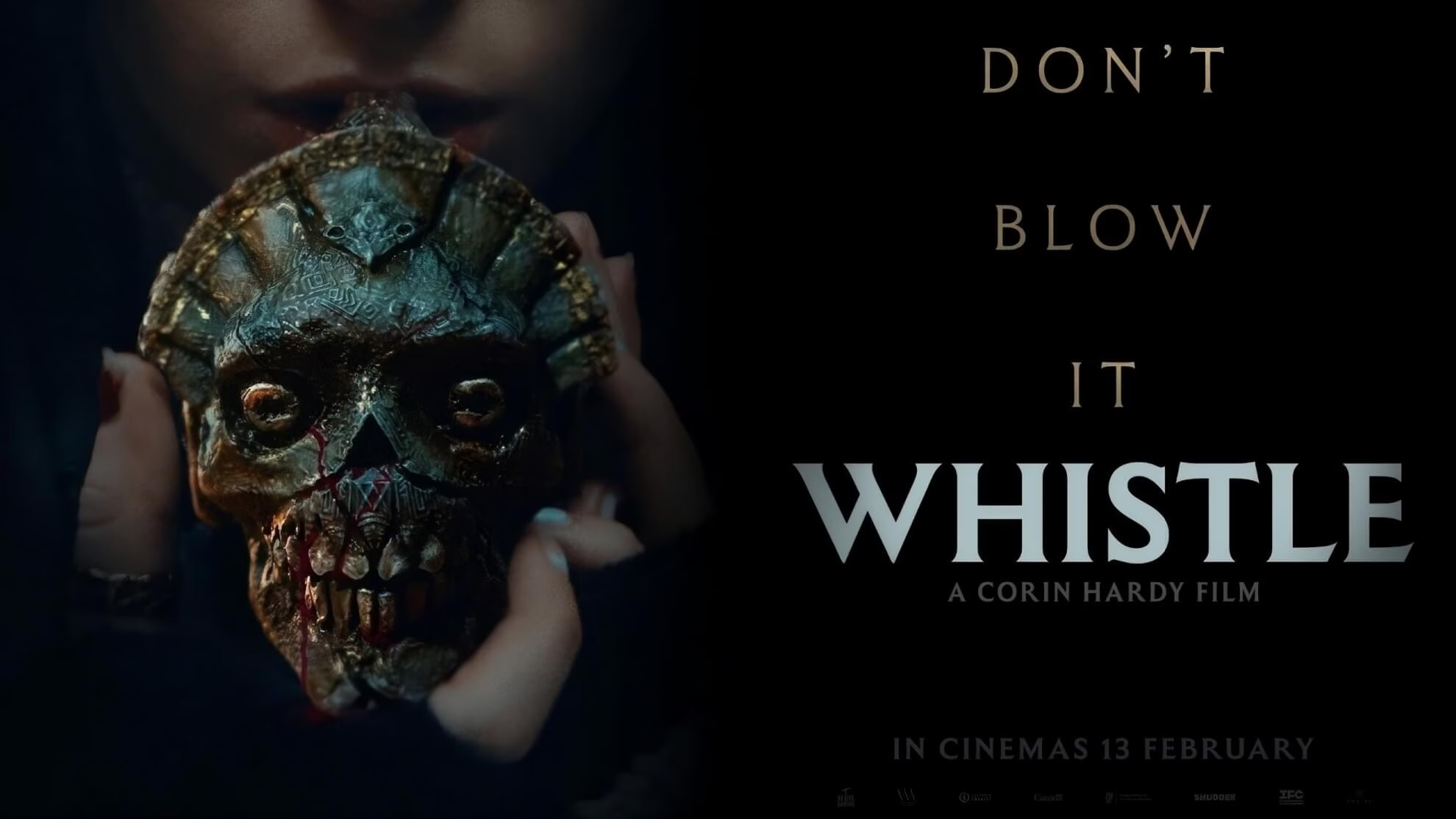
The instruments were subsequently designated Ehecachichtli, combining the name of the wind god with a Nahuatl term for a sound-producing instrument; their association with both Ehecatl and Mictlantecuhtli, the deity of death, is documented in the iconography of the ‘Codex Borgia.’1
Music archaeologist Arnd Adje Both, of the Free University of Berlin, was granted access to the original excavated whistles in the early 2000s and was the first researcher to play them.
What he found was not the shrieking sound that would later spread through internet replica demonstrations: the original instruments produced a soft, atmospheric sound — described by Both as resembling the howling wind of the underworld rather than any human scream — consistent with their ceremonial function and their association with a wind deity.
The screaming replicas — manufactured from photographs and acoustic deduction rather than direct study of the originals — circulated through artifact forums, YouTube channels, and acoustic horror communities across the 2010s, generating the instrument’s current viral reputation. What the internet knows as the Aztec death whistle is, in a precise sense, a fabrication built on the shadow of the actual object.
It is this version — the replica version, the internet version — that Egerton’s screenplay and Hardy’s film inherit. ‘Whistle’ is the first mainstream horror production to center a full curse mythology on the Ehecachichtli specifically, which makes this inheritance worth understanding.
The Instrument and the Brain
A 2024 study published in Communications Psychology by researchers at the University of Zurich, led by cognitive and affective neuroscientist Sascha Frühholz, represents the most comprehensive acoustic and neurological investigation of the Ehecachichtli yet conducted.2
Using CT scans and 3D modeling to reconstruct original instruments held at the Ethnological Museum in Berlin, the team generated over 270 audio recordings by sounding the reconstructions at varying air pressures. Their analysis identified three interlocking psychoacoustic properties that define the instrument’s output: broadband noise producing turbulent sounds that resemble biological distress calls; high-pitched elements that replicate the shrill quality of a human scream; and nonlinear dynamics — sudden, irregular sound bursts — that intensify the startling effect on the listener.
To test those acoustic findings against human response, the team ran seven listening experiments with 70 volunteer participants, comparing the whistle’s sounds to human screams, animal calls, and natural environmental sounds such as wind and rain.
Participants described the instrument’s output as frightening and unnatural, with the word most consistently applied being “scream.” The sounds produced intensely negative emotional reactions and a strong sense of urgency comparable to an alarm. Participants also reported a hybrid quality — partially human, partially mechanical — which Frühholz’s team connected to the documented practice across ancient cultures of encoding natural sounds within ritual instruments.
A subsequent neuroimaging study using functional MRI traced those behavioral findings into the brain. Exposure to the whistle’s sounds produced heightened activity not only in the auditory cortex but in higher-order regions including the inferior frontal cortex, medial frontal cortex, and insula — areas associated with interpreting emotional significance and symbolic meaning, rather than merely processing acoustic input.
The pattern is consistent with the brain’s response to genuinely “aversive stimuli,” and the researchers concluded that a ceremonial function was more probable than any battlefield role, given both the neurological evidence and the consistent archaeological context of ritual burial sites.
The finding that the Ehecachichtli appears to have no comparable counterpart among Pre-Columbian cultures worldwide gives its presence in Egerton’s screenplay a weight that most cursed-object horror films cannot access through fictional means.
Hardy and the Folklore Tradition
The artifact that ‘Whistle’ places in its protagonist’s hands has a documented existence that predates any horror mythology.
Corin Hardy’s position within horror cinema before ‘Whistle’ is legible as a case study in the difference between intimate genre work and franchise obligation. His debut, ‘The Hallow’ (2015), produced on a modest budget and premiered at the Sundance Film Festival, placed an English family in rural Ireland against a folk horror tradition — the Sídhe reframed as physical, biological entities capable of direct bodily harm.
The film situated itself within the documented European folk horror lineage: the natural world as active threat, ancient rural knowledge as something modernity cannot safely dismiss, and folklore rendered not as decoration but as structural load.3
‘The Nun’ (2018) operated under conditions that had little to do with what ‘The Hallow’ demonstrated Hardy could do. A Warner Bros. ‘Conjuring’-universe extension required specific iconography, a specific commercial register, and a budget commensurate with wide international release.
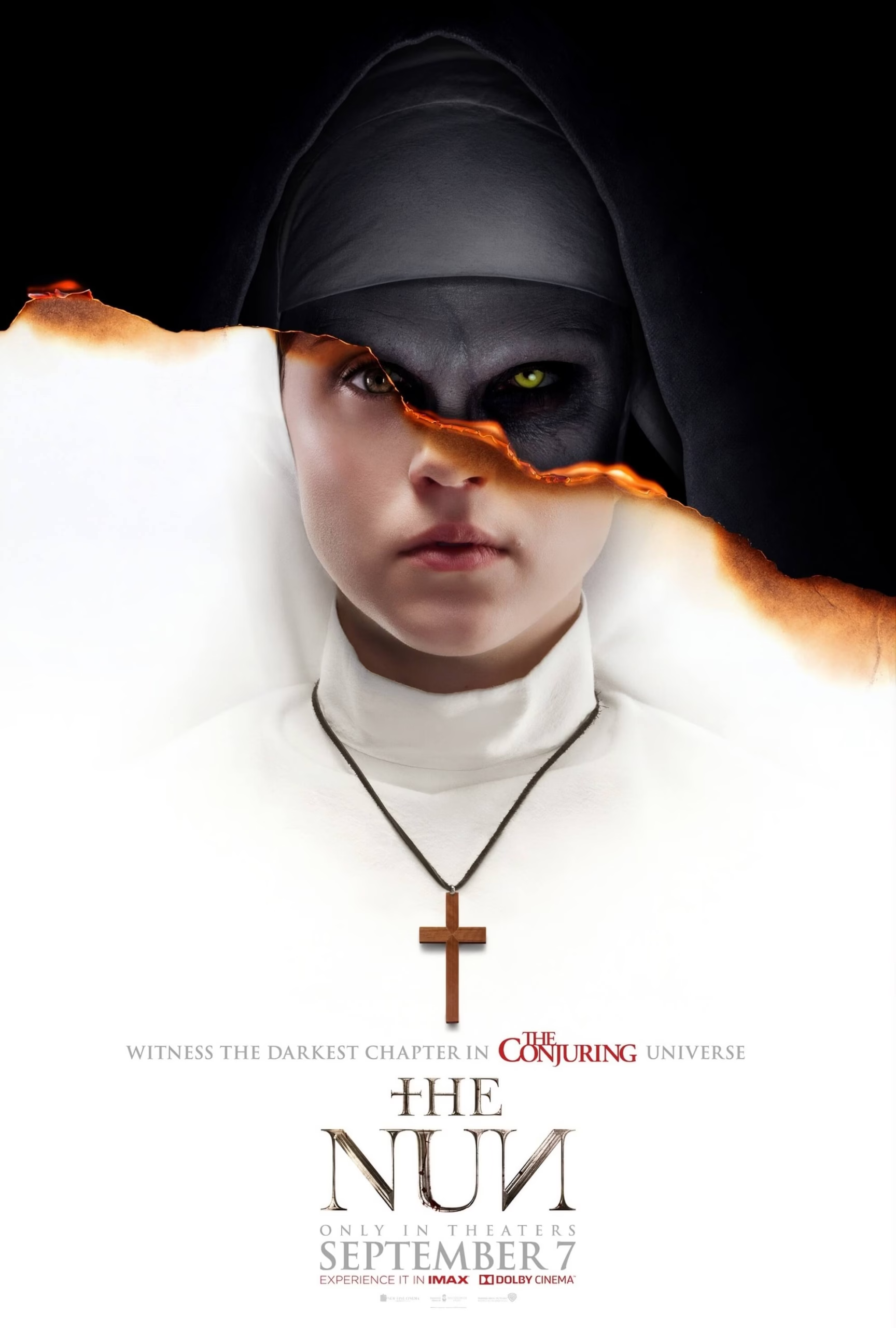
Where ‘The Hallow’ had the freedom to shape its own visual language, ‘The Nun’ was constrained by franchise iconographic requirements from the beginning. Hardy’s investment in the physical reality of folkloric threat — his facility with natural textures, practical effects, and environmental pressure — had limited room to operate within those constraints.
Between the two features, Hardy led two seasons of ‘Gangs of London’ on Sky Atlantic, expanding his command of ensemble action grammar. ‘Whistle’ arrives, then, as neither a return to pure independence nor a franchise extension, but a midpoint: assembled with IFC/Shudder distribution infrastructure that has sustained genre filmmakers outside the major studio system, yet cast with enough recognizable names — Dafne Keen, Sophie Nélisse, Nick Frost — to signal wider commercial aspiration than ‘The Hallow’ carried.
The High School Horror Frame
Hardy has stated his investment in the American high school horror tradition with considerable specificity: ‘A Nightmare on Elm Street’ (1984), ‘The Lost Boys’ (1987), ‘Donnie Darko’ (2001), and ‘The Breakfast Club’ (1985) are among the reference points he cited in pre-release interviews.4
This is a tradition with its own formal logic. The high school horror film produces its victims through hierarchy, and the supernatural threat typically functions as a literalization of the existential danger those hierarchies already contain.
Where ‘A Nightmare on Elm Street’ makes vulnerability during sleep the operative mechanism, the isolation of the outcast the condition for victimhood, ‘It Follows’ (2014) channels a similar logic through sexual transmission, and ‘Final Destination’ (2000) through the pure randomness of cheated death.
Owen Egerton’s screenplay, adapted from his own short story, works within the death-clock tradition: a group encounter with a cursed mechanism initiates an inescapable countdown, and the narrative’s forward motion organizes entirely around the characters’ attempts to understand and disrupt the mechanism.
What Egerton adds — and what connects ‘Whistle’ to the specific Mesoamerican artifact rather than any generic cursed object — is mythological precision: the whistle summons each character’s own personalized future death, the manner in which they would eventually have died had the instrument never been sounded. It is, formally, a film about foreknowledge: the horror is not that death is coming, which was always true, but that it is now visible, specific, and close.
The film is a Canadian-Irish co-production. Principal photography took place in Hamilton, Ontario from November 15th, 2023, through January 19th, 2024, on locations including Delta Secondary School, a private residence off Aberdeen Avenue, and the Rockton Fairgrounds during extended winter night shoots.
It was produced by David Gross and Whitney Brown for No Trace Camping alongside Macdara Kelleher and John Keville for Wild Atlantic Pictures, with Black Bear Pictures handling international sales. The film carries an R rating for strong violent content, gore, drug content, and some language, and runs 97 minutes.
Bjørn Charpentier’s Winter Shoot
Bjørn Charpentier served as director of photography on a production that Hardy described as prioritizing practical effects over digital augmentation. That formal commitment has consequences for what the camera documents and how it does so.
The winter conditions of the Hamilton shoot — running deep into Canada’s cold season, through temperatures that complicated equipment, lighting, and extended night work at the Rockton Fairgrounds — produce a visual character in which institutional flatness and environmental exposure coexist without resolution.
The school interiors read with the lateral, uninflected light that institutional spaces generate; the outdoor horror sequences carry the specific quality of a location that is genuinely difficult to be in.
Doomphonic’s score refuses the percussive punctuation of the conventional horror soundtrack — the stinger, the shock-cut cue, the musical announcement of the scare. What it offers instead is sustained low-register drone: sound as condition rather than event. The acoustic logic is coherent with the film’s source artifact.
The Ehecachichtli, in its original excavated form, produced a soft, atmospheric sound in the register of wind rather than impact or scream; a score that withholds stingers allows the whistle’s audio identity to carry some of that documentary weight.
The death sequences extend a formal interest that runs through Hardy‘s work from its beginning. His stop-motion short ‘Butterfly’ (2003) and subsequent music video output established a recurring visual preoccupation with bodies moved as objects — animated by an external force that behaves more like mechanism than will.
The kills in ‘Whistle’ operate in this register: characters propelled toward their deaths as if by puppetry, mortality arriving as a form of posthumous performance. The effect belongs to Hardy‘s visual grammar rather than to Egerton‘s script alone.
The death sequences extend a formal interest that runs through Hardy’s work from its beginning. His stop-motion short ‘Butterfly’ (2003) and subsequent music video output established a recurring visual preoccupation with bodies moved as objects — animated by an external force that behaves more like mechanism than will.
The kills in ‘Whistle’ operate in this register: characters propelled toward their deaths as if by puppetry, mortality arriving as a form of posthumous performance. The effect belongs to Hardy’s visual grammar rather than to Egerton’s script alone.
Keen, Nélisse, and the Ensembleot
Dafne Keen plays Chrys Willet, a transfer student whose discovery of the Ehecachichtli in an inherited school locker initiates the film’s central mechanism. Keen’s screen history — X-23 in ‘Logan’ (2017) and three seasons as Lyra Belacqua in ‘His Dark Materials’ — has established a specific quality: grounded physical intensity within contexts of escalating genre pressure, a combination that is necessary for this material but unusually difficult to cast. She carries the film’s emotional weight with the controlled economy that has characterized her best work.
Sophie Nélisse, whose extended run across ‘Yellowjackets’ demonstrated particular faculty with ensemble-based psychological pressure, plays Ellie; a developing romantic relationship between Chrys and Ellie is one of the screenplay’s more substantive investments, though the pacing of the final act compresses it.
Nick Frost plays Craven, the adult authority figure and human antagonist collapsed into a single role — a formal choice that removes one of the high school horror film’s conventional structural separations. Percy Hynes White, Sky Yang as Chrys’s cousin Rel, Jhaleil Swaby, Michelle Fairley, and Ali Skovbye complete the principal ensemble.
What the Migration of Objects Costs
‘Whistle’ is the first mainstream horror production to place a full narrative curse mythology around the Ehecachichtli specifically. The question that raises — whether consciously or not, whether the film addresses it or not — is what happens to a ritual object when it passes from its archaeological and cultural context into genre horror machinery.
The artifact was excavated from a ceremonial complex dedicated to a wind deity, associated in documented iconographic sources with Mictlantecuhtli, and identified by researchers as ceremonial rather than martial in probable function — connected to the ritual passage of the dead, not to battlefield violence or individual curse mechanics.
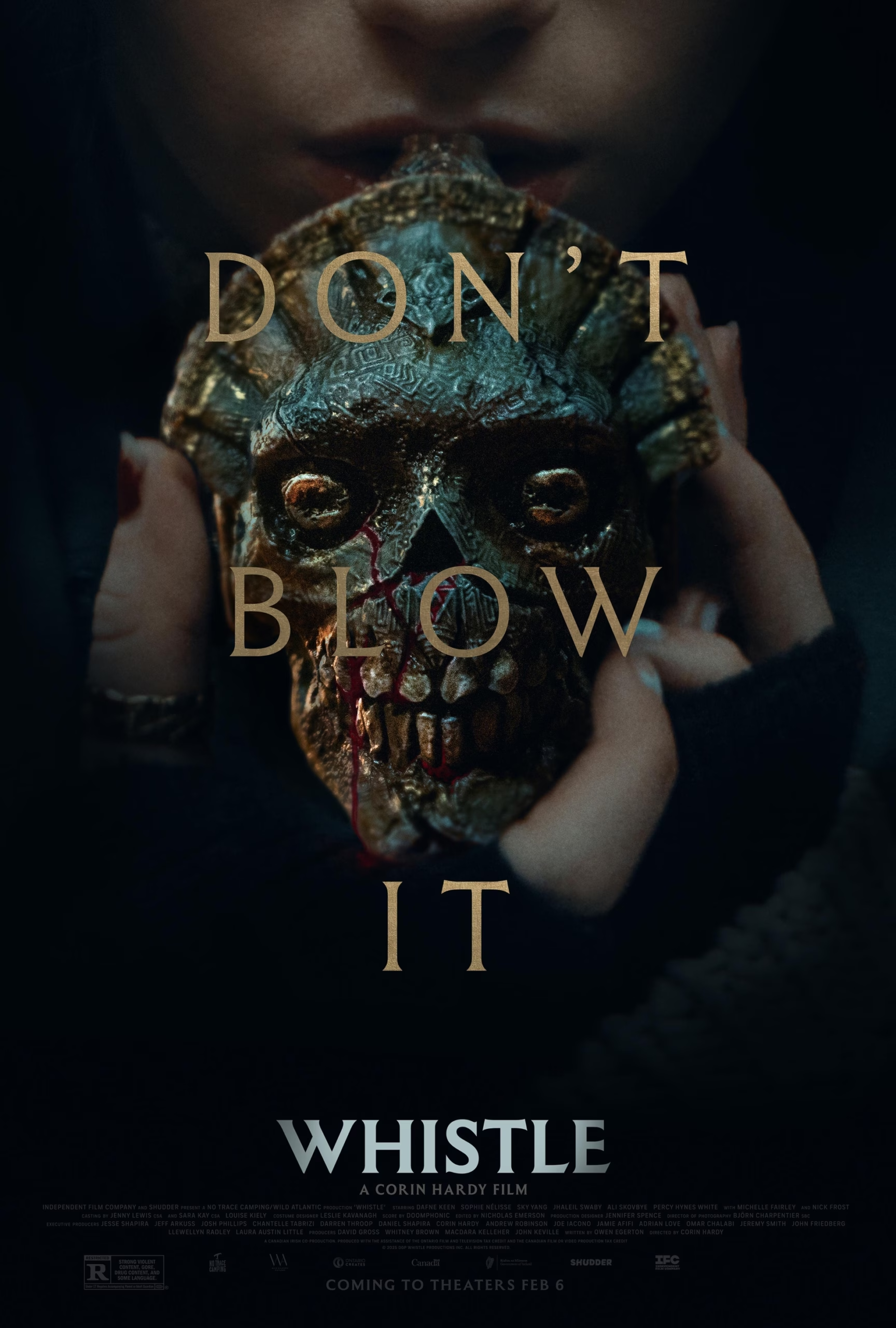
Egerton’s mythology is generative and internally consistent: blowing the whistle summons the blower’s own future death, which then hunts them through the specific manner in which they would otherwise eventually have died.
The mythology has nothing to do with the documented historical function of the instrument, which is neither an accusation nor a disqualification — horror cinema has always converted cultural artifacts into new narrative systems, from the onryō tradition absorbed into American J-horror remakes through the Universal mummy cycle’s conversion of Egyptian funerary mythology into adventure horror.
What is specific to this case is that the Ehecachichtli’s viral reputation already involved a significant mistranslation before Hardy or Egerton encountered it. The soft, wind-like sound of the original excavated instruments became the primal scream of internet replicas through a chain of approximations, reproductions, and popular circulation that had been ongoing for two decades before the screenplay existed.
‘Whistle’ inherits an artifact that had already been culturally processed at least once. Whether that compounds or dissolves the ethical question the film does not attempt to answer, and its refusal to do so is itself a position.
From Tlatelolco to the Stream
‘Whistle’ completes on Shudder the distribution arc that Fantastic Fest inaugurated in September.
The genre streaming platform’s acquisition of the US rights in May 2025 — alongside Independent Film Company’s theatrical distribution deal, which Hardy described at the time as built for the big-screen experience — made ‘Whistle’ a day-and-date release for the February 6th theatrical window, with the Shudder streaming premiere following after the theatrical and home video windows had closed. The film is now accessible to the genre audience its cast and its mythology were most directly assembled for.
The trajectory encapsulates something specific about where Hardy’s work sits within contemporary horror production. ‘The Hallow’ traveled a comparable distribution path — festival premiere, limited theatrical, specialist streaming audience — but with no commercial infrastructure beneath it.
‘Whistle’ arrives through the same pipeline with Black Bear handling international sales, Elevation Pictures distributing in Canada, and Crave offering simultaneous Canadian streaming access. The production scale has changed; the destination audience has not changed as much.
The Ehecachichtli has traveled from a temple burial at Tlatelolco to internet audio communities to Owen Egerton’s short story to Corin Hardy’s lens to the Shudder catalogue. Each translation has done something to the object, and ‘Whistle’ is honest enough — in its best moments, in Hardy’s specifically physical and puppetry-inflected death sequences, in Keen’s performance of earned rather than performed terror — to acknowledge that what it has inherited is a replica rather than the thing itself.
What a filmmaker does with that acknowledgment, and whether it constitutes a genuine engagement or merely a graceful disclaimer, is the question ‘Whistle’ leaves the viewer to carry out of the experience.
Corin Hardy’s trajectory moves from the self-contained folkloric world of ‘The Hallow’ through the franchise constraints of ‘The Nun’ to the Pre-Columbian mythology of ‘Whistle’ — how do you read his sustained investment in ritual objects and ancient belief systems as the operative mechanism of horror, and what does the specific choice of an artifact whose popular reputation is built on a mistranslation of its original sound tell us about the relationship between archaeological documentation and genre mythology?
References
- Richard F. Townsend, ‘The Aztecs,’ 3rd ed. (London: Thames, Hudson, 2009), 136—142. Townsend situates the Ehecachichtli within the ceremonial culture of the Late Postclassic period of Mesoamerica (circa 1300—1521 CE) and its documented association with the wind deity complex and funerary ritual. ↩︎
- Sascha Frühholz et al., ‘Communications Psychology 2’ (2024). The University of Zurich study combines CT reconstruction and 3D modeling of original instruments from the Ethnological Museum in Berlin, generating over 270 audio recordings for psychoacoustic analysis; seven listening experiments with 70 participants establishing the instrument’s documented capacity to produce fear responses; and fMRI neuroimaging confirming activation of higher-order brain regions associated with emotional significance and symbolic meaning. ↩︎
- Adam Scovell, ‘Folk Horror: Hours Dreadful and Things Strange’ (Leighton Buzzard: Auteur, 2017), 12—20. Scovell’s taxonomy of the European folk horror tradition — organized around landscape, isolation, and skewed moral frameworks — provides the critical context within which ‘The Hallow’ has been consistently situated in the critical literature. ↩︎
- Corin Hardy, interviewed by Robin Christian, ‘Red River Horror,’ January 29th, 2026. Hardy names the specific films that constitute his reference framework for ‘Whistle’’s high school horror register. ↩︎

Leave a Reply