

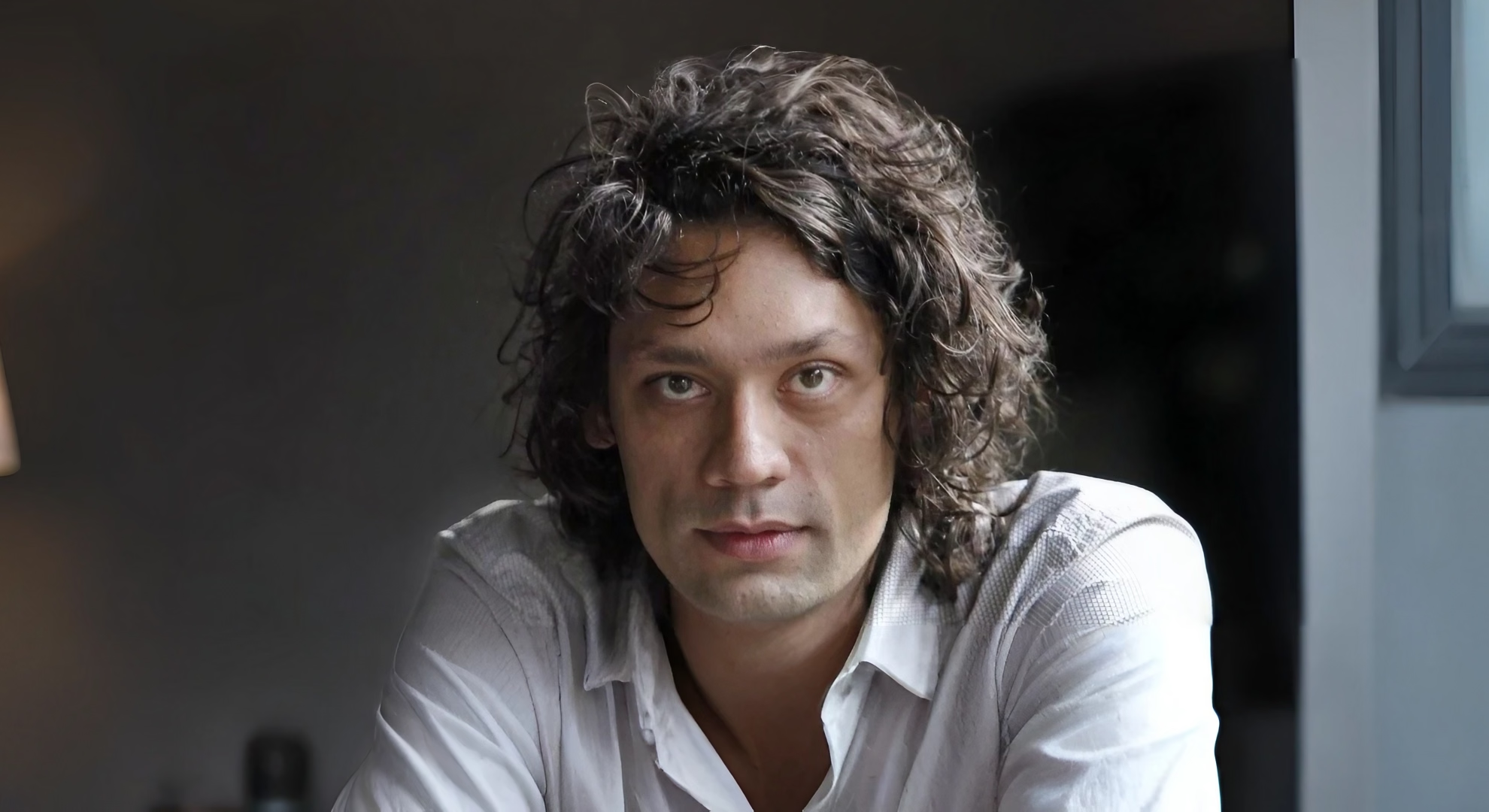
Lee Cronin was born in Dublin in 1982 and has spent his entire directorial career in the business of family horror — specifically, the horror of what happens when the domestic unit becomes a vector for supernatural contamination. His debut short ‘Ghost Train’ (2013) won the Méliès d’Argent for Best European Fantastic Short Film and announced a filmmaker whose instinct for dread operates at the level of the intimate rather than the spectacular.
His debut feature ‘The Hole in the Ground’ (2019), produced by A24 and premiered at Sundance to critical acclaim, centered on a single mother in the Irish countryside convinced her young son has been replaced by something monstrous: folk-horror organized around the terror of maternal doubt.
In 2023, ‘Evil Dead Rise’ — the fifth installment in Sam Raimi’s franchise, grossing $147 million worldwide on a reported production budget of $15–19 million — transposed demonic possession into a Los Angeles apartment block, where two estranged sisters faced the dismemberment of their family by a force wearing a loved one’s face.
The pattern is consistent across all three features: a child becomes the conduit for ancient, malevolent force; the parent is asked to recognize, and then act against, the thing that has come home wearing their child’s skin.
‘Lee Cronin’s The Mummy,’ which premiered in Los Angeles on April 9, 2026 at the American Legion Post 43 cinema and opened wide on April 17 through Warner Bros. Pictures, extends this preoccupation into one of the most venerable horror mythologies in American cinema.
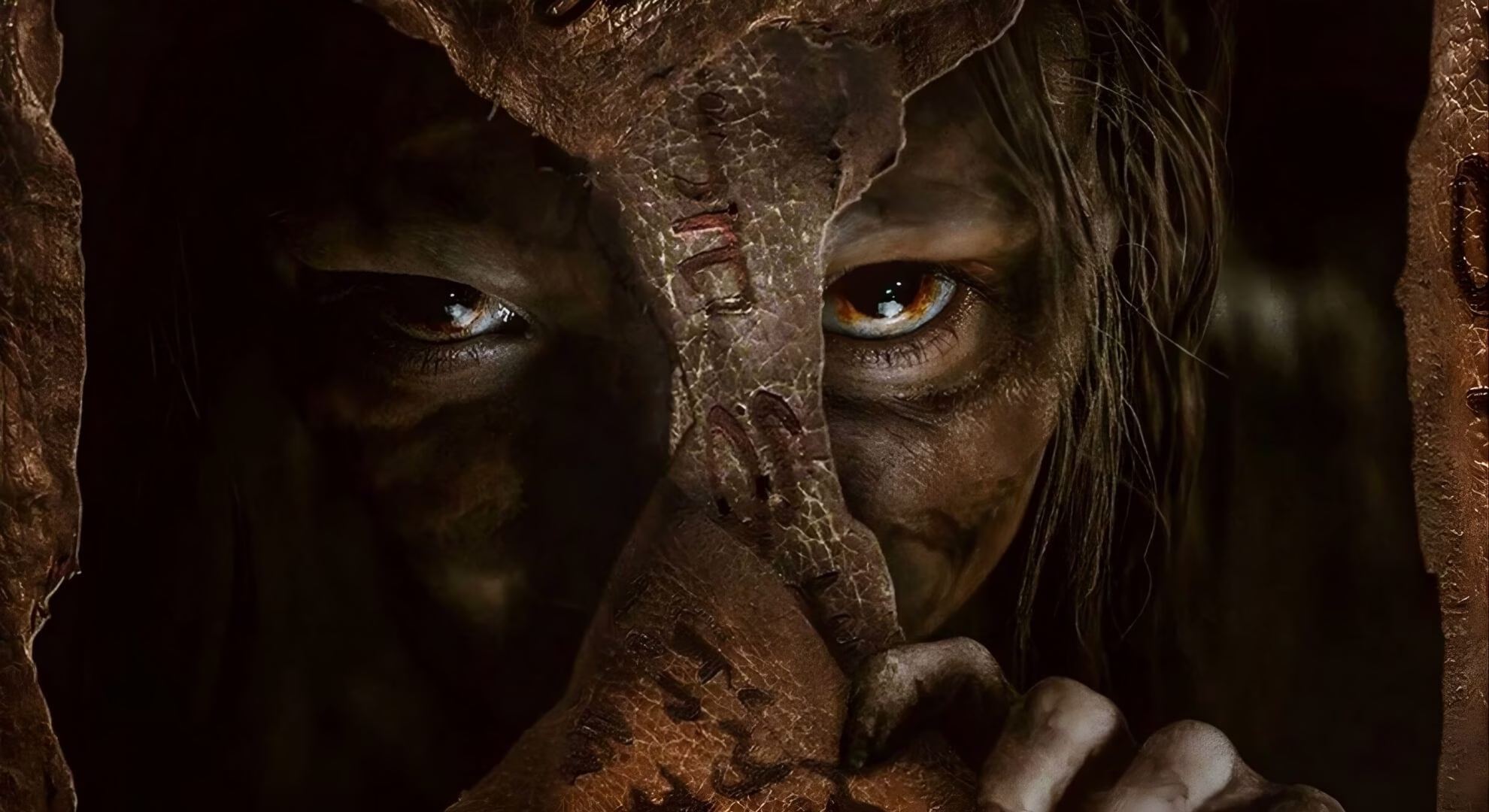
The film follows Charlie Cannon (Jack Reynor), a journalist working in Cairo, whose nine-year-old daughter Katie (Natalie Grace) disappears in the Egyptian desert. Eight years later, with the family relocated to Albuquerque, New Mexico, Katie is returned to them — found inside a 3,000-year-old basalt sarcophagus. The reunion is, of course, the beginning of a siege.
Produced by James Wan through Atomic Monster and Jason Blum through Blumhouse, with Cronin’s own Wicked/Good among the production partners, the film was designed from its announcement as a standalone reimagining — connected to no prior iteration of the franchise, neither the Universal Monsters cycle, nor Stephen Sommers’ Brendan Fraser adventure trilogy, nor Alex Kurtzman’s failed 2017 Dark Universe vehicle.
Cronin himself framed the project in an interview with The Hollywood Reporter as “one part Poltergeist and one part Se7en, but put through my lens.”1 That self-description is, in the event, more accurate than flattering. The central argument of this review is that ‘Lee Cronin’s The Mummy’ is an effective and frequently unpleasant body-horror exercise that fails as a mummy film not because of what it gets wrong, but because of what it deliberately discards: the entire mythology, historical weight, and cultural freight that make the mummy a distinctive horror figure rather than an interchangeable host for demonic possession.
Everything the Film Declined to Exhume
The Universal ‘Mummy’ franchise has a specific cultural logic that Cronin’s film elects to ignore. Karl Freund’s 1932 original, which introduced Boris Karloff as Imhotep — a resurrected Egyptian priest driven by a love transgressing three millennia — was organized around colonial desire: the Western archaeologist who cannot resist disturbing what the ancient world intended to remain sealed.2
That central tension, between the contemporary impulse to excavate and the consequences of what is unearthed, persisted through Hammer Horror’s 1959 reimagining directed by Terence Fisher, where Christopher Lee’s mummy registered as the weight of history refusing to stay catalogued.
Sommers’ 1999 adventure adaptation converted the mythology into spectacle, substituting colonial dread for swashbuckling pleasure, but preserved the figure of an ancient, named Egyptian entity — Imhotep, possessed of individual will and specific mythological motivation. Even Kurtzman’s 2017 debacle, in which Tom Cruise ran from a female Ahmanet, maintained the franchise’s interest in an individuated figure from antiquity.
Cronin’s film dispenses with all of this. There is no Imhotep, no named ancient figure with a legible mythology. There is no colonial archaeology, no excavation anxiety, no romantic transgression across historical time. What remains is an Egyptian curse that has migrated into the body of a nine-year-old girl, rendered through body horror that owes far more to William Friedkin’s ‘The Exorcist’ (1973) and to Cronin’s own ‘Evil Dead Rise’ than to anything in the mummy franchise’s century of accumulated lore.
As William Bibbiani noted in TheWrap, “Cronin’s latest is uncannily similar to his last movie, ‘Evil Dead Rise.’ Both are about families ripped apart — literally and figuratively — after a loved one gets possessed by a demon.”3 This observation carries more critical weight than its context allowed: it is not merely a surface similarity but a structural identity. The mummy mythology is window dressing. Cronin acknowledged as much in his ‘Poltergeist’/’Se7en’ framing — neither of which is a mummy film, and both of which are, in different registers, films about what enters the home.
The possessory title credit, which Cronin explained as giving the film “its own identity,” produces, in practice, the opposite effect. It distances the film from the franchise while simultaneously claiming the franchise’s brand recognition. What the title actually announces is that Cronin’s authorial signature — the corrupted child, the domestic siege, the refusal of parental instinct — has been applied to the mummy concept without absorbing the mummy concept’s own preoccupations.
The result is neither a reinvention of the mummy myth nor a subversion of it. It is simply a Lee Cronin film using Egyptian bandages as a costume.
The Film’s Achievement Against Itself
Where the film earns its rating — and, for a specific audience, its admission price — is in the sustained execution of body horror organized around Natalie Grace’s performance as the returned Katie. Grace carries the film’s most demanding physical and psychological register.
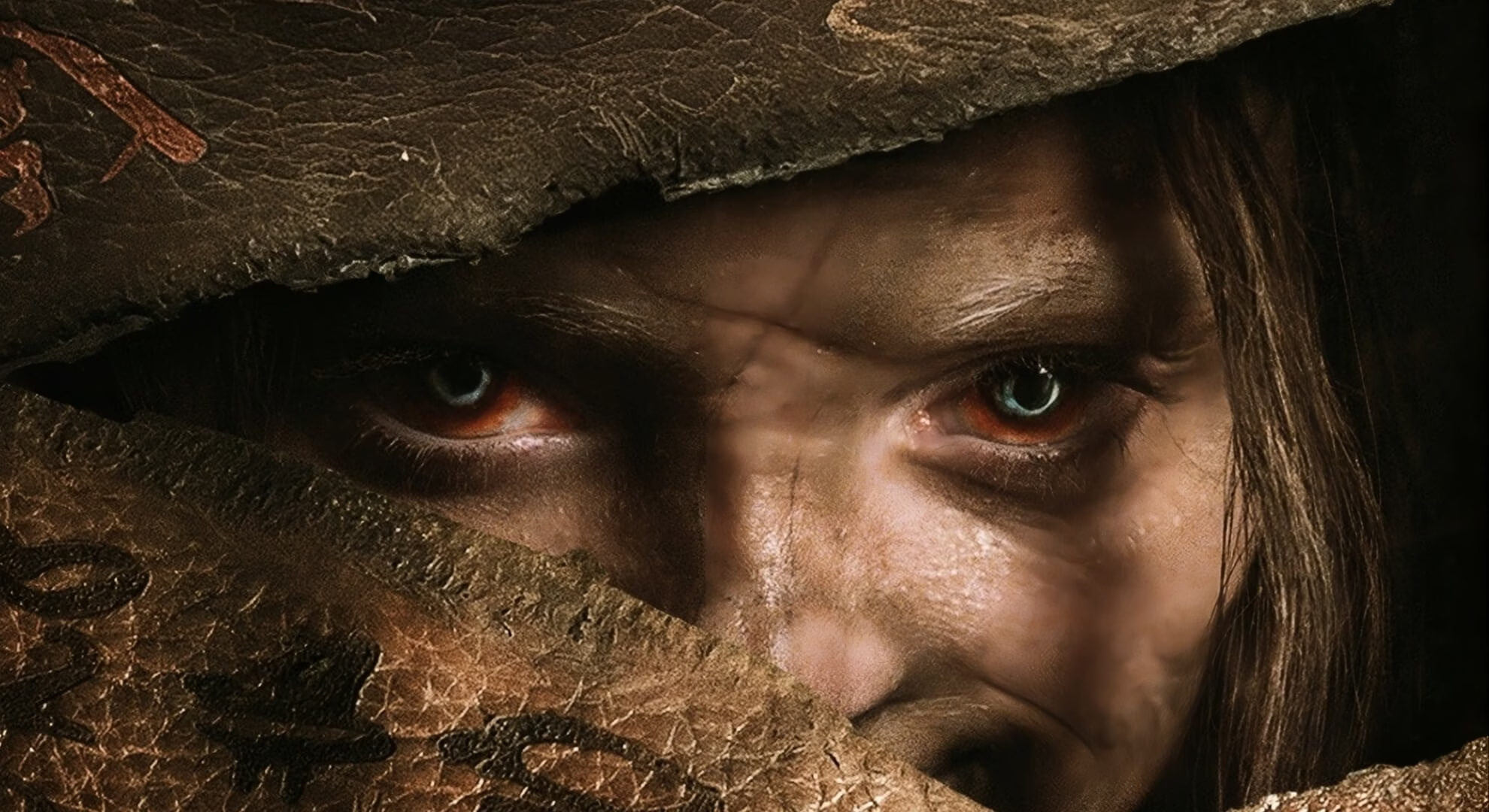
Katie is rendered less as a character than as a site of deterioration: desiccating, cracking at the joints, oscillating between vacancy and sudden explosive violence. Grace commits without reservation, and the makeup and prosthetics work — executed under production designer Nick Bassett — has crafted specific, unglamorous corporeal transformations that resist easy categorization.
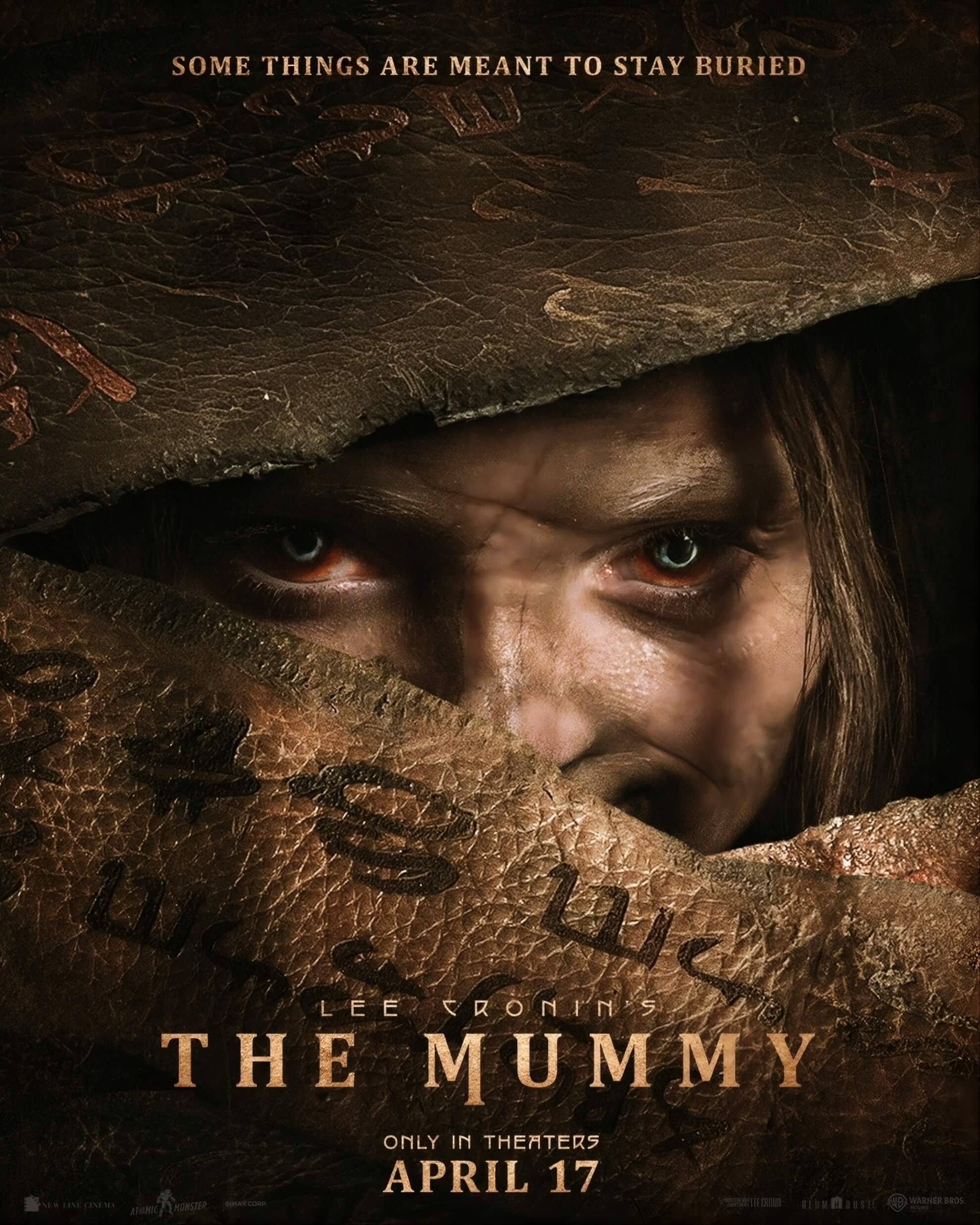
This is not demonic possession in the Linda Blair register. The decay has a texture closer to mummification: Katie is simultaneously preserved and dissolving, held in the condition between death and animation that gives the film’s body horror a specific visual grammar distinct from its obvious predecessors.
Dave Garbett’s cinematography, which reunites him with Cronin for a third consecutive feature, maintains the director’s preference for close interior framing — a camera placed within the domestic space rather than observing it from outside, so that the audience is enclosed in the Cannon family’s Albuquerque home rather than positioned to survey it.
Cronin cited the color work of ‘Breaking Bad’ as a palette reference, and this is visible in the warm amber interiors that drain of saturation as Katie’s condition worsens. It is a deliberate decision, though one that Garbett and Cronin executed with greater precision in ‘Evil Dead Rise,’ where the single apartment-block location concentrated the palette change in a more contained field.
Peter Albrechtsen’s sound design is the film’s most fully realized formal achievement. Stephen McKeon’s score deploys silence as a structural tool, allowing Albrechtsen’s work — a texture of cracking bone, wet tearing, subsonic vibration, and the specific squelch of decomposing tissue — to function as horror’s primary grammar rather than its underscoring.
Several sequences in the film’s second half are organized almost entirely around aural assault: the camera holds while the soundtrack commits the violence. As Guy Lodge observed in Variety, the film’s sound design subjects the audience to “an aural assault akin to sharing an elevator with a running angle-grinder.”4
In a film that accumulates serious charges on other formal counts, this represents a more sophisticated cinematic intelligence than the dominant critical response acknowledged. The sound design does not merely accompany the horror; at its best, it produces it.
The Scene That Should Have Been the Last
The film runs 133 minutes. ‘Evil Dead Rise’ ran 96 minutes. The difference is not productivity but discipline, and the decision — Cronin’s or his studio’s — to extend to mainstream prestige-horror length produces the film’s most consequential formal failure.
As Lodge noted in Variety, “while ‘Evil Dead Rise’ clocked in at a bracingly short, sharp 96 minutes, ‘Lee Cronin’s The Mummy’ sees the director succumbing to the more bloated template of much current multiplex fare.” The bloat is structural. Cronin has embedded a detective subplot — May Calamawy as Detective Dalia Zaki, investigating the mystery of Katie’s disappearance and the origins of the Egyptian curse — that interrupts the body-horror momentum without deepening the dramatic stakes.
Calamawy performs with precision what the script gives her, and the care taken to cast Egyptian and Egyptian-Palestinian actors in roles connected to the Egyptian setting reflects a genuine production commitment, but the investigation itself is an obstacle to the film’s declared purpose.
As Brian Tallerico observed in RogerEbert.com, “the investigation into what actually happened to Katie is a drag. The truth is, it shouldn’t matter what happened to Katie while she’s literally tearing her family apart.”5 Tallerico’s formulation locates the screenplay’s central miscalculation.
The film proposes a dramatic tension that Cronin has navigated before with considerable economy: parental love versus the evidence of contamination, the refusal to acknowledge what stands in the room. ‘The Hole in the Ground’ sustained that tension across 90 minutes of a contained, precise narrative. Here, it is repeated through multiple escalating set pieces without deepening, and without the character development that would give the repetition cumulative force.
Jack Reynor’s Charlie Cannon presents the film’s most significant performance problem. Reynor is a capable actor, and his characteristic detachment may be an intended register rather than a failure of investment, but the result is a lead whose response to escalating horror is consistently insufficient to generate dramatic investment.
Laia Costa’s Larissa is more precisely drawn: her scene during a wake, in which she tells Charlie she does not want Katie in the house anymore, carries the film’s most emotionally specific moment, the instinct of a mother fighting her own love. But the screenplay does not give the scene room to develop, and the film moves on to the next set piece before the moment can settle.
Verónica Falcón, as Carmen, and Hayat Kamille, in the Egyptian prologue, each deliver what the limited material allows; the ensemble is capable throughout, operating within a script that is more interested in physical effect than in the characters who sustain it.
The third act, which deploys escalating body horror at a tempo that eventually becomes mechanical, illustrates the specific danger of a film that has confused relentlessness with intensity. The question that any body-horror film must answer — how much is too much, and at what point does escalation become numbing — is one that Cronin addressed with greater formal intelligence in ‘Evil Dead Rise.’ Here, the answer arrives too late and with too little dramatic preparation.
The CinemaScore of C+ and the Rotten Tomatoes consensus — “the scares in this gross-out extravaganza get entombed by a padded running time” — reflect an audience and critical response that Cronin’s formal achievements in the second section of the film have not been sufficient to displace.
Cronin at the Crossroads
‘Lee Cronin’s The Mummy’ is a technically accomplished, often viscerally unpleasant supernatural horror film that achieves what it sets out to achieve — which is, by its own framing, rather less than the franchise it claims.
Natalie Grace’s performance and Albrechtsen’s sound design represent genuine formal achievements within a film that otherwise represents Cronin running the same play from a larger field and with a longer clock. The film confirms that its director is a skilled craftsman with a genuine instinct for physical dread, a command of domestic staging, and a fixed obsession with the corrupted family unit.
It also confirms that he is a filmmaker at a crossroads: whether his next project will be a further iteration of the possessed-child template or a formal departure is the more pressing question that ‘Lee Cronin’s The Mummy,’ for all its noise and viscera, leaves entirely unanswered. The name in the title turns out to be both the film’s most reliable selling point and its most revealing limitation.
References
- Lee Cronin, interviewed by Aaron Couch, ‘The Mummy Filmmaker Lee Cronin Talks the Original Ending and Test Screening Mistruths,’ The Hollywood Reporter, April 21, 2026. ↩︎
- Rick Worland, ‘The Horror Film: An Introduction’ (Oxford: Wiley-Blackwell, 2007), 83–92. ↩︎
- William Bibbiani, ‘Review of Lee Cronin’s The Mummy,’ TheWrap, April 16, 2026. ↩︎
- Guy Lodge, ‘Review: ‘Lee Cronin’s The Mummy’ Is a Long, Lavishly Gory Horror Ride,’ Variety, April 16, 2026. ↩︎
- Brian Tallerico, review of ‘Lee Cronin’s The Mummy,’ RogerEbert.com, April 17, 2026. ↩︎
Leave a Reply