
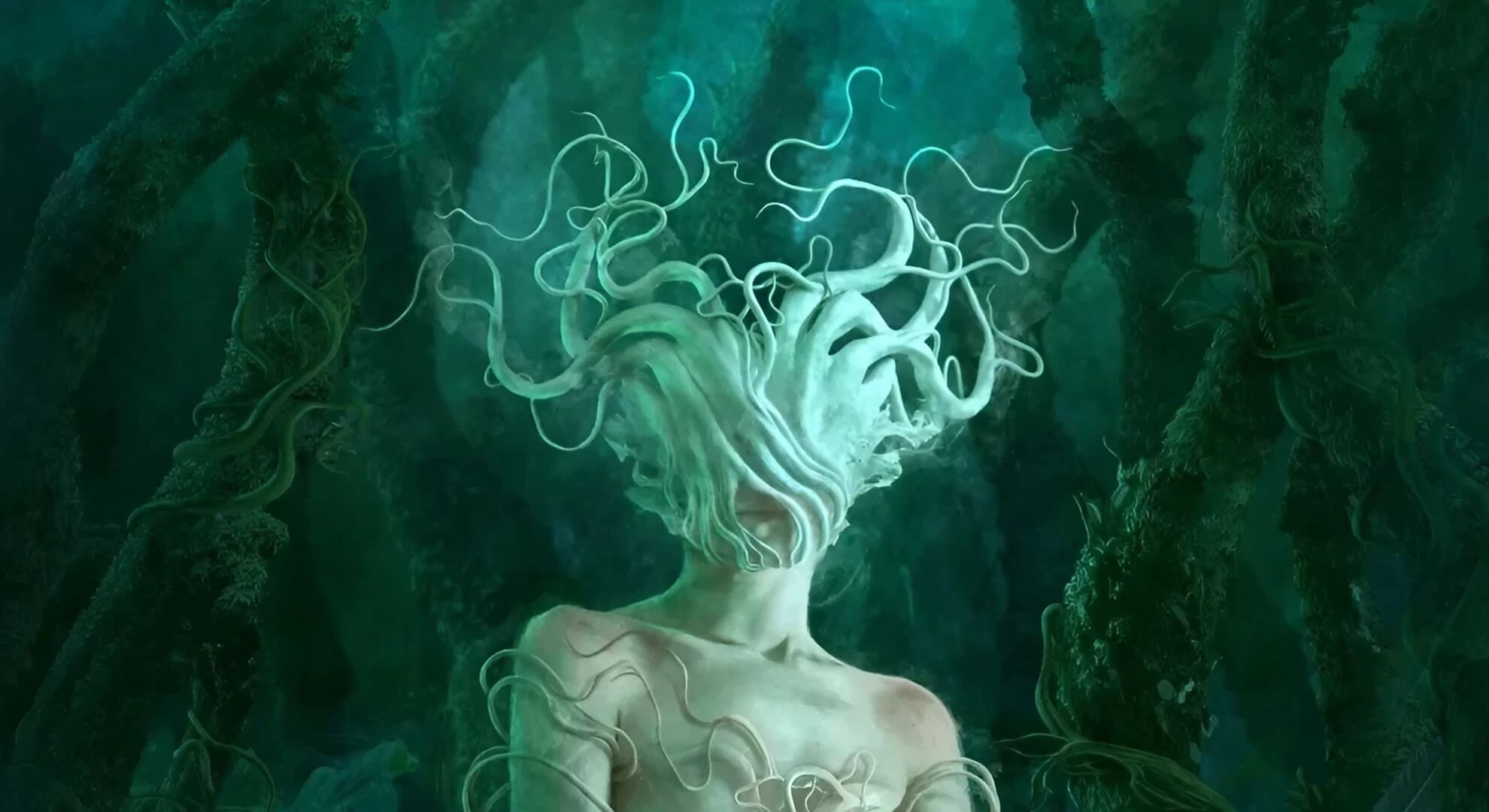


In the western Andes, where the Cauca Valley stretches between two mountain ranges at an altitude that keeps the heat both lush and bearable, plants grow in ways that make the word “growth” feel insufficient. They consume walls, reclaim roads, envelope old facades in a slow darkness that is not absence of light but the completeness of organisms that outlast whatever they surround.
There is no drama in this — only patience, and the quiet authority of things that do not require permission to take up space. Marcela Bolívar left Cali some years ago, first for a graduate programme and then for a permanent base in North Rhine-Westphalia, Germany. The vegetation followed her.
The Child Who Arrived From Somewhere Else
Bolívar was born in Curitiba, Brazil, on January 30, 1986, and came to Colombia as a young child. The crossing between two countries — one subtropical and rain-heavy, the other Andean and heat-dense in its valley floors — is not incidental background to her practice. It is its precondition.
She arrived in Cali already knowing, at the most basic sensory level, that the world looked different elsewhere, that the plants pressing against her bedroom window were a specific kind of lushness rather than simply what lushness was. The child who grows up in only one place takes its density for granted. The child who arrives from somewhere else sees it.
Cali is a city that does not perform its wildness. It does not announce the mountain ranges that flank it or the river that runs through its centre. What it does, over years of residence, is saturate — the humidity seeps into clothing, the vegetation into every gap between built surfaces, the heat into the body’s sense of what is bearable. For Bolívar, growing up in the Valle del Cauca meant growing up in a place where the organic was never decorative. It was simply present, in the same way walls and roads and people were present — another order of life asserting its claim on shared space.
She trained professionally as a graphic designer — a formation that left its mark not in her style but in her understanding of how images function within designed objects. The cum laude distinction she graduated with was less a credential than a confirmation of an aptitude she already had: the capacity to think about an image not as an isolated visual event but as something that exists in relation to text, object, and reader. That understanding would later serve her in the publishing commissions that now define a significant strand of her career. But the design education came after something more fundamental had already happened.
In 2002, when Bolívar was 16, her father gave her a digital camera with a resolution of one megapixel. It is easy now, more than two decades later, to underestimate what a one-megapixel image looked like. It was insufficient. It could not hold the detail of what she pointed it at. The world, seen through that lens, was coarser and more uncertain than it appeared to the eye.
Rather than accepting this as a limitation of the medium, she accepted it as an instruction: the camera could not capture the world she saw, so she would have to build it another way. The manipulation began in Photoshop — photographs combined first with drawings, then with hand-painted textures, then with objects she made herself. The frustration of that inadequate camera is, twenty years later, still the engine of her practice.
What the Medium Refuses to Forget
Bolívar’s working method constitutes a philosophical position as much as a technical one. She photographs her own botanical specimens — plants she has grown, acquired, or documented in the field — and scans acrylic paintings and stained papers she produces as texture layers.
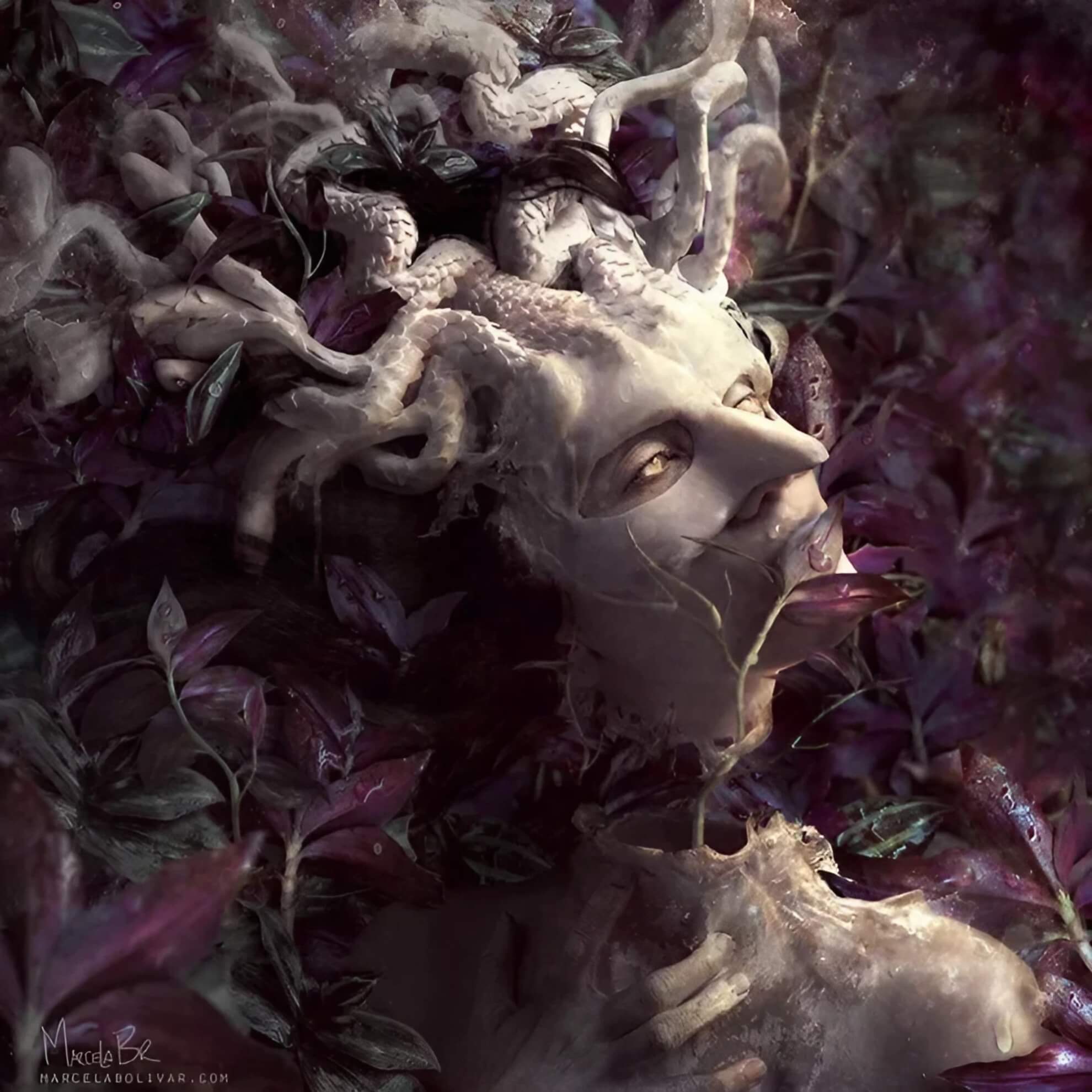
She sculpts props from cold porcelain and plaster, photographs them under controlled light, and assembles all of it in Photoshop using a Wacom Intuos. The Nikon D750 she uses to photograph her physical materials is not incidental equipment; it is the device that converts the tactile into the digital, insisting at every stage that what appears in the final image was once, in some form, a physical object in the world.
This insistence is the most important formal distinction her practice carries. The digital illustration field in which she works is populated largely by practitioners who draw directly into software, who composite from stock photography libraries, or who generate from artificial intelligence models — each of which produces a fundamentally different relationship to the image than Bolívar’s.
Her images are constructed from things that existed: real plants photographed in real light, real plaster masks cast from real moulds, real paint applied to real paper and then scanned and disassembled into layer components. The digital is the assembly room, not the origin.
Her explicit rejection of generative tools follows directly from this position. In a 2022 interview she described how artificial intelligence and unlimited stock photography make it easy for every image to look alike and for no voice to remain one’s own. The remedy she prescribed — get up from the desk, go outside, make your own resources — is a physical manifesto as much as artistic advice.
An image made from the world carries the world’s specificity. An image made from a statistical average of millions of other images carries their average. The difference, in Bolívar’s work, is not merely philosophical — it is visible.
The photomontage tradition that informs this practice was developed simultaneously as political satire and as a surrealist method for producing images the unconscious recognises before the rational mind can name them.1 Bolívar’s practice inherits both impulses. The surrealist dimension is the more active of the two: her images are not arguments about the world but reports from somewhere else, assembled from worldly materials. They do not ask the viewer to think about anything in particular. They ask the viewer to look, and to notice what looking, in this case, costs.
The Protagonist That Did Not Ask Permission
The botanical element in Bolívar’s work did not arrive by design. She has described noticing, over years, how Colombian vegetation entered her images until plants became a protagonist equal to the human figures she placed beside them. This is a significant observation: not that she decided to include plants, but that she noticed they were already there.
The distinction matters because it reframes the relationship between the artist and her material — she was not imposing a symbol but registering a presence that had made itself known.
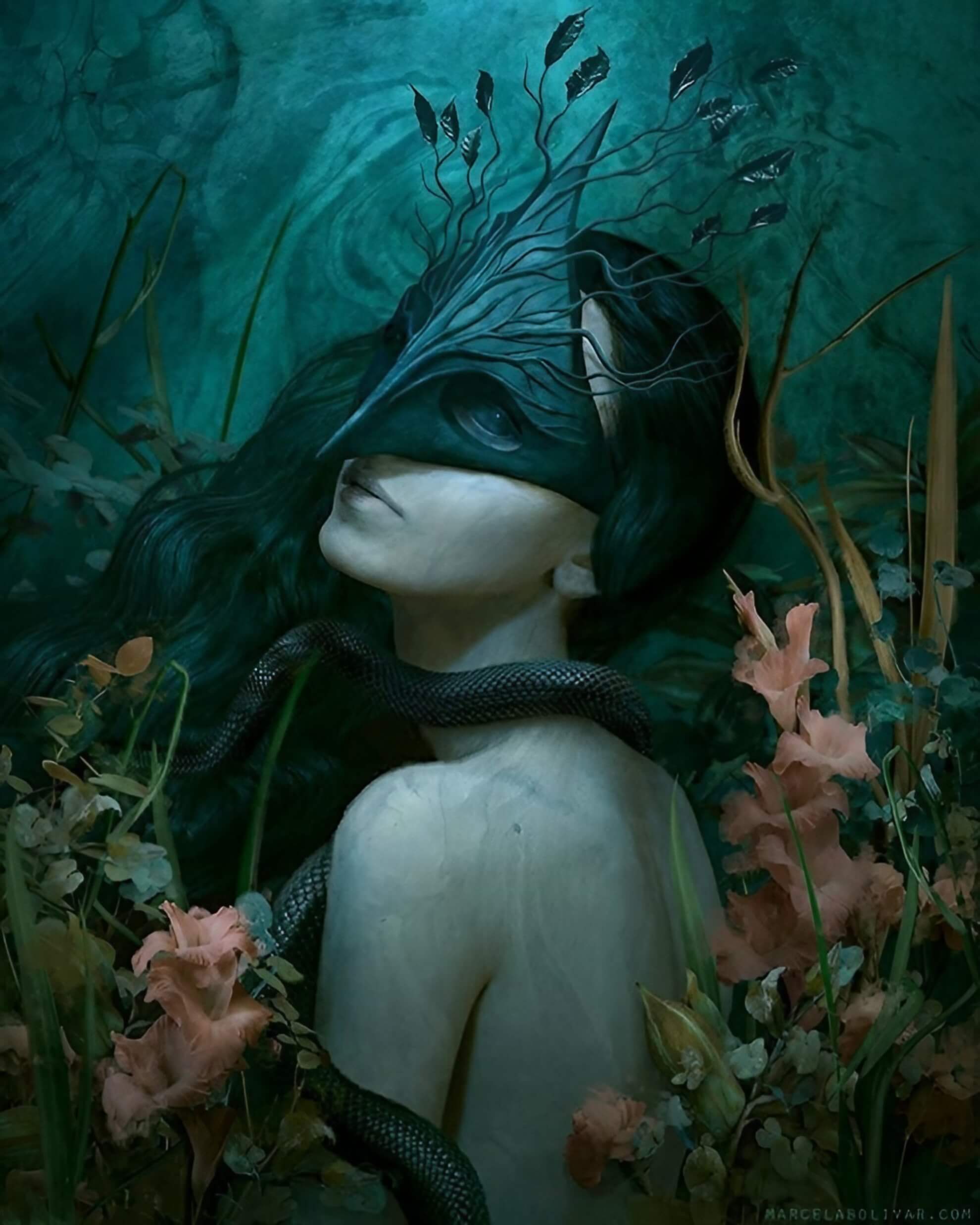
In a 2022 interview she described plants as “inscrutable, mysterious, silent but tireless beings, the very paradigm of alien lives sharing the earth with us” — the organic and irrational, everything that a human tries to control both in the civilised world and in their own being. This is a precise characterisation. Plants do not have intentions and do not experience resistance. The wall is not an obstacle to the vine; it is a surface.
They grow where conditions permit, and they do not stop when they encounter what a human would call an obstacle. This quality — purposeless, incessant, without affect — is exactly what makes plants disturbing in the context of the human body, and exactly what makes them formally useful to Bolívar.
The botanical element in the personal work is not illustrative. It does not decorate the figures it surrounds or explain the psychological states it accompanies. It is simply present, in the same way that it is simply present in the Cauca Valley — another order of life asserting its claim.
The Gothic Grammar of the Body
This relationship is rendered in deep, saturated registers — near-black greens, rich earth browns, deep crimson — from which pale figures emerge as if surfacing from soil rather than standing against it. The figures do not recede into the dark grounds; they are continuous with them. The boundary between skin and leaf, between flesh and root, is formally undecided. This is not a surrealist trick or a compositional flourish — it is the central visual argument of the practice, and it belongs to a specific tradition.
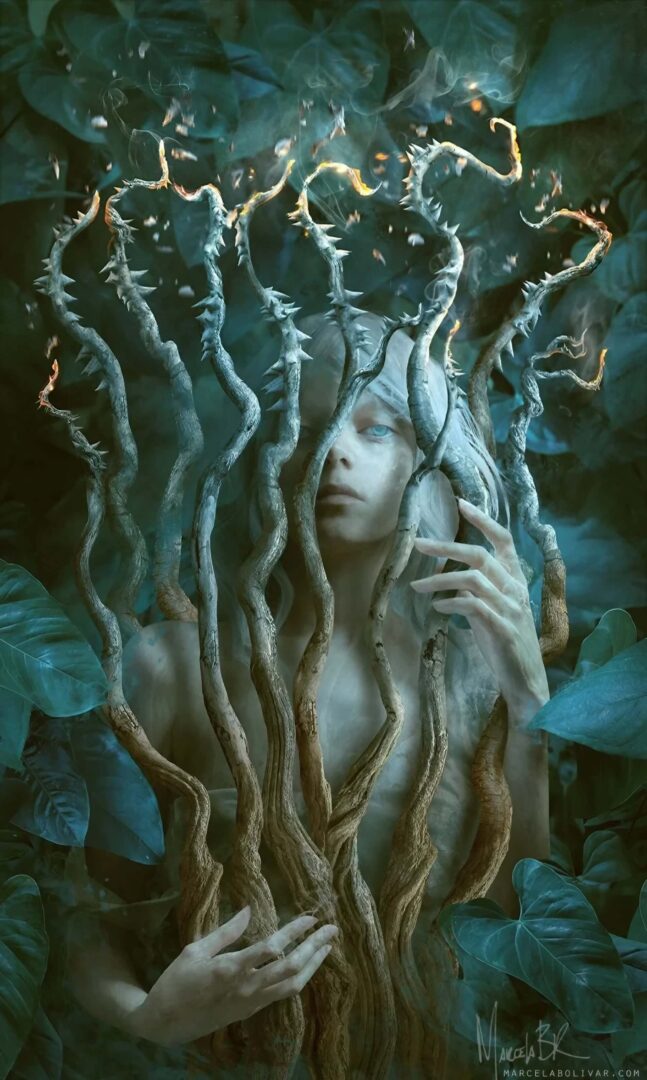
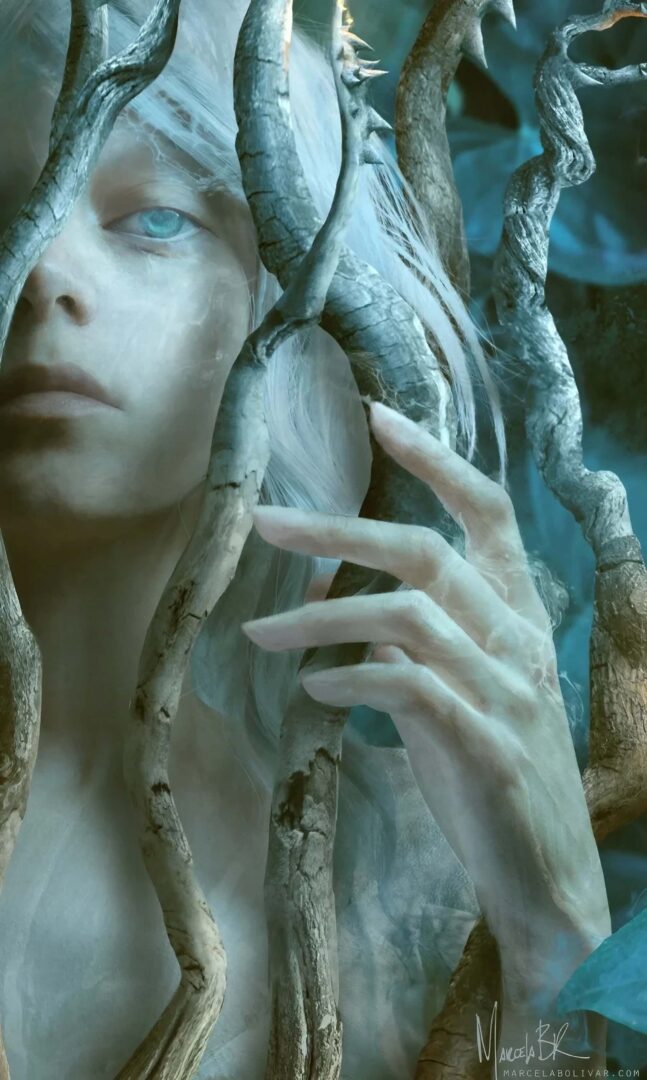
The compositional logic is gothic: the body exceeded by what surrounds it, stripped of the reassurance of a stable outline. In the Northern European panel painting tradition from which modern gothic visual logic descends — from Hieronymus Bosch’s triptych panels in which bodies merge with their torments to the Flemish grotesque in which hybrid creatures occupy the margins of sacred images — the human figure is never securely itself.2
It is always in a relationship with what surrounds it that threatens to become an incorporation. Bolívar’s work operates in this tradition precisely, and not accidentally. In a 2022 interview she described having arrived from Madrid, where she had visited a special Bosch exhibition, and noted that the impression lasted long enough to be visible in specific details of Cold Vessel — the influence precise, not ambient.
Masks and crowns recur across the personal work — hand-fabricated in plaster, photographed, and absorbed into the digital composition — each granting the body a new persona in a lineage that runs from Bosch’s fantastic assemblages to the dark illustrated fiction that now commissions her covers.
Each one represents what Bolívar has described as designing a new creature, an accessory that grants the body a new persona and a new story. The mask is a gothic instrument: it does not conceal the face so much as propose an alternative to it, one that is simultaneously more and less human than what lies beneath.
Marta Traba, whose critical writing remains the most searching account of twentieth-century Latin American visual practice, identified the tension between natural abundance and the human impulse to shape or transcend it as a defining pressure across the region’s modern art.3 That it recurs in a practice whose botanical archive spans Colombia, Central Europe, and East China is an argument not about national origin, but about an eye trained in the Cauca Valley that has never stopped seeing.
Inside Specific Works
‘Chthonic Tide,’ awarded second prize in the Digital Art Award at the Beautiful Bizarre Art Prize in 2022, makes visible something about Bolívar’s process that the finished images do not advertise. The work began with failed sketches. After abandoning methodical approaches entirely, she allowed the composition to assemble itself from her personal image bank. “I let myself be freely carried away by the creative resources around me,” she explained, “and let each of the elements come into the image without methodical thought.”
The result is dense and centripetal. A figure is positioned at the composition’s gravitational centre, submerged — or perhaps rooted — in a mass of root systems whose tonal range runs from deep ochre through near-black brown. At the image’s heart, an orb is enveloped within roots as their nourishment, cradled rather than trapped, suggesting that the relationship between the human and the organic is mutual rather than predatory.
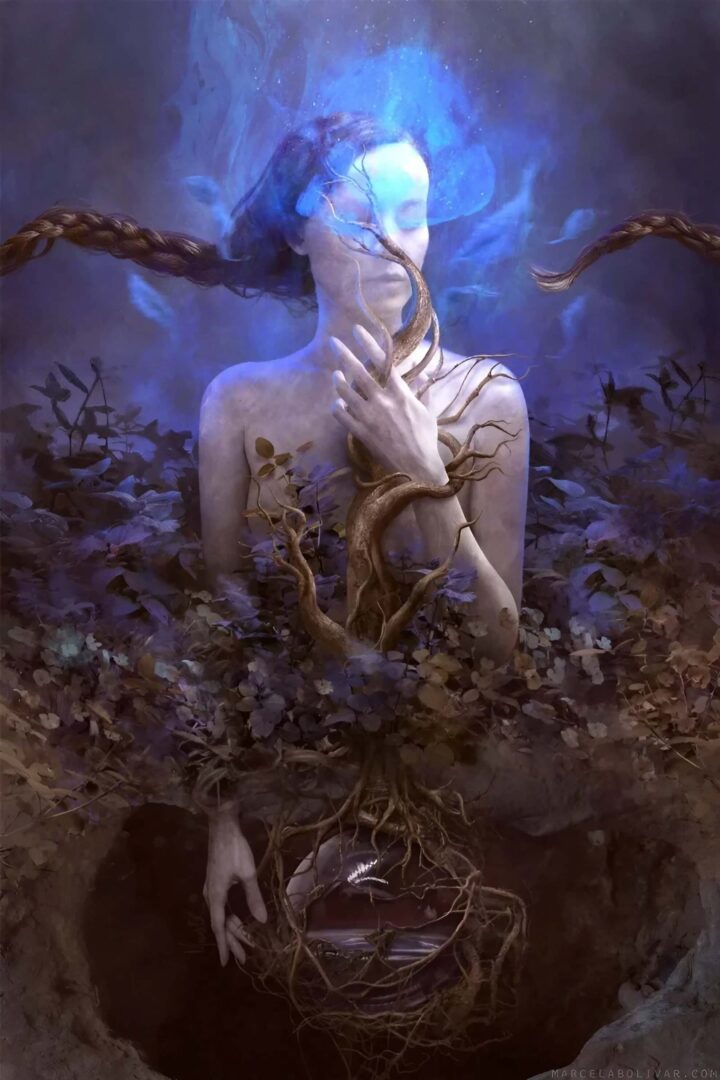
(Credit: Marcela Bolívar)
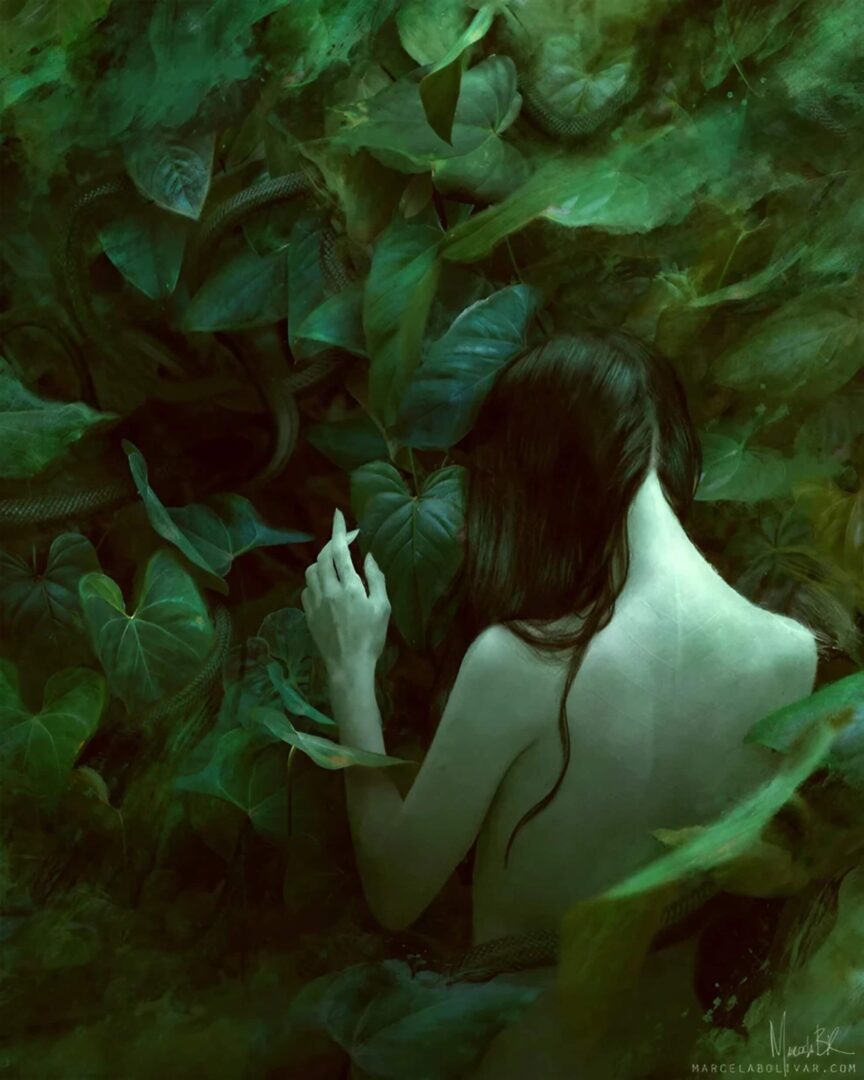
The figure neither struggles nor surrenders. It inhabits a state that the eye keeps trying to categorise — burial or germination, consumption or transformation — and that the image steadily refuses to resolve. This refusal is the work’s primary formal achievement, and it draws from subterranean forces to produce visible form: exactly the gothic logic the practice returns to most honestly.
‘Altera Natura’ — Latin for “altered nature,” which earned Best of Show at Creative Quarterly 61 — works from an archive of plants gathered across Colombia, Central Europe, and East China. Where ‘Chthonic Tide’ is dense and enveloping, the ‘Altera Natura’ works tend toward a different register: figures placed in specific relationship to botanical elements that are not overwhelming them but changing them. The plants in these images are catalysts.
A figure is not being consumed but transformed — in the process of becoming something whose category is unclear, something the gothic tradition has always found more unsettling than destruction. Pure destruction is at least legible. Transformation into an unknown category is not.
‘Abdita Vestigia,’ whose title takes its name from the Latin for traces or remnants, pursues the question of what the body leaves behind — or what remains when the figure has partially withdrawn from the image. Hothouse operates at the other extreme: the pressurised environment in which growth is forced beyond its natural rate, where the organic density is not ambient but imposed, and where the human figure must negotiate with a botanical world that has been deliberately intensified.
What the Work Does to the Body
To encounter Bolívar’s images at the size and resolution at which they are typically experienced — a screen, at close to life scale, in the backlit medium that makes digital photography simultaneously more saturated and more weightless than print — is to experience a specific kind of patience being required of you.
The images do not yield their full content quickly. The deep, near-black grounds hold detail that the eye misses in the first pass: a root system that extends further than first visible, a mask whose plaster surface bears marks that are only legible at sustained attention, a figure whose outline dissolves at the exact point where the eye expects it to firm up.
This is not a technical observation. It is the emotional argument of the work. What Bolívar’s images produce — the specific feeling they leave the viewer with — is not dread, though they operate in a register adjacent to it. It is closer to the feeling of having failed to see something important, of having looked and not quite looked enough.
The images produce a mild, productive vertigo: the sense that the ground one is standing on is slightly less stable than it appeared, that the categories one was using to order the world — human and plant, alive and inert, surface and depth — have been shown to be more provisional than comfortable. This is not an aggressive effect. It does not announce itself. It accumulates over the duration of looking, which is precisely why the work requires duration.
For the viewer who brings the practice’s full context — who knows the plants were photographed, the masks hand-cast, the compositions assembled from physical materials — there is an additional layer to this experience. The knowledge that every botanical element was once a specific plant in a specific location, that the texture layer was once paint on paper, that the crown was once wet plaster in a mould, changes the relationship between the viewer and the image.
It is not merely that these things look real. They are, in their constituent parts, real — assembled into a formal arrangement that has no equivalent in the unmanipulated world but is made entirely from elements of it. This is the photomontage paradox at its most precise: the image is impossible, but it is made of facts.
The Publishing World and What It Carries
Bolívar’s client list reads as a map of the international illustrated fiction market: Penguin Random House, HarperCollins, Simon & Schuster, Bloomsbury, Macmillan, and Scholastic Inc. among the major houses, alongside the specialist imprints — Subterranean Press, Centipede Press, Suntup Editions, PS Publishing UK, Apex Publications — that serve the genre fiction audiences for whom dark, gothic, and fantastic imagery is not a niche preference but a primary aesthetic language.
She has also produced work for Adobe and Wacom Americas, a confirmation of professional standing within the digital illustration industry itself.
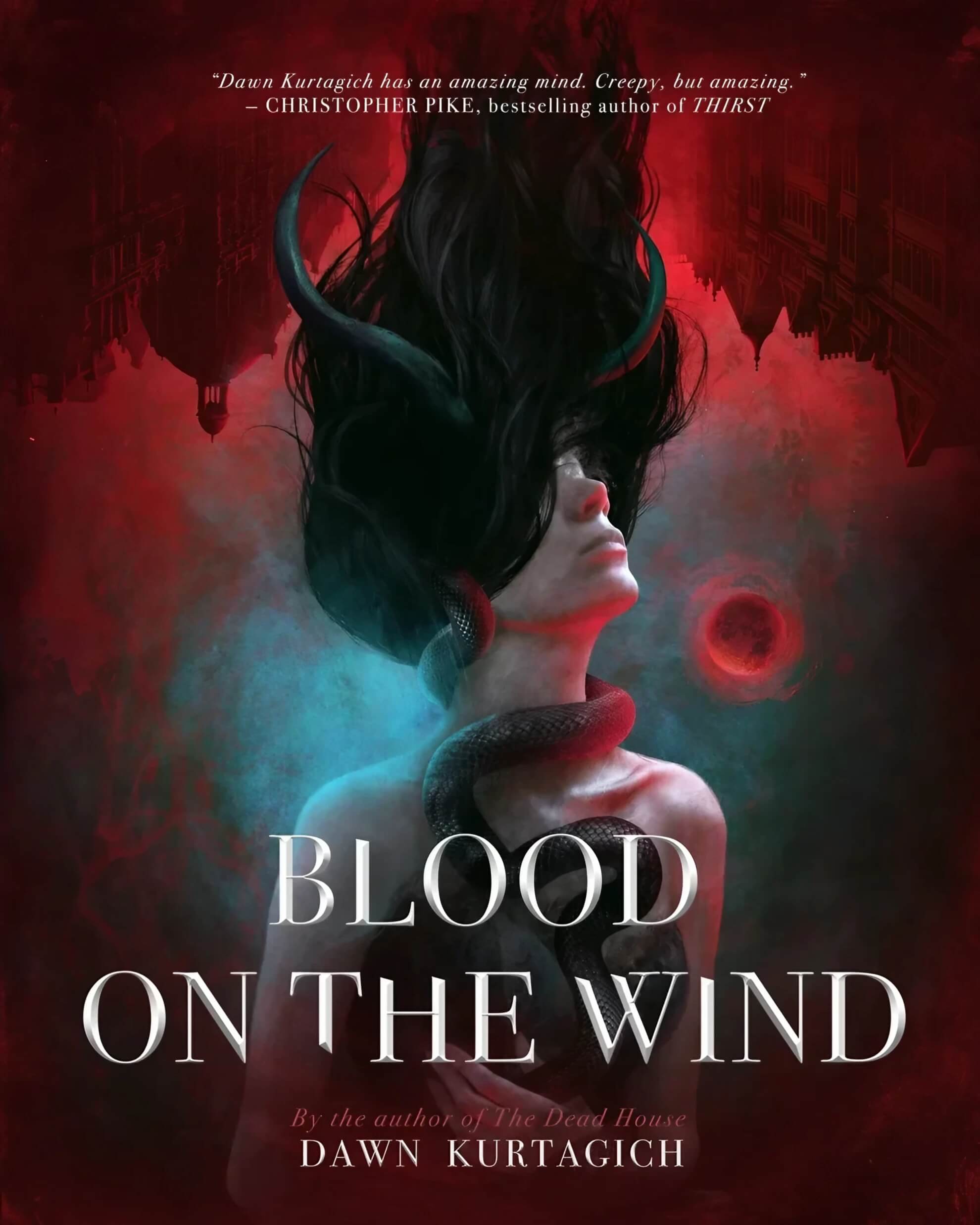
This reach is not merely commercial. It means that her images appear on books — physical and digital objects that exist in millions of homes, that readers handle and return to over years, that function as the visual face of narratives in exactly the genre tradition that Bolívar’s formal language engages most naturally. Cover illustration is a consequential form.
It shapes the first encounter a reader has with a text; it produces the mental image that persists even after the book is read; it performs cultural work that gallery-based visual art, for all its institutional prestige, rarely does at this scale. For Colombian visual culture, the fact that one of its most formally sophisticated practitioners is also one of the most visible image-makers in international genre fiction is not incidental. It is an argument about where cultural impact actually accrues.
The awards that frame this practice confirm its standing at multiple institutional levels. The Jury Selection at Illustrators 65, hosted by the Society of Illustrators in New York — one of the oldest and most respected illustration institutions in the world — places her within a tradition that runs from editorial illustration to book cover art to fine art practice.
The Chesley Award nominations — for Best Monochrome Work: Unpublished in 2017 and Best Cover Illustration: Hardcover in 2018, from the Association of Science Fiction and Fantasy Artists — place her within the genre tradition specifically.
The Adobe Creative Residency Community Fund in 2020, the Juror’s Award (First Place) at PhotoPlace Gallery Vermont in 2016, and the first-place recognition in the School’s Forum category at Marea Digital 2013, hosted by the Universidad de Palermo in Buenos Aires, trace a trajectory from early career institutional attention to sustained international recognition.
What these awards share is not their prestige but their diversity: they confirm that Bolívar’s practice is legible and valuable across multiple critical frameworks simultaneously.
The German Chapter
The move to Germany in 2017 was not a departure from the Colombian formation but its completion under different pressure. Bolívar enrolled in a master’s programme in photography at the University of Applied Sciences and Arts Dortmund, in North Rhine-Westphalia — a programme whose rigour, she has said, pressed her understanding of image-making to a theoretical depth the preceding career had not demanded.
The thesis project that emerged from that programme was ‘Altera Natura.’ It is worth pausing on this: her most formally complex series, and the one most directly concerned with the altered relationship between the human and the plant world, was produced under academic conditions, in a German city, from a photographic archive that began in Colombia and expanded into Central Europe and East China.
The conditions of the MA — the institutional pressure to articulate what the work was doing and why, the encounter with a photographic tradition that in Europe carries different critical freight than in Colombia, the specific experience of being far from the Cauca Valley while making work that depends on it — produced what she described as, at the thesis’s end, “a raw urge to create in a purely hedonistic and daydreaming state of mind.”
This is a precise report from a specific moment: the relief of having satisfied an institutional demand and the return to practice as a free formal act. ‘Chthonic Tide,’ with its deliberate abandonment of methodical approaches, appears to be a direct response to this experience — the work made in the aftermath of the thesis, from what accumulated during the constraint.
Germany also changed what it meant for Bolívar to be a Colombian image-maker in a specific way. Distance from the Cauca Valley concentrated rather than diluted the vocabulary it had given her. The plants she now photographs in Central Europe and East China are not substitutes for the Colombian plants of her formation; they are evidence that the eye her formation produced keeps seeing in the same way regardless of what it points at. The botanical archive she maintains is not a record of Colombian flora. It is a record of what a Colombian-trained eye finds significant wherever it travels.
What This Practice Asks of the Field
The question Bolívar’s career poses to Colombian visual culture is not about national pride or international success. It is about the conditions under which a specific kind of practice becomes possible. She was formed in Cali in a period when Colombian graphic design education was strong enough to produce a practitioner with the technical and conceptual grounding to enter the international illustrated fiction market — and she was formed there at a moment when the Cauca Valley’s particular density was available to her as a formative visual experience rather than a backdrop.
The gothic thread in that practice was not borrowed from European tradition; it grew from the same Andean terrain that produced the plants. The patience of the vine climbing the facade is not different in kind from the patience the gothic tradition places at the heart of its formal logic: the body giving way, slowly, to something larger than itself.
That this convergence happened in a Colombian artist working in dark illustrated fiction, and that the resulting practice now appears on books read by millions of English-language readers, is not a coincidence to celebrate. It is an argument to understand.
The Bolívar practice currently points toward a question it has not yet fully answered: what happens when the transformation is complete? Her figures are always in process — always in the middle of becoming something that is not yet nameable. The work does not show what they become. Whether this is a formal choice or an unresolved investigation, whether the transformation’s destination is something she is working toward or something she has decided to leave outside the frame, is the question that the next body of work will have to address.
What would Colombian image-making lose if its practitioners stopped treating their own terrain as a source of formal invention and began treating it merely as setting?
References:
- Dawn Ades, ‘Photomontage’ (London: Thames and Hudson, 1986). ↩︎
- Marina Warner, ‘Phantasmagoria: Spirit Visions, Metaphors, and Media into the Twenty-first Century’ (Oxford: Oxford University Press, 2006). ↩︎
- Marta Traba, ‘Art of Latin America 1900–1980’ (Washington, D.C.: Inter-American Development Bank, 1994). ↩︎
Leave a Reply