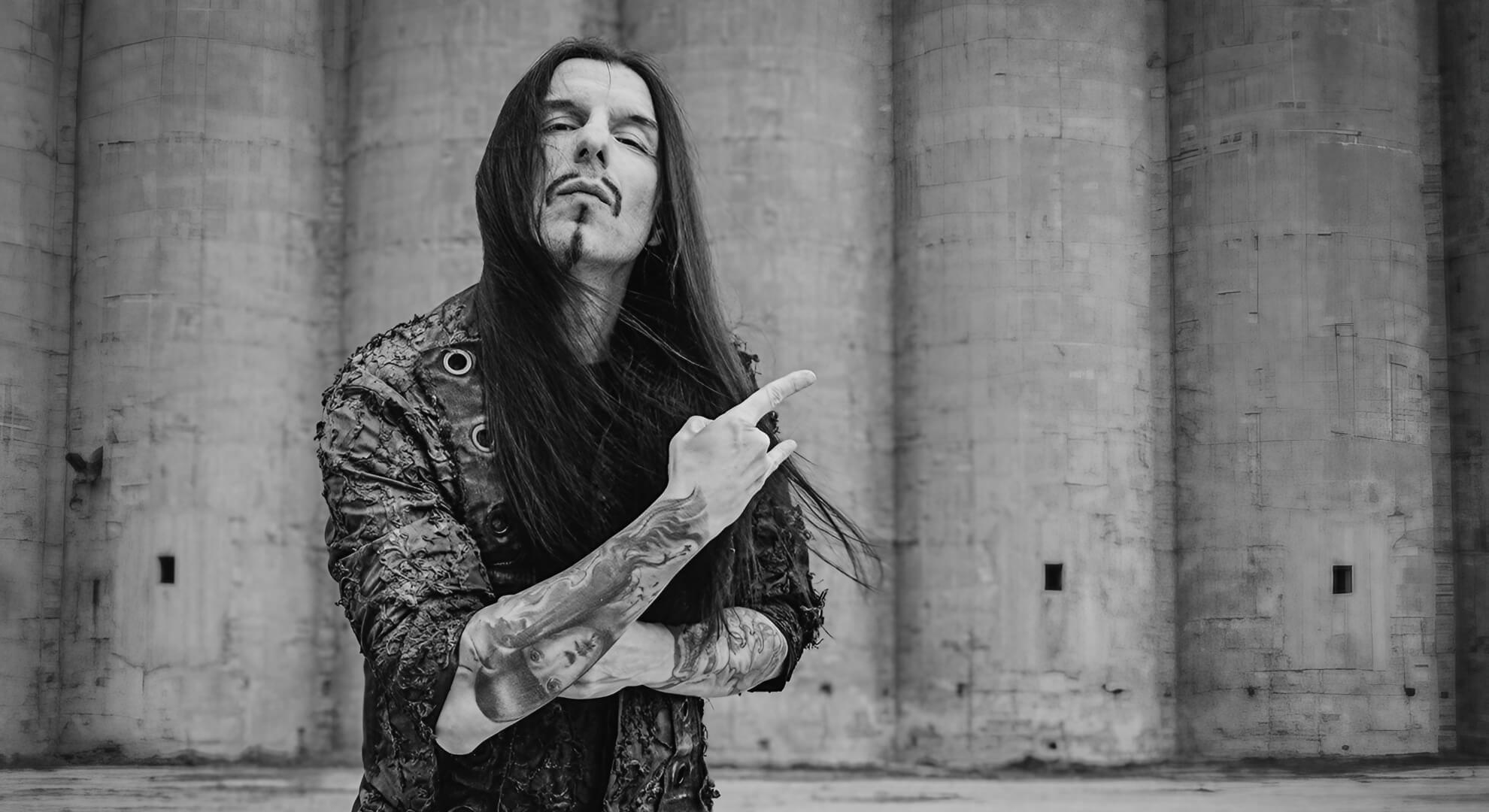


The Parthenon sits above Athens the way a persistent thought sits above a life — visible from nearly every angle of the city, impossible to encounter without some adjustment to the scale of what one considers possible. To grow up in Athens is to grow up in the presence of a mythology that is not decorative but structural: woven into the names of streets, the syllables of surnames, the moral vocabulary of the culture. The god whose name Spiros Antoniou would later borrow for his artistic pseudonym — Seth, the Egyptian god of storms, of the desert, of what lies outside ordered civilisation — would have felt less like a foreign import and more like a relative.
Athens is a city that knows its monsters, and has been carving them out of stone since before the first Christian century. Antoniou was born in that city on 24 October 1973, the final year of the military junta that had governed Greece since 1967. By the time he was old enough to hold a brush, democracy had been restored, and the culture around him was in the process of excavating what the years of suppression had cost it.
His mentor at the Athens School of Fine Arts, Dimitris Mytaras, had produced his Photographic Documents series during the junta years — a body of work that used photographic realism as a vehicle for political critique, that trusted the eye’s fidelity to the real world in order to argue against the world as it was being managed.
Antoniou does not discuss this history directly in any documented interview, and it would be wrong to construct a causal line between that political climate and the darkness of his mature practice. But the Athens that shaped him was a city simultaneously processing its own unresolved grief and surrounded, as always, by the visual vocabulary of gods, battles, and transformed bodies that the ancient world had left in stone above it. The two conditions were not separable, and they are not separable in the work.
At the age of eight, he began painting on small wooden surfaces — portraits, landscapes, objects that interested him.1 The wooden panel is not an accidental surface in the history of painting; it is the material of the Northern European masters, of Jan van Eyck and Hieronymus Bosch, of the Flemish tradition that would much later become one of the formal ancestors of the dark surrealist lineage he now inhabits.
Whether the child Antoniou chose wood for such reasons is not documented. What is documented is the impulse: something that needed to be externalised, that could not stay inside the body.
The Education of an Eye
The Athens School of Fine Arts — Ανωτάτη Σχολή Καλών Τεχνών — is not a place one enters casually. Admission requires examination, and competition is serious among those who have spent years preparing for it. In 1993, Antoniou sat those examinations and earned one of the top positions among the applicants of his year.
This is the kind of detail that is easy to pass over in a biographical summary but difficult to pass over in a serious assessment of what followed: the artist who would become identified with the underground of extreme metal entered the premier fine arts institution in Greece as one of its highest-ranked incoming students.
His first professor at the school was Dimitris Mytaras, the painter and scenographer who is now considered one of the defining figures of twentieth-century Greek art.2 Mytaras was a practitioner of a particular discipline — a commitment to the human figure drawn through naturalism and then pushed toward expressionism, a practice that moved between lyricism and violence without fully settling into either register.
The National Gallery in Athens holds his work; he represented Greece at the Venice Biennale in 1972. His teaching, by all accounts, was formative rather than prescriptive.
In his first three years under Mytaras’s instruction, Antoniou won three consecutive scholarships and received awards of Excellency in his end-of-term assessments. In his fourth and final year at the school, he pivoted. The painting workshop gave way to a sustained engagement with photography, digital processing, and the possibilities opened by Photoshop and Corel Painter. This was not an abandonment of the discipline his earlier years had built — it was its extension into a different set of materials.
He had entered a private DTP and digital design school in 1990, the same year he and his brother Christos and their friend Sotiris Vagenas founded Septicflesh. The two tracks — fine art and the underground — were never sequential; they were simultaneous. Christos Antoniou went on to study classical composition at the London College of Music.
Their parents, Antoniou has noted, supported both endeavours without reservation. The household was one where the serious pursuit of art, in multiple registers and through multiple disciplines, was simply what one did with genuine talent.
Two Names, One Practice
Between 1997 and 2009, Antoniou worked as Art Creative Director for Metal Hammer Greece. A twelve-year editorial directorship at a major music publication is not a side project; it is a professional identity, a sustained immersion in the aesthetic culture of a specific genre, and a daily negotiation between the image one wants to make and the image that a context requires.
It was during this period that his visual practice and the world of heavy metal — its imagery, its audiences, its publishers — became genuinely and perhaps irreversibly fused.
The pseudonym came before the directorship. Seth: the Egyptian god of storms, of the desert wind, of what the ordered world leaves outside its walls.3 In the Egyptian theological system, Seth is not simply a destructive figure — he is a necessary one, the force of chaos without which the ordered cosmos cannot define itself against anything.
To take his name is to position oneself at the edge of the permissible, which is exactly where Antoniou’s practice has always operated. The full pseudonym — Seth Siro Anton — compresses the civil name across a divine one, a reassignment rather than an erasure.
“I consider my art a dark portal to things forbidden, freed from the safeguarding valve of Reason,” Antoniou has written. “My works are distorting dream mirrors of the body and soul.” This is an artist’s statement, but it is also a technical description. The dream does not have to invent its strangeness; it inherits the real world’s contents and rearranges them according to a logic the waking mind cannot quite follow.
His method, as he has described it across several interviews, rests on a precise refusal. He uses Photoshop as a darkroom — not as a special-effects generator, not as a surface for filters or composite tricks that announce their own artificiality. “I never use filters or special effects,” he said in a 2014 interview. “I want to keep the originality of the work.”
What this means in practice is that the surreal quality of his images — the body that is too extended, the flesh that bleeds into non-flesh, the figure that exists inside a mythology rather than a world — is produced not by digital sleight of hand but by the careful assembly of photographed real things. Everything in the image was, at some point, in front of a camera.
What the Body Becomes
In ‘Communion,’ released in 2008 and widely regarded as the work that defined Septicflesh’s mature visual identity, Antoniou produced a cover image in which the human figure has been admitted into a hierarchy of forms that extends well beyond the human. The palette is stone grey throughout — achromatic, cool without committing to blue, a surface that reads as fired ceramic or plaster rather than flesh.
Only at the right shoulder does a faint cold tinge enter the image, and it does so so quietly that it registers as a condition of the light rather than a choice of colour. The central figure occupies the image at a scale that suggests both monumentality and vulnerability: large enough to dominate the frame, but surrounded by forms that dwarf it in kind if not in size.
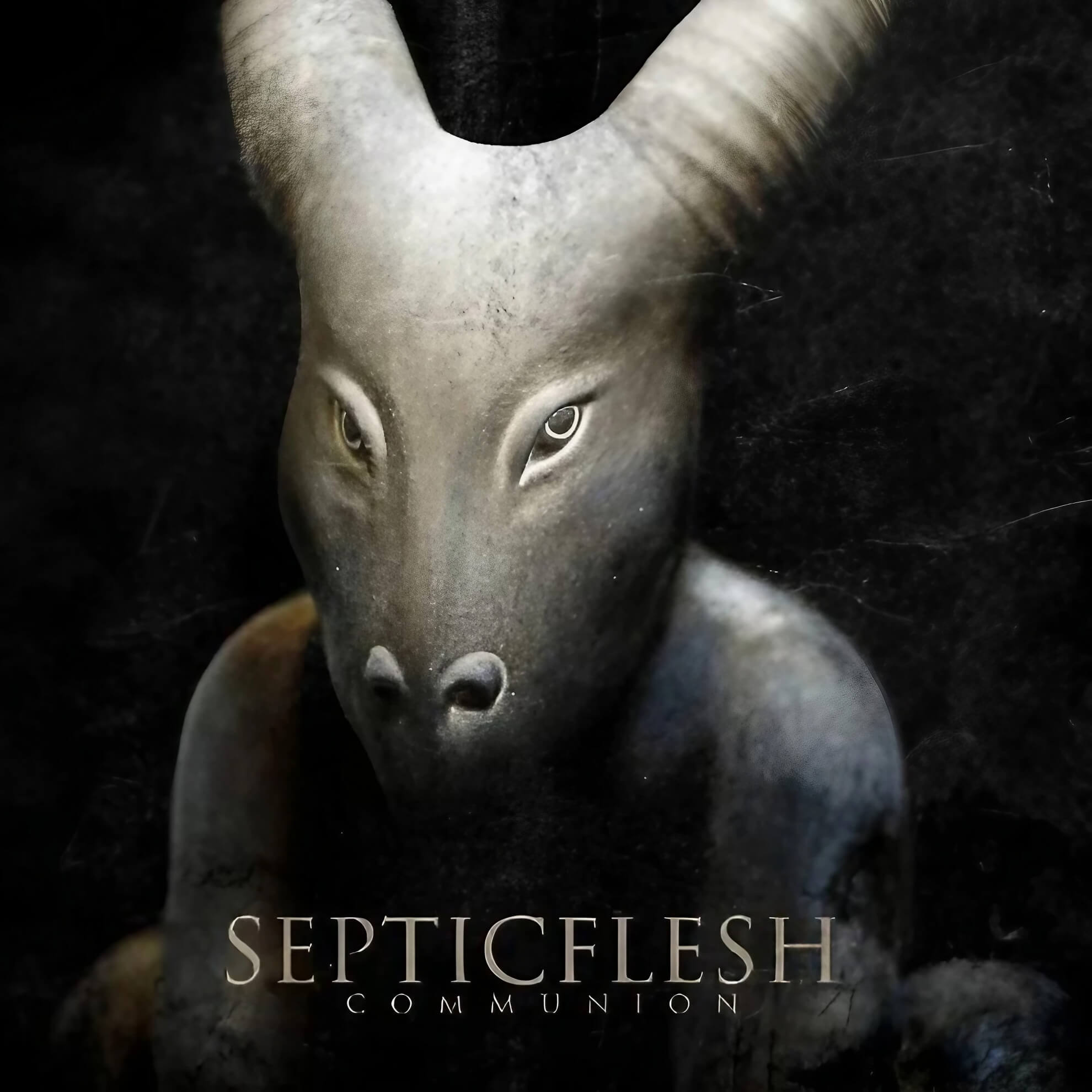
The body is not precisely intact. Its edges have become permeable, its outline less a boundary than a suggestion of where the human ends and something else begins. The image does not illustrate the album’s title so much as argue it. To commune, in the oldest sense, is to share what one holds in common with a larger body — to dissolve, at least partially, into it. That is what the figure in the image is doing, and the discomfort of it, if discomfort is what the viewer feels, is inseparable from what might be called its seduction: the figure is not resisting. The dissolution appears chosen.
‘The Great Mass,’ from 2011, represents the most explicitly sculptural of Antoniou’s major works. He referred to the central figure as “the Suicidal God” and produced the image over four months, at a complexity sufficient for the work to function as the dust jacket of a collector’s art book as well as an album cover.
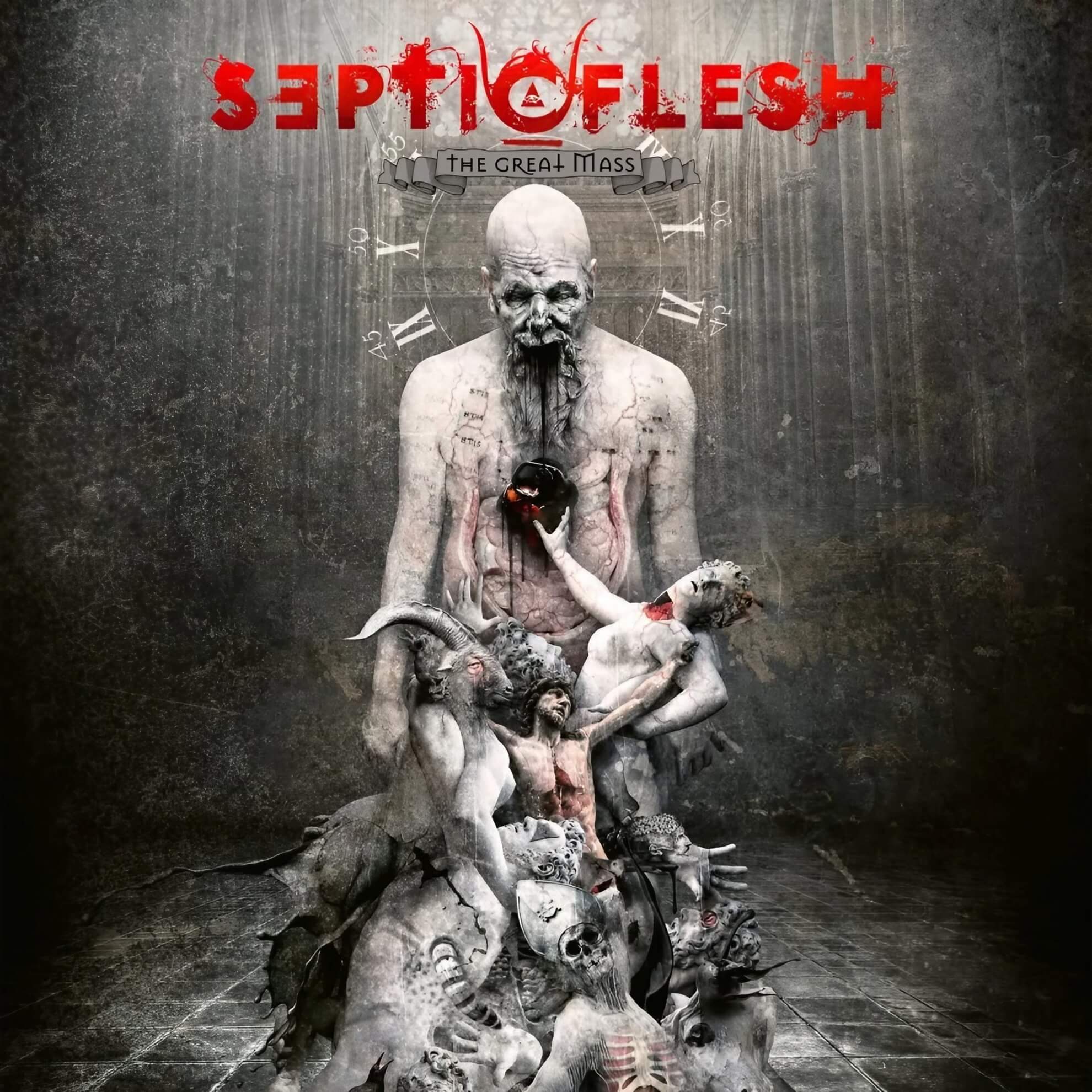
But this is not a martyr’s body. It is a god’s body, and the distinction matters formally as much as philosophically. The martyr suffers something imposed from outside; the god, in Antoniou’s image, appears to have decided. The collapsed posture reads not as defeat but as a position chosen with full awareness of its consequences. It is this quality — agency inside extreme formal distress — that separates the work from horror imagery in the conventional sense, and connects it to the longer tradition of the figure in extremis that runs from Greek sculpture through Baroque painting into the twentieth century.
A Darkness With a Pedigree
The word “gothic” is commonly misapplied to work like Antoniou’s, used as an atmospheric descriptor when it should function as a specific historical address. Gothic is a visual tradition with verifiable coordinates: the Northern European panel painters of the fifteenth century, the grotesque body in Flemish art, the Romantic sublime and its dark elaboration, the surrealist absorption of dream logic into the image.4
Antoniou’s practice does not fit cleanly inside this tradition, because it arrives at similar formal positions from a different direction — from the Mediterranean, from the classical body already in the process of mythological transformation, from a culture in which the gods have always been capable of making human flesh into something else.
What connects his work most directly to the gothic lineage, properly defined, is Francis Bacon. Bacon was himself formed partly on the Flemish grotesque tradition: he kept reproductions of Grünewald’s ‘Isenheim Altarpiece’ and used them as a formal reference, drawn to the way the painted body could be pushed to the limit of its own legibility without losing its claim on the real.5
The specific quality of Bacon’s figures — the sense that the body is undergoing something to which it cannot put a name, the flesh rendered in a register of distress that is also somehow accurate — recurs in Antoniou’s work, though Antoniou’s context is mythological where Bacon’s was existential.
Antoniou names Dalí, Magritte, and Bacon as his primary visual influences, and the logic of that trio is legible in the practice. From Dalí, the commitment to rendering the impossible with the surface precision of a Flemish still-life — the melting clock that is so accurately painted that its impossible condition registers as real. From Magritte, the understanding that the image is always an argument about the image, a proposition rather than a depiction. From Bacon, the body at the edge of what representation can hold.
Greece provides its own version of this argument, one that predates all three of those Europeans. The metamorphosis tradition in Greek mythology — the spider Arachne, the stag Actaeon, the laurel Daphne — is the longest sustained account in Western literature of the body’s capacity to become something other than what it was, and it is not a tradition of horror in the modern sense.6
It is an account of what happens when the human encounters the divine at close range. Antoniou’s images live in exactly that encounter, and it is worth noting that this tradition was not something he needed to import. It was, in the most literal sense, carved into the stone above the city in which he grew up.
What Happens to the Viewer
The critic writing for INSIDE artzine, the German dark art publication that devoted a six-page feature and interview to Antoniou, described the experience of encountering his images as a two-stage event: first, the immediate shock of the surreal content; then, after the initial register has settled, a second and more precise encounter with what the critic called “the fragile textures in the faces of the tragic actors” and “the insectoid melancholy that is unerringly established under the skin.”
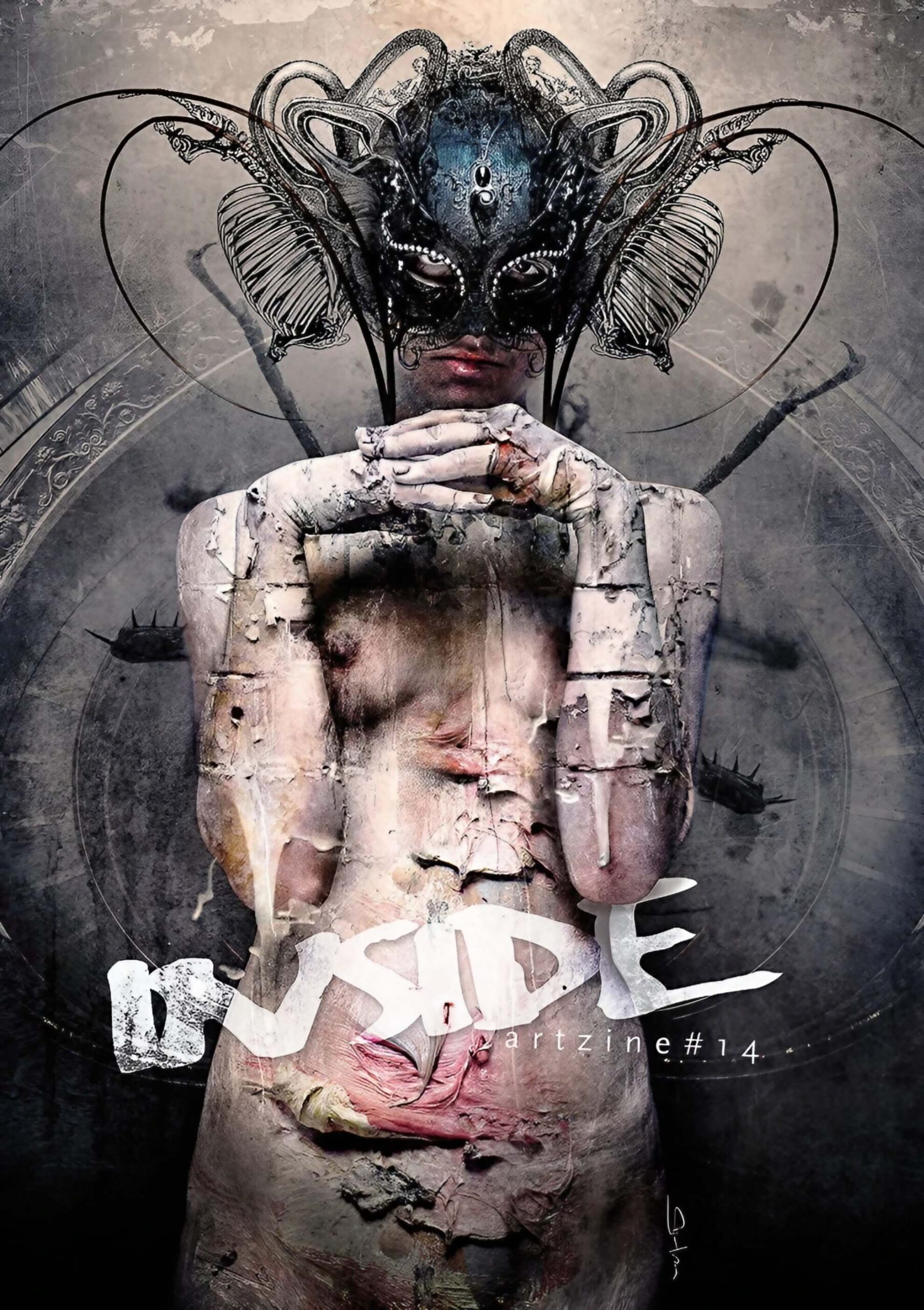
This is a useful description because it names something formal rather than merely atmospheric: the images reward sustained attention in a way that many works in the genre do not.
The photographic realism is the technical instrument of this second encounter. Because every element in the composition was at some point a real thing in front of a camera, the eye approaches the work with the same cognitive apparatus it uses for documentary photographs — an apparatus that assumes fidelity to the real before it begins to assess the image for strangeness.
The Flemish tradition that informs the surrealist lineage worked on the same principle: the painted surface so precise in its imitation of material reality that when the impossible appears within it, the eye has already committed to the terms of the image and cannot easily withdraw.
Antoniou has articulated the philosophical frame of this experience with reference to Carl Jung. “Jung defines the Collective Unconscious as the area of the soul which is infinitely older than the personal life of the individual,” he observed in the INSIDE artzine interview. “Dreams are valuable because they release the primordial chaos stored in our neurons.”7
His own stated aim is to produce the visual equivalent of lucid dreaming: the state in which the dreamer retains just enough awareness to know that what they are seeing is not real, but not quite enough to escape it.
This is a precise and honest description of what the viewer experiences. The discomfort is not the discomfort of obvious fakery but of a world that appears continuous with the one outside the frame and has quietly ceased to obey the same rules. The eye has been extended credit it cannot collect.
The Gallery and the Stage
In 2010, Spiros Antoniou became a member of the Chamber of Fine Arts of Greece — Επιμελητήριο Εικαστικών Τεχνών Ελλάδος — the legal body of public law that governs professional fine artists in the country under the auspices of the Ministry of Culture and the National Committee of the International Association of Art. This is not an honorific; it is a professional credential, a formal recognition by the Greek state that an individual qualifies as a practising fine artist. For the man who was already the most recognised visual artist in the global extreme metal underground, it placed him simultaneously inside two institutional systems that barely register each other’s existence.
Between 2003 and 2012, the exhibition record is consistent: a solo exhibition at the Vavel Exhibition Gallery in Athens in 2006, titled ‘Composition & Character’; a solo photography exhibition at Les Abattoirs Gallery in Riom, France, in 2007; a solo exhibition at the municipal photography programme in Clermont-Ferrand in 2008; a solo exhibition at the Inferno Festival Swiss Gallery in Lausanne in 2012. Group exhibitions in Athens, Nantes, Nancy, the Netherlands, and Paris over the same period placed the work in contexts beyond the metal world. In 2010, the Athens Video Art Festival at Technopolis included his work as part of its group exhibition programme.
His commercial reach is, by any objective measure, extraordinary. Album covers produced for labels including Sony Music, Nuclear Blast, Season of Mist, Century Media, and Roadrunner Records have placed his images in the hands of audiences measured in millions.
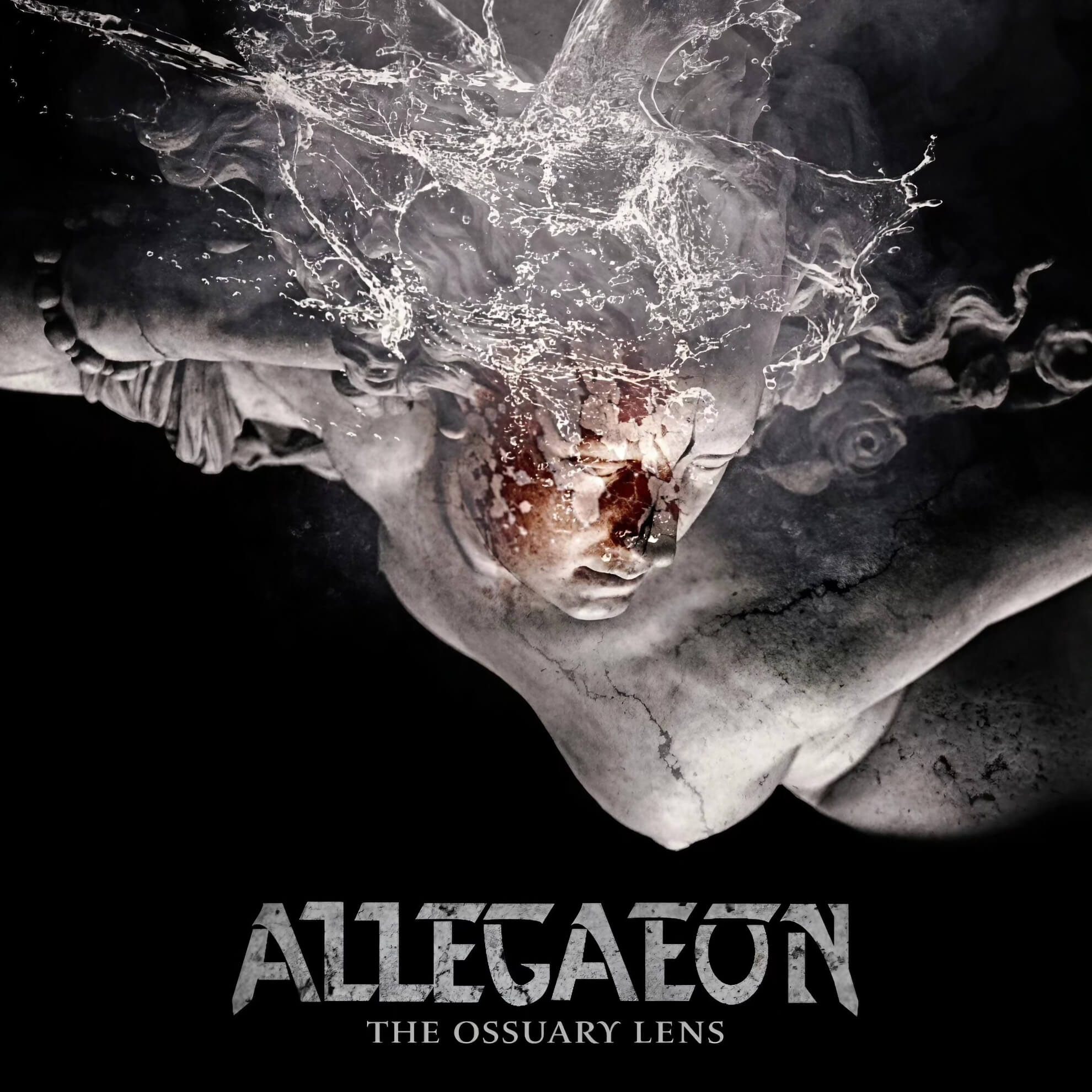
The collectors’ art book edition of ‘The Great Mass,’ printed on high-quality stock with a dust jacket reproducing the full Suicidal God composition and a poster that unfolds to 98 by 55 centimetres with cold foil printing, was treated as a cultural event within the metal press, covered by publications in Germany, France, Hong Kong, and across the English-language world. In 2025, the commission for Allegaeon’s ‘The Ossuary Lens’ confirmed that the commercial practice continues uninterrupted.
The three-album collaboration with Moonspell — the Portuguese gothic metal band whose visual identity Antoniou shaped across ‘Alpha Noir / Omega White’ (2012), ‘Extinct’ (2015), and a third confirmed commission — illustrates a dimension of his practice that the album-cover list alone does not fully convey.
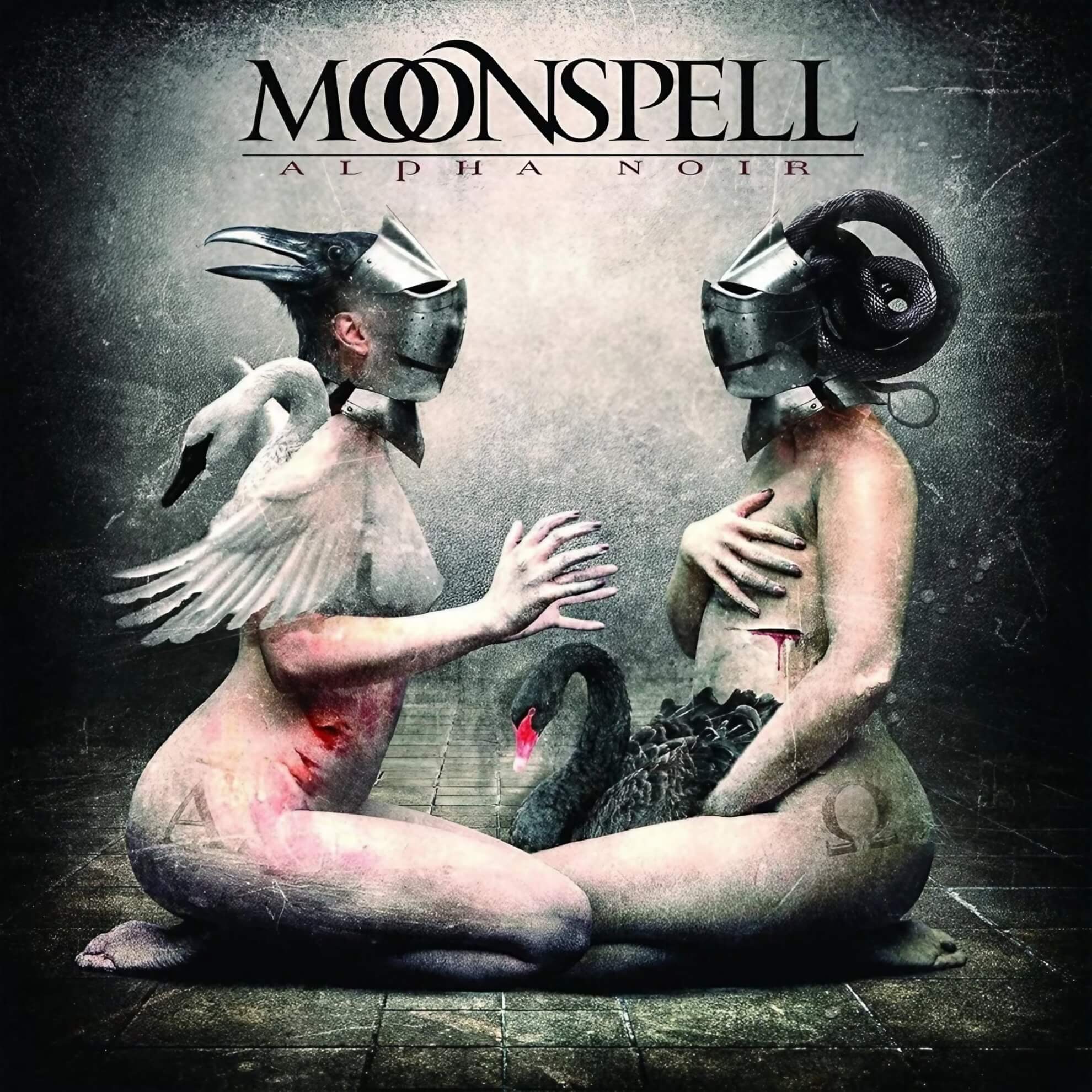
Moonspell occupy a different register of the dark music world from the symphonic death metal of Septicflesh: theirs is a tradition of Romantic melancholy, of the gothic in its literary as much as its sonic sense, of the body at the edge of dissolution not through mythological force but through grief.
For Antoniou to produce sustained, coherent visual identities for both his own band and a band working in an adjacent but formally distinct idiom demanded a kind of critical translation — a transfer of his formal vocabulary into a new emotional key.
In a 2012 interview, he addressed the formal continuity between ‘The Great Mass’ and the Moonspell commissions directly: “I used some of the background — not the same, it maybe has the same mood, but it was on purpose.” The acknowledgement that recurrence of element is a choice rather than a limitation is not a defensive statement. It is a description of a coherent practice.
This is not gallery reach; it is a different kind of audience, geographically dispersed and culturally committed in ways that gallery attendance cannot replicate. An artist whose images appear on albums distributed by Sony Music and Nuclear Blast is making a different kind of cultural argument than one whose work circulates within the institutional art system. The question is not which form of reach is more legitimate. The question is what it costs an artist to have their formal intelligence most fully recognised in a context that the institution of fine art does not know how to address.
The Painting That Waits
A 2019 interview is titled, in the journalist’s own words, with a statement attributed directly to Antoniou: “When we’ll stop Septicflesh, I will concentrate on my paintings.” The sentence is arresting not for what it says about the band but for what it implies about everything else. It positions the personal painting practice not as an ongoing endeavour but as a deferred one — a project held in reservation, waiting for the clearance that a band with a thirty-five-year history and a touring schedule covering multiple continents per year may never quite provide.
The paintings section of the official website remains unpopulated. The commissions continue: ‘The Ossuary Lens’ in 2025, adding to a body of album imagery that already numbers in the dozens and spans labels on three continents. The artist who entered the Athens School of Fine Arts as one of its top applicants, who won three scholarships under Mytaras, who holds a credential from the Chamber of Fine Arts of Greece, has built the widest recognition of his career through images that are reproduced, purchased, streamed, and encountered on a screen rather than a wall.
This tension is not a failure. It is a condition of a specific kind of artistic life, and it has a history. The history of artists whose formal training far exceeded what the available commercial contexts could accommodate is long. What distinguishes Antoniou’s version of this condition is the scale at which the commercial practice has succeeded — so thoroughly that it has produced a parallel public identity capable of obscuring the gallery practitioner beneath it.
What the waiting itself reveals is something about the practice’s deepest formal argument. His images are not images of stasis — they are images of transformation, of the body in the act of becoming something else. The figure that has dissolved into the divine, the flesh that has crossed into stone or wing or root, the organism that has allowed its own outline to be renegotiated: these are images of a process, not a conclusion. It would be consistent, if not entirely comfortable, to read the practice itself in the same terms — as a practice still in the process of becoming what it has always had the formation and the instinct to be.
The question the work is currently working through — whether the image made for millions can give way to the singular object on a wall, whether the deferred canvas can carry everything the commissioned cover has been asked to carry — is not a question of ambition. It is a question of time, and of what Antoniou chooses to do with the time that Septicflesh eventually, or does not, release.
When that canvas is finally filled, it will not be a departure. It will be the completion of something that began on a small wooden surface in Athens, in the hands of an eight-year-old who already knew that the world inside an image was not quite the same as the one outside it.
References
- Spiros Antoniou, ‘The Artist,’ primary biographical statement, accessed March 2026. ↩︎
- Marina Lambraki-Plaka, ‘The Painter Dimitris Mytaras,’ in Dimitris Mytaras: Retrospective Exhibition (Athens: National Gallery – Alexandros Soutsos Museum, 1995), 11–22. ↩︎
- Herman te Velde, ‘Seth, God of Confusion: A Study of His Role in Egyptian Mythology and Religion’ (Leiden: E.J. Brill, 1967), 1–25. ↩︎
- Walter S. Gibson, ‘Hieronymus Bosch’ (New York: Thames and Hudson, 1973), 9–38. ↩︎
- David Sylvester, ‘Interviews with Francis Bacon,’ rev. ed. (London: Thames and Hudson, 1987), 14–17. ↩︎
- Charles Segal, ‘Landscape in Ovid’s Metamorphoses: A Study in the Transformations of a Literary Symbol’ (Wiesbaden: Franz Steiner Verlag, 1969), 3–19. ↩︎
- C.G. Jung, ‘The Concept of the Collective Unconscious,’ in ‘The Archetypes and the Collective Unconscious,’ trans. R.F.C. Hull, Collected Works vol. 9i, 2nd ed. (Princeton: Princeton University Press, 1969), 42–53. ↩︎

Leave a Reply