

Around the year 998, Abbot Odilo of Cluny ordered every monastery under his rule to commemorate the faithful dead on November 2nd, the day after All Saints. The ordinance, remembered as the ‘Statutum de defunctis,’ called for Masses for souls in purgatory, bells tolling through the day, and alms for the poor at the monastery gate.
That is the founding paper of the three-day season whose first night clerical warnings now treat every autumn as a doorway to the devil, and nothing in it resembles a satanic rite. Anyone who denounces Halloween as one has to forget that the season of the dead was designed by monks, for the Church, and recorded in the Church’s own hand.
Our position is plain, and we will defend it without hedging. Halloween is a Christian vigil, Satan is a Christian figure, and the habit of finding a satanic rite behind a night of costumes and candy is a Christian reflex with a long record of destroying innocent people. Each claim rests on dates and texts. None requires hostility toward the faith.
I want that last sentence to carry weight. The position I defend is narrower than a verdict on Christianity, and a tradition that kept its dead in prayer for a thousand years is not discredited by a recurring misreading of its own calendar. Not every church makes the mistake we describe, since the warnings come from particular clergy and movements rather than from any doctrine of the faith, and many parishes still keep the vigil with All Saints’ Masses.
The argument is about ownership. The devil whom clergy invoke against Halloween is Christian property, a creature the Church assembled and lent to every group it feared, and the sermon that turns it on the Church’s own vigil is a serpent swallowing its own tail.
The Night Was Made by Monks
The word itself gives the game away. Halloween is the English contraction of All Hallows’ Eve, the vigil before All Hallows, which is All Saints’ Day. The feast began as a commemoration of martyrs, kept in Rome on May 13th after Pope Boniface IV rededicated the Pantheon to the Virgin and the martyrs in 609.
In the eighth century Pope Gregory III dedicated an oratory in St. Peter’s to all the saints and tied its feast to November 1st, and in 835 the Frankish emperor Louis the Pious, at the urging of Gregory IV, imposed that date across his realms. Odilo’s ordinance then added the day of the dead, and over the following two centuries the sequence of vigil, feast, and commemoration spread through the Latin Church.
The standard rejoinder is that the Church merely painted over a Celtic festival of the dead. That thesis dates from the late nineteenth century, when James Frazer reasoned backward from the Christian feast to an imagined pagan original, supplying an inference where the record was silent.1
The Irish texts that mention Samhain were written by Christian scribes centuries after conversion, and they describe a season of assemblies, tribute, and uncanny visitors from the burial mounds, not a cult of the dead. Nicholas Rogers adds a chronology that spoils the tidy story: the Irish church kept its feast of the saints in the spring, which contradicts the claim that November 1st was chosen to baptize Samhain.2
Northern European folk custom did contribute mumming, bonfires, and ritual misrule, and nobody need deny it. Folk custom is not Satanism, and the devotion to the dead at the center of the night is Catholic through and through.
None of this means the Church never borrowed from older religions, and it did not pretend otherwise. In 601 Pope Gregory I wrote to the abbot Mellitus, then traveling to join the English mission, that the pagan shrines of the English should be cleansed and converted into churches rather than destroyed, and that customary feasts should be redirected to the commemoration of martyrs.3
Satan Belongs to the Church
The devil of the accusation has no pagan pedigree either. In the Hebrew Bible the word “satan” means an adversary or accuser. In the prologue to Job it carries a definite article, so it is a title rather than a name, borne by an officer of the divine court who tests human loyalty with permission and reports back.4
The cosmic rebel took shape later, in Second Temple Jewish apocalyptic writings such as 1 Enoch and Jubilees. Christian writers inherited that figure and fused the prosecutor with the serpent of Genesis, with the fallen morning star of Isaiah 14, which began as a taunt against a Babylonian king, and with the dragon of Revelation, until they had an adversary large enough to justify a redeemer. By the high Middle Ages the Scholastics had a systematic demonology in which the devil is the inverted mirror of divine order. The figure is a product of the Judeo-Christian tradition, systematized by the Church, and every sermon that fears it is the serpent mistaking its own tail for prey.
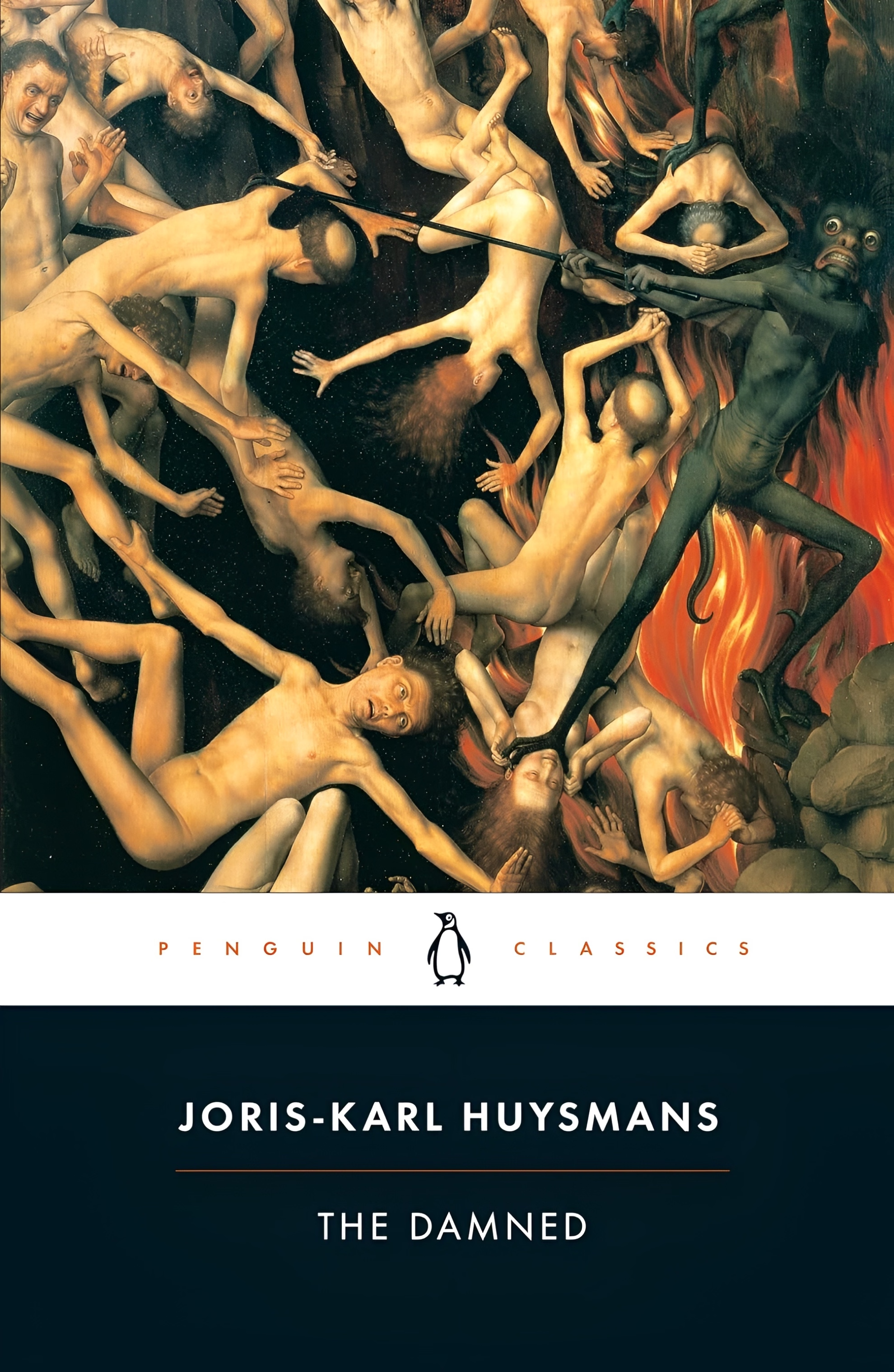
Modern Satanism did not escape that inheritance. It was assembled from Christian parts. Romantic readers of Milton, among them Blake and Shelley, recast his rebel angel as a hero of conscience against tyranny, and late nineteenth-century Decadent fiction, notably Huysmans’s ‘Là-bas’ in 1891, staged the Black Mass as a literary inversion of Catholic ritual.5
Anton LaVey’s Church of Satan, founded in San Francisco in 1966, was atheistic, treating Satan as a symbol of appetite and self-reliance.6 The Satanic Temple, founded in 2013, is non-theistic as well, and it uses demonic imagery to campaign for the separation of church and state.7
Neither group believes in the being the Halloween sermons fear. Both depend on Christian symbols to have anything to invert. A rebel needs a house to rebel against, and the circle is already closed: the Church supplied the figure, its inverters supplied the rebellion, and the Church now condemns the result as foreign.
The Accusation Has a Pedigree
What survives of the charge is its method, and the method is old. A nocturnal conspiracy is alleged. The crimes it commits, flight through the night air, abused children, murdered animals, leave no physical trace. Confessions are obtained under pressure, and every denial is read as proof of the devil’s deceit.
This was the procedure of the early modern witch trials, and it was the procedure of the Satanic Panic of the 1980s and early 1990s, when claims that cults were abusing children and sacrificing animals on All Hallows’ Eve spread across North America and Europe. The sociologist Jeffrey Victor classified the episode as a contemporary legend, and a federal review of the allegations in 1992 found no corroboration of an organized network.8
Individuals have committed crimes while invoking Satan, and no honest account denies it. What the record has never produced is the multigenerational cult that each annual warning implies. That is the distinction between a crime and a conspiracy, and every panic in this lineage erased it.
The Law the Church Forgot
The forgetting is documented, and it is the Church’s own. In the early tenth century, a text known as the ‘Canon Episcopi,’ first recorded in the penitential of Regino, abbot of Prüm, ruled that women who imagined they rode out at night in the train of the goddess Diana were deceived by the devil in dreams, and that to believe such flights real was itself infidelity. Church law therefore classed the night ride as an illusion and the belief in it as the sin.
Nearly six centuries later the rule had become inconvenient. In 1485 a commission acting for Georg Golser, the bishop of Brixen, vacated the Innsbruck proceedings of the Dominican inquisitor Heinrich Kramer over procedural errors and released the accused women, and within months Golser ordered him out of the diocese. None of the learned men present doubted that witches existed; they disputed how one was recognized.
Kramer answered with the ‘Malleus Maleficarum,’ published at Speyer in 1486, with the papal bull ‘Summis desiderantes affectibus’ of 1484 printed near its front. The book holds that witches exist, that they make a pact with the devil, and that the pact is the crime, and it argues around the old canon, so that a ruling from the Church’s own past could be set aside by an inquisitor’s present: what the canon held to be delusion, the book held to be fact. We do not claim that the ‘Malleus Maleficarum’ lit the pyres. It was idiosyncratic even among learned contemporaries, and the great panics came generations after its first printing.9
The pattern is the one this column keeps meeting. An institution writes down the correct reading, loses the page, and then prosecutes others for the error. The Halloween sermon repeats it at lower stakes. The season of the dead is the Church’s own, as the ordinance of Cluny shows, and the warning forgets the document.
The Doubters Were Inside
The sharpest critics of this machinery were Christians, and some were its own officers. One of them stopped Kramer before the ‘Malleus Maleficarum’ was printed: in 1485 Georg Golser, the bishop of Brixen, halted Kramer’s proceedings against women at Innsbruck on grounds of irregular procedure, and the accused went free.
After the Basque witch panic around Zugarramurdi in 1609 to 1611, the Spanish Inquisition’s Supreme Council sent the inquisitor Alonso de Salazar Frías to review the cases. He interviewed the accused, tested their confessions against what could be checked, and reported in 1612 that the witches multiplied in proportion to how much was said and written about them. The Council then issued instructions that demanded material proof and discounted uncorroborated confessions.10
In Germany, the Jesuit Friedrich Spee, who had served as confessor to women condemned for witchcraft, published ‘Cautio Criminalis’ anonymously in 1631. He argued that torture manufactured the confessions it claimed to discover, and that the same procedure would make any judge, theologian, or prince confess to witchcraft.11
Candor requires two corrections to the popular story, and we make them although they cost us a rhetorical advantage. The figure of nine million women burned has no archival basis; Brian Levack’s survey of the trials puts executions across Europe between 1450 and 1750 at roughly 45,000.12 And the Catholic inquisitions of Spain and Rome were not the engine of that violence.
Most executions took place in secular and local courts, above all in the Holy Roman Empire, while the Spanish tribunal, restrained by appellate review, handled witchcraft with skepticism. The inquisitions have other ledgers, and those belong to a different argument. On this one the Church’s record is divided, and a divided record condemns the panic rather than the creed.
Cartagena Knew the Pattern
Colombia sits inside this lineage, not beside it. The Inquisition tribunal of Cartagena de Indias, established in 1610, prosecuted African and Afro-descendant healers under demonological categories borrowed from Europe. Paula de Eguiluz, a healer born in Santo Domingo, was tried three times, the first in 1624, and her interrogators questioned her through the stock European script of night flight and sabbath.
The surviving record also shows that inquisitors and a friar had sought her cures. When the Cartagena inquisitor sentenced her to be handed to the secular arm for execution, the Supreme Council in Spain questioned the sentence and ordered a third trial.13 She survived. The institution that policed her medicine as diabolism had consulted her as a physician, and the second role undid the first.
We have covered the modern echo of this. In our Andean chronicle of the First World Congress of Witchcraft, held in Bogotá in August 1975, we described how Cardinal Aníbal Muñoz Duque, then the senior Colombian prelate, condemned the gathering four days before it opened, and how the event nonetheless made room for Afro-diasporic traditions the colonial order had once prosecuted.
We still hold that the congress was an early draft of the pluralism Colombia’s 1991 Constitution later wrote down. We add one qualification here. The 1975 objections did not come only from the pulpit; a former president published a secular, rationalist version of the same complaint, and a commemoration in Medellín in October 2025 drew near-identical objections to the very word “brujería.”
The reflex is not owned by one creed. What the accusers share is a grammar, the nameless nocturnal threat and the missing proof, and that grammar crossed the Atlantic with the tribunal.
The Bells Still Ring
Return to Cluny. Odilo’s bells were never a spell, and the alms at the monastery gate were never a sacrifice. They were a medieval answer to a question every culture asks on its darker evenings, which is what the living owe the dead.
The costumes, the candy, the horror marathons, the metal gigs, and the cemetery visits on All Souls’ are later, louder, mostly secular answers to the same question, and the Church has a legitimate claim to be heard among them. It has no claim to call the night satanic.
The devil it points to is its own property, a figure it assembled, defined, and lent to every group it feared, and the serpent can let go of its tail whenever it remembers whose tail it is. A faith that remembers who wrote the season would hear those bells as a family inheritance and stop mistaking its own body for the enemy’s.
Where does our own coverage of religion, demonology, and the history of fear fall short of what you expect from us?
Reference
- Ronald Hutton, ‘The Stations of the Sun: A History of the Ritual Year in Britain’ (Oxford: Oxford University Press, 1996), 360–370. ↩︎
- Nicholas Rogers, ‘Halloween: From Pagan Ritual to Party Night’ (New York: Oxford University Press, 2002), 11–29. ↩︎
- R. A. Markus, ‘Gregory the Great and a Papal Missionary Strategy,’ Studies in Church History 6 (1970): 29–38. ↩︎
- Henry Ansgar Kelly, ‘Satan: A Biography’ (Cambridge: Cambridge University Press, 2006), 13–52. ↩︎
- Ruben van Luijk, ‘Children of Lucifer: The Origins of Modern Religious Satanism’ (New York: Oxford University Press, 2016), pp. 16–45, 76–99, 164–188, 295–299, 328–336. ↩︎
- Per Faxneld and Jesper Aagaard Petersen, eds., ‘The Devil’s Party: Satanism in Modernity’ (New York: Oxford University Press, 2013), pp. 3–18, 41–52, 83–122, 177–196. ↩︎
- Joseph P. Laycock, ‘Speak of the Devil: How the Satanic Temple Is Changing the Way We Talk about Religion’ (New York: Oxford University Press, 2020), pp. 12–22, 27–60, 83–115, 155–168, 187–196. ↩︎
- Jeffrey S. Victor, ‘Satanic Panic: The Creation of a Contemporary Legend’ (Chicago: Open Court, 1993), 43–64, 95–118. ↩︎
- Hans Peter Broedel, ‘The Malleus Maleficarum and the Construction of Witchcraft: Theology and Popular Belief’ (Manchester: Manchester University Press, 2003), 1–3, 16–18, 102, 113–14. ↩︎
- Gustav Henningsen, ‘The Witches’ Advocate: Basque Witchcraft and the Spanish Inquisition (1609–1614)’ (Reno: University of Nevada Press, 1980), 278–294, 370–385. ↩︎
- Friedrich Spee, ‘Cautio Criminalis, or a Book on Witch Trials,’ trans. Marcus Hellyer (Charlottesville: University of Virginia Press, 2003), 59–73, 125–136. ↩︎
- Brian P. Levack, ‘The Witch-Hunt in Early Modern Europe,’ 3rd ed. (Harlow: Pearson Longman, 2006), 23. ↩︎
- Kathryn Joy McKnight, ‘Performing Double-Edged Stories: The Three Trials of Paula de Eguiluz,’ Colonial Latin American Review 25, no. 2 (2016): 154–174. ↩︎
Leave a Reply