

Colombian horror cinema first carried the gothic into the countryside by way of literature, through Álvaro Mutis’s 1973 novella ‘La mansión de Araucaima,’ a story of a young woman sacrificed inside an old hacienda in the Valle del Cauca. Carlos Mayolo coined the term tropical gothic when he adapted the novella for the screen in 1986, after he and Luis Ospina had already placed gothic figures in the colonial haciendas and penthouses of Cali with ‘Carne de tu carne’ (1983) and ‘Pura sangre’ (1982).1
A new Colombian feature returns to a vanished young woman and a community that closes ranks around her absence. This time there is no landowner at the center of the story, only a sect.
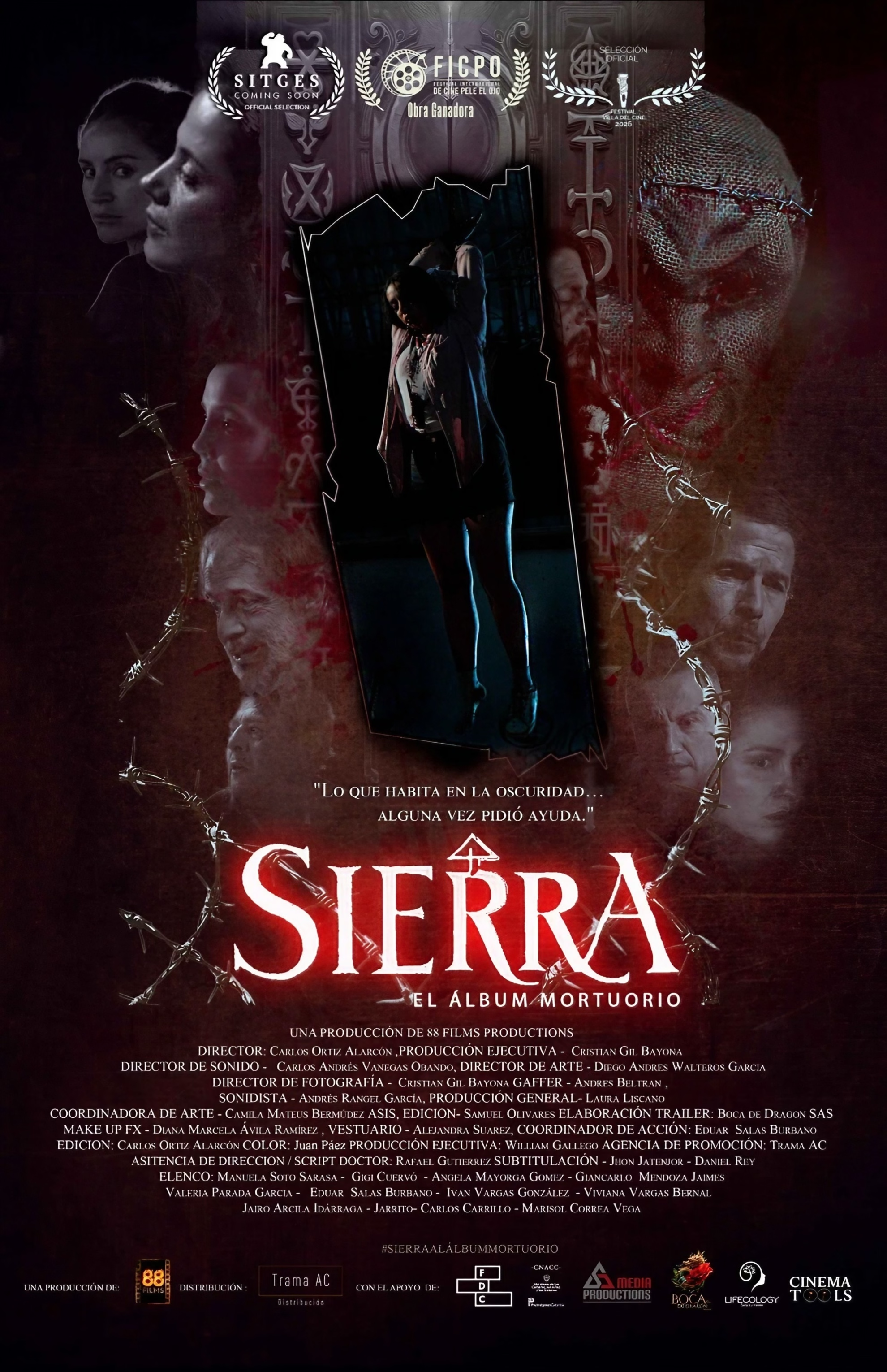
‘Sierra: El Álbum Mortuorio,’ written and directed by Carlos Ortiz Alarcón, receives a special press screening at the Cinemateca de Bogotá on Saturday, October 24th, at 6:00 p.m., as part of the eighth Bogotá Horror Film Festival. The 88-minute film opens in Colombian theaters on November 5th, 2026, with national distribution by Trama AC, and its Colombian classification had not been confirmed at the time of publication.
A Preview Inside the Festival
The festival runs from October 22nd to 31st under the slogan “El Miedo Habla Un Mismo Idioma,” or “fear speaks a single language,” with the Cinemateca de Bogotá as its main venue. Further screenings reach the local cinematecas of El Tunal and Fontanar del Río and the CEFE Chapinero.
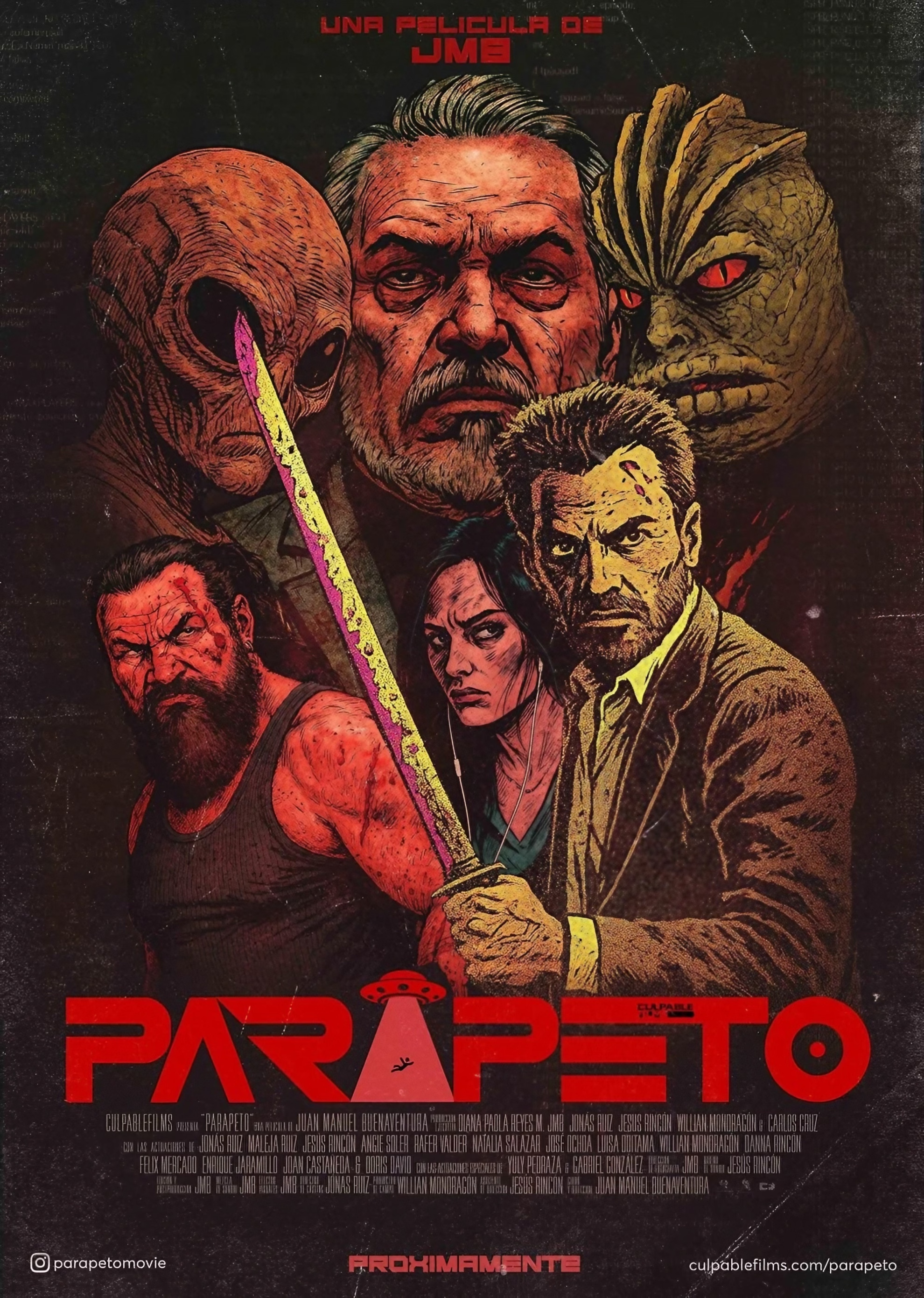
Opening night belongs to another Colombian title, Juan Manuel Buenaventura’s ‘Parapeto,’ on October 22nd. The screening of ‘Sierra’ two days later is a press preview held ahead of the commercial release, and the closing gala on October 31st carries the festival’s awards, which include separate prizes for national and international fiction features.
Founded in 2019, the festival presents itself as a screen for horror, suspense, dark fantasy, and adjacent forms that have difficulty finding room in the commercial circuit. It is a member of FANLATAM, the Ibero-American Network of Genre Film Festivals, and ANAFE, and its program keeps working ties with Santiago Horror in Chile, Insólito in Peru, and Cinefantasy in Brazil.
Gustavo Valdivia, founder and director of Santiago Horror, travels to Bogotá this year to present a selection of short films and to lead a session on curation and international circulation. The Chilean connection is older than the program itself.
A Founder on His Own Screen
Ortiz Alarcón founded the Bogotá Horror Film Festival and has served as its director. Recounting its origins in 2022, he traced the event to his own selection at the Santiago Horror Film Festival, where directors of other festivals urged him to open an equivalent space in Bogotá for Latin American genre work.
The links between film and festival extend to production. 88 Films Productions, the company behind ‘Sierra,’ also supplies this edition’s prize for Best National Short Film, an equipment-rental bonus aimed at new Colombian genre projects.
None of this is hidden, and all of it belongs in the release details. The October 24th screening is a festival founder presenting his own feature to the press inside the event he created, and it is properly treated as a preview rather than as an outside curatorial verdict.

Based in Bogotá, Ortiz Alarcón has concentrated his work on thriller, horror, and genre film, and production materials credit that work with more than 40 official festival selections. He wrote and directed ‘Sierra’ after what he has described as several years of writing and development of the film’s world.
In an announcement published July 26th, 2024, as principal photography wrapped, he described the project as the story of a serial killer and a destructive sect. The stated aim was to provoke reflection on morality, spirituality, and the limits of the survival instinct.
Ahead of the film’s industry presentation in Sitges in September 2025, he framed it as a mortuary album of collective trauma, a record in which moral collapse, religious manipulation, and systemic abuse meet.
Pueblo Blanco and Katharsis
The film is set in Pueblo Blanco, a fictional town composed from recognizable elements of Colombian territory: isolated, forgotten, and stalled in time, marked across generations by violence, secrets, and fanaticism. The disappearance of a young woman sets off a chain of violent events and exposes Katharsis, an ancestral sect whose influence still governs the lives of the townspeople.
Production materials describe the town not as a backdrop but as a participant with its own rules, memories, and wounds. That framing matters for the genre the film enters, because it places the source of dread in a community’s own habits rather than in an intruder.
The shoot took place at the Club Campestre El Bosque in Silvania, Cundinamarca, whose grounds stand in for an old town far from any city. Principal photography concluded in July 2024.
Its genre credentials are not in question. The production combines psychological thriller, slasher, and social horror, and its Sitges presentation described sinister forces, both human and supernatural, emerging from the sect hidden within the town.
Cast and Camera
Eduar Salas Burbano plays the adult Sierra and Iván Vargas González plays the younger Sierra, according to the cast list released when the shoot wrapped. Manuela Soto Sarasa plays Andrea, Sierra’s mother, with Ángela Mayorga Gómez as Sonia and Jairo Arcila Idárraga as Ambrocio.
The wider ensemble includes Marisol Correa Vega, Giancarlo Mendoza Jaimes, Valeria Parada García, Gigi Cuervo, Viviana Vargas Bernal, and Carlos Carrillo. The production reports a months-long rehearsal process designed to establish each character’s identity, relationships, and emotional weight before cameras rolled.
Cristian Gil Bayona serves as executive producer and director of photography, and Laura Liscano López leads general production. The stated visual approach rests on a contrast between light and darkness; the composer had not been confirmed at the time of publication, and any judgment of camera, sound, and editing strategy waits on the screening itself.
The Album as Archive
The object named in the title carries the film’s central idea. According to production materials, the mortuary album holds part of the record of violence in Pueblo Blanco and is tied to Sierra’s own past, standing for what the community has tried to bury.
That premise gives the film a specific horror device: not a curse or a relic but a document, a collection of images that outlasts the silence of the people who made it. The production’s own formulation is that a past can be hidden, buried, or silenced, yet traces always remain.

The same materials describe a film concerned with people who suffer violence and come to reproduce it, and with those who keep their humanity under extreme pressure. Placing a killer inside that cycle, rather than outside the community he stalks, is the film’s most consequential choice on paper.
Tropical Gothic Moves Inland
Mayolo later described the aim of the Cali group as low-budget horror shot on the periphery, allegories meant to demystify the horrors of violence and misery, with feudal lords feeding on their workers and incest serving as an instrument of power. Those films located their monsters inside the landowning household.
‘Sierra’ moves the question from the dynastic family to the congregation. Power in Pueblo Blanco, as the film describes it, belongs to a doctrine that residents inherit, which shifts the unit of horror from blood relation to belief.
Scholarship on folk horror identifies the subgenre by its rooting of horror in a local community bound together by inherited tales, and observes that those traditions are frequently fabricated within the text rather than drawn from documented custom.2 The same work locates the source of fear in a monstrous group whose identity remains unstable, since each side of the conflict assumes that it represents normality.
Katharsis fits that description closely: an invented sect in an invented town, owing nothing to a recorded Colombian legend or a historical movement. The film’s stated interest in victims who become perpetrators corresponds to that instability, since the line between the town and its sect is the very thing the story sets out to test.
That combination places ‘Sierra’ at a specific junction in the national genre, joining the tropical gothic’s concern with violence as social inheritance to folk horror’s invented doctrine and the slasher’s body count.
Beyond the Bogotá Screen
The film was selected for Sitges Coming Soon 2025, the industry showcase held within the 58th Sitges International Fantastic Film Festival of Catalonia from October 9th to 19th, 2025, a selection rather than a prize. It has also taken part in Santiago Horror in Chile, and Proimágenes Colombia supports its international circulation.
At home, it has passed through the Festival Villa del Cine in Villa de Leyva, the Festival Internacional de Cine de Pasto, the Guatapé Film Fest, and Gritos en el Planetario. Production materials list recognition at the Pele el Ojo International Film Festival in the national fiction feature category; the specific prize had not been confirmed at the time of publication.
The November 5th run is theatrical only, with participating cities and theaters to be announced in stages through the production’s official channels.
A Town That Keeps Its Dead
Colombian horror has drawn its monsters from the hacienda and from regional legend, and both sources came with a ready-made authority, the weight of history or of oral tradition. ‘Sierra: El Álbum Mortuorio’ gives up that support and asks an invented creed to carry the same charge, which is a harder test of craft and a more direct claim on the present.
The October 24th preview lets the press measure execution against that premise 12 days before the national release on November 5th.
Indeed, Colombian horror has placed its monsters in haciendas, in regional legend, and now in a doctrine handed down inside a single town: which of those settings has given you the Colombian horror film you return to most, and why?
References
- Felipe Gómez G., ‘The Tropical Gothic and Beyond: El Grupo de Cali’s Legacies for Contemporary Latin American Literature, Cinema, and Culture,’ eTropic: Electronic Journal of Studies in the Tropics 18, no. 1 (2019): 54. ↩︎
- Dawn Keetley, ‘Introduction: Defining Folk Horror,’ Revenant: Critical and Creative Studies of the Supernatural, no. 5 (2020): 4, 22. ↩︎


Leave a Reply