


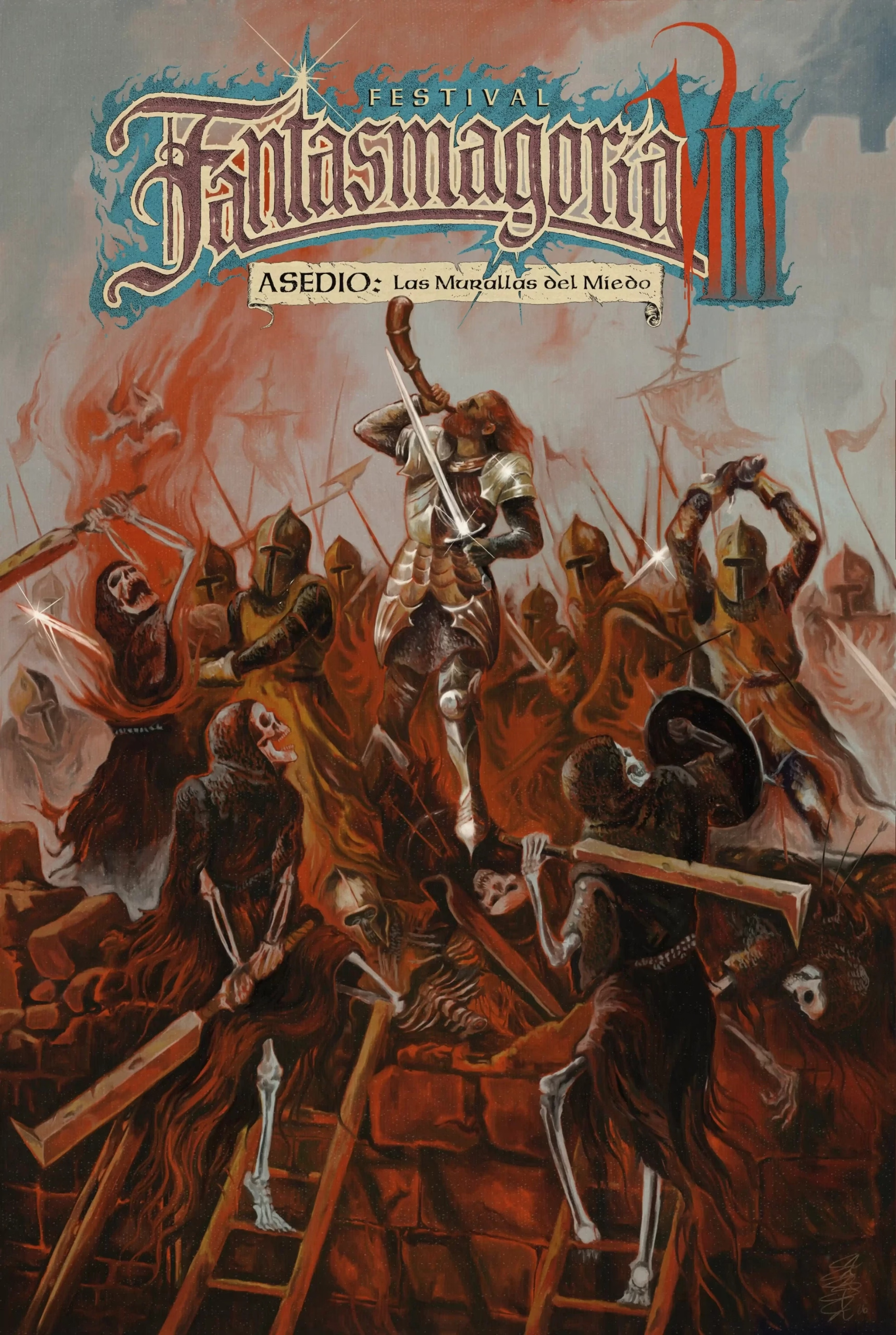
A single festival section in Medellín now spans 61 years of besieged rooms, from Akira Kurosawa’s ‘Seven Samurai’ in 1954 to Jeremy Saulnier’s ‘Green Room’ in 2015. The section belongs to the eighth Fantasmagoría, the Festival Internacional de Cine Fantástico y de Terror de Medellín, which runs October 15th to 25th under the theme “Asedios: las murallas del miedo,” or “Sieges: the walls of fear.”
The catalogue lists 47 works in seven sections: fiction features, documentaries, the siege selection, shorts, animated shorts, Latin American shorts, and Colombian shorts. The festival’s statement on the theme calls the siege horror in its most methodical form, a small group holding a space while a threat outside waits for supplies and morale to fail.
Opening night, October 15th at 7:00 p.m. at the Centro Colombo Americano, goes to ‘Decorado,’ Alberto Vázquez’s 95-minute fantasy and science fiction film, a 2025 co-production of Spain and Portugal. The title sits at the fantasy edge of a remit that covers the fantastic as a whole rather than horror alone. Awards and the closing ceremony follow on October 25th at 5:00 p.m. at COMFAMA San Ignacio.
Eight Editions in Medellín
Fantasmagoría began in 2018 as a “muestra,” or showcase, started by five friends and horror enthusiasts who wanted the city to have a place for genre cinema. Recent editions have each centered on a single theme.

The sixth edition, in 2024, took werewolf cinema as its subject under the title “La maldición de la luna llena.” The seventh, in 2025, took “Los Infantes Terribles,” and the eighth turns to the siege. The theme governs the talks as well as the screenings, and the preliminary schedule includes a talk on sieges and military tactics in Frank Herbert’s ‘Dune’ saga on October 23rd at Librería Antimateria, and a live-scored talk on ‘Sinners’ that evening at La Pascasia.
The festival lists the schedule as subject to change. Screenings are spread across the Centro Colombo Americano, the Museo de Arte Moderno de Medellín, the COMFAMA venues La Capilla and San Ignacio, and Cineprox Las Américas, among others.
Prizes Named for Genre Makers
Every 2026 prize is genre-specific, awarded within the festival’s own competition rather than in a general category. The best fiction feature prize carries the name of the Mexican director Carlos Enrique Taboada, and the best short film prize that of the Brazilian director José Mojica Marins.
The audience prize honors the Argentine actor Narciso Ibáñez Menta, and the Latin American short film prize honors the Colombian director Jairo Pinilla. The remaining awards are the Tres Moiras prizes for best actress and best actor, the Julio Jiménez prize for screenplay, the Gótico Tropical prize for documentary, the Gritos Animados prize for animation, and the Madremonte prize for Colombian short film.
Those first four names come from Mexico, Brazil, Argentina, and Colombia, so the prize list records horror as a Latin American tradition before any winner is announced.
The Grammar of the Siege
The siege selection lists five films: ‘Seven Samurai’ (1954), ‘Rio Bravo’ (1959), ‘Assault on Precinct 13’ (1976), ‘Dèmoni’ (1985), and ‘Green Room’ (2015). Only ‘Dèmoni’ is classed as horror in the festival’s own listing, and the others are filed as action, drama, Western, and thriller.
Their place in a horror program rests on descent rather than category. Scholarship on Carpenter’s film traces its ancestry through Howard Hawks’s ‘Rio Bravo’ and George A. Romero’s ‘Night of the Living Dead,’ and one critic in that literature calls it finally closer to a remake of Romero’s film.1 The same article adds John Ford’s ‘Stagecoach’ (1939) to that ancestry.
‘Assault on Precinct 13’ screens on October 18th at 9:00 p.m. as a 50th-anniversary presentation. Carpenter wrote, directed, scored, and edited the film, and he took his editing credit under the name John T. Chance, the name of John Wayne’s character in ‘Rio Bravo.’
The film confines its action to a nearly empty police station over one night, framed in 2.35:1 widescreen. The attackers use suppressed firearms, so the assault is heard in breaking glass and impact more than in gunfire, and Carpenter’s own synthesizer score carries the rhythm between assaults.
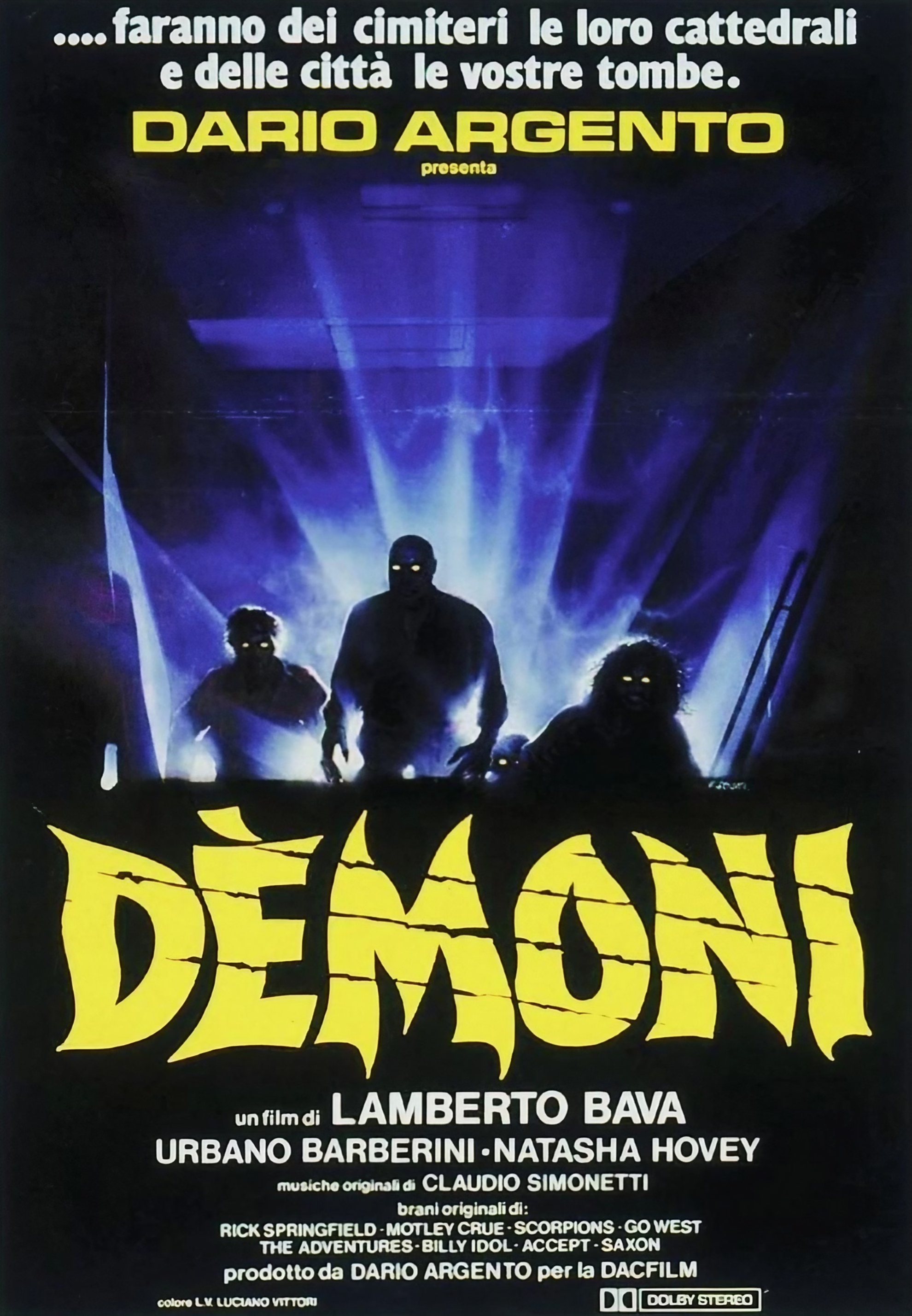
‘Dèmoni,’ Lamberto Bava’s 1985 film, stages its siege inside a cinema. Patrons invited to a free screening in Berlin turn into monsters, and the sealed theater makes a trap of the audience’s own seats. Claudio Simonetti’s score shares the film with a hard rock and heavy metal soundtrack.
The festival screens ‘Dèmoni’ on October 22nd at 8:10 p.m. in a Grindhouse program at the Centro Colombo Americano, so a film set in a movie theater plays in one. ‘Green Room,’ Saulnier’s thriller about a touring punk band trapped backstage, screens on October 20th at 9:00 p.m., and ‘Seven Samurai’ (207 minutes) and ‘Rio Bravo’ (141 minutes) screen on October 16th and 18th.
The five films hold a bounded space and an enemy who can wait constant while the country and the genre change around them.
Colombia es Fantástica
The strand called Colombia es Fantástica places Colombian work beside the international selection. The Colombian short film selection, seven titles competing for the Madremonte prize, screens on October 18th at 7:00 p.m. at the Centro Colombo Americano with a conversation.
The seven are ‘Chaika,’ ‘La Flor del Miedo,’ ‘No Vacancy,’ ‘No es el Fin del Mundo,’ ‘HDLT,’ ‘Vientre,’ and ‘Pudor Ante el Asalto de los Ojos Furtivos.’
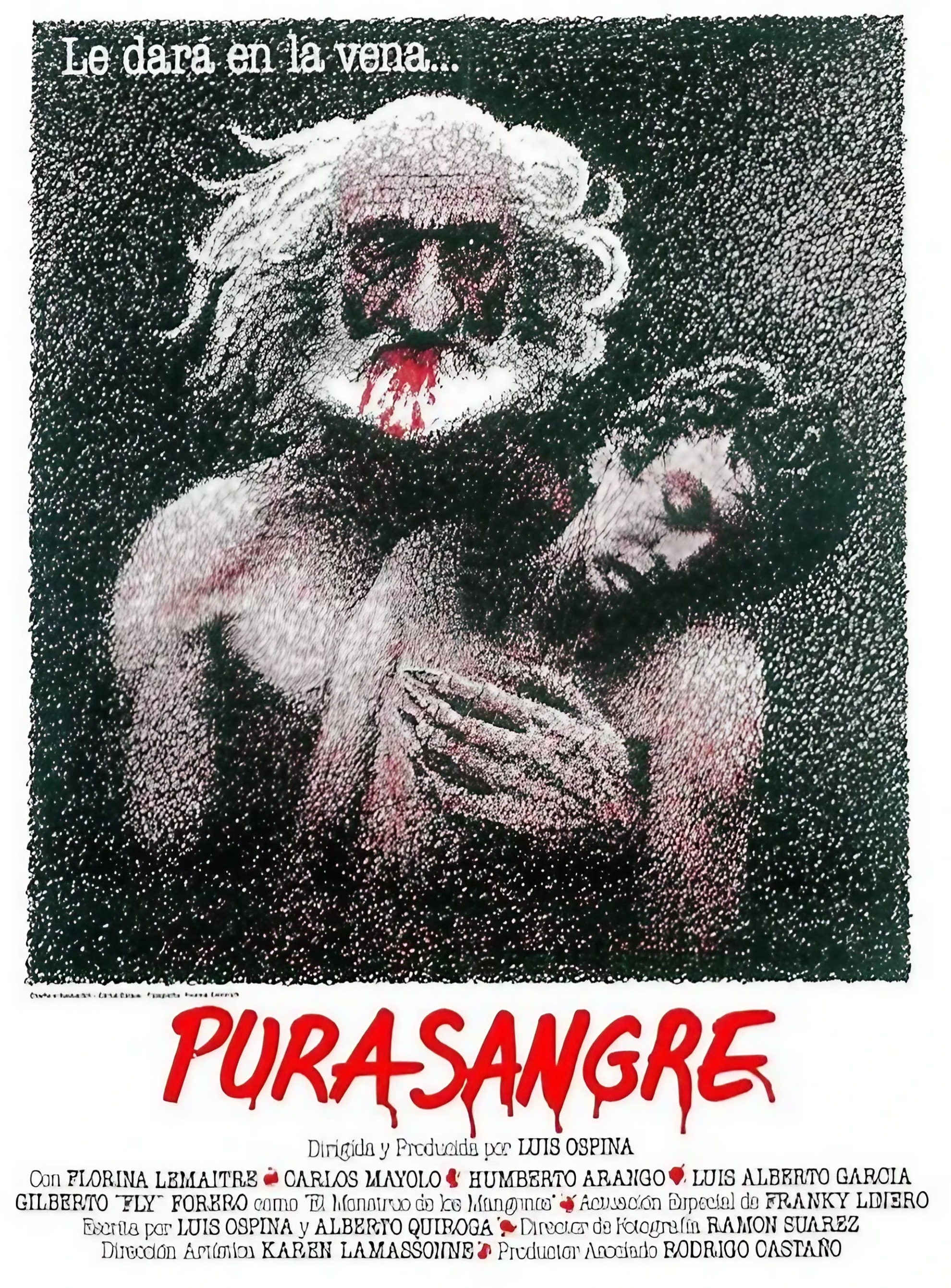
Colombian features sit in the strand across decades. Luis Ospina’s ‘Pura Sangre’ (1982) screens on October 20th at the Universidad Nacional’s Plazoleta de la Luz with a conversation, and Juan Felipe Orozco’s ‘Al Final del Espectro’ (2006) screens on October 17th at the Parque de los Deseos and again on October 20th.
The strand runs from 1982 to 2026, 44 years of Colombian genre work in one program. Placing a 1982 film beside 2026 work treats Colombian genre cinema as a continuous line with its own history, not a recent development.
A Director of Enclosed Spaces
Osorio Márquez was born in Cali on October 30th, 1975, studied in France, and returned to Colombia in 2000, where he worked as a director of commercials before his first feature. That feature, ‘El Páramo’ (2011), sends a high-mountain squad of nine soldiers to a remote base that has gone silent, and it is a co-production of Colombia, Argentina, and Spain.
The film won the Citizen Kane Award for Best Directorial Revelation at the Sitges International Fantastic Film Festival of Catalonia in 2011, a prize from a genre festival’s competition. It won Best Screenplay at the Guadalajara International Film Festival in 2012, a prize from a general competition.
His second feature, ‘Siete Cabezas’ (2017), had its world premiere at the Warsaw Film Festival and follows a withdrawn park ranger whose isolation breaks when two biologists come to investigate the deaths of animals. Speaking in an interview published October 13th, 2017, Osorio Márquez said a nature park suited a story about the end of the world because it is a refuge of life.
He also directed the HBO series ‘Mil Colmillos,’ about a special Colombian Army unit pursuing a religious sect’s leader in the jungle, which premiered two months before his death on December 23rd, 2021, at the age of 46.
A squad cut off at a páramo base, a ranger shut in a nature reserve, and a unit sent into the jungle are variations on one situation, a person or group confined by terrain and beyond help. The siege theme names a situation that Osorio Márquez’s work had already made its own.
The Posthumous Feature
‘El Despertar’ has its Colombian premiere on October 16th at 6:40 p.m. at Cineprox Las Américas, with a second screening on October 21st, both in the official fiction selection. The festival credits three directors, Jaime Osorio Márquez, Federico Durán Amorocho, and José Luis Rugeles, and lists the film at 96 minutes.
Osorio Márquez died with the film advanced but unfinished. Durán Amorocho, the project’s creative producer from its start, completed it as a co-director, and Rugeles, who belonged to the original directing team, shares the credit.
The film had its world premiere in April 2026 at the 41st Guadalajara International Film Festival, in the Official Genre Cinema Selection competition, with screenings on April 19th and 20th. Guadalajara is also the festival where ‘El Páramo’ won Best Screenplay.
The film’s published synopsis sends an elite military unit into the South American jungle on a mission to eliminate a target, where a supernatural force turns the operation into a nightmare, and it follows a Spanish expedition of the sixteenth century consumed by the same force. The cast includes Claudio Cataño, Alejandro Buitrago, Héctor Sánchez, Andrea Olaya, Carlos Mariño, and Quique Sanmartín, and Rhayuela Films produced it.
The synopsis reverses the usual siege, since the armed unit enters as the aggressor and the territory closes around it. The film opens in Colombian theaters on October 29th, 2026, and its Colombian classification, cinematographer, and composer had not been confirmed at the time of publication.
A Colombian Siege Tradition
The eighth Fantasmagoría places a Colombian horror film inside the lineage it belongs to. Osorio Márquez’s squads, rangers, and commandos were confined long before the festival named the situation, and ‘El Despertar’ extends that line from the opposite side, with a territory closing around the unit that entered it.
Shown in the same program as ‘Rio Bravo,’ ‘Assault on Precinct 13,’ and ‘Dèmoni,’ the film invites measurement against the siege’s own history, not against horror in general. That is a narrower and more exact standard, and the festival has set it for itself.
Which Colombian horror film would you place in the siege selection beside ‘Dèmoni’ and ‘Green Room,’ and what keeps its characters from leaving?
References
- Emma Hamilton and Alistair Rolls, ‘Assault on Stagecoach: An Intertextual Analysis,’ Film Criticism 49, no. 1 (2025): article 7935. ↩︎

Leave a Reply