


The city of Aveiro, nestled on the lip of a vast coastal lagoon, exudes a serene, almost dreamlike European charm. It is known as the “Venice of Portugal,” a title earned by the canals that slice through its historic heart, plied by the high-prowed, flamboyantly painted “moliceiro” boats that glide under picturesque bridges. Its streets are a living museum of Art Nouveau elegance, where intricate tile facades and ornate wrought-iron balconies speak of a prosperous, genteel past. It is a city of sun-drenched squares and secret-recipe sweets, a place that has found a comfortable harmony between its history and a vibrant, university-town present.
Into this placid scene, an unsettling guest has arrived. This summer, an international art exhibition will erect a contemporary version of an ancient Aztec tzompantli—a skull rack. The historical tzompantli was a monument of terrifying power, a public scaffold where the skulls of sacrificed warriors and captives were displayed as a testament to imperial might and a tribute to the gods. It is a symbol saturated with the memory of ritual violence, conquest, and a worldview profoundly alien to the tranquil canals of coastal Portugal.
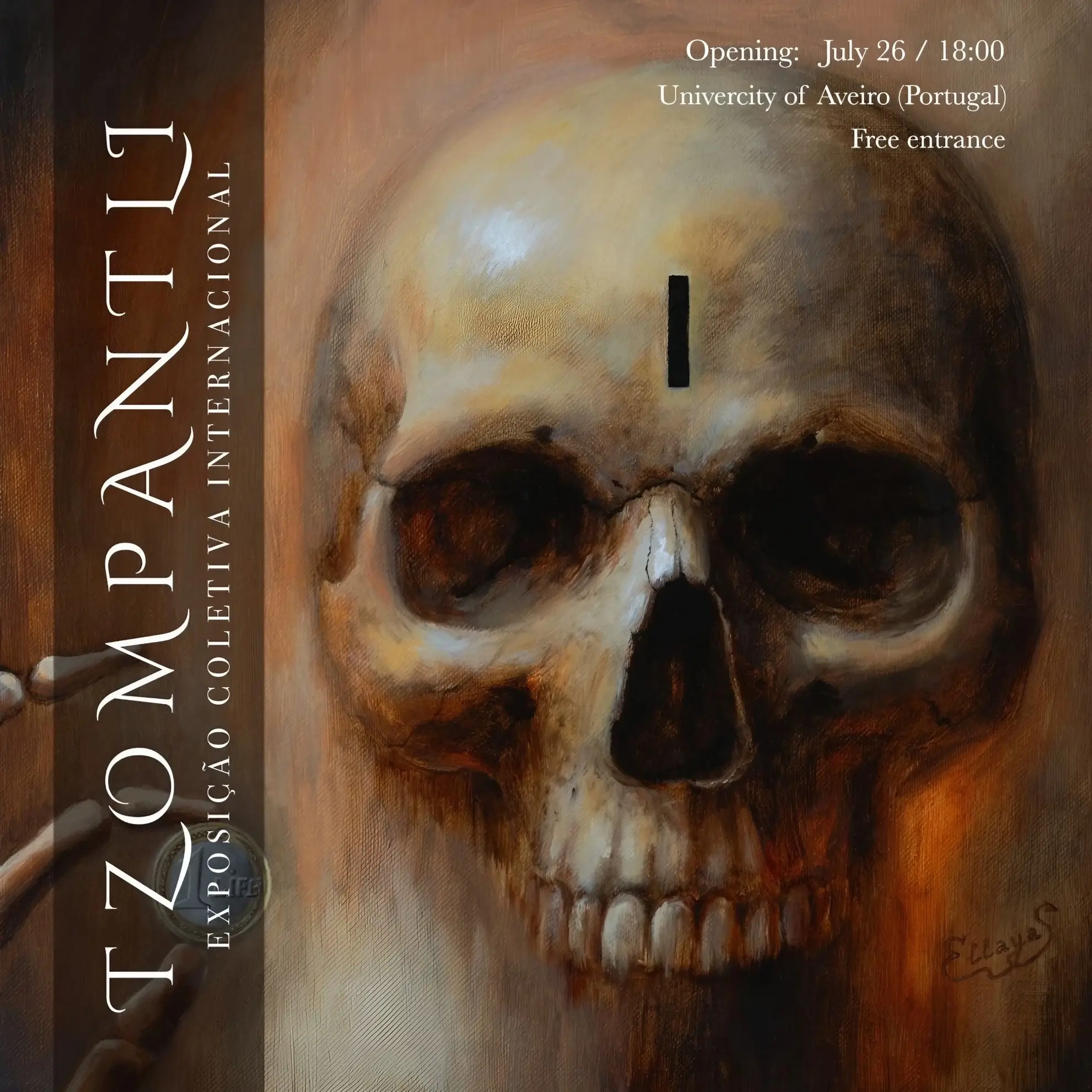
This striking cultural collision is at the heart of TZOMPANTLI – Exposição Coletiva Internacional, an event that promises to be one of the most intellectually stimulating and visually compelling of the year. But the true enigma, the detail that elevates this exhibition from a curious juxtaposition to a profound cultural paradox, is its venue. This meditation on Mesoamerican death rituals will unfold within the walls of the local Confucius Institute, an official, state-affiliated organ of Chinese cultural promotion, housed at the University of Aveiro.
The arrangement creates a startling triangular dialogue between Latin American history, European contemporary art, and Chinese cultural diplomacy. At the center of this convergence stands Ellaya Yefymova, a Ukrainian refugee and physician-turned-artist whose work, forged in the crucible of war, gives the exhibition’s ancient theme a terrifying and modern urgency.
Her journey from a basement in Kyiv to a gallery in Aveiro transforms the exhibition from a philosophical inquiry into a visceral showcase. This exhibition is far more than a collection of artworks; it is a microcosm of twentieth-first-century globalization, where ancient symbols, contemporary traumas, and geopolitical soft power collide to create new, challenging, and profoundly urgent meanings.
Ellaya Yefymova: From a Basement in Kyiv
For one of the exhibition’s most compelling contributors, the theme of mortality is not a distant, historical curiosity. It is a lived reality. Ellaya Yefymova’s journey to the gallery in Aveiro began in a basement in Kyiv, the sounds of the Russian invasion echoing above, grappling with a terror so profound it would fundamentally reshape her life and her art.
Born in Zaporizhzhia, Ukraine, in 1990, Yefymova’s path to becoming an artist was anything but direct. She graduated from art school with honors but, driven by a parallel love for the natural sciences, pursued a medical degree and for years lived a life of science. The dream of being an artist, however, never faded.
The global lockdown in 2020, followed by the birth of her child, became a catalyst. “Becoming a mom made me realize that dreams cannot be postponed!” she writes. “There is no better time than now!.” She began her art career in earnest, her medical background infusing her work with a clinical precision and a focus on the human body.
But it was the Russian invasion in 2022 that became the defining force in her artistic evolution. The experience of fleeing her home, of confronting the possibility of annihilation, stripped away any remaining artifice. Now a refugee living in Lisbon, her work turned to what she calls “dark art,” a direct and unflinching exploration of mortality. Her journey is a profound and tragic irony: a physician trained to preserve the body, now compelled by war to render the skull—the very icon of its ruin. Her clinical precision, once a tool for healing, is now a tool for observation.
Her artistic philosophy is a declaration of survival. “Now, after I went through the depression caused by the need to flee the war, I am investigating the theme of mortality and perception of death as a great motivation to live this life consciously,” she states. She aims to “transform my fear and despair experienced at the beginning of the war into art.” She believes the fear of death is “paralysing,” and instead of turning to religion, she seeks to transform that fear “into a motivation to live.”
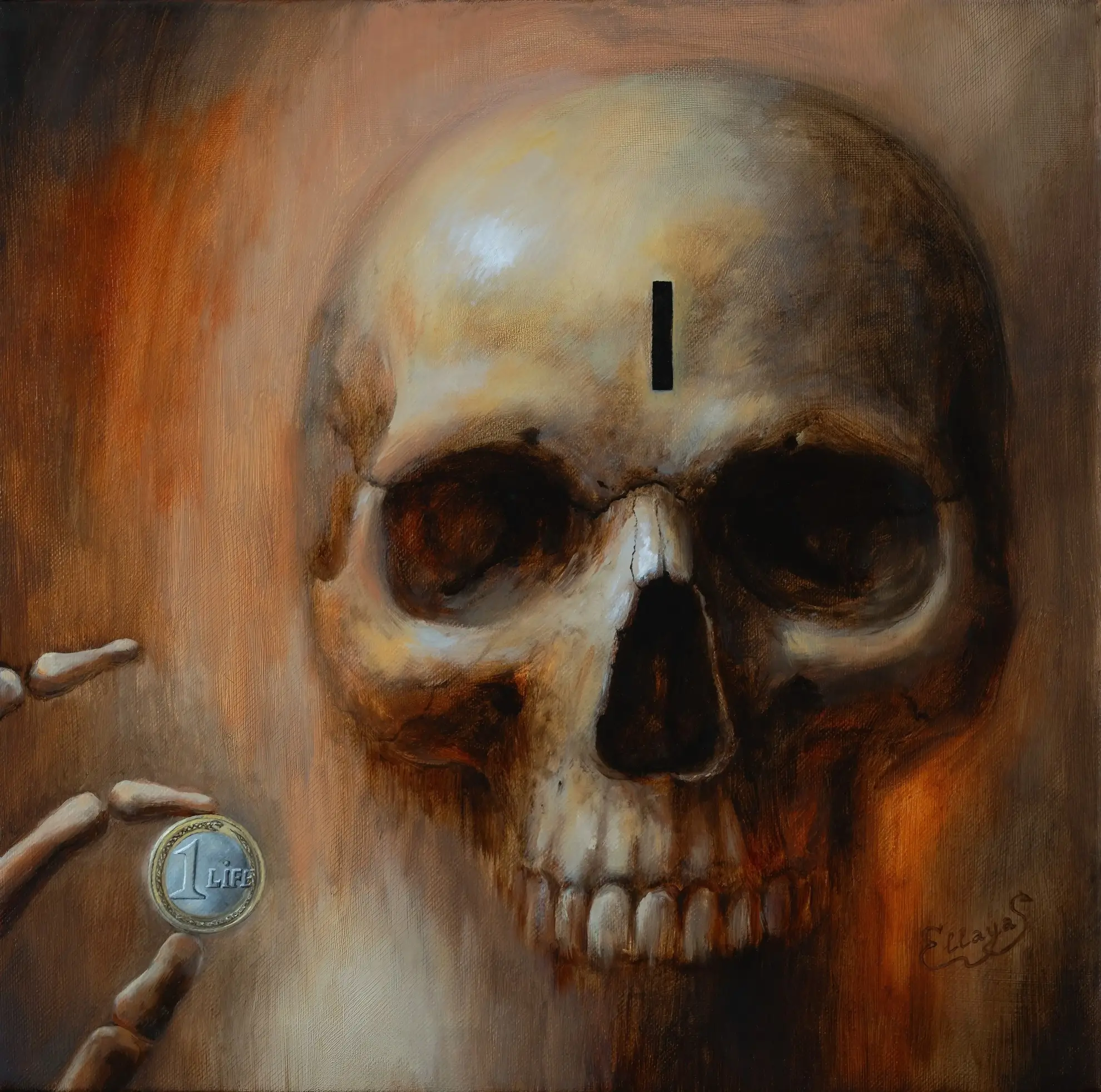
Her paintings for the exhibition are the stark embodiment of this philosophy. The promotional image for the show features one of her works, ‘The Last Trade’: a human skull, rendered with an anatomist’s precision, stark against a dark background. It is devoid of sentimentality. It does not romanticize death, nor does it sensationalize it. It is a direct, unblinking confrontation from a woman who has “looked into the abyss.” This is a modern, politically charged memento mori.
“I strongly believe that it is time for humanity to stop wasting lives and resources for wars and instead direct it to technological, emotional and personal evolution to finally become a better version of ourselves – human 2.0,” she has said. Her art is not just a meditation on the universal fact of death, but a specific indictment of the political forces that hasten it. It is a post-traumatic anatomy lesson, diagnosing a sickened world.
An Altar of Art, Not of Conquest
To understand the exhibition is to first feel the weight of its central symbol. The historical tzompantli was not an abstract concept. It was a visceral reality, a monumental structure of wood and bone that stood in the ceremonial hearts of Mesoamerican cities like the Aztec capital, Tenochtitlan.
Accounts from Spanish conquistadors and illustrations in post-Conquest codices depict rows upon rows of skulls, pierced through the temples and threaded onto horizontal poles—a public ledger of sacrifice and military power. These were often the heads of prisoners of war, and their display was integral to complex rituals connected to the cycles of life, death, and the maintenance of cosmic order. The tzompantli was a raw display of both imperial might and spiritual belief, a public monument of immense political and religious power.
Transforming this legacy is the stated mission of the Art Spectrum collective, the specific, project-based group of international artists driving this exhibition series. The exhibition is explicitly “Inspired by the ancient Aztec tradition of the tzompantli,” but its goal is to foster a “contemporary reflection on memory, identity and the impermanence” of life. The organizers describe the project as a “visual ceremony that summons thought and wonder,” clarifying that their modern altar is constructed not from bone but from “living work.” This act of reinterpretation is the project’s foundational gesture, an attempt to detach the symbol from its literal, violent origins and repurpose it as a catalyst for a more universal, philosophical inquiry.
Yet, the project resists a complete sanitization of its theme. While the collective aims for a global meditation on mortality, the work of its Mexican artists ensures the exhibition remains tethered to its complex, often painful, and politically charged origins. This prevents the skull from becoming just another generic memento mori.
For the exhibition’s inaugural showing in Mexico City, the artist Olinka Domínguez contributed a painting titled ‘Herencia de una conquista’ (“Heritage of a Conquest”), which depicted a skull adorned with elements referencing the Spanish invasion, a direct commentary on the violent imposition of one culture upon another. Her work connected the pre-Hispanic ritual to the current climate of violence that plagues parts of Mexico, demonstrating that the tzompantli is not a relic of a distant past but a living symbol, its echoes resonating in the historical trauma of colonialism and the raw wounds of the present.
Herein lies the delicate negotiation at the heart of the project: the tension between its universalizing ambition—to create a space for a global audience to contemplate mortality—and the specific, politically loaded history of its central motif. The exhibition seems to ask: can the tzompantli be both a universal symbol of impermanence, like a Dutch vanitas painting, and an inescapably political emblem of Mesoamerican history and post-colonial struggle?
The power of the project lies in its insistence that it can be both at once, creating a richer, more challenging dialogue that refuses easy answers. It leverages the global recognizability of the skull while forcing a confrontation with a specific, non-European history of violence, creating a more complex and uncomfortable dialogue than a simple meditation on death. It becomes a meditation on whose death, and at whose hands.
A Global Seance on the Inevitable
The exhibition in Aveiro functions as a kind of global seance, where diverse cultural experiences of mortality converge and speak to one another. The project’s curatorial strength emerges from a powerful dialogue between three distinct artistic voices: Ellaya Yefymova, Olinka Domínguez, and Francesca Dalla Benetta. Their voices demonstrate the exhibition’s ability to use a single, potent symbol as a prism through which a multitude of human experiences with life and death can be refracted.
The first pole of this conversation is the political, grounded by the work of Olinka Domínguez. As previously noted, her art anchors the exhibition in the specific historical soil of Mexico, confronting the trauma of colonialism and the specter of contemporary violence. Her work ensures the skull remains an emblem of a specific political struggle, a reminder of historical debts and present-day injustices.
The second pole is the existential, embodied by Ellaya Yefymova. Her hyper-realistic paintings connect the exhibition to the long European tradition of the memento mori, the skull as a universal reminder of life’s transience. Yet, her biography infuses this tradition with a profound and immediate poignancy. For Yefymova, the skull is not an abstract philosophical prompt but a symbol forged in the crucible of personal trauma and geopolitical conflict, speaking to an existentialism sharpened by the immediate threat of annihilation.
Acting as a cultural bridge between these two worlds is Francesca Dalla Benetta, an Italian sculptor who has been based in Mexico for many years. Her work introduces a third pole: the metaphysical. For the Mexico City show, her bas-relief sculpture, ‘Hasta que la muerte nos separe’ (“Until Death Do Us Part”), featured a resin skull from which three-dimensional flowers emerged.
Inspired by the idea of death as a “doorway to other realities,” her surrealist approach moves beyond the political or the purely philosophical into the realm of the spiritual. This perspective resonates with the celebratory, life-affirming traditions of Mexico’s Día de los Muertos, where skulls are adorned with bright colors and flowers to honor, not mourn, the deceased.
When placed together, these three perspectives create a rich and challenging dialogue. Domínguez asks, “What is the history of this violence?” Yefymova asks, “How do we live in the face of this violence right now?” Dalla Benetta asks, “What comes after this violence?”
The exhibition does not provide a single answer but holds these three vital questions in a powerful, unresolved tension. Domínguez’s political anger prevents Dalla Benetta’s spiritualism from becoming escapist. Dalla Benetta’s sense of transcendence prevents Yefymova’s raw trauma from becoming nihilistic. And Yefymova’s immediate, visceral reality prevents Domínguez’s historical critique from feeling purely academic. They moderate and enrich one another, revealing a highly sophisticated curatorial strategy.
The Bulletin
Subscribe
Subscribe today and connect with a growing community of 613,229 readers. Stay informed with timely news, insightful updates, upcoming events, special invitations, exclusive offers, and contest announcements from our independent, reader-focused publication.
The Dragon and the Skull
The significance of the “Tzompantli” exhibition lies not only in its art but also in its organizational architecture. The project is the product of a unique and sophisticated triumvirate: a fluid international artist collective, a venerable local Portuguese arts association, and a state-affiliated Chinese cultural institute. This unlikely coalition is a case study in a new, dynamic model of twentieth-first-century cultural collaboration.
The creative engine of the project is the Art Spectrum collective. A search for a formal entity yields little, but the Mexican press consistently refers to the group as a colectivo—a collective. This distinction is crucial. In Mexico City’s vibrant art scene, artist-run collectives, like the famed Taller de Gráfica Popular, have a long history as nimble, experimental, and often political alternatives to traditional institutions. The amorphous, project-based nature of Art Spectrum is a strategic advantage, allowing the group to assemble international talent around a single idea and carry it across borders with a flexibility larger museums might lack.
Providing the essential local foundation in Portugal is AveiroArte, the Círculo Experimental dos Artistas Plásticos de Aveiro. With a history stretching back over half a century, AveiroArte is one of the most respected cultural associations in the region, known for its commitment to promoting experimental and contemporary art. Its involvement anchors the international project in the local community, providing it with institutional legitimacy and a connection to the Portuguese art world.
The final and most fascinating partner is the stage itself: the Confucius Institute at the University of Aveiro (IC-UA). Inaugurated in 2015, the institute’s official mission is to support and promote the teaching of Chinese language and culture in Portugal. Globally, Confucius Institutes are often viewed through a geopolitical lens, seen as instruments of Chinese “soft power” and sometimes criticized for promoting a sanitized view of China while avoiding contentious topics.
This context makes the decision to host the “Tzompantli” exhibition a truly remarkable and paradoxical act. Here is a Chinese state-affiliated body providing the platform for an exhibition centered on a visceral Aztec theme, with content exploring ritual sacrifice, colonial conquest, and contemporary warfare—the very opposite of safe, state-sanctioned content.
This paradox, however, is not a contradiction of the institute’s mission but arguably its most sophisticated execution. By hosting a challenging, non-Chinese exhibition, the IC-UA moves beyond the role of a mere cultural exporter and into the more complex and nuanced role of a global cultural facilitator.
This strategic choice subtly counters the common critiques leveled against Confucius Institutes, projecting an image of openness, intellectual curiosity, and cosmopolitanism. It is a form of “meta-soft power”—building influence not by directly promoting its own culture, but by becoming an indispensable hub for global cultural dialogue. In this strange and potent paradox of the Dragon and the Skull, the institute enhances its own prestige by making itself a necessary stage for the world’s art.
Conclusion
A work of art is never just itself; it is always in dialogue with its surroundings. The journey of the “Tzompantli” exhibition from Mexico City to Aveiro is not merely a change of venue but a profound act of recontextualization that inevitably shifts the meaning of the works themselves.
In Mexico City, the exhibition was largely an internal dialogue. For a Mexican audience, confronting the skull rack—even in its contemporary, artistic form—is a dialogue with their own national heritage, a negotiation with the ghosts of their own history. But in Aveiro, Portugal, the conversation changes entirely.
When a painting like Olinka Domínguez’s ‘Herencia de una conquista’ is displayed in a former colonial empire, its meaning multiplies. It is no longer just a reflection on Mexico’s history but a mirror held up to Europe. The skull ceases to be solely a Mesoamerican symbol and becomes a shared emblem of historical power dynamics that have shaped the modern world.
Similarly, the presence of a Ukrainian artist like Ellaya Yefymova, whose work is informed by the trauma of war, resonates with a particular urgency on a European continent still grappling with the conflict in her homeland. What might have been received as a distant tragedy in Mexico becomes an immediate, continental reality in Portugal. Her stark skulls are no longer just symbols; they are potential futures. Her work ensures that this modern tzompantli is not just an altar for philosophical reflection, but a memorial to the ongoing, needless creation of skulls in the heart of Europe.
The final image is a powerful one. An ancient Mesoamerican symbol of death and power, reinterpreted by a global cohort of artists whose conscience is a Ukrainian refugee, is given a stage by a Chinese cultural institute in the historic heart of Portugal. In this unlikely setting, the skull transcends its specific origins. It becomes a shared icon for a complex, interconnected, and often troubled human condition. It is a testament to the strange, unpredictable, and ultimately hopeful power of art to build bridges of meaning across the deepest of cultural and historical divides, reminding a comfortable European audience that the fundamental questions of life and death belong to us all.
Support
Independent
Journalism
Fund the voices Behind Every Story
Every article we publish is the product of careful research, critical reflection, and stringent fact-checking. As disabled individuals, we navigate this work with unwavering dedication, poring over historical records, verifying sources, and honing language to meet the highest editorial standards. This commitment continues daily, ensuring a consistent stream of content that informs with clarity and integrity.
We invite you to support this endeavor. Your contribution sustains the work of writers who examine their subjects with depth and precision, shaping narratives that question assumptions and shed light on the overlooked dimensions of culture and history.
Donations are processed through an in-kind sponsorship model powered by Paymattic—a secure, reliable donations plugin that enables direct support for our ongoing editorial work.

Leave a Reply