

This October we celebrate 16 years of publishing, and the anniversary deserves a statement of purpose rather than a blood toast. We are, before anything else, educators: our work is to teach what stands behind fear, its origins, its myths, and the history that produced it, so that readers can trace where a dread comes from instead of merely enduring it.
In the Llanos that Colombia shares with Venezuela, cattle hands still caution one another about El Silbón, the revenant condemned for parricide to wander the plains with his father’s bones in a sack, and their warning encodes a rule no horror film has surpassed: when his whistle sounds close, he is far away, and when it sounds distant, he is already at your shoulder.
That inversion is not a shriek. It is syntax, a clause the listener must parse correctly or pay for the misreading, and it names the position I want to defend at this milestone.
Fear is a language whose vocabulary every human body already speaks, yet its grammar is composed of myth, history, and physiology, and a publication devoted to dark culture owes its readers that grammar or nothing at all. That conviction explains why, across the past year, we have published less and declined more.
A Vocabulary Older Than Words
Every reader of this column commands the vocabulary. The pupils dilate, the breath catches, the heart accelerates, and the hands chill as blood withdraws toward the large muscles.
Neuroscience has spent decades describing a rapid subcortical pathway along which sensory signals reach the amygdala and trigger defensive responses before the cortex has finished identifying what was seen or heard, a shortcut that sacrifices accuracy to speed because, across most of our evolutionary past, mistaking a stick for a snake cost little and the reverse could cost everything.1 The body flinches first and interrogates afterward.
That mechanism answers most urgently to what it cannot yet name. H.P. Lovecraft opened his 1927 essay ‘Supernatural Horror in Literature’ by declaring fear of the unknown the oldest and strongest form of humanity’s oldest emotion, and clinical psychology has since given the intuition firmer footing, proposing that fear of the unknown may be a fundamental fear beneath a wide range of specific anxieties.2
Here lies the dialectic this anniversary asks us to name. Ignorance and dread feed each other: what we cannot explain, we fear, and what we fear, we avoid examining. Knowledge interrupts that circuit. Our educational work exists to carry readers across the threshold that separates not knowing, and therefore fearing, from comprehending, and therefore being able to embrace what once only threatened.
Our educational work exists to carry readers across the threshold that separates not knowing, and therefore fearing, from comprehending, and therefore being able to embrace what once only threatened. Comprehension does not abolish the shiver. It converts the shiver from a verdict into a question worth pursuing.
Not every blindness is an accident of circumstance. Some of it is chosen, a blindfold knotted by one’s own hand and kept in place because the alternative is the labor of learning. I hold that willful blindness to history to be the most dangerous state a mind can occupy in the presence of fear.
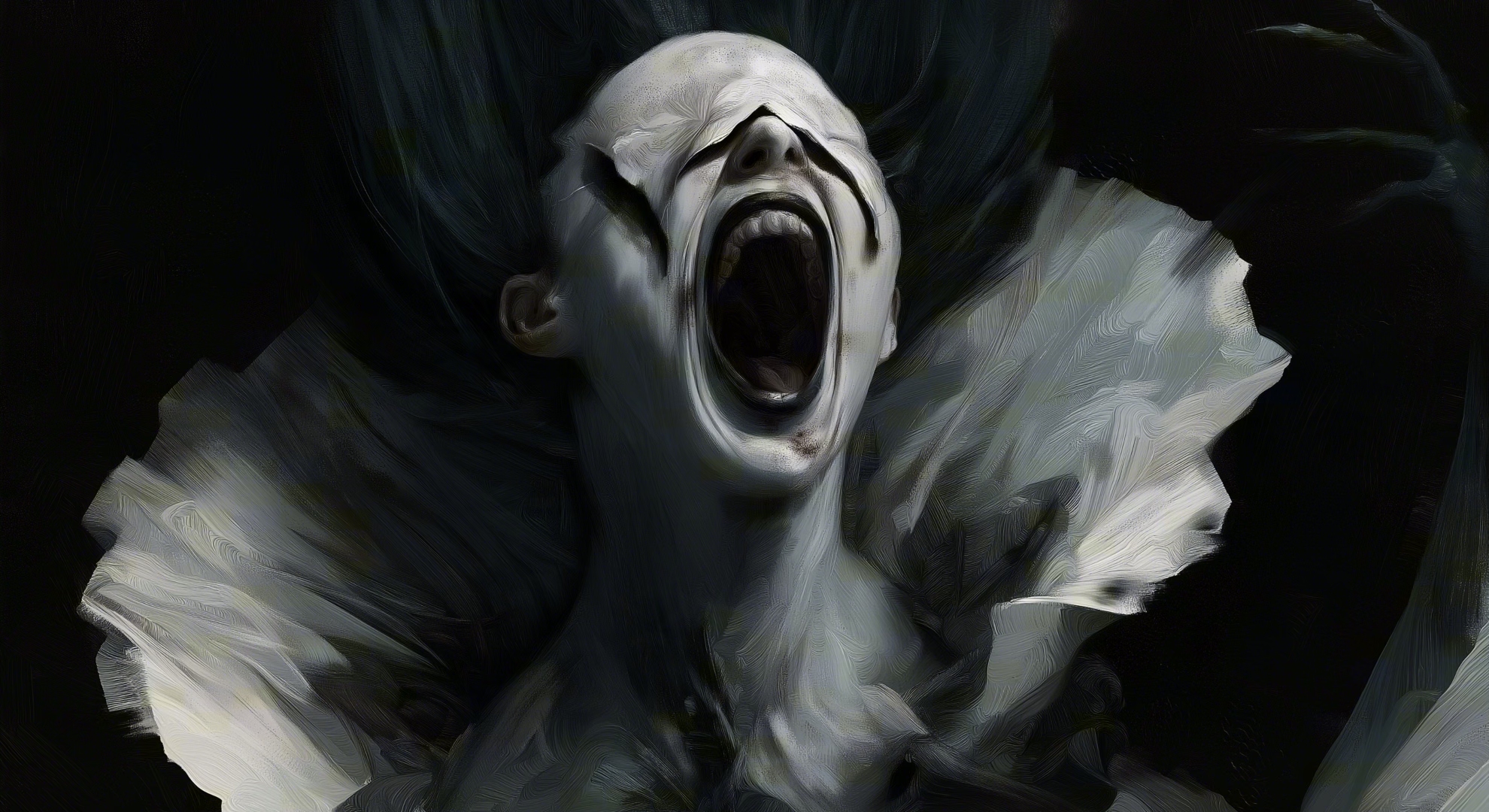
The person who declines to look does not escape the unknown; that person is sealed inside it, the mouth still open while the eyes register nothing, and a fear with no object is the fear most easily turned against a neighbor. The uncanny thrives in precisely that condition, because what is refused examination never loses its strangeness.
The screams preserved in the trial records of people accused of witchcraft still carry across the centuries, and I hear in them less the terror of the supernatural than the cost of communities that preferred an accusation to an explanation. Knowledge is audible in those echoes for anyone prepared to remove the blindfold and listen, and listening is the first discipline our educational work asks of its readers.
An earlier editorial of ours, on teaching horror literature in multicultural classrooms, argued that this shared physiology can unite readers across every background. We still hold that view, with one qualification. The vocabulary is universal; the grammar is local. A whistle on a deserted road signifies nothing in particular to a reader in Oslo and something exact to a family in Casanare. The object the jolt attaches to, and the lesson it carries, is written by the history of those who feel it.
Colombia teaches that lesson with unusual density. La Patasola, the one-legged figure of Andean and Pacific folklore, appears as a beautiful woman who draws men into the forest before revealing what she is; La Muelona works the Caribbean coast with the same deferred revelation; El Silbón punishes on the plains of a frontier world where, for generations, neighbors rather than courts administered justice. Each is a monster whose horror cannot be separated from the transgression that produced it, the kind of figure scholarship on folk monsters identifies as monstrous because it violates a category its community holds inviolable.3
This October, as Halloween fills Colombian shop windows with imported masks and children chant their way from door to door, I would rather our readers recognize the figures that already inhabit their own departments, because a borrowed costume frightens no one into remembering anything.
Education in fear therefore begins with the reader’s own body. A reader who knows that the racing heart precedes the thought has been handed a translation key. The jolt ceases to be an accusation of weakness and becomes information: my body has registered something before I have. Such knowledge does not make horror less frightening. It makes the fright legible, and legibility is the difference between a person who is merely startled and one who can account for the startle.
The body supplies only half of the grammar; the mind supplies the rest. Psychology distinguishes the defensive reflex from the conscious feeling of fear, and fear, a response to present threat, from anxiety, a response to threat that is uncertain or anticipated, the very territory of the unknown.4 What the mind makes of the alarm is not fixed.
Research on emotion regulation has found that reappraisal, reinterpreting a situation before the emotion takes hold, reduces the fear actually felt, while suppression merely hides the expression and leaves the body’s arousal elevated.5 Education is reappraisal made durable: a reader who knows why the whistle frightens can reinterpret the fright instead of merely enduring it.
The Scare That Is Withheld
Anyone can make someone jump by shouting in the dark. The shout exploits the body’s rapid pathway and leaves no residue once the pulse subsides; it is noise, and noise requires no critic. It inhabits the footstep that slows outside a door, the room two degrees colder than it ought to be, the cut that ends a scene one second before the thing appears.
It withholds, and in withholding it delegates the labor to the audience’s imagination, which is invariably more precise about its own terrors than any effects department could be. Suggestion is, in this sense, the unknown put to deliberate artistic use.
Our coverage has moved in that direction by design rather than by drift. In our early years we granted generous space to spectacle, to gore and the ruptured body. The criticism our contributors publish now puts a more exacting question to every work it examines: what does the piece decline to show, and does the refusal carry meaning? Colombian legend has always known the answer; nearly every figure in its repertoire is heard, glimpsed, or rumored long before it is seen.
The same standard governs immersive horror, which we report on and review and which we intend to practice ourselves. A field study at a haunted-house attraction fitted 110 visitors with heart-rate monitors; enjoyment rose with fear only to a threshold and then declined, tracing an inverted U.6
For creators, that result amounts to a design brief: performers who know when to hold perfectly still, sound that lingers below conscious notice before it swells, corridors that compress the visitor’s sense of space gradually, and a safety protocol so dependable that the body can surrender to the fiction because the mind trusts the frame. Those are the four questions we put to any immersive production, including, in time, our own.
A Rehearsal With the Lights On
Why would anyone pay to feel this? A controlled fright is a rehearsal. Researchers of recreational fear describe horror as threat simulation, a benign masochism sought inside a frame known to be safe, an appetite that tracks sensation seeking and, notably, intellectual curiosity.7 Within that frame the body runs its full threat program and then undergoes something ordinary life rarely provides: the program concluding well.
A later survey distinguished three kinds of horror fan, those who chase the adrenaline, those who endure intense fright for what lies beyond it, and those who use frightening fiction to cope with anxiety in their own lives, and all three reported learning about themselves and growing better at handling fear.8
Such findings are self-reported, and we will not inflate them into therapy, but they retire the old assumption that seeking out fear is a symptom to be managed.
Why We Now Publish Less
The same conviction has reshaped what reaches our pages. Our August and September editorials last year set out a method of slower, curated journalism, resistant to the churn of reactive coverage. A year later, we can name the principle of curation that method now serves, and it is narrower than we anticipated: a subject enters this publication when it carries a mythological or historical context our writers can use, and it waits outside when it does not.
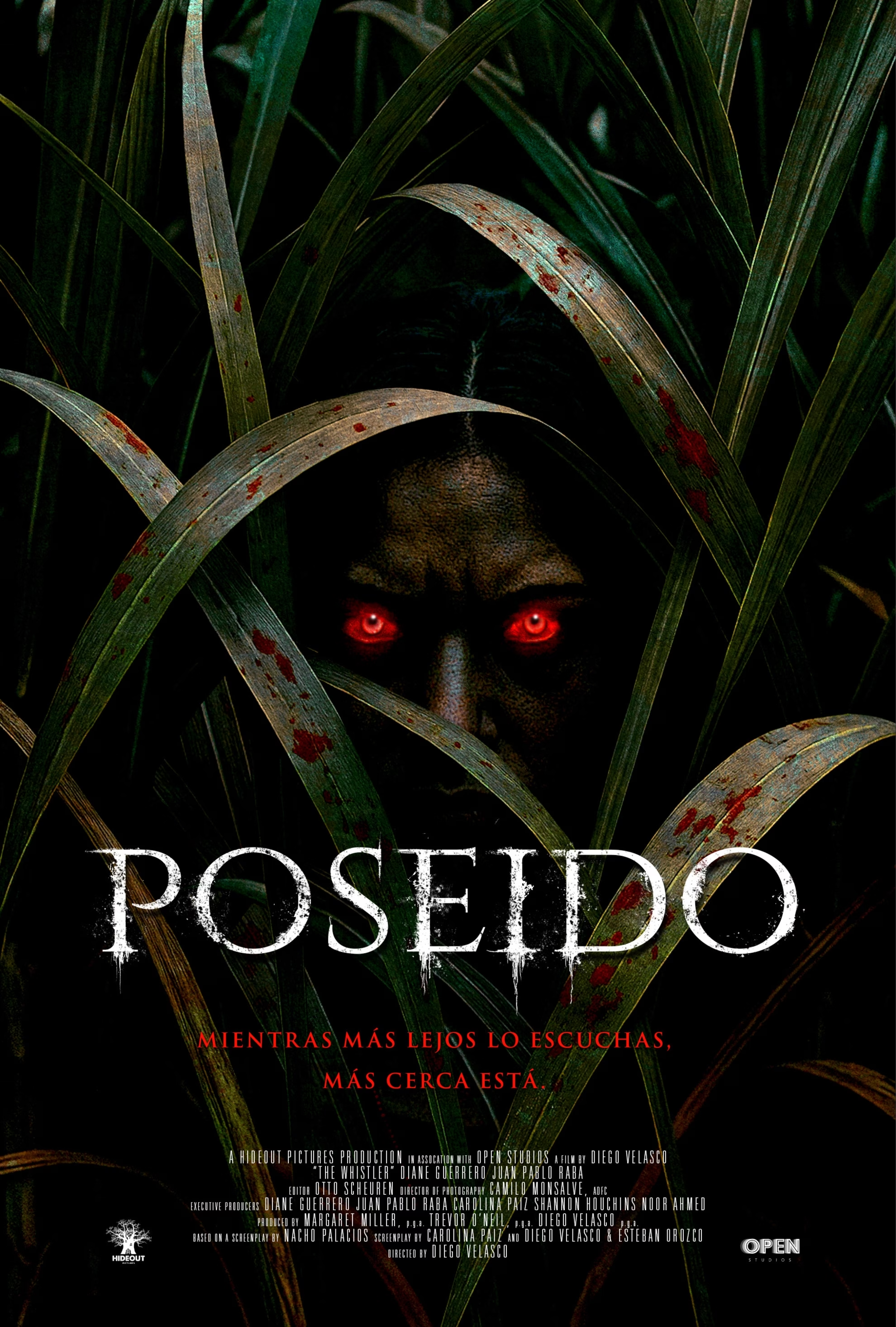
The record of recent months makes that curation visible, and it is overwhelmingly Colombian. Ahead of the Colombian release of Diego Velasco’s ‘Poseído,’ our coverage followed El Silbón from the cattle camps of the Llanos across a border the legend has never respected.
We followed the Bogotá Horror Film Festival into its eighth edition at the Cinemateca de Bogotá, running October 21st through 31st and closing on Halloween itself, and argued that its poster borrowed a Mexican Catrina when the country’s own imagery, from the hooded nazarenos of Popayán’s Holy Week to the funerary gold of the Muisca, lay within reach.
We returned to August 1975, when Colombia hosted the World Congress of Witchcraft; to Ibagué, where a regional museum staged folk demonology as art; and to Carlos Garaicoa’s ‘Ciudad Armero’ at La Tertulia in Cali, which renders the ruins of a buried town as bone.
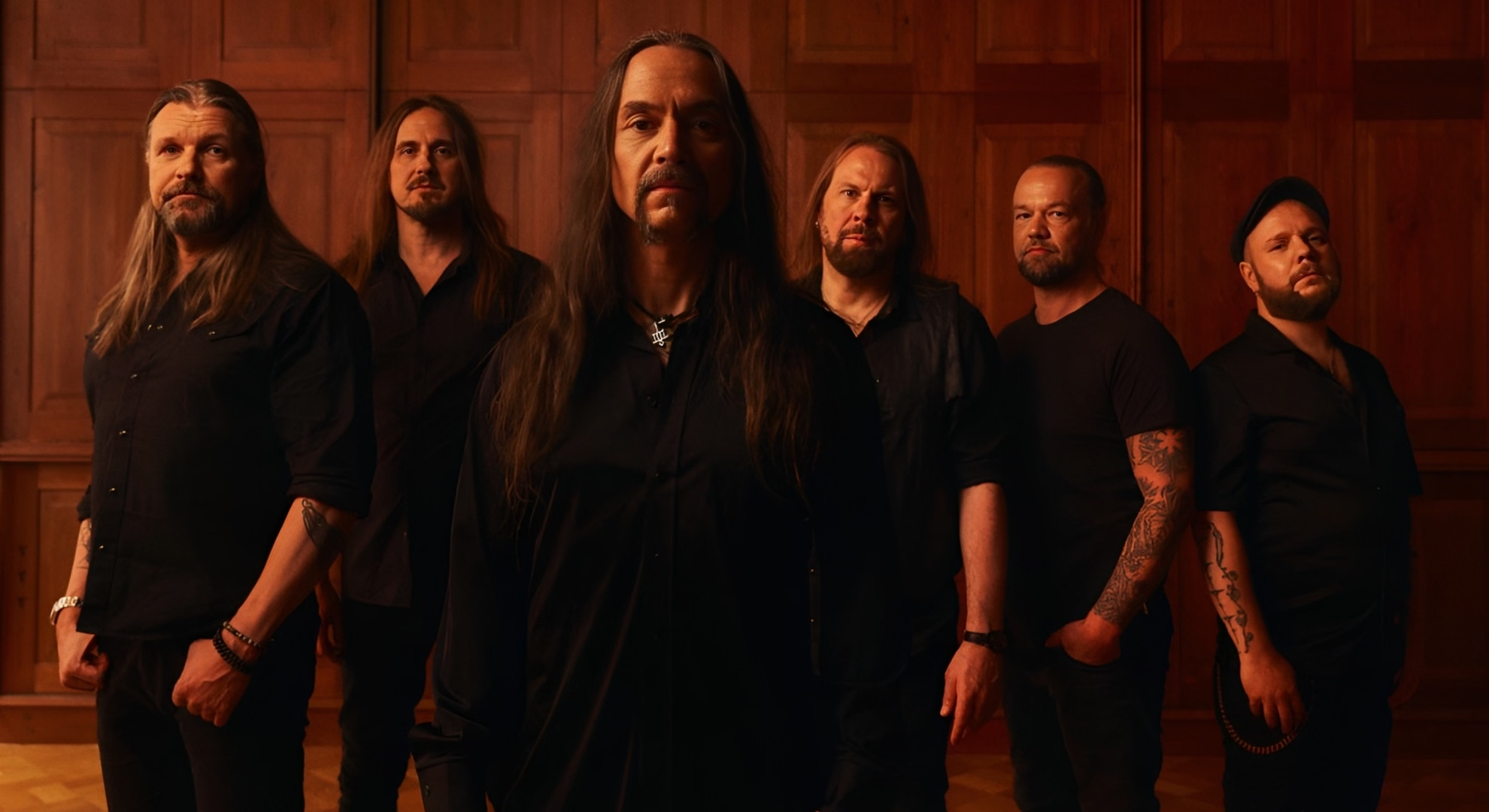
The same curation governs every medium we cover. In music, we premiered the video for ‘Into the Woods’ by Pereira’s Eshtadur, whose fifth album, ‘In Darkness All Shadows Gone,’ is due October 2nd with a crow guiding its frontman through darkness as passage rather than ending; Bogotá’s Unified staged a refusal of fear through ritual and ancestral imagery on ‘Arcane of Uncertainty’; and our conversation with Bogotá’s Argovia, whose ‘Primal Repetition’ dwells on the cycles that shape a life, appears soon.
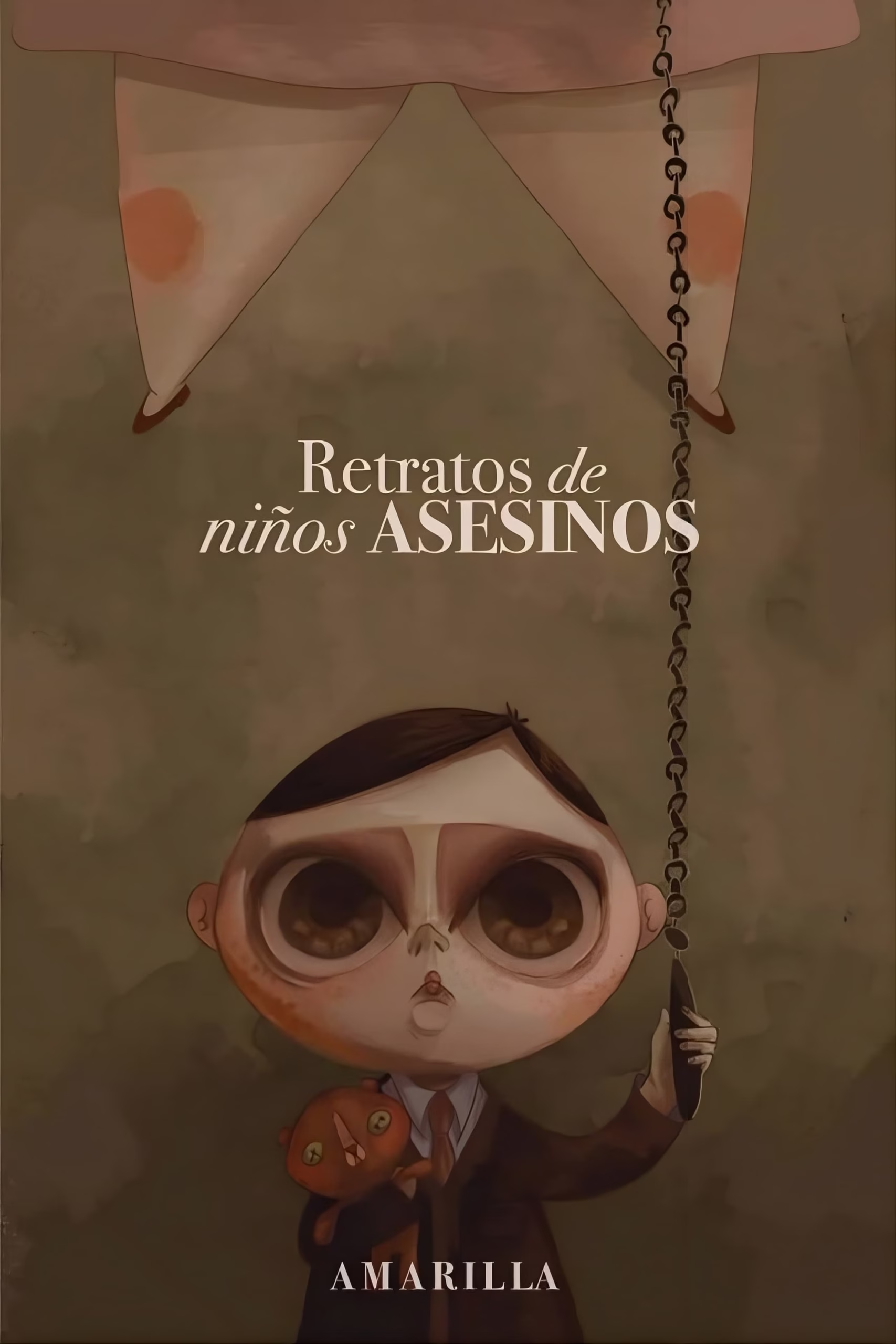
In literature, Carolina Flórez-Cerchiaro carried La Muelona into a new anthology of Latiné horror, ‘Something Followed Us Home,’ and the Colombian illustrator Amarilla rendered seven tales as portraits of children edging toward monstrosity, in ‘Retratos de Niños Asesinos.’ Games are the one field where we have yet to cover a Colombian title of this kind, so ‘Spiritus Sancti,’ which makes spoken Latin exorcism rites its mechanic of survival, remains our reference.
Each treats the monster, the rite, or the ruin as a cultural body, a figure that condenses the fears of the particular time and place that produced it.9
This month our curation opens a second front. We begin revising the Gothic studies essays already in our archive, a body of work reaching back to our 2019 editorial on the field, and we begin publishing new studies alongside them, because an archive that still speaks in yesterday’s terms teaches yesterday’s grammar.
The same pedagogy extends beyond the page through AExpo, the international cultural festival we developed in-house, whose exhibitions, conferences, and curated journeys through the more enigmatic chapters of Bogotá’s history, among them the folklore of the Hotel del Salto, carry the grammar of fear onto the ground where its stories were born.
Obscaerivm, the annual dark culture awards we administer from Bogotá, completes that circle: its Vestige distinction exists to honor work that brings folklore and ancestral tradition into contemporary life, and submissions for work released this year open in January.
This curation carries a cost, and we will not disguise it. We now decline announcements that would have filled a week of pages a few years ago. We have also published material we would not publish today. Our archive holds a roundup of celebrities who outgrew a goth phase, written when traffic seemed a reasonable measure of relevance.
It is no disgrace, but it speaks the vocabulary of darkness without any of its grammar. We would rather publish one solid article that explains why La Muelona’s teeth still frighten a coastal village than 10 that remind readers black clothing exists.
The Grammar After 16 Octobers
On October 1st, 2010, this publication began in the Azores, Portugal, as a music publication, and over the years that followed it widened, discipline by discipline, to cinema, literature, folklore, the visual arts, and the history of belief. The wager behind it has not changed: dark culture deserves the seriousness customarily reserved for the canon. Its object has sharpened, and the people who carry it now form a team of editors, writers, and contributors based in Bogotá.
Writing in English from Colombia, we have become the most widely read publication of our kind in the country, and we hold that reach as an obligation rather than a distinction: it binds us to carry Colombian dark culture, its legends, musicians, filmmakers, and artists, to readers abroad who would otherwise never meet them.
To speak the dialect of dread is something a gifted filmmaker, a black metal band, or a grandmother in the Llanos can accomplish without ever explaining it. To teach its grammar is a separate labor, and it is the labor I believe this publication exists to perform.
Once readers comprehend how fear works, it ceases to be a source of helplessness and becomes an instrument: of connection, because two strangers who flinch at the same whistle share something real; of resilience, because an alarm rehearsed in safety is easier to survive in earnest; and of storytelling, because a writer fluent in the grammar can say more with a closed door than with a flood of blood.
That is why our doors stand open to the Colombian artists, labels, festivals, and researchers who work in this register: we would rather hear from them before a release than discover them after it. After 16 Octobers, we are no longer in the business of shouting in the dark. We are teaching readers to hear the whistle correctly.
As we begin our 17th year and open our Gothic studies series, which Colombian myth, tradition, or subject would you most like our team to examine first?
- Joseph E. LeDoux, ‘Emotion Circuits in the Brain,’ Annual Review of Neuroscience 23 (2000): 155–184. ↩︎
- R. Nicholas Carleton, ‘Fear of the Unknown: One Fear to Rule Them All?,’ Journal of Anxiety Disorders 41 (2016): 5–21. ↩︎
- Jessica Balanzategui and Allison Craven, eds., ‘Monstrous Beings and Media Cultures: Folk Monsters, Im/Materiality, Regionality’ (Amsterdam: Amsterdam University Press, 2023), 13. ↩︎
- Joseph E. LeDoux and Daniel S. Pine, ‘Using Neuroscience to Help Understand Fear and Anxiety: A Two-System Framework,’ American Journal of Psychiatry 173, no. 11 (2016): 1083–1093. ↩︎
- James J. Gross, ‘Emotion Regulation: Affective, Cognitive, and Social Consequences,’ Psychophysiology 39, no. 3 (2002): 281–291. ↩︎
- Marc Malmdorf Andersen, Uffe Schjoedt, Henry Price, Fernando E. Rosas, Coltan Scrivner, and Mathias Clasen, ‘Playing With Fear: A Field Study in Recreational Horror,’ Psychological Science 31, no. 12 (2020): 1497–1510. ↩︎
- Mathias Clasen, Jens Kjeldgaard-Christiansen, and John A. Johnson, ‘Horror, Personality, and Threat Simulation: A Survey on the Psychology of Scary Media,’ Evolutionary Behavioral Sciences 14, no. 3 (2020): 213–230. ↩︎
- Coltan Scrivner, Marc Malmdorf Andersen, Uffe Schjødt, and Mathias Clasen, ‘The Psychological Benefits of Scary Play in Three Types of Horror Fans,’ Journal of Media Psychology 35, no. 2 (2023): 87–98. ↩︎
- Jeffrey Jerome Cohen, ‘Monster Culture (Seven Theses),’ in ‘Monster Theory: Reading Culture,’ ed. Jeffrey Jerome Cohen (Minneapolis: University of Minnesota Press, 1996), 3–25. ↩︎

Leave a Reply