

Long before anyone printed it, the poetry that became Finland’s national epic lived in the voices of village singers. It passed between two performers who repeated each line in turn, memorized rather than read, and its sorrow was never a costume but a meter and a vocabulary handed down through generations.
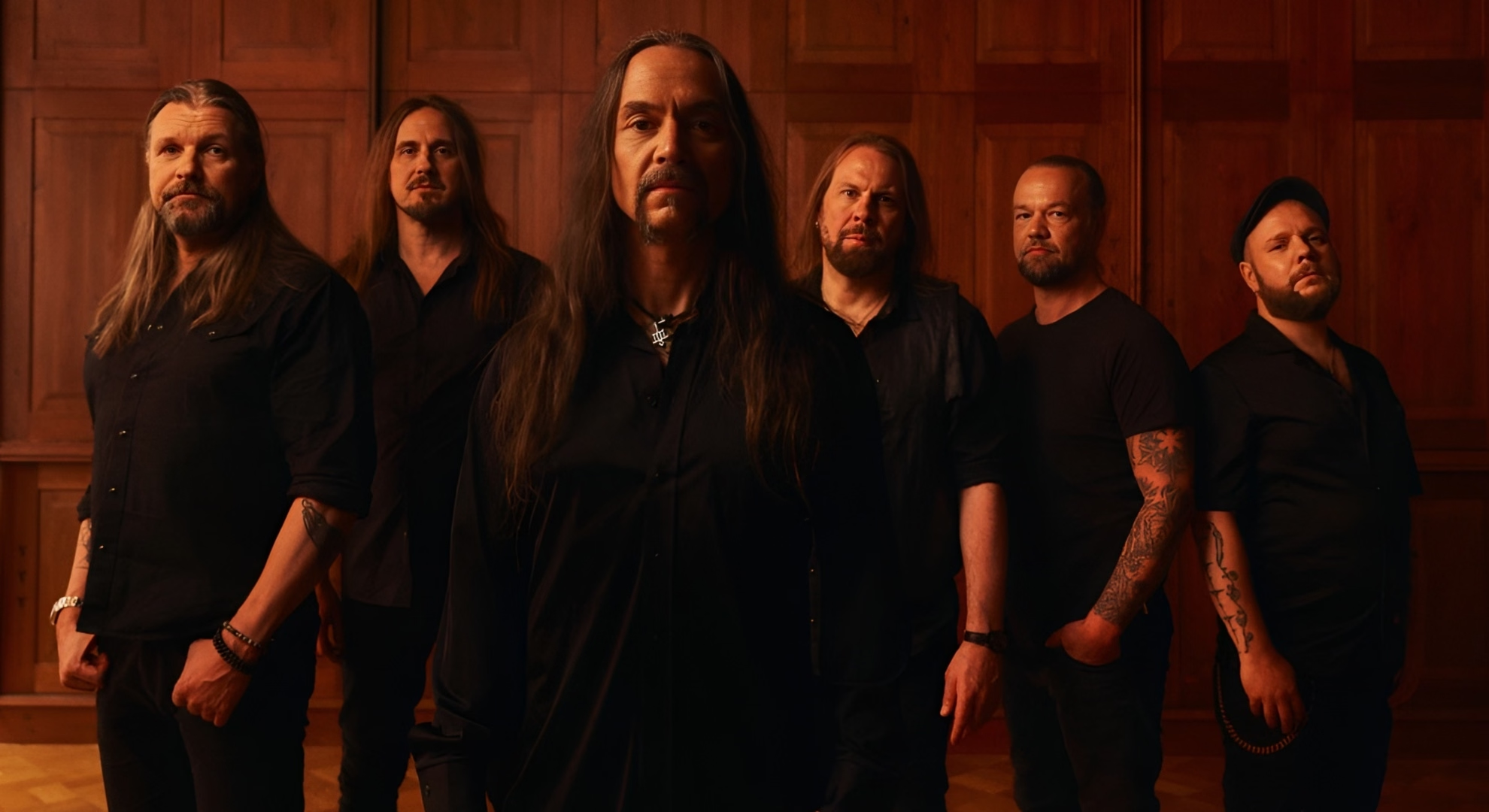
That inheritance has been the working material of Amorphis for three decades, and on October 9th it returns to Bogotá in a room the band has never played. The Finnish sextet performs at the Auditorio CEG on Avenida Caracas, in Chapinero, after a date first announced for the Teatro Astor Plaza moved a few blocks across the same district.
It is the band’s fourth appearance in the capital. The address is new, the bass player is a stand-in, and the argument the music makes is older than either change.
A Poem Meant for Two Voices
The Kalevala was never a text for silent reading in the communities that produced it. The verses assembled in the nineteenth century came from singers, and the hundreds of thousands of lines preserved in Finnish archives were all originally performed to melodies.1
Among the most generous of those sources was Arhippa Perttunen, a Viena Karelian singer from whom Elias Lönnrot transcribed thousands of lines in 1834. The epic, in other words, is a written record of a sound.
Amorphis was the first metal band to take up that material, drawing on the Kalevala and its lyric companion, the Kanteletar, for ‘Tales from the Thousand Lakes’ in 1994 and ‘Elegy’ in 1996. ‘My Kantele,’ from the second of those records, is still the song most often named as the model of Kalevala-rooted heavy metal.2
The distinction matters in a city schooled on Scandinavian extremity. The black metal records that circulated through Bogotá’s clubs in the nineties drew menace from blasphemy and provocation, while Amorphis draws its gloom from a text, from archaic diction, and from a singing practice that treated grief as something to be voiced in company.
That practice finds an echo in Colombian rooms. The old Karelian singers worked in pairs, the second voice returning each line the first had offered, and a Bogotá crowd that answers a guitar figure with its own voice performs a version of the same exchange.
The Fourth Night in Bogotá
The relationship began in bars, with two early appearances in rooms far smaller than any theater. The third visit, on April 15th, 2024, filled the Teatro Libre in Chapinero on the tour for ‘Halo.’
October 9th therefore belongs to a pattern of return rather than discovery. The Bogotá date falls midway through a run that took the band through Japan, China, and Australia in September and continues through Mexico and Costa Rica before Colombia, with Santiago, Buenos Aires, Curitiba, Belo Horizonte, and São Paulo still ahead.
The Auditorio CEG stands at Avenida Caracas No. 63-23, on the thoroughfare that has carried the city’s north-south traffic since 1932 and now carries the TransMilenio trunk line. Its operators present it as a new space for culture and entertainment, and its recent programming includes the Norwegian progressive act Leprous, which played there in March 2025.
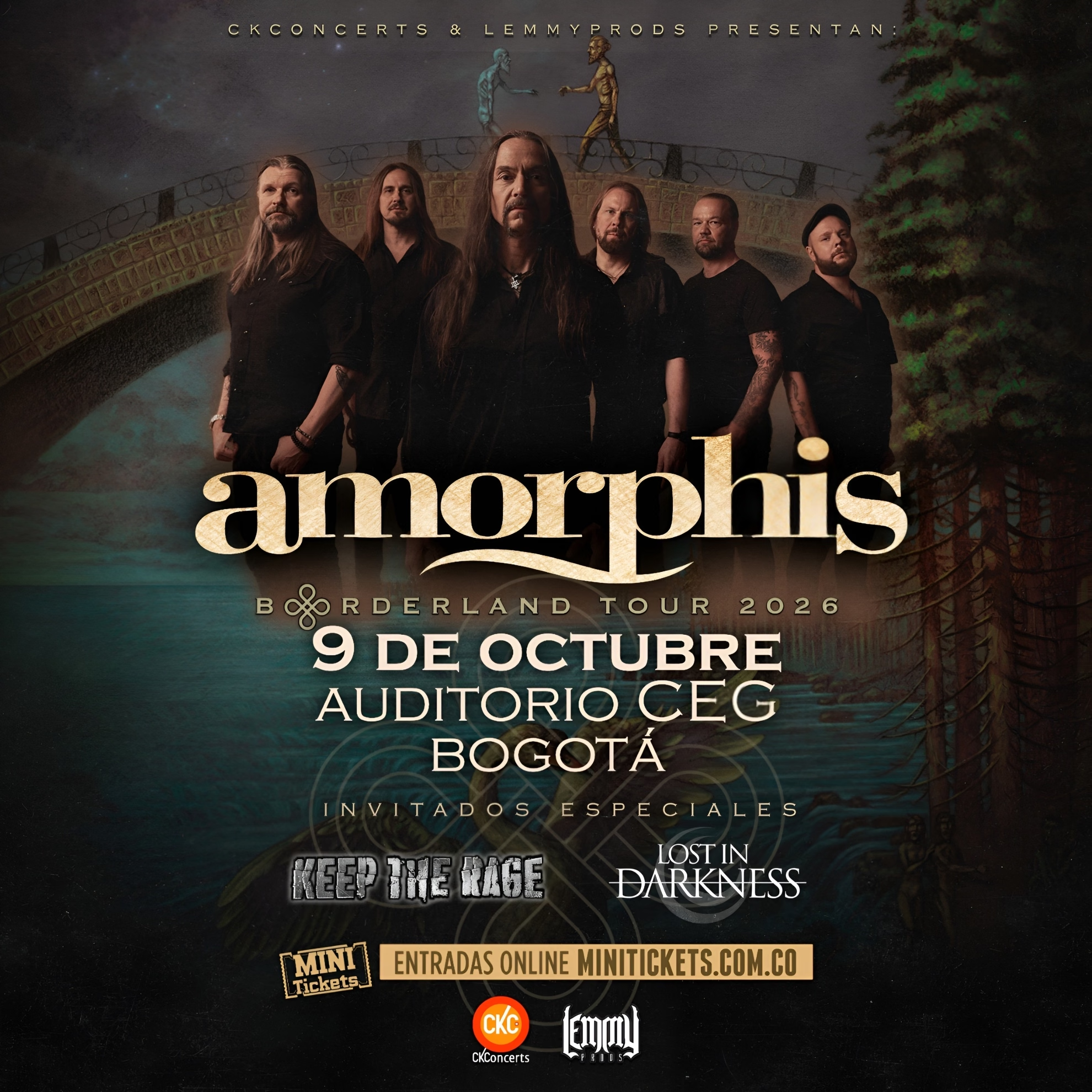
Admission is sold in a single general tier at 190,000 COP (approximately $61 USD), with doors at 7:00 PM and entry limited to attendees 18 and older.
Two Colombian bands open the night, and the pairing is precise. Keep the Rage, a Bogotá melodic groove metal band that played Rock al Parque on June 21st, 2025, as one of the festival’s 20 district-selected acts, gives the evening the capital’s own rhythm-first heaviness. Lost in Darkness, formed in Medellín in 2004, plays melodic doom-death, the idiom Amorphis helped define on its earliest records, and so offers the room a Colombian reading of the headliner’s own point of departure.
In Bogotá a ticket at that price is a considered commitment rather than an impulse. That is what gives a fourth visit its weight, because the city has sustained this relationship one paid night at a time.
Bones Beneath the Borderland
The tour carries ‘Borderland,’ the band’s fifteenth studio album, released in September 2025. Its second single, ‘Bones,’ is the heaviest song on the record, and keyboardist Santeri Kallio explained that he began it wanting to prove a keyboard player could write an Amorphis song around a heavy riff.
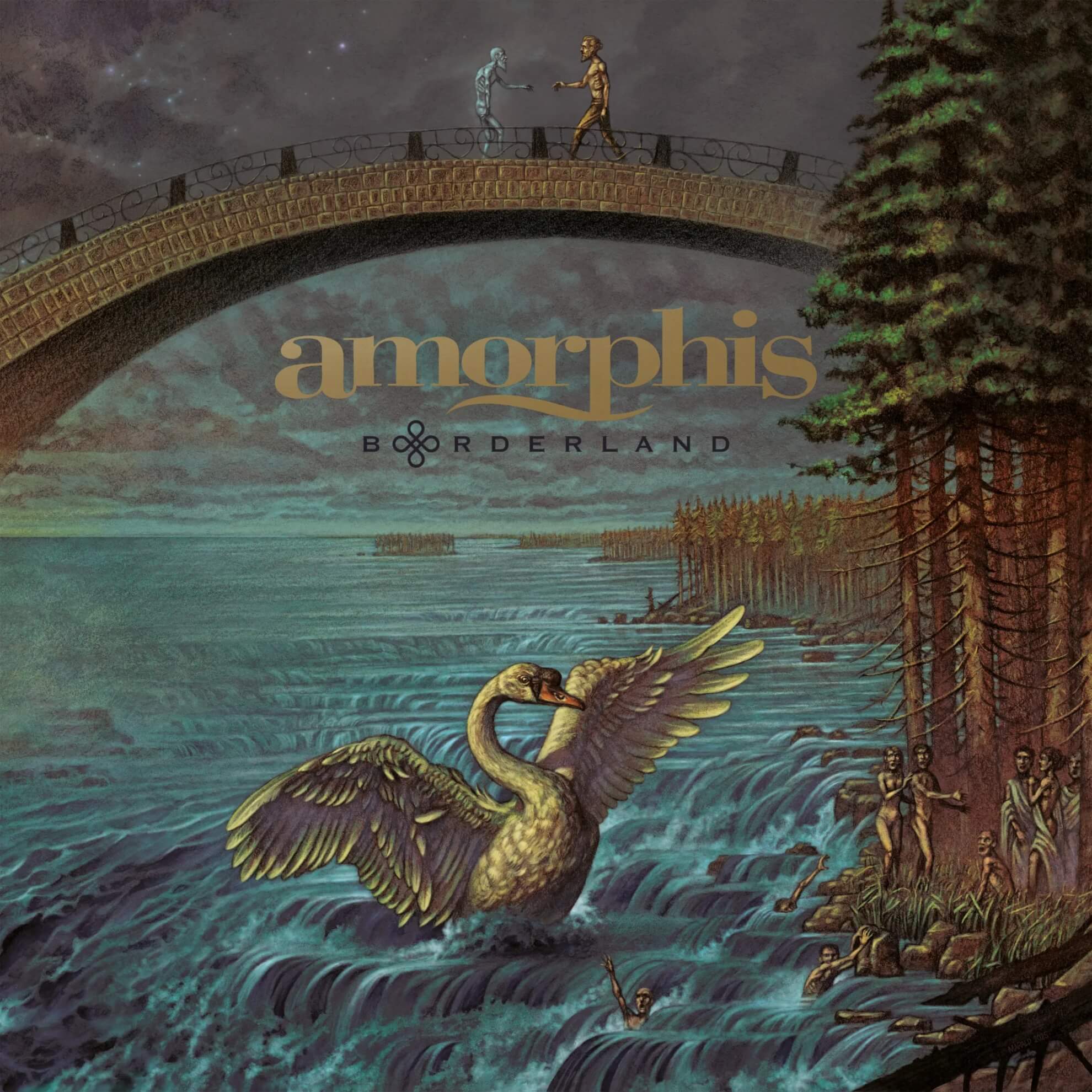
The lyric raises the dead from a field of remains under a climbing moon, ancestors who will not stay beneath the soil. Beside ‘My Kantele,’ the song measures three decades of distance, since the early records set verses drawn from the old poetry while ‘Bones’ invents new folklore in its image.
A Borrowed Low End
The Bogotá lineup carries one change. In a statement published in September, bassist Olli-Pekka Laine said he was stepping aside from touring for the rest of the year for personal reasons and noted that “the low end remains in the best possible hands.”
Laine played on the band’s first records in the early nineties and rejoined in 2017, and he has said he expects to return early next year. His absence removes, for one night, a musician present at the moment Amorphis first turned to the Kalevala.
His replacement, Pyry Hanski, is a Finnish bassist whose credits include Before the Dawn and …And Oceans. He also played on ‘Into the Eternity a Moment We Are,’ the 2018 debut of the Finnish-Greek doom band Aeonian Sorrow, whose harsh vocals were sung by the Colombian vocalist Alejandro Lotero, lead guitarist of Lost in Darkness from 2006 to 2010, and recorded in Colombia.
The detail is small and telling. Music scenes of this kind link distant local communities through recordings, musicians, and fans rather than through a single center,3 and the man holding the bass on October 9th has already made a record with a Colombian voice on it.
Cementerio Central, Calle 26
Within half an hour of the venue by TransMilenio, south along the Avenida Caracas line, the Cementerio Central occupies the ground between Calle 24 and Calle 26 at Carrera 20. It opened in 1836, during the presidency of Francisco de Paula Santander, and was declared a National Monument in 1984.
Its oldest section, an elliptical ring of republican-era mausoleums, preserves the funerary sculpture of nineteenth-century Bogotá, and the poets José Asunción Silva and Rafael Pombo rest there among former presidents. Popular devotion to the souls of the dead still gathers at certain tombs, where the living leave petitions for people they never knew.
The Kalevala places the dead in Tuonela, a realm beyond a river that the living may still approach for counsel. The cemetery on Calle 26 keeps a comparable arrangement in stone, a city of the dead set within the city of the living and still addressed by it.
The Answering Voice
An epic that survived because singers kept handing each line to one another has never depended on a fixed room or a fixed roster. On October 9th, a new address, a borrowed bassist, and a city on its fourth hearing carry the verse forward the way it has always traveled, aloud and in company.
Which Amorphis song would you most want to hear the Auditorio CEG sing back to the stage, and what has it come to mean to you across the band’s visits to Bogotá?
Tourism Partnership
We reach an audience that travels with intention — drawn to documented history, dark heritage, and the cultural weight of the places they seek out. If you operate tours, cultural experiences, accommodation, or heritage sites aligned with that ethos, we would like to hear from you. We consider partnerships with tour operators, travel agencies, hostels, hotels, museums, and any organization whose work engages seriously with dark tourism, gothic culture, or historical travel. We do not promote services we cannot stand behind editorially. Reach us through our Contact page.
References
- Hannu Tolvanen, ‘The Quiet Past and the Loud Present: The Kalevala and Heavy Metal,’ Volume! 5, no. 2 (2006): 76–78. ↩︎
- Kari Kallioniemi and Kimi Kärki, ‘The Kalevala, Popular Music, and National Culture,’ Journal of Finnish Studies 13, no. 2 (2009): 61–72. ↩︎
- Richard A. Peterson and Andy Bennett, ‘Introducing Music Scenes,’ in Andy Bennett and Richard A. Peterson, eds., ‘Music Scenes: Local, Translocal, and Virtual’ (Nashville: Vanderbilt University Press, 2004), 8–9. ↩︎



Leave a Reply