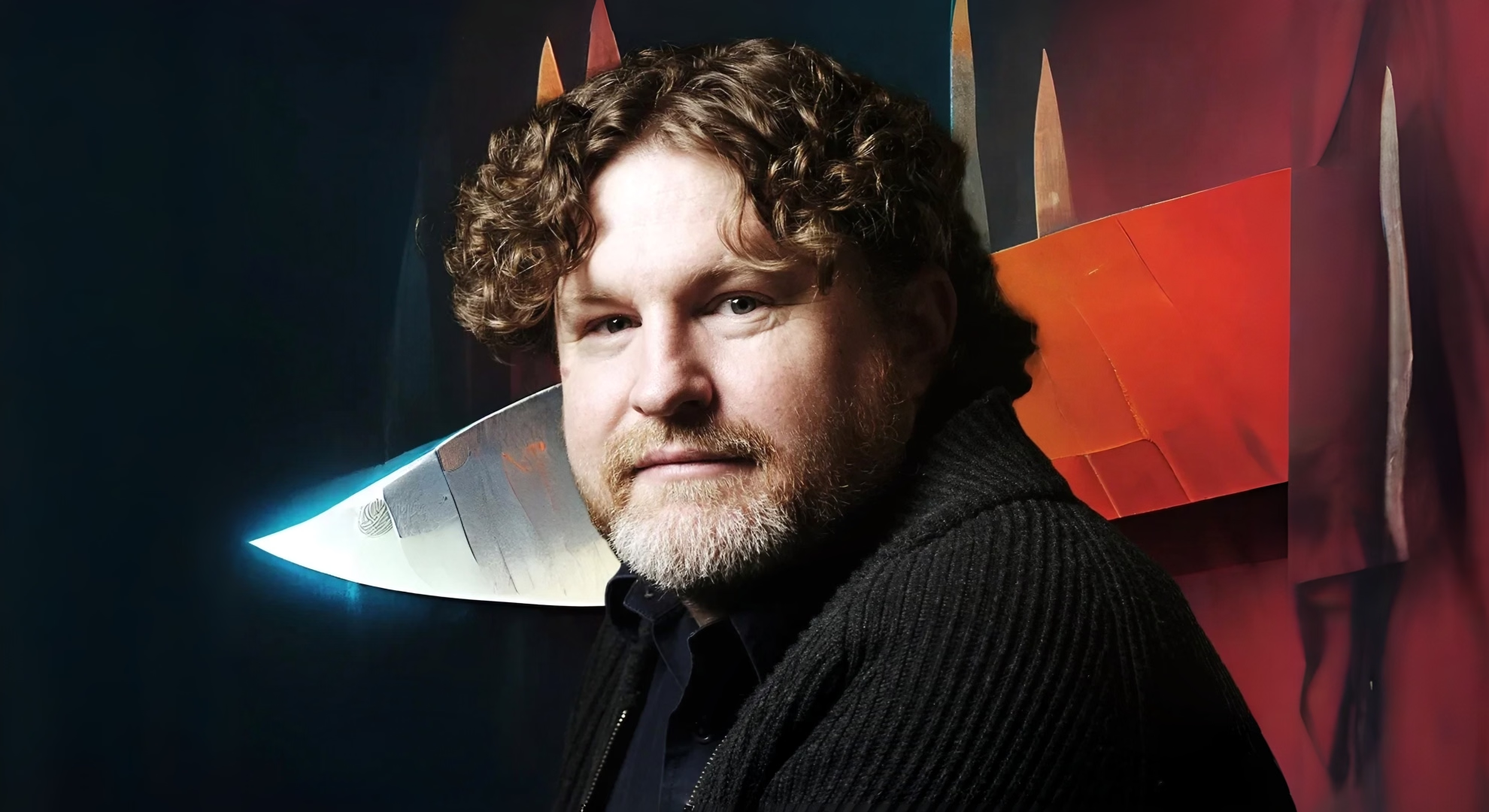


A cult can lose its compound and keep its creed. That is the situation at the center of ‘Phantom Limb,’ the new novel by Brian Evenson that Coffee House Press releases on October 13th, 2026, as a 200-page trade paperback. After the headquarters of an underground amputation cult is dismantled, the character Kline is imprisoned. He is then drawn into an investigation of ritual murders tied to a splinter faction, with the added danger that the inquiry may lure him into its ranks.
The author is at home in this register. Evenson has won the World Fantasy Award, the International Horror Guild Award, and the Shirley Jackson Award, and his collection ‘Song for the Unraveling of the World’ took both the 2019 Shirley Jackson Award and the 2020 World Fantasy Award. The publisher calls the new book “frigid and precise,” and frames its questions around wholeness, fate, and the pursuit of a higher power.
Where Kline Was Left
Kline first appeared in ‘The Brotherhood of Mutilation,’ a novella issued by Earthling Publications in 2003 as a limited edition. Evenson has said that he wrote that first part first and published it as a chapbook, then wrote a second part and published the two together as ‘Last Days.’
In an interview published October 8th, 2019, he described a deliberate shift between the two parts, driven by the main character’s changing relationship to the brotherhood and to himself, and he said he was in the middle of writing “a sequel to it, called ‘Phantom Limb,’ which shifts it even further.”
The chronology settles any doubt about the new book’s ancestry. ‘Phantom Limb’ continues a story begun in 2003, and Evenson had named the sequel in public seven years before its release. It is the third movement of a narrative about one man and one institution, not a departure into new material.
Earthling and Coffee House
The Coffee House release follows an earlier one. In August 2026, Earthling Publications issued ‘The Mutilation Trilogy,’ a set of standalone hardcovers gathering ‘The Brotherhood of Mutilation,’ ‘Last Days,’ and ‘Phantom Limb,’ with artwork by Chris Nurse. The set carries introductions by Paul Di Filippo, Peter Straub, and Luigi Musolino, who introduces the sequel, along with a new afterword by Evenson.
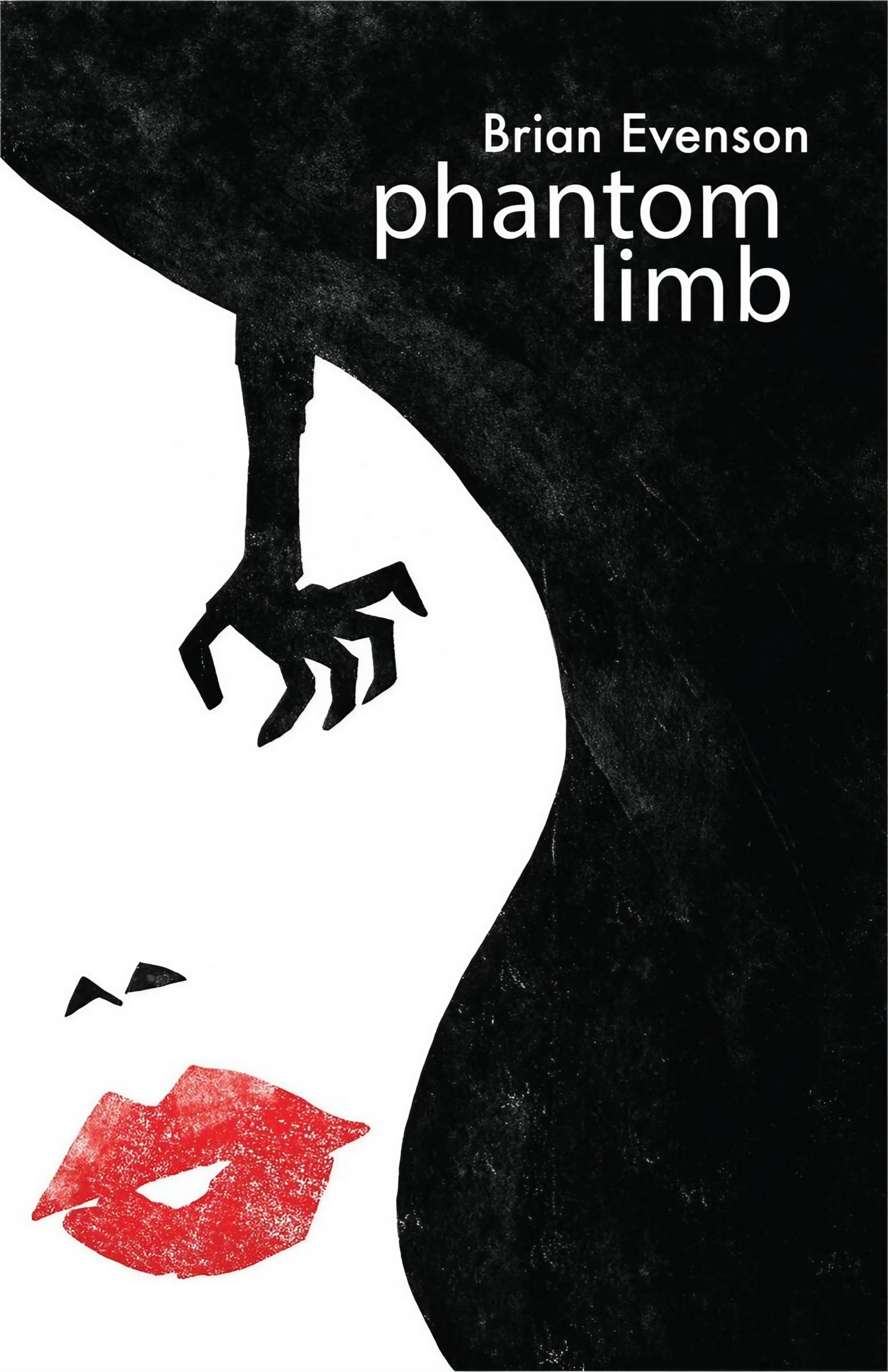
Earthling states that its edition of ‘Phantom Limb’ is “the true first.” That claim holds for English-language editions only: Éditions Rivages issued the novel in French as ‘Membre fantôme’ on May 7th, 2025, in a translation by Jonathan Baillehache. The October 13th paperback is therefore the first English-language trade edition rather than the first appearance of the text.
Nurse is credited with the artwork across the Earthling volumes, but the images were not available for assessment at the time of writing. The cover artist for the Coffee House edition had not been confirmed at the time of publication.
Raised Inside a Doctrine
Evenson’s interest in belief has a biographical root. Raised in the Church of Jesus Christ of Latter-day Saints, he published the collection ‘Altmann’s Tongue’ in 1994 while teaching at Brigham Young University, and the violence of its stories set off an uproar there.
He left the university in 1995, after administrators told him, by his account, that the collection was unsuitable work for a faculty member. He broke with the church around 2000.
His fiction since then runs from Utah-set psychological horror to cult noir, alongside translations from the French and media tie-in novels written under the name B. K. Evenson.

His immediately preceding book, ‘Good Night, Sleep Tight,’ appeared from Coffee House Press on September 10th, 2024, runs to 229 pages, and in the publisher’s description concerns artificial intelligence, post-human relationships, maternal warmth, and ecological dread. Placed beside it, ‘Phantom Limb’ reverses direction.
The collection looks forward to bodies replaced or imitated by machines; the novel looks back to a body diminished by deliberate subtraction. Both decline to treat the body as a settled thing.
A Term Born on the Ward
The title belongs to medicine before it belongs to fiction. Silas Weir Mitchell, a Philadelphia physician who worked as a contract surgeon during the Civil War, treated wounded soldiers at Turner’s Lane Hospital and described the sensations of lost limbs as “sensory hallucinations.”
The phrase “phantom limbs” entered medical language through his later writing. Mitchell also wrote fiction, and his story ‘The Case of George Dedlow,’ the account of a man who loses both arms and both legs, was his first attempt at it. Dedlow describes himself as “not a happy fraction of a man,” and the story ends at a spiritualist séance where he is “reindividualized” and walks on invisible legs.
The same history ties the phantom to belief. Horatio Nelson, after losing his right arm in battle, took the sensation of his phantom arm as “direct evidence for the existence of the soul.” His reasoning was that if an arm could survive amputation, a person could survive death. In the interviews consulted, Evenson has given no account of why he chose the title, so the connection below is this publication’s reading and not a stated intention.
Flesh as Doctrine
A phantom limb is the felt presence of what has been removed. A cult organized around amputation, which the publisher frames as a pursuit of a higher power at the cost of wholeness, is the one institution for which that sensation is not a symptom but a sacrament: what is cut away continues to be felt, and the felt absence can be preached as presence.
Once the compound falls, the same logic operates at the scale of the institution. The headquarters is the amputated limb, and the splinter faction is the phantom, still acted upon, still painful, still insisting that it is there.
The novel itself had not circulated at the time of writing, so its prose, pacing, and handling of dread cannot be assessed here. The publisher’s materials and the author’s statements support the premise and the sequence of events, not a verdict on execution. What can be said is structural. The earlier book divided its two parts by Kline’s shifting relation to the brotherhood, Evenson says the sequel shifts that relation further, and the publisher’s summary bears this out in the risk that Kline is drawn into the splinter faction.
Subtraction That Persists
The strongest claim available for ‘Phantom Limb’ before its release is a narrow one: it tests whether a doctrine of loss can outlast the institution that taught it, in a series its author has been circling since 2003. Dismantling a compound removes the address, and the sensation remains in the body that was trained to feel it.
That is what Mitchell’s patients reported, what Nelson read as a soul, and what Evenson, by naming his sequel for the phenomenon, proposes as the afterlife of a cult. A paperback from a Minneapolis literary press and a limited hardcover from a horror specialist together make sure the question reaches the readers most likely to follow it.
Which novels or stories have followed a belief system after the institution that housed it was destroyed, and which of them deserve this publication’s attention next?

Leave a Reply