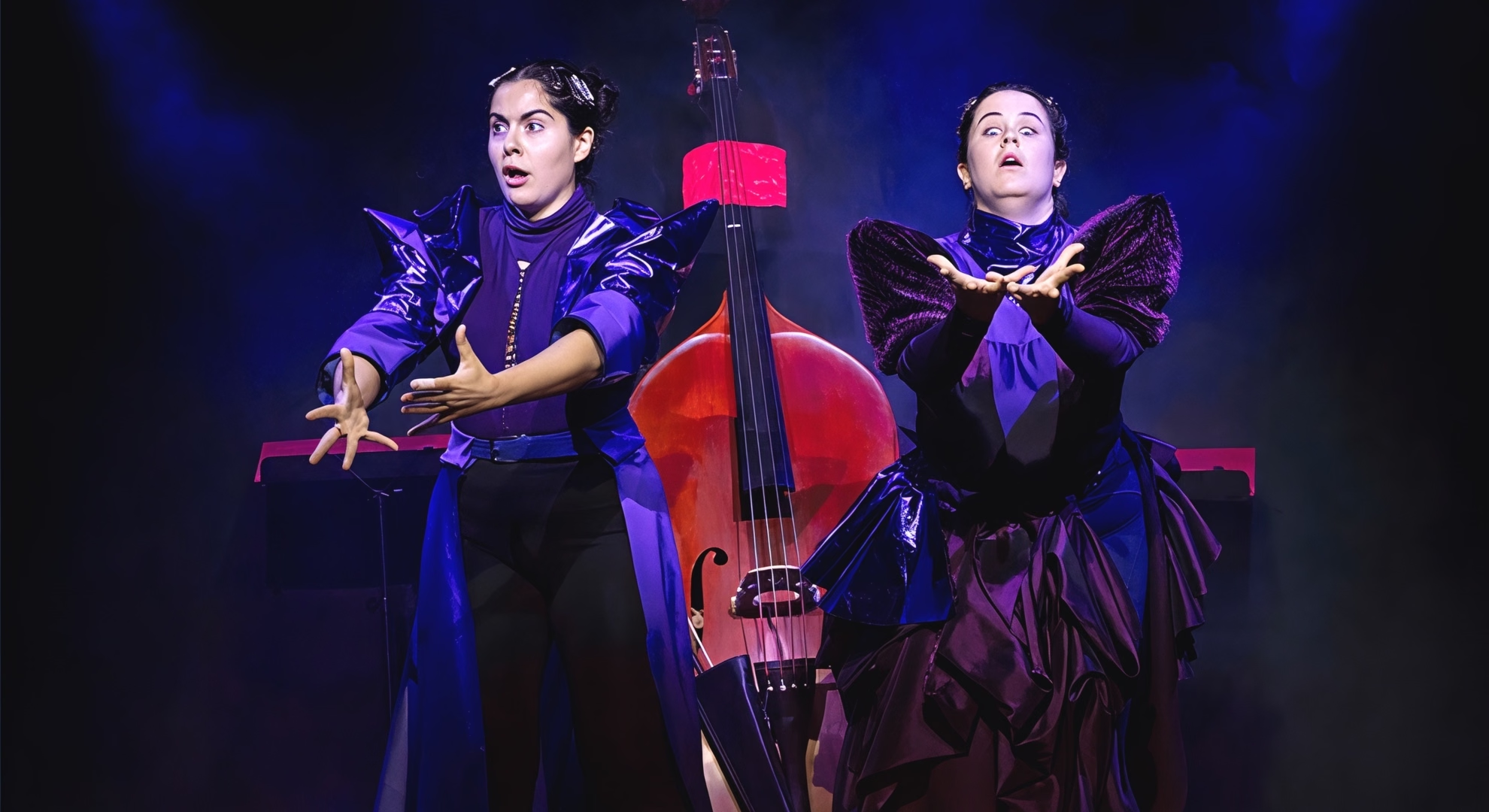


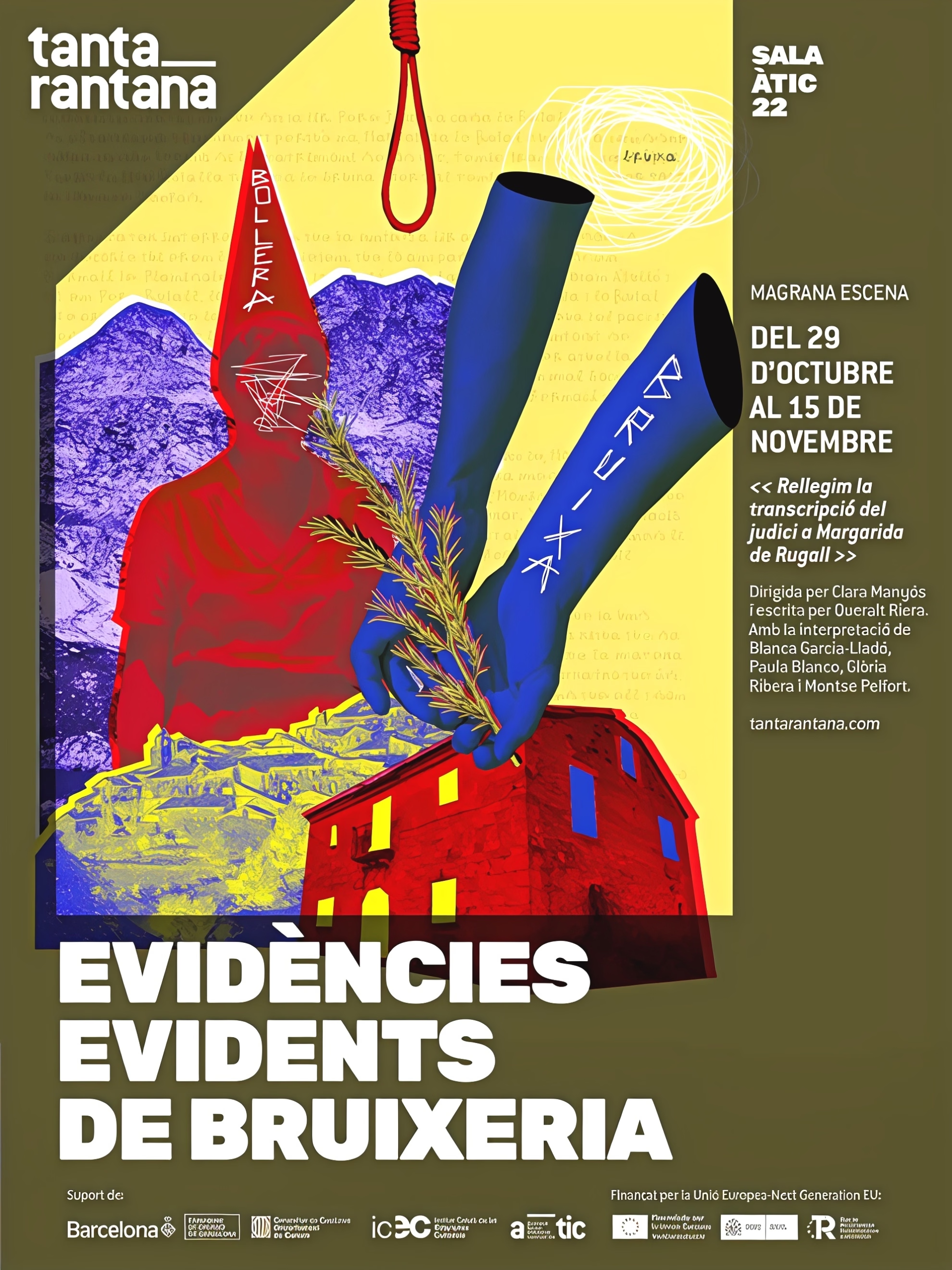
‘Evidències evidents de bruixeria,’ a Magrana Escena production directed by Clara Manyós from a text by Queralt Riera, runs at Teatre Tantarantana in Barcelona from October 29 to November 15, 2026. The performance is in Catalan and lasts 60 minutes. Its source is the transcript of a 16th-century witchcraft trial against Margarida de Rugall in the Vall Fosca, a mountain valley in the Catalan Pyrenees, and its title repeats the phrase that the company’s synopsis gives to the court as it condemns her to the gallows.
Four performers carry the evening: Blanca Garcia-Lladó, Paula Blanco, Glòria Ribera, and Montse Pelfort. Manyós directs, Riera is credited with the dramaturgy, and Manyós made brief modifications to the text. Jordi Cornudella composed the music and designed the sound, Sandra Prat of taller11 designed the scenography and lighting, Iris Ros made the costumes, and Rita Ollé served as assistant director.
The production adapts ‘Un ram de margarides (a cada nínxol de bruixa),’ a reading by Riera, directed by Manyós, that the Teatre Nacional de Catalunya presented in its 365 Dones l’any cycle on March 1 and 2, 2025.
According to the synopsis, the action moves between three moments. In the middle of the 16th century, in the town of Mont-Ros, a court finds what it calls evident evidence of witchcraft in the conduct of Margarida de Rugall and sentences her to hang. Her daughter takes her down from the gallows, keeps vigil over her, and honors her memory. Many generations later, a distant descendant reaches the family house, which everyone calls the witch’s house, and discovers the story.
Why It Matters
The central choice is the source. Starting from the transcript puts the procedure of accusation on stage before any interpretation of it: who asked the questions, which answers the court wanted, and how a widowed healer and midwife who owned land, in the company’s description, came to be named a danger to her neighbors.
The company noted that it is “surreal and almost comic to read the real manuscript of the trial” (translated from Catalan), given the far-fetched pretexts that were needed to accuse a woman of that description.
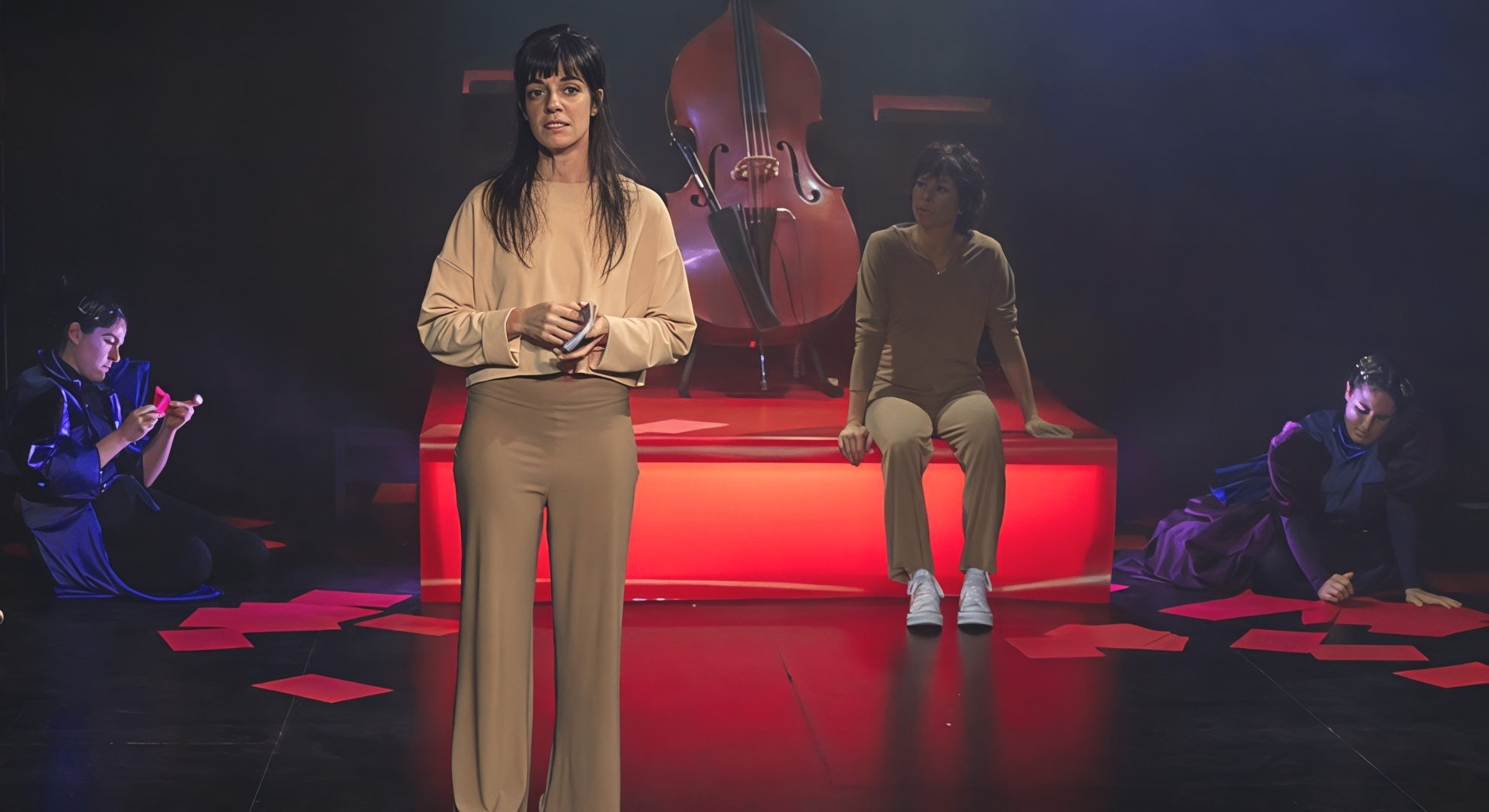
The structure then moves past the end of the record. A transcript stops when the court stops, and the synopsis follows the daughter who takes the body down and the descendant who finds the house, so that the evening continues into what survivors do with an accusation after the verdict.
The company also states a purpose in the present: its notes ask what will happen when, centuries from now, someone reads the absurd excuses with which sexism and lesbophobia are legitimized today. That parallel is the company’s own argument, and the court record discussed below does not supply it.
The Historical Record
A published scholarly edition documents a trial in the same valley that matches the company’s description in place, period, and the name of the accused, and, as the company’s notes also report for their own source, in the loss of the last page of the sentence.
Pau Castell i Granados of the University of Barcelona edited the transcripts, which are held in the Medinaceli Ducal Archive, and the accused he records is a widow named Margarida Rugall, resident in the village of Paüls within the Coma de Mont-ros.1 The company’s materials do not name this edition as its source, so the match is recorded here as a documented parallel and not as a confirmed link.
According to Castell i Granados, the trial ran from October 1548 to January 1549. It opened with a general inquiry at the castle of Mont-ros on October 12 and 13 and moved to the castle of Sort, the capital of the marquisate of Pallars. Five people from the Coma de Mont-ros, three men and two women, were arrested, and four of the victims survived.
The court examined bodies for marks it took as signs of witchcraft, dismissed the defense, and questioned the accused under torture over several weeks. The three surviving sentences find the accused guilty, and two of the men were hanged. The fate of Margarida Rugall is unknown, although the legal assessor recommended a death sentence.
The hanging shown on stage is therefore the artistic choice of Queralt Riera and Magrana Escena, not an established historical fact: the company’s own notes say only that execution is the most probable outcome.
The edition allows three layers of cause to be told apart. Locally, the Coma was a cluster of three villages, Mont-ros, Paüls, and Pobellà, at about 1,200 meters, where three witchcraft inquiries took place in roughly 50 years. One of the accused told the court that outsiders greeted people from the Coma with the words “You are from the land of the warlocks” (translated from Catalan).
Institutionally, the Cardona family held the marquisate from 1491, the marquis never lived in the territory, and the trial was presided over by his procurator general, the highest political, judicial, and administrative authority on the spot, advised by a legal assessor with a doctorate in law.
The holder of the Mont-ros castle as a fief and a Hospitaller commandery also held rights in the Coma, but neither exercised jurisdiction. Agustí Alcoberro of the University of Barcelona observes that in Catalonia and Aragon, unlike Castile and Valencia, witchcraft fell to the lay courts responsible for criminal justice.2
Doctrinally, the accusations followed a pattern already fixed in the 1424 ordinances of the Àneu valleys, which Castell i Granados describes as the first legal condemnation of a witches’ gathering in the European sphere: a pact with the devil, night gatherings, the killing of infants and animals, and the making of poisons.
The confessions recorded in 1548 follow that pattern and add a gathering place, the mountain pass of Serra Spina, and the case was not isolated. Castell i Granados identifies 13 witchcraft trials in Pallars between 1516 and 1593 in the Medinaceli archive, plus two further inquiries in the district of Toralla, in a period that expert historiography has treated as a pause in the European hunts.
Who Speaks in the Transcript
The record exists because a court wrote it. The notary Jaume Gervasi de les Eres, a public notary of the marquisate, set down the proceedings in Latin and in the Catalan of the Pallars. Castell i Granados observes that the notary noted the words, cries, prayers, and mockery of the accused with a rigor that contrasts with the omissions and concealments visible throughout the trial.
A change of handwriting at the sentence and in the marginal notes shows that the manuscript was worked on afterward, and it is not confirmed that the phrase giving the production its title appears in the notary’s manuscript: the synopsis attributes it to the judges, and the company’s materials do not say that it is quoted from the record.
The accusations rest largely on hearsay. Eight witnesses testified at the opening inquiry, seven men and one woman, and most reported only what they had heard said or what they suspected. The exception was a boy of 12, the son of one of the accused, whose reported statements most witnesses repeated and whom Castell i Granados describes as the source of the key accusation.
The transcript also preserves the order in which names appear. Joan de la Dida, one of the accused, first denied any knowledge of witchcraft in the valley, and then, after the prosecutor urged him to tell the truth and promised that it would go well for him, he confessed, as Castell i Granados relates.
On October 16 he said he did not know whether Margarida Rugall was a witch. By October 29, before the torture sessions began, he named her. Her own voice survives in an extended questionnaire in which, according to Castell i Granados, she describes healing practices that used herbs, oils, and wool, together with prayers and curative spells. What remains of her, in other words, is her answers in the notary’s hand to the questions of the people who tried her.
How to Attend
The production plays in the Sala Àtic 22 of Teatre Tantarantana, at 22 Carrer de les Flors in Barcelona, Wednesday through Saturday at eight in the evening and on Sundays at half past six in the evening. There are no performances on November 11 and 13. The language is Catalan and the running time is 60 minutes. The theatre’s listing does not mention surtitles or translation, so visitors who do not read Catalan may wish to ask the theatre beforehand.
A conversation follows the performance on Friday, November 6, with Manyós and the performers Garcia-Lladó, Blanco, Ribera, and Pelfort, moderated by the cultural journalist Pere Solà Gimferrer. On November 4, Manyós performs in place of Blanco. The room is on the second floor and is reached by stairs, and the theatre notes that there is no elevator. Tickets are sold through the theatre’s website, at listed prices from 11.50 euros to 24 euros.
The synopsis closes on a question put to the audience in the present tense: “And now? What continues to unite us with our persecuted and hanged ancestors?” (translated from Catalan). The company ties that question to a reading of the transcript, so that the procedure of accusation stays in view while the present is asked about. The record supplies a verdict that cannot be recovered in full, and the stage is where the company chose to ask what such a verdict leaves behind.
References
- Pau Castell i Granados, ‘La persecució senyorial de la bruixeria al Pallars: un procés contra bruixes i bruixots a la Vall Fosca (1548),’ Estudis Històrics i Documents dels Arxius de Protocols 27 (2009): 121–250. ↩︎
- Agustí Alcoberro, ‘La cacera de bruixes al Vallès (1619-1622): processos locals i causa general,’ Revista del Centre d’Estudis de Granollers 24 (2020): 7–30. ↩︎

Leave a Reply