


In the spring of 1575, a peasant from the Friulian village of Giassìcco told a parish priest that on certain Thursdays of the year his spirit left his sleeping body to fight witches in the fields with a bundle of fennel, and that the coming harvest depended on the outcome. Five years later, after interrogation and imprisonment, the same man agreed that the angel who had summoned him to those battles was the Devil in disguise.
Between the first statement and the second lies the inheritance a new Italian novel takes up: a vocabulary a community once used to protect itself, rewritten sentence by sentence into a vocabulary of damnation.
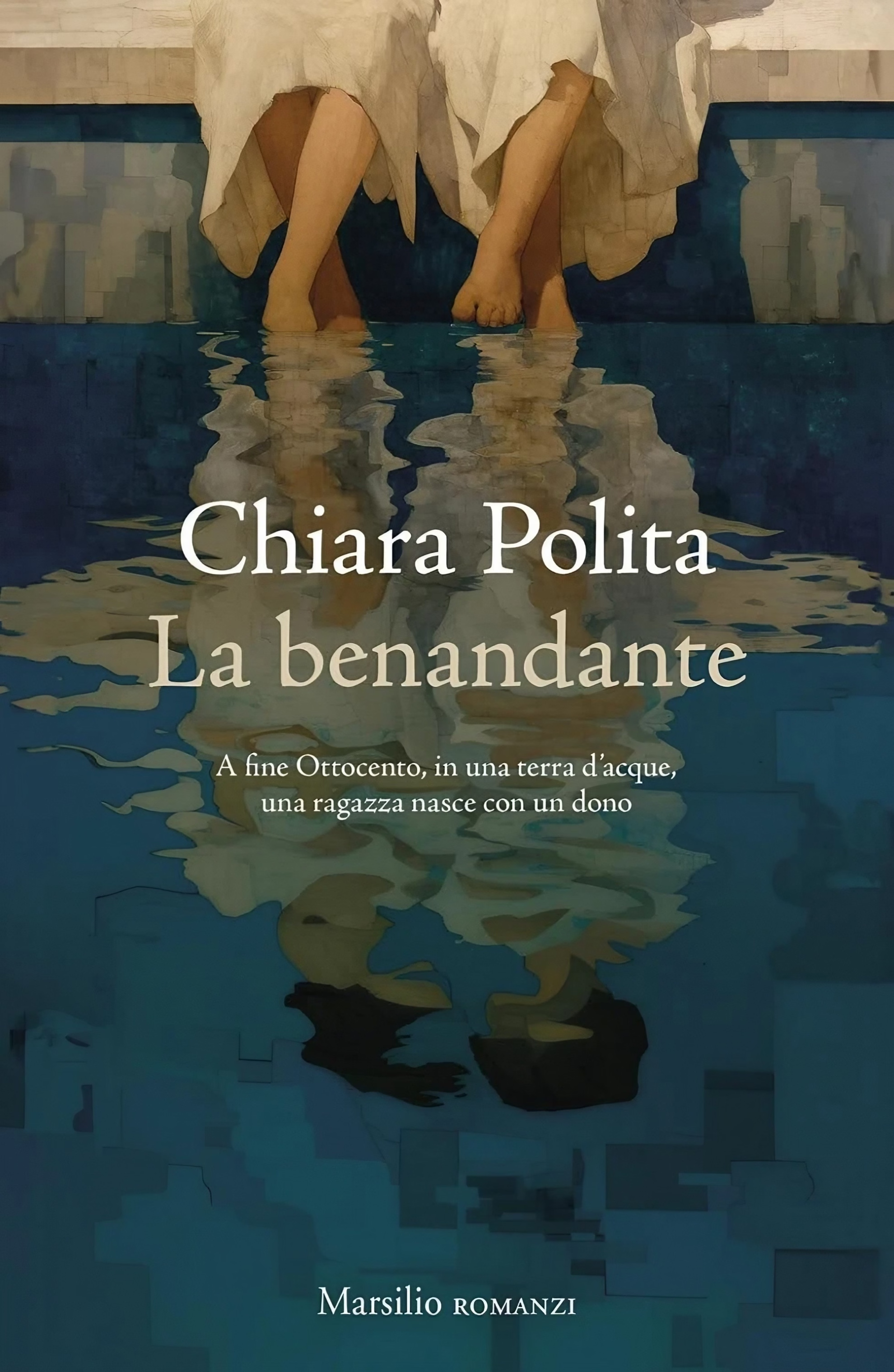
‘La benandante,’ Chiara Polita’s second novel for the Venetian publisher Marsilio Editori, goes on sale in Italy on October 13th, 2026, in a 432-page Italian-language edition (ISBN 978-88-297-9559-8).
Set in Polcenigo in 1887, it follows Lene, 12 years old, who sees the spirit of a girl reflected in the water of the Gorgazzo spring and takes it at first for a hallucination. When the apparition persists, Cumina — a woman the surrounding villages regard as almost a witch and almost a healer — tells her that the gift belongs to a far older tradition and that she can become a benandante. Behind the girl in the water, the publisher’s synopsis confirms, lies a femicide that was never solved.
The book is presented as a historical novel, and its claim on a dark-fiction readership rests on something more specific than atmosphere. It stages a ghost story inside one of the best-documented visionary traditions of early modern Europe and binds that ghost to a killing the living community would rather forget.
A seer, a dead woman, and a village’s inherited magical explanation for harm: that combination belongs to folk horror as firmly as it belongs to the historical novel. No English translation had been announced at the time of publication.
A Girl at the Abyss
Polita’s setting is chosen with precision. The Gorgazzo rises at the foot of the Cansiglio plateau, roughly a kilometer from Polcenigo, in the western Friulian province of Pordenone; its name derives from the Friulian “gorc,” meaning abyss, sharpened by an augmentative and pejorative suffix.
Divers have followed its flooded karst shaft to 212 meters, the deepest explored spring in Italy. The site already carried a nineteenth-century artistic afterlife by the time of the novel’s events: the painter Luigi Nono exhibited his canvas of the springs at Brera in 1873, and in 1877 the geographer Giovanni Marinelli wrote a sonnet likening its surface to a sky turned to water.
Polita sets her first apparition a decade after that sonnet, at a surface the region had already learned to treat as a window onto something beneath it.
The title is a feminine singular — “benandante,” from the Friulian benandant, “good walker” — and the grammatical gender carries meaning. In the trial records, male benandanti described leaving their bodies on the Thursdays of the Ember Days to fight witches over the harvest, armed with fennel against sorghum stalks; female benandanti more often described traveling in spirit to great nocturnal gatherings, where they learned which villagers would die within the year.
A girl whose gift is to see a dead girl belongs, by documented precedent, to that female branch, the one concerned less with crops than with the dead and what they know.
The novel’s promotional synopsis grants Lene the male branch’s dream battles against evil as well, and adds the birth sign the records attach to every benandante: she was born with the caul. The Italian idiom “nato con la camicia,” born with the shirt, still means simply born lucky; Polita’s title returns an everyday phrase to the Friulian belief that once gave it consequences.
The Good Walkers on Trial
The history behind the novel is specific and entirely archival. In 1575 Paolo Gasparotto of Giassìcco gave a charm to a miller whose son had fallen ill, and the parish priest Don Bartolomeo Sgabarizza, curious about the cure, heard from him the account of the Ember Day battles.
On March 21st, 1575, Sgabarizza brought the matter before the inquisitor at the Franciscan monastery of San Francesco in Cividale del Friuli. A second benandante, Battista Moduco, the public crier of Cividale, confirmed the stories, and the inquiry was set aside as peasant fantasy.1
The case was reopened on June 27th, 1580, by the Franciscan inquisitor Fra Felice da Montefalco. Moduco declared that the benandanti fought in the service of Christ; Gasparotto, after initial denials, added that an angel had called him to the company. Montefalco seized on the angel, and his questioning turned openly suggestive: was it not a demon in angelic form?
Under imprisonment and repeated interrogation, both men conceded the point. On November 26th, 1581, they were declared heretics and sentenced to six months in prison and to penances on the Ember Days themselves, the nights of their battles converted into nights of contrition.
Across the following century the pattern repeated. Between 1575 and 1675 a succession of benandanti came before the Holy Office in Friuli, and with each generation of interrogation their testimony moved closer to the clerical template of the witches’ sabbath, until the distinction between the defenders of the fields and the witches they claimed to fight collapsed.
Maria Panzona of Latisana, a self-declared benandante and professional healer arrested in 1618, was transferred to Venice and sentenced to three years’ imprisonment for heresy. The tradition did not disappear because its adherents abandoned it; it disappeared because the only institution recording it could hear it in a single vocabulary.
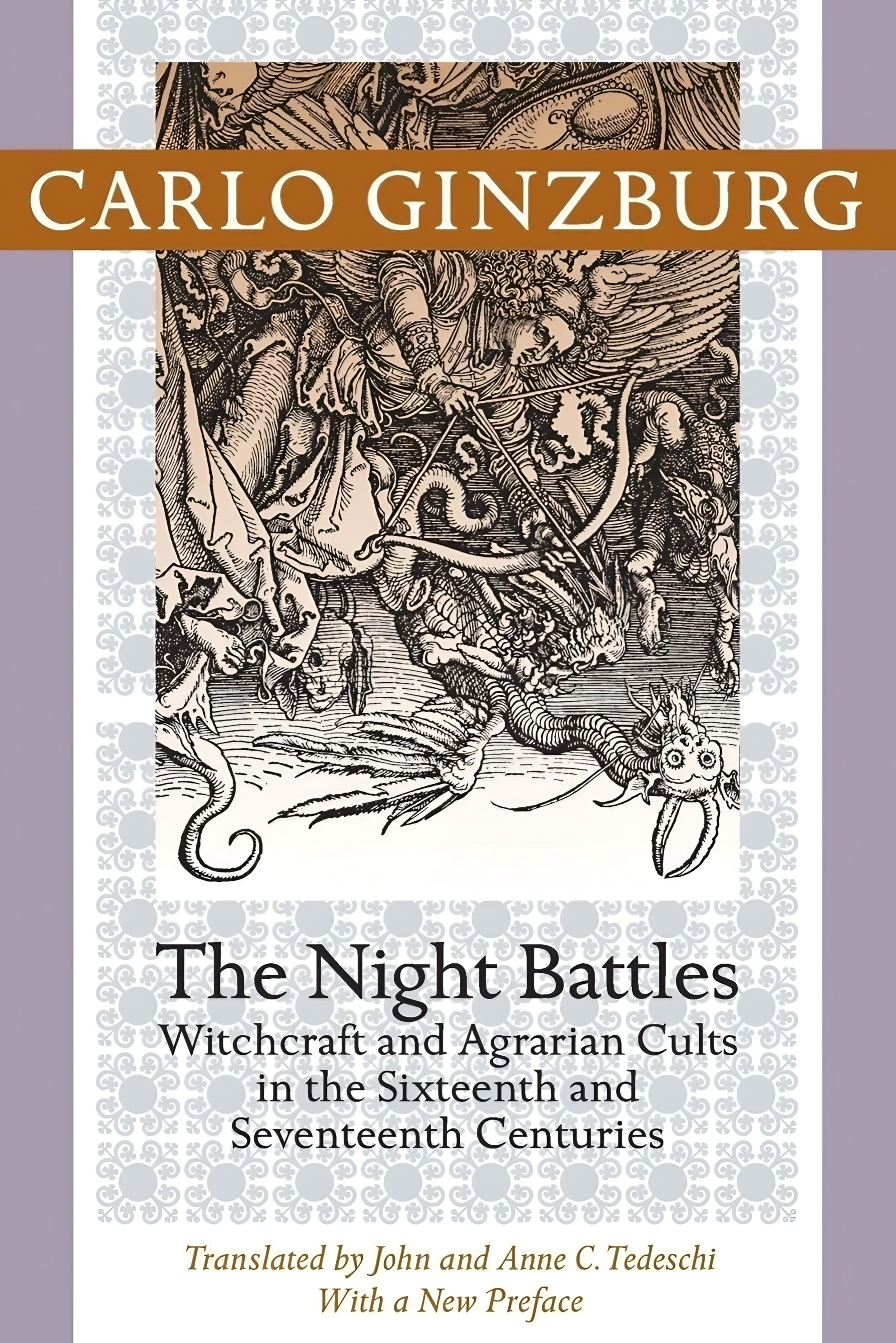
That record survived precisely because it was never meant to preserve the benandanti. Carlo Ginzburg found the trial files in the archiepiscopal archives of Udine in the early 1960s and published his reconstruction as ‘I benandanti’ in 1966; the English translation, ‘The Night Battles,’ followed in 1983. Ginzburg read the practice as an agrarian fertility rite, a surviving fragment of a wider European complex of visionary combat reaching as far as Livonia, and that interpretation remains contested.
Norman Cohn argued in ‘Europe’s Inner Demons’ (1975) that nothing in the sources justified calling the benandanti the survival of an ancient fertility cult, and later historians of witchcraft have pressed the same objection. No historian disputes the mechanism the files document: the progressive conversion of a local visionary practice into diabolism by the institution interrogating it.
A Word Turned Against Itself
In the year Polita chose, that conversion had long since reached ordinary speech. Friulian folklorists of the late nineteenth and early twentieth centuries, Valentino Ostermann among them, recorded benandante in popular usage as a plain synonym for strega, witch: the name for the protector had become the name for the threat. Lene therefore receives a title her own valley uses as an accusation.
Cumina, suspended between witch and healer in the publisher’s description, is the living form of that semantic damage, the figure who keeps the older meaning while bearing the reputation the newer one assigns. To call a girl a benandante in Friuli in 1887 is to call her two opposite things at once.
The trials record a second edge to that title. Benandanti did not only defend; they named. Gasparotto denounced two individuals as witches during his 1580 interrogations, and by the 1620s self-professed benandanti were publicly accusing neighbors, women among them, of bewitching children and households, accusations that inquisitors frequently dismissed.
The seer’s power to identify who had caused harm was the same power that could deliver a neighbor to suspicion. A novel that gives that power to a 12-year-old girl and points it at the unsolved killing of a woman sets the tradition’s protective and accusatory faces against each other, and makes the community’s response to her the measure of which face it remembers.
The Historian as Detective
‘La benandante’ reaches readers four months after the death of the historian who made its subject legible. Ginzburg died in Bologna on June 17th, 2026, at 87. Beyond the benandanti, his most influential statement of method was the 1979 text ‘Spie. Radici di un paradigma indiziario,’ published in English as ‘Clues: Roots of an Evidential Paradigm,’ which set the historian beside the physician reading symptoms and the detective reading traces, all practitioners of a knowledge assembled from marginal, involuntary details.
Polita’s premise joins Ginzburg’s two subjects in a single plot: a girl from the visionary tradition he excavated undertakes an inquiry of the kind his clue paradigm described, reading a village’s silences for the traces of a buried crime.
Marsilio’s materials make no claim that Polita wrote in dialogue with Ginzburg, and this publication makes none on her behalf. The convergence is structural, and it gives the book a sharper critical frame than period witchcraft dressed in costume could supply.
Ghosts Without a Sabbath
On the structure the publisher has confirmed, the novel braids its two registers rather than alternating them. The gift for seeing the dead is the instrument of the investigation, not a parallel subplot, and the dead girl is at once apparition and witness. That arrangement reverses the evidentiary order of the old trials, in which the visions of the living were the testimony and the inquisitor decided what they meant.
Here the vision points toward a crime the community declined to pursue, and the promotional summary locates the dread precisely: the gift forces Lene to look at what the living would prefer to forget. The horror sits in the gap between what a village knows and what it has agreed to say. The prose itself was not available for assessment ahead of the October 13th release, and nothing in this account substitutes for it.
In Italian letters the novel’s line runs back at least to the fantastic tales of the Scapigliatura. Igino Ugo Tarchetti’s ‘Racconti fantastici’ appeared in 1869, less than two decades before Lene’s apparition, and admitted the uncanny into Italian fiction through the provincial and the half-believed.
The benandanti have recently entered popular Italian fiction from the opposite direction: in Tiziana Triana’s ‘Le città perdute. Luna nera,’ issued by Sonzogno, the imprint Marsilio has controlled since 2011, they appear as a brotherhood of witch hunters, the historical defendants recast as persecutors. Polita restores the documented polarity, and in doing so poses a harder problem than either the hunter or the heroine framing permits: a seer who is also, by inherited reputation, a suspect.
From the Piave to the Livenza
Polita lives and works in San Donà di Piave, in the eastern Veneto, where she has long combined writing with work as a cultural organizer. Her published output began with three poetry collections and a book of short stories, accompanied by nonfiction on the history and art of her territory that in recent years concentrated on the First World War along the Piave, including ‘La grande guerra degli ultimi. «Di qua e al di là del Piave»’ (Mazzanti Libri, 2016).
In 2020 her manuscript ‘Siamo l’acqua, siamo la terra,’ a choral historical novel set among the reclaimed marshlands of the Lower Piave, won the novel section of the 18th Arcangela Todaro-Faranda biennial prize for unpublished Italian fiction, awarded in Bologna by a jury of the literary scholar Marco Antonio Bazzocchi, the critic Roberto Carnero, and the novelist Simona Vinci. The winning works appeared that year from Bononia University Press.
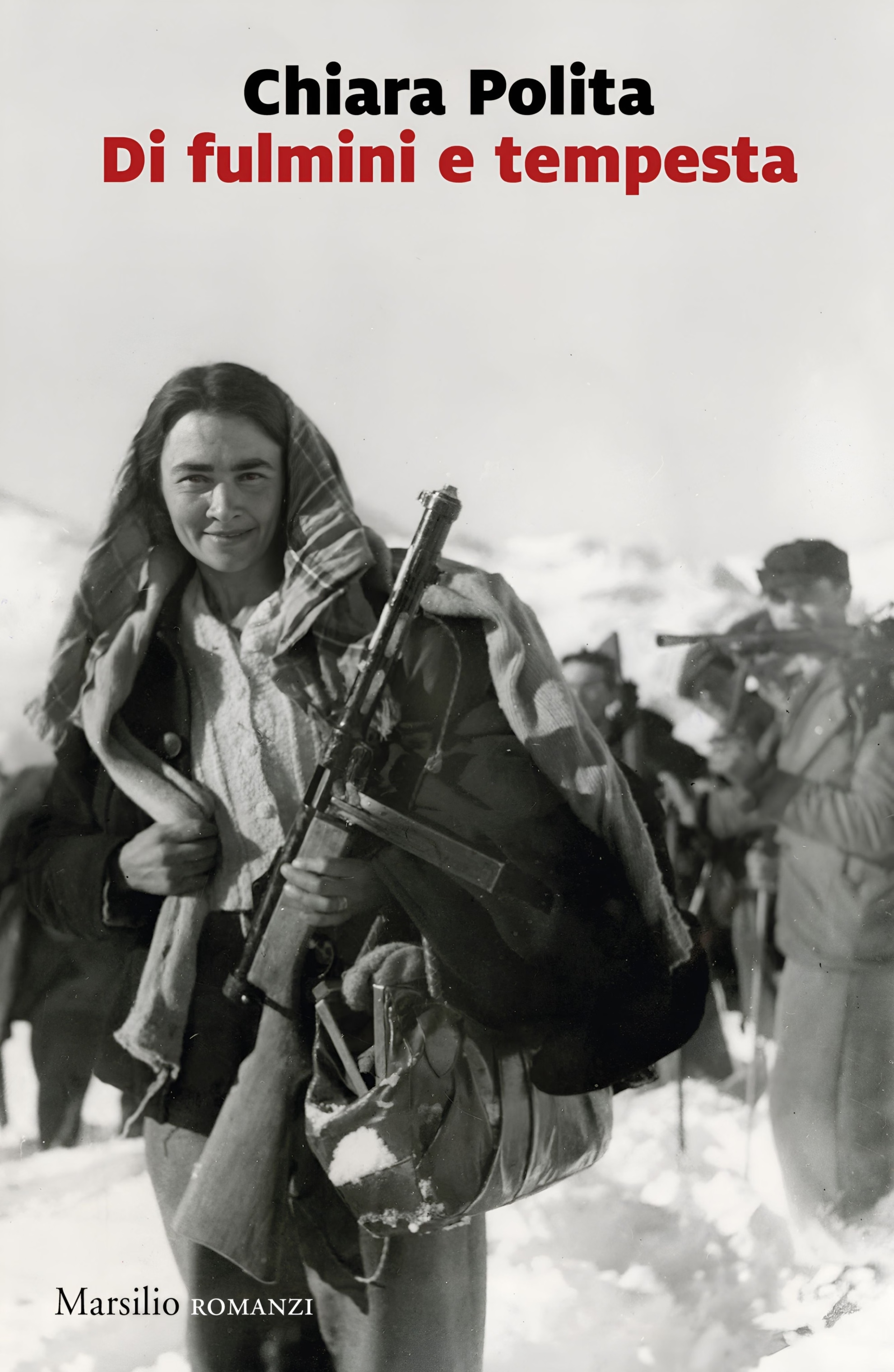
‘Di fulmini e tempesta’ (Marsilio, April 2025) was presented on its first book tour as her debut, though it was more precisely her first novel for a national trade house. It opens in the autumn of 1943 in the eastern Veneto and follows Maria, a 48-year-old worker at the jute mill of San Donà di Piave, a pragmatic woman of few words drawn into the Resistance through a younger colleague.
The novel sets invented characters beside documented figures of the local Resistance, grounds its plot in research on the San Donà patriots, and keeps the Piave beside Maria through arrests, reprisals, and losses as both setting and governing image.
The continuity with ‘La benandante’ is direct. Both novels center a woman the conventional heroic template would overlook, a middle-aged factory worker in one and a peasant girl in the other, and both read a community through its water: the Piave there, the Gorgazzo and the Livenza basin it feeds here.
The move from 1943 to 1887 is less a change of subject than a change of archive. The earlier book drew on the records of wartime violence in a single town; the new one draws on the folk record that the Holy Office’s own files preserved, and on a crime against a woman that no record preserved at all.
A Venetian House of Crime
Marsilio was founded on February 23rd, 1961, in Padua by a group of recent graduates of the city’s university and named for Marsilius of Padua, the fourteenth-century philosopher and jurist; it has long been based in Venice and has belonged to the Feltrinelli group since 2020. Its genre identity is crime rather than horror.
The Giallosvezia series introduced Italian readers to Scandinavian crime fiction, Stieg Larsson’s Millennium trilogy among it. ‘La benandante’ fits that list through its investigative spine while carrying the house into territory its fiction catalog rarely enters, where the supernatural functions as testimony. The cover designer and the book’s editor had not been confirmed at the time of publication.
The Cartagena Mirror
For readers in Colombia, the benandanti case has a precise local counterpart, though not quite the one it is often assumed to have. The Holy Office established its tribunal at Cartagena de Indias in 1610, with jurisdiction over the New Kingdom of Granada and much of the Caribbean.
Indigenous peoples lay outside its reach: a royal decree of Philip II in 1571 had excluded them from the Holy Office’s jurisdiction in matters of faith, leaving Indigenous healing and ritual practice to episcopal authorities.
The Cartagena tribunal’s witchcraft prosecutions therefore fell chiefly on enslaved and free Afro-descendant women and men and on Spaniards, the populations whose healing, love magic, and herbal knowledge the tribunal interpreted through the European template of the diabolical pact.2
The clearest Colombian counterpart to Gasparotto is Paula de Eguiluz, born into slavery in Santo Domingo around 1592 and known across the Caribbean as a healer and practitioner of what the records call the “arte del bien querer,” the art of keeping love.
Brought before the Cartagena tribunal in 1624, arrested again in 1632, and sentenced in a public ceremony in the city’s main square on March 25th, 1638, she eventually described a pact with the Devil, a confession that historians including Kathryn Joy McKnight have interpreted as a strategic accommodation to the narrative her judges required.
The pattern is the one the Friulian files record: a practitioner her community knew as a healer, questioned until her testimony matched the sabbath her interrogators already believed in.
Colombian fiction has already given this mechanism its definitive literary form. Gabriel García Márquez’s ‘Del amor y otros demonios’ (1994) follows Sierva María de Todos los Ángeles, bitten by a rabid dog on her 12th birthday in colonial Cartagena, a girl raised among the enslaved Africans of her father’s household whose languages, songs, and knowledge the Church reclassifies as demonic possession.
Lene and Sierva María share an age and a predicament: each is a girl whose inherited, extra-institutional knowledge an adult world can read only as witchcraft. García Márquez’s novel ends in the convent where that reading destroys its subject. Polita’s premise points the other way, toward a girl who turns the suspect gift against the silence surrounding a murdered woman, and that inversion is what gives the Friulian novel a claim on a readership raised on Cartagena’s version of the story.
Testimony From the Spring
Four centuries after the benandanti last stood before their inquisitors, the files that condemned them remain the only reason anyone can write about them at all. ‘La benandante’ turns that paradox into plot. Its seer is a figure the tribunals spent a century teaching Friuli to fear, and its ghost is a woman whose death left no file.
Placing the two together, Polita lets the oldest suspect in Friulian folklore become the only witness a murdered woman has, a reversal that matters wherever an institution once decided which knowledge counted as healing and which belonged to the Devil.
Which novels have you read that draw their fiction directly from inquisitorial trial records — in Friuli, the Basque country, Cartagena de Indias, or elsewhere — and which of them deserve this publication’s attention beside ‘La benandante’?
References
- Carlo Ginzburg, ‘The Night Battles: Witchcraft and Agrarian Cults in the Sixteenth and Seventeenth Centuries,’ trans. John Tedeschi and Anne Tedeschi (Baltimore: Johns Hopkins University Press, 1983), 1–32. ↩︎
- Anna María Splendiani, José Enrique Sánchez Bohórquez, and Emma Cecilia Luque de Salazar, ‘Cincuenta años de inquisición en el Tribunal de Cartagena de Indias, 1610–1660,’ 4 vols. (Santafé de Bogotá: Centro Editorial Javeriano and Instituto Colombiano de Cultura Hispánica, 1997), vol. 1. ↩︎

Leave a Reply