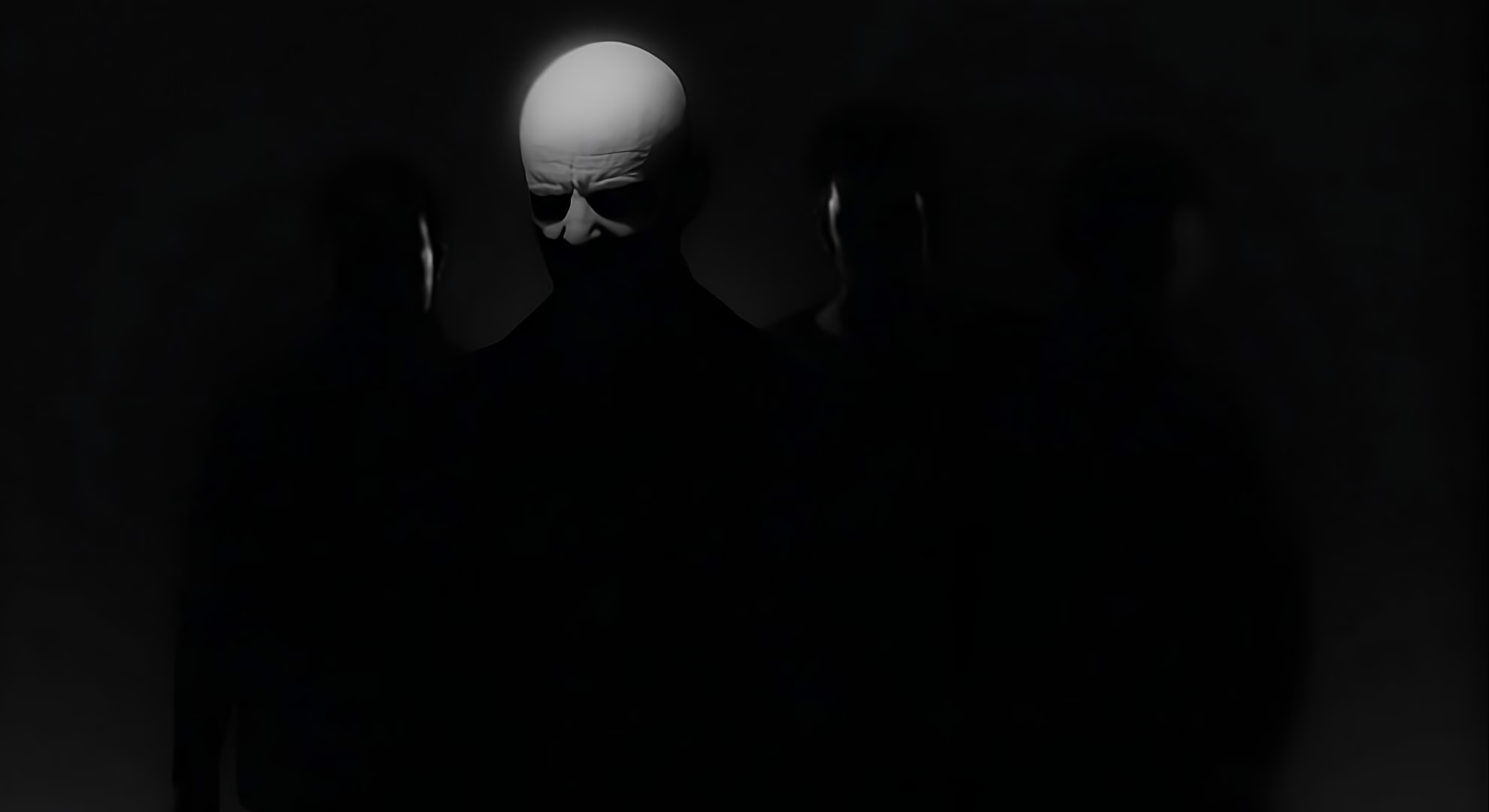


The lyric sheet of a black metal album is not, strictly speaking, a standalone literary object. It functions as one layer of a larger work: words that exist in relation to music, performance, and the physical design of the object that carries them. ‘Syner,’ a hardcover collection issued by Harg Forlag Publishing on April 30th, 2026, proposes a different arrangement.
The book gathers Hilde “Hildr” Nymoen’s complete lyric work for the Norwegian black metal band Khold — twenty-five years of Norwegian-language verse, translated into English by the author herself and augmented by contextual commentary on history, folklore, and Norse mythology. It makes a quiet but deliberate case that this body of writing has earned its own critical attention independent of its recorded context.
A Voice Long in Shadow
Hilde “Hildr” Nymoen has been the lyrical engine of two of Oslo’s most significant black metal bands since the early nineteen nineties, without ever occupying a performing role in either. She began writing for Tulus — one of the first True Norwegian Black Metal bands, formed in 1991 by her husband Sverre “Blodstrup/Gard” Stokland and drummer Thomas “Sarke” Berglie — from the outset of the band’s recorded output. When those same members established Khold in 2000, her lyrical role transferred without interruption.

Her work for Khold and for the Sarke project — the latter fronted by Ted “Nocturno Culto” Skjellum of Darkthrone — earned her two Spellemann Award nominations, Norway’s principal music industry recognition. Both nominations confirmed what sustained listening already demonstrated: that Khold’s literary dimension was not incidental to the music but constitutive of it.
Harg Forlag, the publishing house Hildr operates herself, previously issued ‘Prestekragemyndighet,’ a poetry collection attributed to her civilian name Hilde Nymoen and working in a different literary mode, with a small number of Hildr’s darker compositions included. ‘Syner’ is the first volume to address the black metal body of work directly and in its entirety.
From Tulus to Khold
The relationship between Tulus and Khold is not that of predecessor and successor but of parallel operation. Tulus released their debut full-length, ‘Pure Black Energy,’ in 1996; when Khold formed from the same core lineup four years later, Tulus continued. Both bands have operated simultaneously, sharing members and the same lyricist, across the entirety of their recorded histories.
Khold’s first label, Moonfog Productions — the imprint operated by Satyricon’s Sigurd “Satyr” Wongraven — signed the band after hearing a demo recorded in late 2000. The debut album, ‘Masterpiss of Pain,’ followed on April 23rd, 2001. It established the band’s defining characteristics immediately: down-tuned, mid-paced black metal with a pronounced groove, a complete rejection of English-language lyrics, and a thematic engagement with death, Norse folk belief, and the particular character of Norway’s natural world.
Seven additional albums followed: ‘Phantom’ (2002, Moonfog Productions), ‘Mørke Gravers Kammer’ (2004, Candlelight Records), ‘Krek’ (2005, Tabu Records), ‘Hundre År Gammal’ (2008), ‘Til Endes’ (2014), ‘Svartsyn’ (2022, Soulseller Records), and ‘Du dømmes til Død’ (2024, Soulseller Records), the last produced by Andy La Rocque at Sonic Train Studios, Sweden.
Eight Albums and What They Ask
Across eight studio albums, Hildr’s writing for Khold engages a specific set of concerns: death as both personal loss and cultural inheritance, ancient Norse religious practice, the historical record of violence within Scandinavian society, and the human instinct to locate meaning in natural phenomena that offer none.
These are not metaphorical gestures toward darkness; they are precise subjects rendered in archaic Norwegian diction that connects extreme metal to a longer literary tradition of Nordic verse.
‘Du dømmes til Død,’ the most recent album, is a concept work documenting actual historical executions in Norway, from the first witch burnings in the sixteenth century to the last public beheading in 1876.1 Each of the nine songs takes a different documented case as its subject: specific people, named places, verified events. The lyrics function as documentary verse, a mode with its own tradition in Scandinavian literary history.
The Eighth Album in Full
Released March 22nd, 2024 on Soulseller Records and produced, mixed, and mastered by Andy La Rocque at Sonic Train Studios in Sweden, ‘Du dømmes til Død’ is Khold’s most formally focused record. The nine tracks address specific documented cases of capital punishment drawn from Norwegian legal history, and the album’s 32-minute runtime compresses the material without atmospheric interlude.
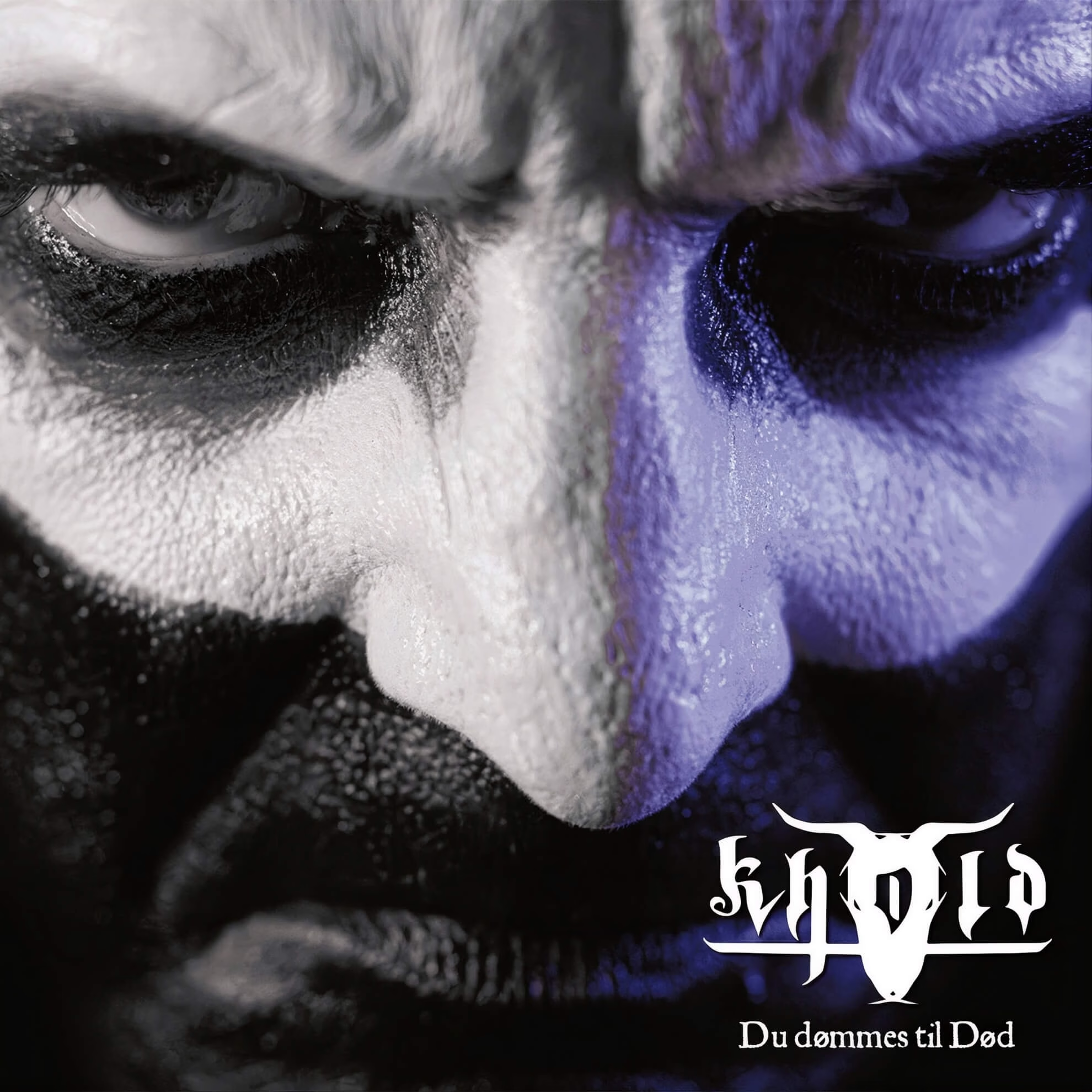
The tracklist reads as a catalogue of historical offence and official response: ‘Myrdynk’ addresses murder by drowning; ‘Heks (du dømmes til død)’ a witch formally condemned to death, with a melodic solo by La Rocque providing one concession to formal convention; ‘Trolldomsdømt’ conviction for sorcery; ‘Skoggangsmann’ the Norwegian outlaw placed outside legal protection; ‘Dølgsmål’ the concealment of birth, a capital offence in Norwegian statute for centuries.
‘Galgeberg og Retterbakke’ names the physical sites of public execution that stood at the edges of Norwegian cities into the nineteenth century.
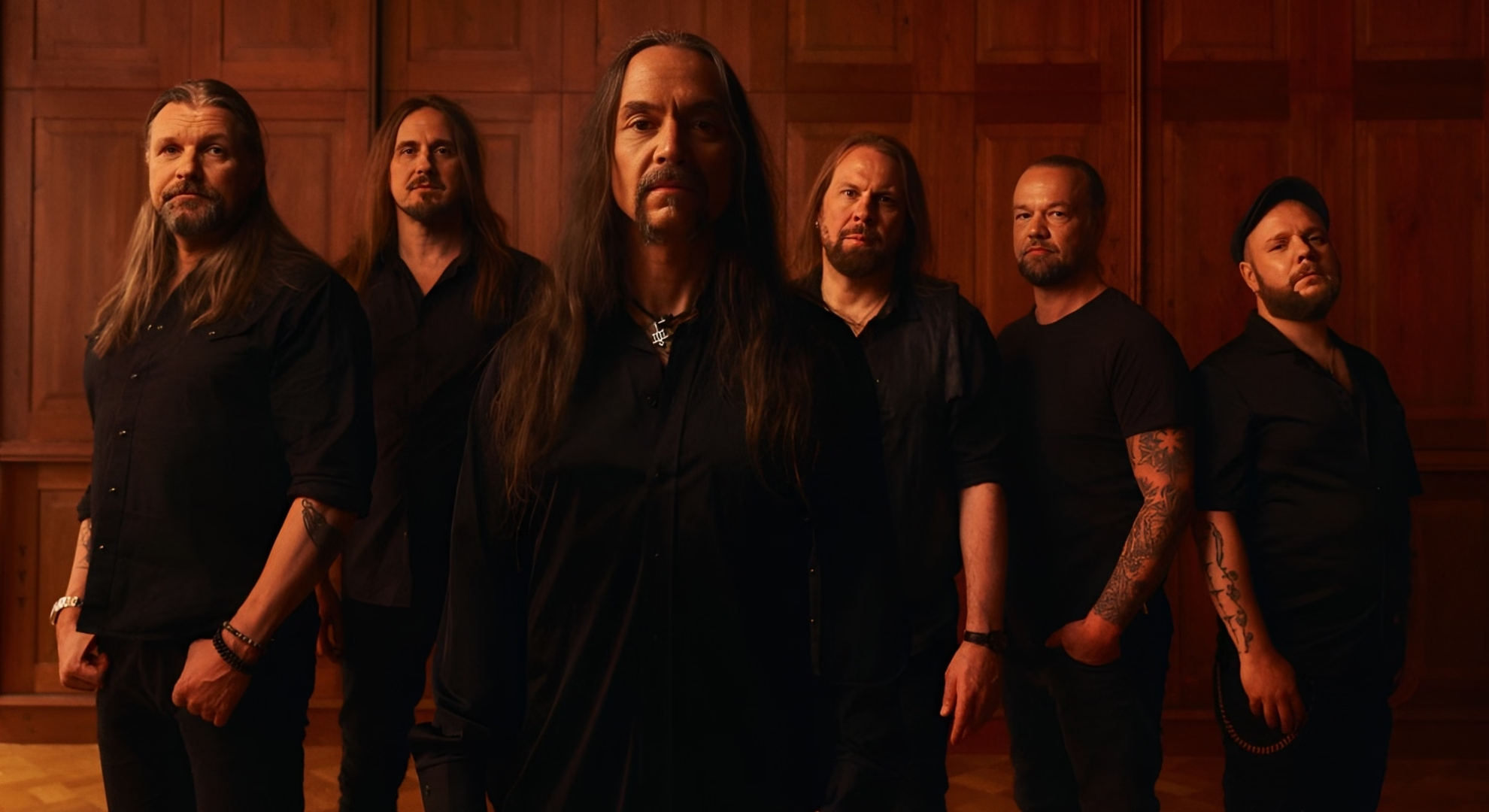
The lineup adds one change from prior recordings: bassist Steinar Gundersen, known on the album simply as Steinar, joined Gard, Rinn, and Sarke for the sessions, drawing from his work in Sarke’s extended circle. The LP editions of the album carry alternative cover art designed by Kjell Åge Meland, on 150gsm art paper in a 300gsm carton sleeve, distinct from the CD version.
Inside the Volume
‘Syner’ collects the complete lyric output Hildr produced for Khold’s eight studio albums, presenting each work in its original Norwegian alongside her own English-language translation. Her stated approach to translation is artistic rather than literal: the English versions are independent expressions of the same material, designed to preserve the poetic quality of the originals rather than to produce transparent equivalents.
The book also includes contextual additions — commentary on Norse mythology, Norwegian folk history, and the documented circumstances behind specific songs. The ‘Du dømmes til Død’ section is particularly rich in historical detail, as each execution case the album addresses is accompanied by Hildr’s own annotation.
One addition in that section carries particular weight: after the album’s completion, Hildr discovered that one of her own ancestors had served on a committee during a witch trial in Norway. That biographical connection, unknown at the time of recording, became a 2026 addition to ‘Syner’ — a poem in which the historical record and the author’s personal lineage become indistinguishable.
Reading Verse Without Music
The question ‘Syner’ puts to any attentive reader is whether verse written in service of musical performance retains its force when removed from that frame. The volume makes no prefatory argument on the matter; it presents the material and lets the writing carry its own case.
Hildr’s decision to translate her own work is both the volume’s central editorial commitment and its most defensible one. The elevated archaic Norwegian she writes would not survive a conventional literary translation without significant loss; her English versions function as what translation theory calls free verse renderings — independent expressions of the same material, governed by fidelity to poetic register rather than semantic equivalence. The result is two distinct readings sharing a page: not source and shadow, but two expressions of the same core intention.
Where Hildr’s annotations connect a lyric to a specific documented historical event — as they do throughout the ‘Du dømmes til Død’ section — the volume is fully self-sufficient as a reading experience. The more incantatory verse of Khold’s earlier albums, which drew part of its force from Gard’s delivery and the specific mid-paced weight of the music, may ask more of a reader approaching it cold, without prior knowledge of the recorded sources.
That is an accurate description of how the material works on the page, not a case against the volume. ‘Syner’ is not offered as a replacement for the records; it is offered as a parallel reading of the same body of verse. What it makes available is the possibility of encountering Hildr’s writing as poetry with its own internal coherence — one that the music carried for twenty-five years without requiring acknowledgment outside the album insert.
The Scope of Dark Non-Fiction
‘Syner’ sits within dark non-fiction as precisely as any subgenre permits. A verse collection grounded in witch burnings, official executions, Norse folk horror, and pagan religious practice does not require a fictional frame to belong to the tradition of dark literary publishing. The historical record it engages — Norway’s long archive of documented persecution and execution — is itself a dark document of the first order.
The companion volume ‘Vintervolve,’ released simultaneously and gathering Hildr’s complete lyric output for Tulus, covers adjacent territory: ancestral grief, the Norwegian winter as an existential condition, and ancient religious feeling that Christianity suppressed without eliminating. A separate feature on ‘Vintervolve’ is available in this publication.
Together, the two volumes constitute a sustained literary engagement with the darker strains of Norwegian cultural inheritance, one that takes the form of poetry but makes no less specific a claim on the reader’s attention.
The Book as Artifact
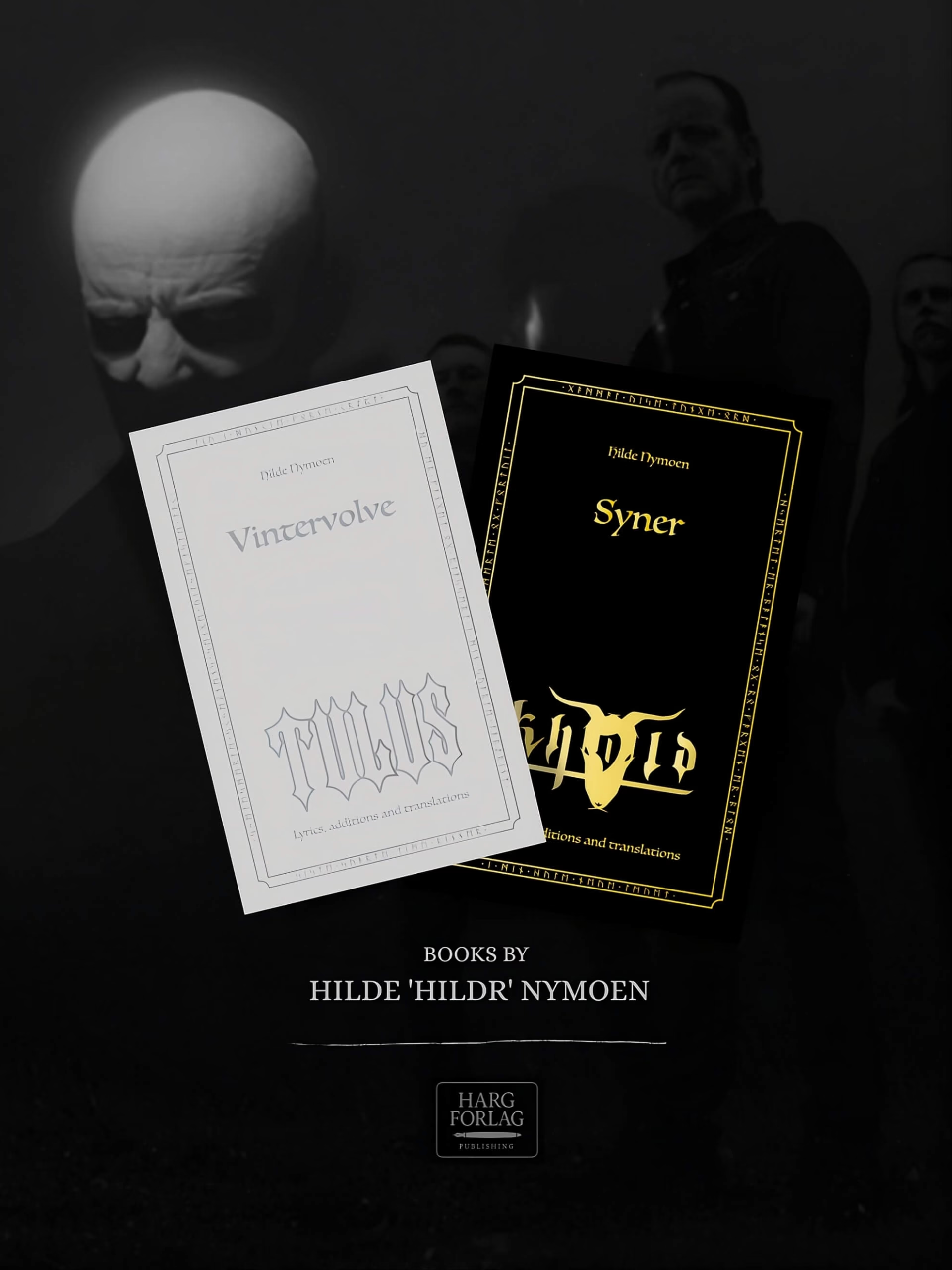
‘Syner’ is issued in hardcover format, bound in black with gold embossed design and a rune border bearing Khold’s logo. The roughly 140 pages of the volume include watercolor illustrations and band photographs provided by Hildr, alongside pen and pencil sketches by Blodstrup/Gard — the vocalist and guitarist of both Khold and Tulus.
A portrait photograph of Hildr was produced by Trym Stokland. The cover design for both volumes was produced by Hildr herself. ‘Syner’ was printed in Norway by Merkur Grafisk (Langhus), on Edixion 120g paper, set in Baskerville.
The visual collaboration extends the creative logic that has sustained both bands. In Khold’s eight studio albums, Hildr provided the words and Gard the music; in ‘Syner,’ the same division produces a book in which text and image reinforce each other as the lyrical and sonic registers have always done across the discography.
Harg Forlag’s Growing List
Harg Forlag Publishing is a small press Hildr operates herself — “forlag” denoting “publishing house” in Norwegian — whose catalog now extends to three volumes with the simultaneous release of ‘Syner’ and ‘Vintervolve.’ Its operating model — direct order by email, physical hardcover editions, no mass distribution — places it within a small press tradition with its own documented history in dark literature publishing.
Cemetery Dance Publications, PS Publishing, and Undertow Publications all operated at the margins of commercial distribution before achieving wider recognition; Harg Forlag occupies a comparable position by method, if not by genre origin.
Words That Were Always There
For close to twenty-five years, the literary dimension of Khold’s recorded output existed almost entirely within the album insert — accessible to those reading Norwegian, largely invisible to everyone else. ‘Syner’ does not transform that body of work; it repositions it. The horror encoded in Khold’s verse — in the witch burning, the ancestral grief, the ancient Norwegian understanding of a natural world that offers no consolation — was always present in the music.
What ‘Syner’ provides is the conditions for that darkness to be read in full, by anyone willing to sit with twenty-five years of verse in a language shaped precisely for the material it carries. For a band that has never made a concession to accessibility, that is not a small thing.
Among Khold’s eight studio albums, which lyrical territory — the mythological verse of the early records, the historical documentary mode of ‘Du dømmes til Død,’ or the folk-religious range between them — do you regard as Hilde Nymoen’s most fully realized engagement with the Norwegian dark tradition?

Leave a Reply