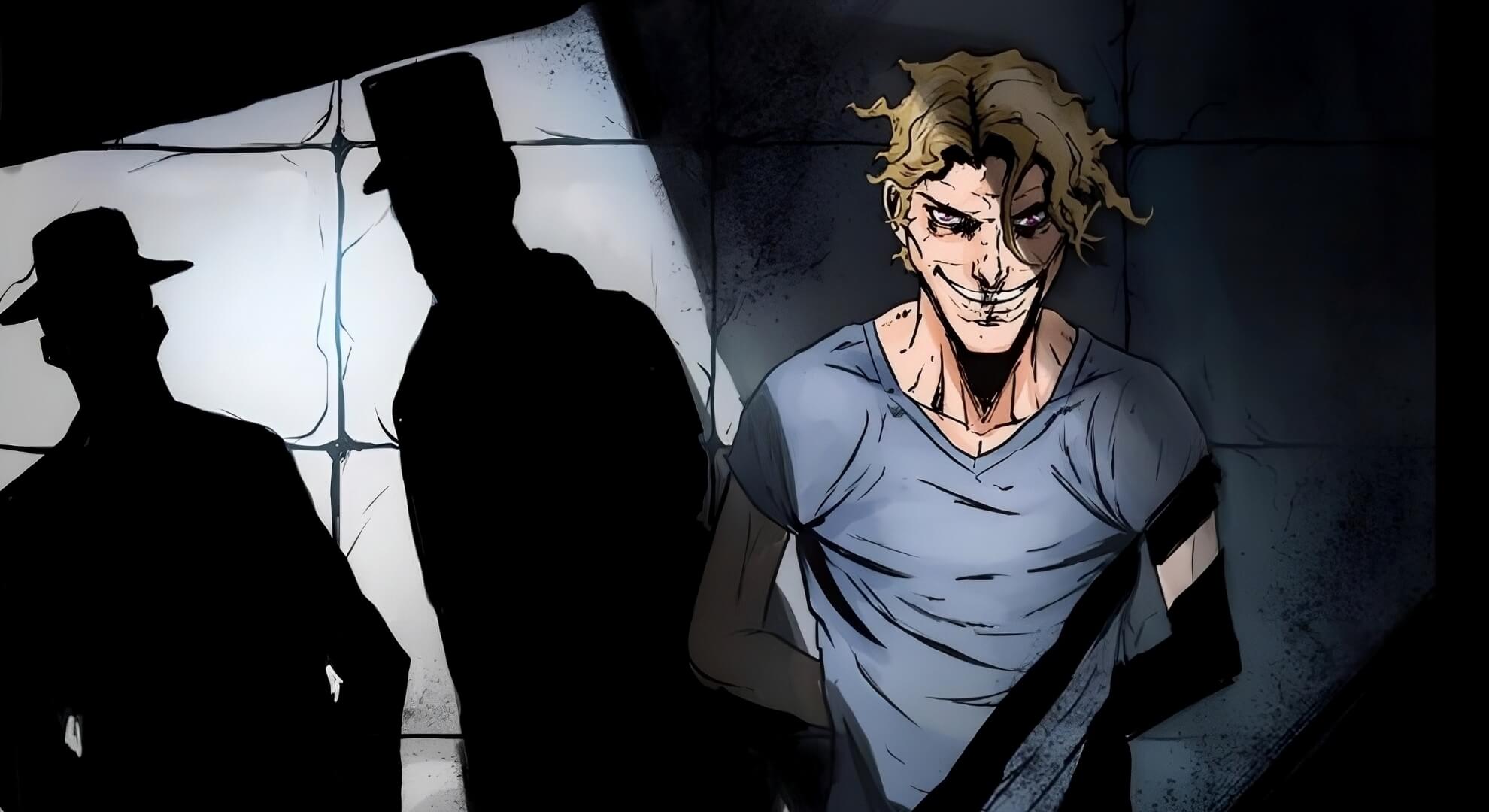


When Alberto Breccia adapted Lovecraft’s ‘The Thing on the Doorstep’ for comics in 1973, he was the sole cartoonist to have attempted it in the medium. The source material resisted the idiom: a story whose central dread depends on what cannot be directly shown — a consciousness displaced from its own body, a will foreign to the flesh that wears it — offers the panel and gutter very little to grip by illustration alone.
Breccia’s solution was expressionistic distortion, a visual language that traded fidelity for psychological intensity. His pages implied rather than depicted the central horror. More than fifty years passed before any American publisher committed to a full-length comics adaptation of the story.
That gap is now being closed. Simon Birks and Willi Roberts, who previously collaborated at Image Comics and Top Cow Productions on the sci-fi series ‘Antarctica’ beginning in 2023, have brought ‘The Thing on the Doorstep’ to the same publisher in a five-issue miniseries running monthly from February through June 2026. All five issues share the same creative team: Birks writing, Roberts drawing — handling pencils, inks, and colors as a sole visual author — and Rob Jones on letters, with Elena Salcedo as editor.
What Lovecraft Wrote, and When
The source story was written in August 1933 and first published in the January 1937 issue of ‘Weird Tales.’ Lovecraft described its seed in his commonplace book as a dream note: a man with a terrible wizard friend kills him in defense of his own soul, walls the body up — but the dead wizard, having said strange things about the soul lingering in the body, changes bodies, leaving the narrator as a conscious corpse in the cellar. The published story elaborates that premise across a sustained first-person account of a doomed male friendship.
Daniel Upton narrates from a position already past the catastrophe: he has shot his closest companion, Edward Derby, inside Arkham Sanitarium. The remainder of the narrative reconstructs how that act became necessary — tracing Edward’s lifelong interest in the occult, his marriage to Asenath Waite, and the progressive loss of his own personality to forces Upton cannot name. The story’s central mechanism is soul transference: Asenath’s father Ephraim, an occultist whose body had long since died, has been inhabiting her body, and has used that position to begin claiming Edward’s.
Critical reception of the story has ranged from hostile to qualified. S.T. Joshi’s ‘H.P. Lovecraft: A Life’ calls it one of Lovecraft’s poorest efforts; L. Sprague de Camp placed it in a middle rank, noting its unusual attention to character. The story is, regardless of its standing in the Lovecraft hierarchy, the only work of his included in the Library of America’s 2009 anthology ‘American Fantastic Tales: Terror and the Uncanny from Poe to the Pulps.’
From Blue Fox to the Direct Market
Birks founded Blue Fox Comics in Scotland in 2015 to publish his own work — plays, novels, and comics — that would not find a conventional route to distribution. His first Lovecraft adaptation under that imprint was ‘The Shadow Over Innsmouth,’ drawn by R.H. Stewart and published in 2023. He had been working on a Blue Fox version of ‘The Thing on the Doorstep’ in parallel, with Roberts as artist, publishing it in parts through the imprint and funding sections through Kickstarter campaigns.
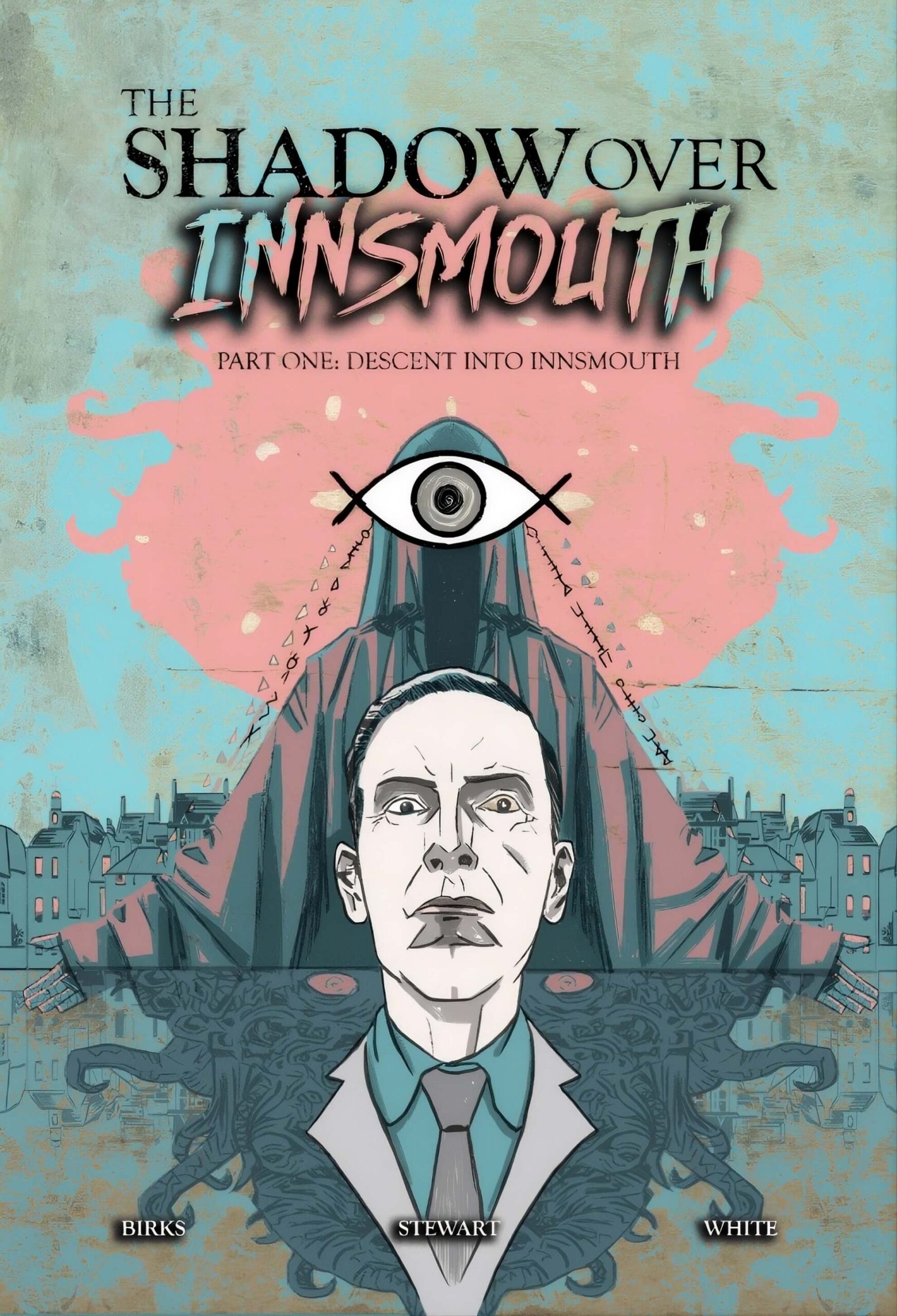
The Image Comics and Top Cow arrangement came through Top Cow editor Elena Salcedo, who noticed the Blue Fox ‘Thing on the Doorstep’ Kickstarter while Birks and Roberts were already publishing ‘Antarctica’ through the imprint.
At the San Diego Comic-Con dinner in 2024, Top Cow CEO Marc Silvestri and president Matt Hawkins expressed interest in publishing the adaptation, and the announcement followed in November 2025. The Image Comics version reformats the Blue Fox material across five monthly issues, incorporates artwork Roberts updated for the new edition, and adds back matter to each release.
“I am thrilled to bring ‘The Thing on the Doorstep’ to life with Top Cow and Image Comics,” Birks stated in the official Image Comics press release issued November 25, 2025. “Lovecraft’s original tale has always fascinated me, and in adapting it, I wanted to explore not only the classic cosmic horror but also the human relationships and psychological tension beneath it.” Silvestri added that Birks “has an incredible ability to craft tension and emotion in equal measure,” and that his writing “pulls you in and does not let go.”
Top Cow Productions was founded in December 1992 by Silvestri, who co-founded Image Comics earlier that same year. The imprint has published its line of comics in 21 languages across more than 55 countries, with horror and horror-adjacent titles — ‘The Darkness’, ‘Witchblade’, ‘Haunt You to the End’ — forming a documented part of its genre identity. ‘The Thing on the Doorstep’ sits within that lineage while extending it: the source material predates the publisher by six decades.
A Corrective Casting
Birks has described his primary motivation in adapting the story as its portrait of male friendship: the bond between Daniel Upton and Edward Derby that Lovecraft’s narration tends to hold at clinical distance. The adaptation expands that emotional register. It also makes a structural revision that no prior adaptation had attempted: Daniel Upton is Black, and the Upton family is depicted as a Black family navigating Arkham in the nineteen twenties.
In a March 2026 interview with Bleeding Cool, Birks stated that the decision came from his commitment to writing comics that reflect the society he sees around him. The choice has consequences beyond representation: Lovecraft’s racial anxieties were a documented structural element of his horror, and centering the narrative on a Black protagonist who watches his closest friend’s consciousness be occupied and destroyed by an external will reframes what is at stake in the story’s body horror.
Roberts, in the same interview, described wanting the adaptation to maintain the organic quality of the Lovecraft universe while taking readers “straight back to the 1920s.” The period setting and the supernatural content make competing visual demands: the former requires historical restraint in period idiom, while the latter demands a sustained willingness to push figure and color toward the wrong and the inexplicable. Roberts handles both as the sole author of every visual decision on the page.
The Miniseries, Issue by Issue
Issue One — The Frame Is Everything
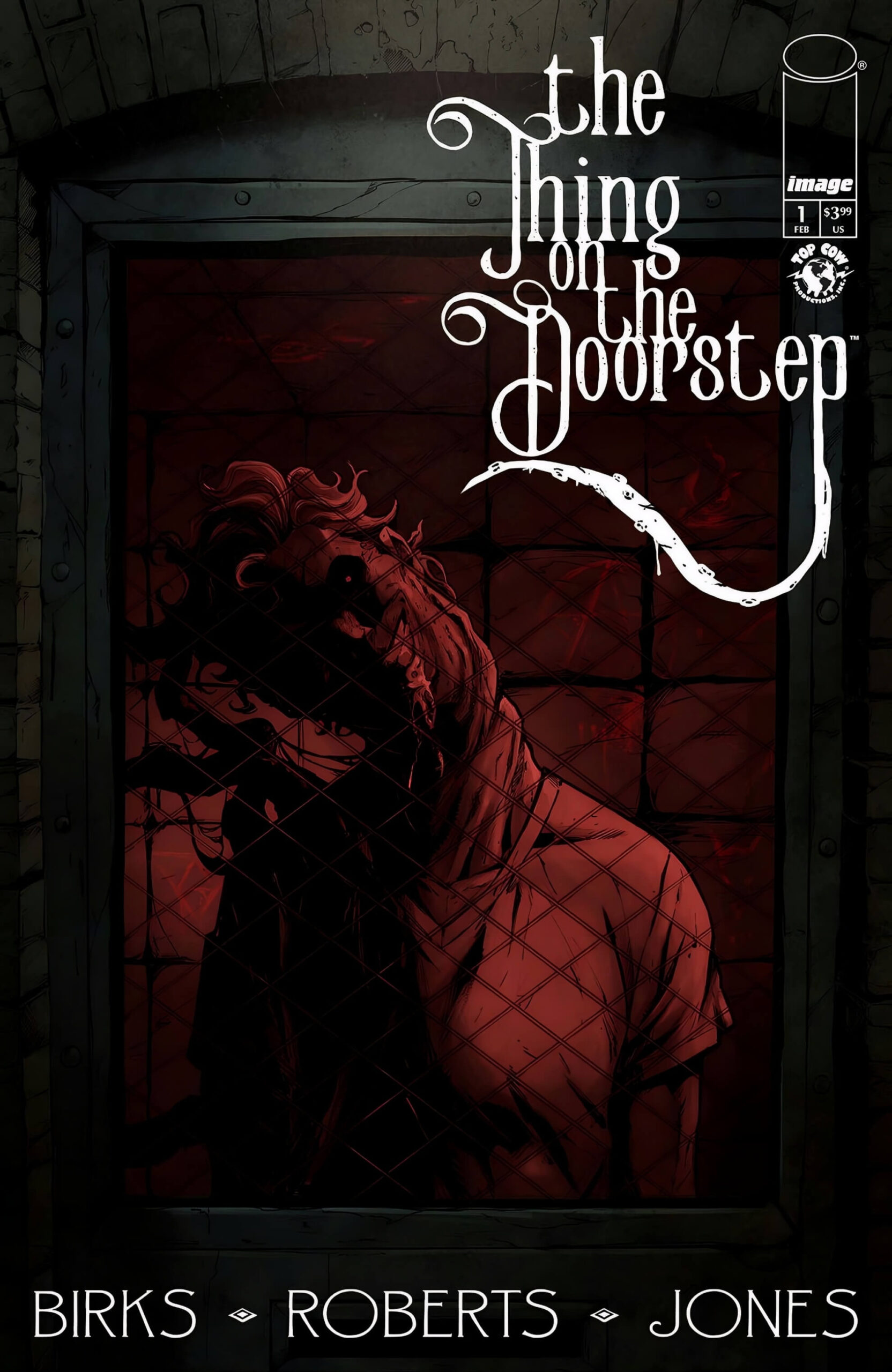
‘The Thing on the Doorstep’ #1 reached shops on February 11, 2026, priced at $3.99 USD, 32 pages, rated T+. The issue opens in 1933, at Arkham Sanitarium: a man signs in to visit one of the inmates, enters a padded cell where a smiling figure waits, produces a gun, and declares “I avenge ye, Edward Derby!” before shooting the inmate in the face as a guard looks on. He is arrested. That is the end of the story’s present tense. Everything that follows is retrospect.
The flashback begins in 1899. Daniel and Edward meet at an exhibition of selected work of the macabre — Edward is hiding from his nurse, and it is this particular hiding place, chosen by a boy drawn to the wrong and the strange, that puts the two of them in the same room. The friendship develops across the following decade in brief scenes: Edward venting about his nurse, the two reconnecting after the Derby family’s recurring trips to Europe, Edward’s increasingly intense interest in occult texts.
When Edward begins formal studies at Miskatonic University, he is drawn specifically to the library’s collection of forbidden and arcane material. At one point, an unnamed stranger approaches him while he is reading from one of these texts — a figure who seems to know what the book is without needing to ask — and the issue hints, without stating, that Edward may have spoken of making friends with people who share his interests.
In 1924, Edward’s mother dies and he is left psychologically incapacitated for months; his father takes him to Europe to recover. By 1928, Edward revisits the Miskatonic library out of nostalgia and asks after the old librarian, Celia. He is told she has not died — but she has gone insane and is now in the sanitarium. The information lands as a warning that the issue does not press.
A review at The Comic Book Spot noted that the man who fires the gun at the issue’s opening had Edward’s face but was no longer Edward, and that the magic-related texts at Miskatonic carry a strong implication of leading toward madness or possession without stating it directly. Cover variants include Cover A by Roberts, Cover B by Lyndon White, a 1:10 incentive Cover C by Roberts, and a 1:25 virgin Cover D by White.
Issue Two — The Beguiling of Edward Derby
‘The Thing on the Doorstep’ #2 followed on March 18, 2026, at the same $3.99 USD price point and 32-page format. Edward is enrolled at Miskatonic University, deepening his study of the occult. The issue’s pivotal scene finds a crowd gathered at an upstairs window, transfixed by something outside — Edward does not understand the fascination until he sees it: a storm being conjured out of open air by a woman standing at the window.
Her name is Asenath Waite. The reviewer at You Don’t Read Comics observed that she becomes a powerful presence in the issue despite limited page time, and that Roberts renders her with a haunted quality that holds just enough intimacy to sustain the mystery around her.
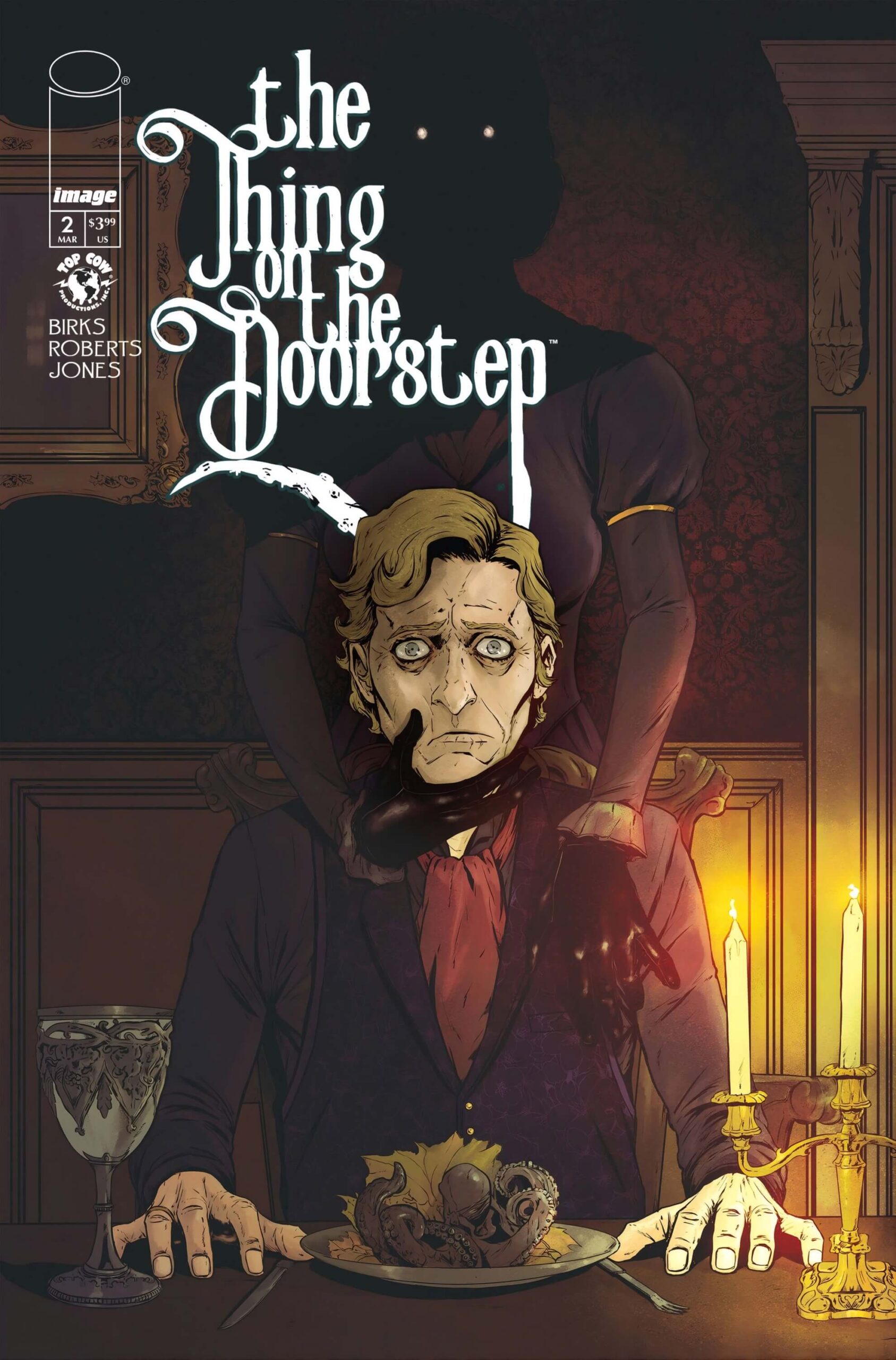
After this demonstration, Asenath performs a hypnotism on Edward — the solicitation describes it as disturbing — and a courtship follows that leads to marriage. Clara and Daniel are ostensibly glad for their friend, but both register something wrong about Asenath that they cannot articulate.
Changes begin appearing in Edward: in demeanor, in behavior, in the quality of his attention. Clara has what a review of the issue describes as a strange encounter with an Edward who appears to be fleeing — a moment that pushes the Uptons from unease into active concern. A visit from Edward confirms he intends to leave and may not return, without explaining where or why. Cover B for #2 is by Abigail Harding.
Issue Three — Something in the Car
‘The Thing on the Doorstep’ #3 arrived April 8, 2026. The solicitation describes an Edward returning from Europe who is qualitatively different from the man who left — someone who has witnessed rituals in places that should not exist and cannot be explained. He tries to warn Daniel of what is coming.
Mid-conversation, something shifts in him: something sinister takes over, and the warning stops. The issue covers the months that follow, during which Edward’s condition deteriorates in front of Daniel and Clara — lucid intervals, sudden changes of manner, the steady erosion of whatever it is that makes Edward recognizably himself. Then a call comes from a distant town: Edward has been found and needs to be retrieved.
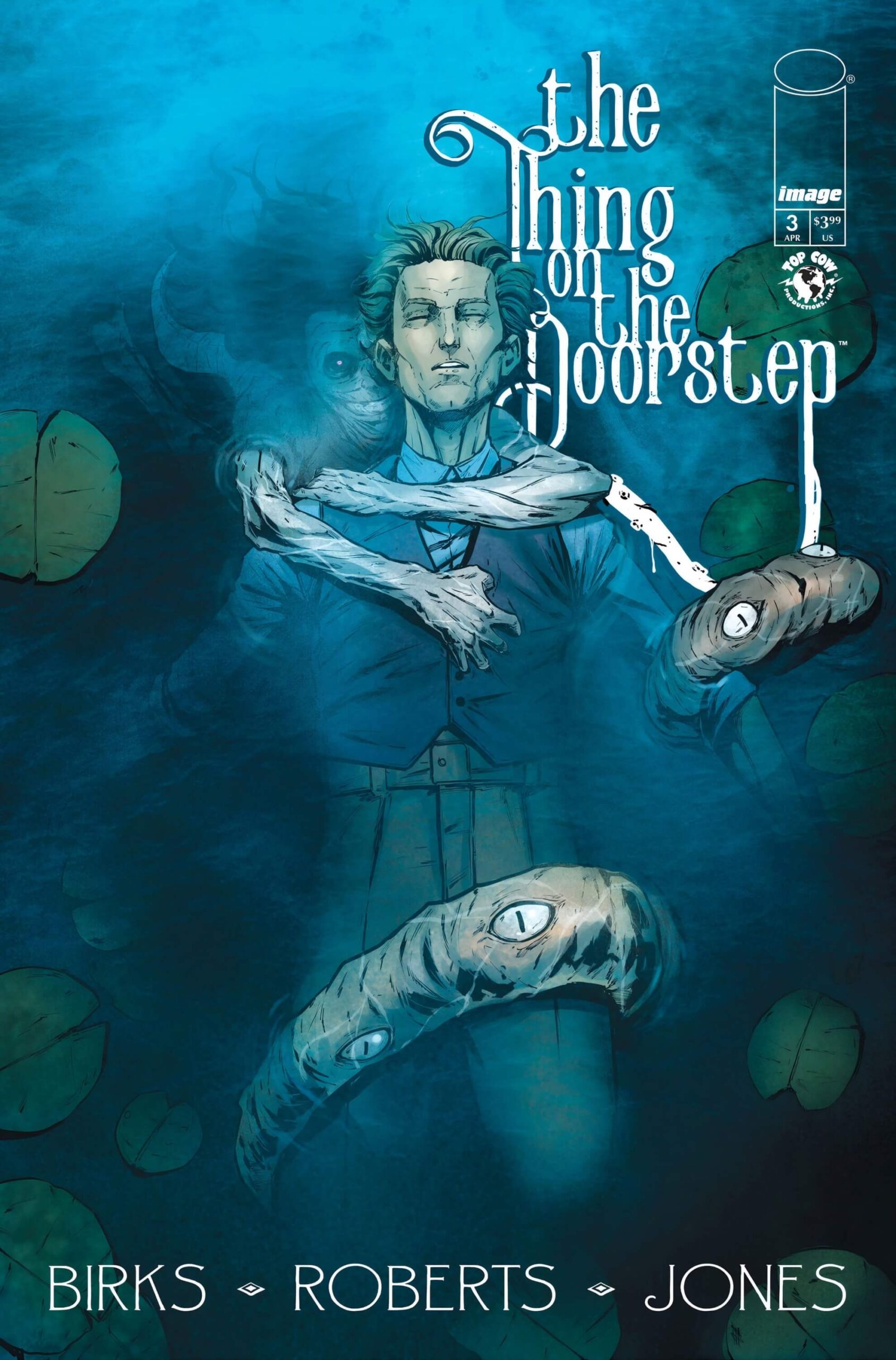
Daniel drives out to collect him. The rescue happens. But the solicitation ends on the question that organizes the issue’s final pages: halfway home, just who has Daniel got in his car? The question is not rhetorical.
In Lovecraft’s source story, this interval corresponds to the point at which Edward, after being found wandering in a state of hysteria near Maine, confides to Daniel that Asenath has been using him — occupying his body, sending his consciousness elsewhere — and that he has found a way to stop her.
The comic adaptation places this revelation inside the visual problem Roberts must solve: a face Daniel has known for thirty-four years, producing expressions he has never seen it produce. Cover B for #3 is by Robert Ingranata with colors by Steve Firchow.
Issue Four — A Familiar Knock
‘The Thing on the Doorstep’ #4 is solicited for May 6, 2026. The issue opens with a visitor at Daniel’s door — a knock the solicitation characterizes as familiar. Edward provides an account of what has happened: Asenath has left the marriage abruptly. He has returned to his old family home, begun renovations, and is attempting to reconstitute the life he led before she entered it. He tells Daniel that he has found a way to keep her out. To all appearances, the crisis has passed and Edward is recovering.
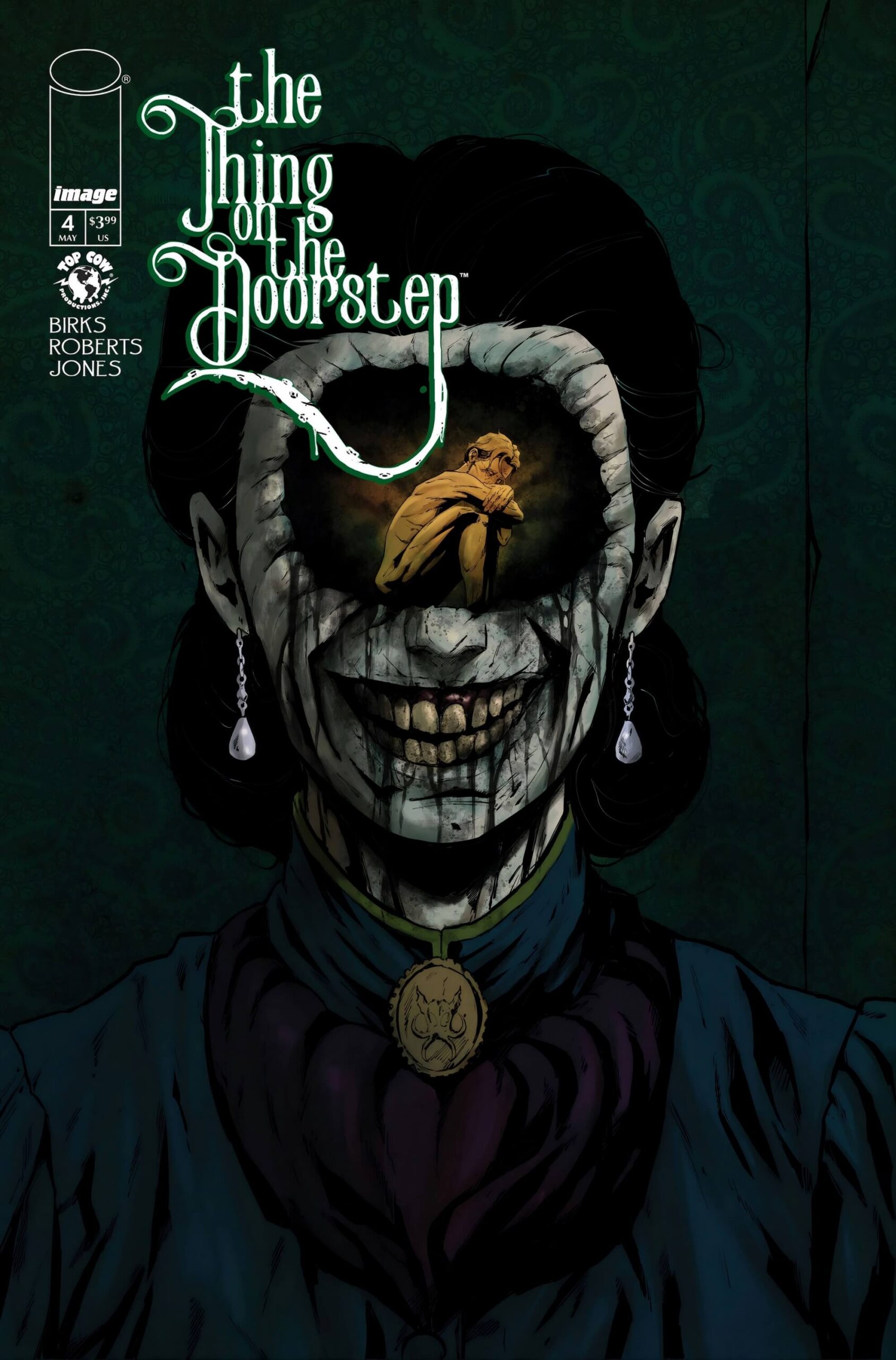
The solicitation’s phrase “a familiar knock” is the issue’s central horror instrument, because in Lovecraft’s source story the apparent improvement is a deception — the entity Daniel is speaking to is not Edward. It is Asenath, or rather Ephraim, inhabiting Edward’s body while the real Edward is displaced.
By the issue’s end, the behavior that seemed like recovery has deteriorated again, and the solicitation notes that Asenath Waite is described as seeking a new place to live. That construction is precise: she has not left. She is looking for a next host.
The miniseries reaches its penultimate issue with every apparent exit foreclosed.
Issue Five — What Knocks on the Front Door
‘The Thing on the Doorstep’ #5 is solicited for June 2026. Edward has been committed to Arkham Sanitarium in a disturbed state. Then his demeanor changes — abruptly, and completely — and the doctors decide he is well enough for discharge. That shift is the issue’s first horror: the improvement is not Edward recovering.
In Lovecraft’s source, Daniel visits the sanitarium after being told his friend has regained normality, and immediately recognizes that the personality looking back at him from Edward’s face is not the one he has known for thirty-four years. Knowing something terrible is now in motion, Daniel and Clara make what the solicitation describes as desperate plans.
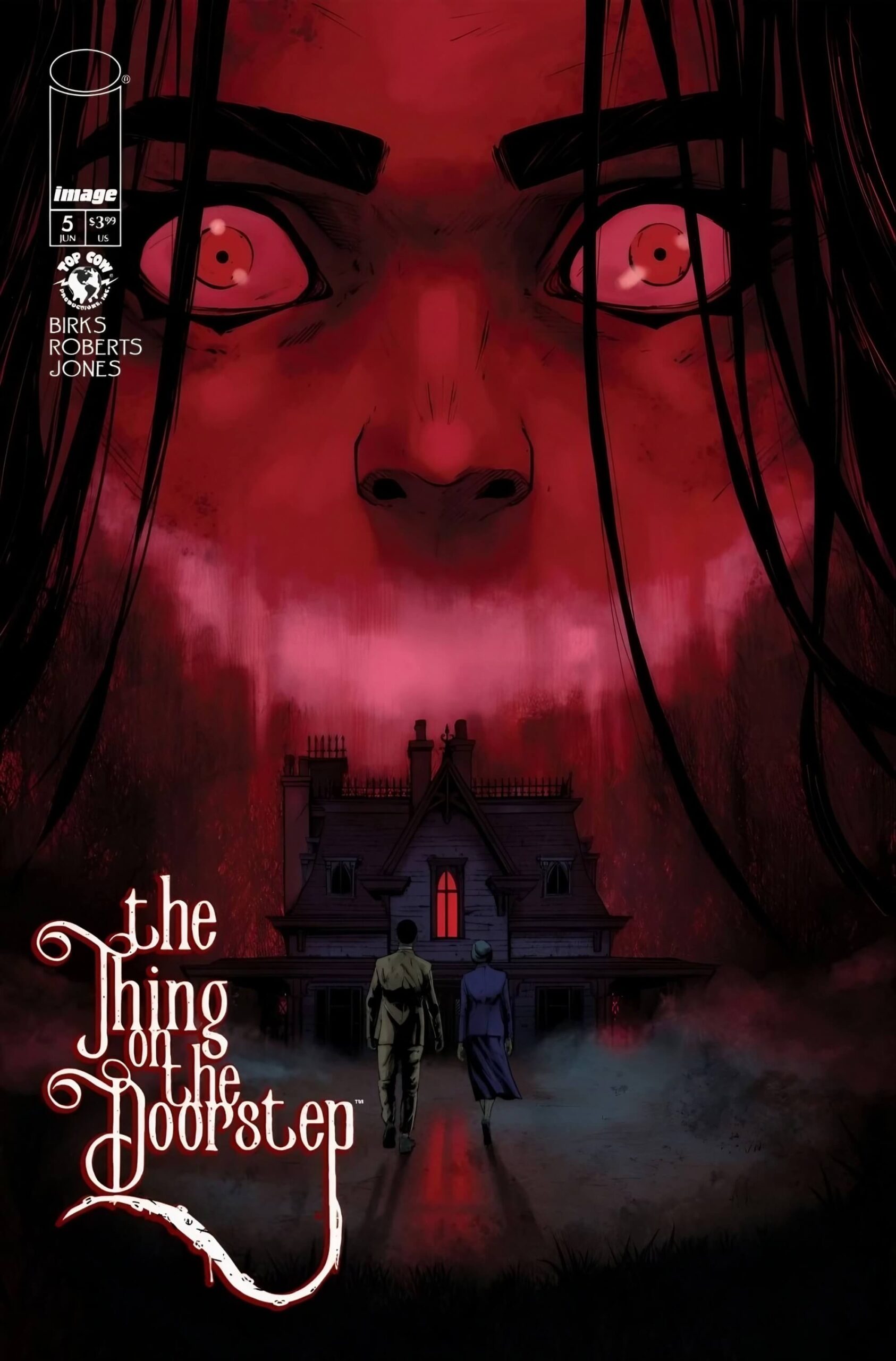
That evening, something knocks on their front door. The solicitation states that nothing could have prepared them for what it is. In Lovecraft’s original conclusion, the thing Daniel opens the door to is a dwarfed, hunched figure wrapped in a coat too large for it — a body in advanced decomposition, carrying a letter.
The letter is from the real Edward, who has managed to communicate one last time from within the wrong flesh: it explains that he killed Asenath and buried her in the cellar, that Ephraim’s soul has now permanently occupied his own body, and that Daniel must go to the sanitarium, shoot whatever is walking around in Edward Derby’s body, and cremate it before the cycle continues.
The horror of the story’s title is that the thing on the doorstep is Edward — occupying what remains of the woman his wife’s father murdered to wear her. Daniel does what the letter asks. That is what the opening of #1 has shown the reader all along. An exact release date for #5 had not been confirmed at the time of writing.
One Artist Carrying the Visual Weight
Roberts’s assumption of all visual responsibilities — pencils, inks, and colors — is not an incidental production decision. It produces a coherence of visual tone across five monthly issues that distributed creative teams cannot always sustain. The palette must do period work — conveying the nineteen twenties with specificity — while also supporting the progressive intrusion of cosmic dread into the domestic register. These are different demands, and they require the same sensibility to arbitrate between them at the panel level.
His prior body of work, across titles including ‘The Dark,’ ‘Clodagh,’ ‘The Blood Below,’ and ‘Remothered,’ has brought him through territory where physical wrongness must be sustained with specificity rather than shock. The body horror at the core of ‘The Thing on the Doorstep’ — a consciousness occupying flesh it does not belong to, a man’s face producing expressions he would never choose — requires exactly that quality: a willingness to render the wrong thing with patience and precision, without the shortcut of the grotesque.
The first issue’s visual approach, as documented in published reviews, employs a darkened but soft palette that carries the vintage quality of the period without flattening it into mere costume. The series is published in full color. It is also available on digital platforms including Amazon Kindle, Apple Books, and Google Play.
Also on the Shelf
Running alongside ‘The Thing on the Doorstep’ across the spring 2026 Image Comics schedule is a body of horror work worth tracking. The most directly relevant is ‘Universal Monsters: The Phantom of the Opera,’ a four-issue series written by Tyler Boss and drawn by Martin Simmonds, from the Skybound imprint of Image Comics, which launched February 25, 2026 at $4.99 USD per issue.
Like the Birks and Roberts adaptation, it is a period literary horror story — set in the Paris Opera House, adapted from Gaston Leroux’s novel — and it trades in a similar dynamic: the threat that inhabits a familiar environment and wears a recognizable face. Simmonds, who drew the Eisner-nominated ‘Universal Monsters: Dracula,’ uses early twentieth-century Paris as a stage for painterly horror that operates by suggestion as much as revelation.
‘In Your Skin,’ launching April 22, 2026 at $4.99 USD from Image Comics and James Tynion IV’s Tiny Onion imprint, occupies the body horror register that ‘The Thing on the Doorstep’ shares from a different angle.
Written and lettered by Aditya Bidikar, with art by Som, it follows a Bollywood superfan who decides — when her idol announces retirement — that occupying the star’s place may be a literal ambition. Image Comics has described it as a David Cronenberg–inflected horror in the vein of ‘The Substance’ and ‘Perfect Blue’. Where Birks and Roberts use soul transference as the horror mechanism of a nineteen-twenties friendship, Bidikar and Som deploy it as a critique of the economics of celebrity and the violence of fandom.
‘Odin’ #1, arriving May 6, 2026 from Image Comics and Tiny Onion, is a nine-issue series co-written by James Tynion IV and Marguerite Bennett with art by Letizia Cadonici, colors by Jordie Bellaire, and letters by Tom Napolitano. The series follows an undercover journalist who infiltrates a group of neo-Nazis in the frozen forests of Norway and finds they have succeeded in summoning the actual Norse deity.
Tynion and Bennett described the concept to The Hollywood Reporter as a Nordic nightmare that leaves no taboo unexamined; both writers had completed all nine scripts before the series was announced. Where Birks locates cosmic horror in the intimate damage of a male friendship, Tynion and Bennett locate it in the political pathology of white supremacy. Both series use the encounter with something genuinely larger than human scale as the engine of their horror.
Readers interested in the body horror anthology tradition should note ‘Hello Body Horror’ #1 from BOOM! Studios, arriving April 29, 2026 at $5.99 USD for 48 pages, with stories by Mark Bouchard, Derick Jones, Robert Hack, Jenna Cha, Michael W. Conrad, and Jeremy Bastian, with cover art by Rebeca Puebla. BOOM! Studios has been publishing its ‘Hello Darkness’ anthology series as a sustained vehicle for short-form horror; ‘Hello Body Horror’ is a direct-subject spinoff, and its contributor list represents a cross-section of contemporary horror comics talent across indie and mid-tier publishing.
‘The Thing on the Doorstep’ arrives at Image Comics and Top Cow as a five-part monthly adaptation of a Lovecraft text that criticism has consistently undervalued and that the comics medium had, prior to Birks and Roberts’s Blue Fox version, left almost entirely untranslated. The decision to recast Daniel Upton and his family changes the interpretive frame of the soul-transference horror at the story’s center.
Roberts’s consolidation of all visual duties into a single authorship gives the adaptation a tonal unity that its subject demands. And the shift from small-press publication to the Image Comics direct market places this version before a substantially larger readership than any prior treatment of the source material could reach. The series concludes in June 2026.
Birks has stated that the friendship between Daniel and Edward is the story he most wanted to tell in this adaptation: does the casting of Daniel Upton as a Black man in nineteen twenties Arkham change what the reader understands to be at stake when that friendship is destroyed by possession?




Leave a Reply