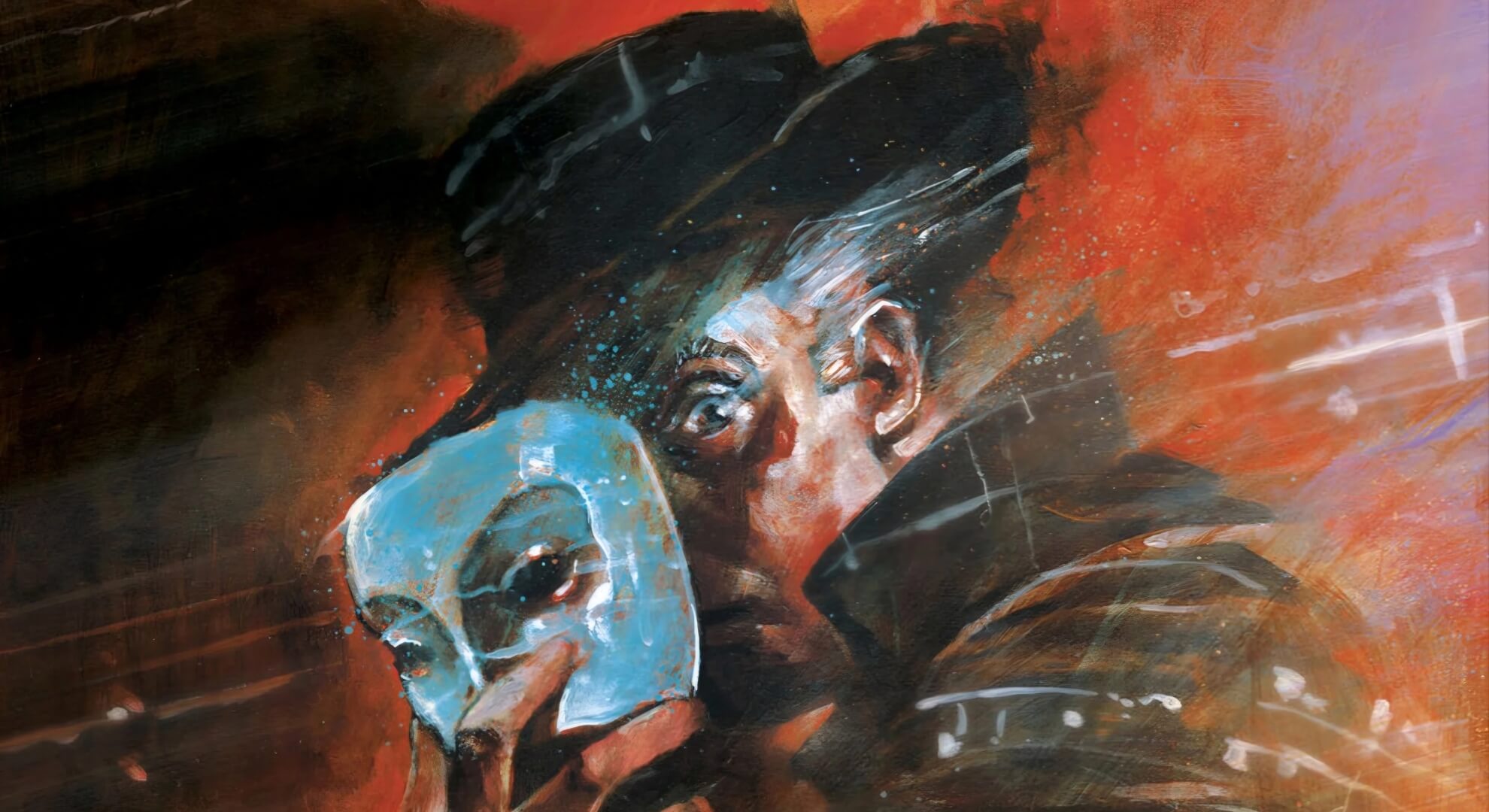


The Paris Opera House has served as a horror setting for well over a century, functioning as what writer Tyler Boss correctly identified in pre-publication interviews as perhaps the most effectively constructed haunted house in Western fiction. Gaston Leroux’s 1910 novel built its dread in the subterranean — the hidden lake, the labyrinthine cellars, the mask as concealment for something the reader’s imagination constructs more completely than any description could.
The two most consequential film adaptations divide cleanly on the question of what the Phantom actually is. The 1925 Universal silent film, with Lon Chaney in grotesque prosthetics, insists that Erik is a disfigured man whose obsession has curdled into something monstrous. The 1943 Claude Rains version shifts the emphasis toward pathos and coincidence, making the Phantom a figure of tragedy rather than terror — a man wronged by the world and by his own genius, disfigured in an act that erases his former identity.
Boss and Simmonds’ ‘Universal Monsters: The Phantom of the Opera’ begins from the 1943 film and immediately dismantles its sympathy. The Phantom here is genuinely spectral — a haunting presence rather than a hiding man. By routing the adaptation through the less-canonical Claude Rains version, Boss creates distance from the most familiar iconography and opens space for structural reinvention, while Martin Simmonds applies an Impressionist visual language derived explicitly from Edgar Degas to a story that has historically resisted indeterminacy. The choice is both critical and formal: Impressionism’s refusal to resolve edges is precisely what a ghost story requires.
Two issues into a four-issue miniseries published by Skybound Entertainment through Image Comics, the series has established itself as the most formally committed entry in Skybound’s Universal Monsters line — a work whose central argument is that the Phantom’s power over Christine is inseparable from the existing systems of performance, observation, and aesthetic coercion that have already defined her world before he arrives.
The Sixth Monster in Skybound’s Horror Line
‘Universal Monsters: The Phantom of the Opera’ is the sixth limited series in Skybound Entertainment’s Universal Monsters line, produced in partnership with Universal Products & Experiences. The line launched in October 2023 with ‘Universal Monsters: Dracula’ by James Tynion IV and Martin Simmonds, a series that earned Simmonds an Eisner Award nomination for Best Painter/Multimedia Artist (Interior Art).
It has since expanded through Ram V, Dan Watters, and Matthew Roberts’ ‘Creature from the Black Lagoon Lives!’; Michael Walsh’s ‘Frankenstein’; Faith Erin Hicks’ ‘The Mummy’; and James Tynion IV and DANI’s ‘The Invisible Man’, which debuted August 27, 2025.
Each entry in the line is a four-issue miniseries priced at $4.99 USD per issue, each handling a different Universal Monster through the distinct creative vision of a separately assembled team. The model is more anthology than franchise: the monsters share a commercial imprint but not a narrative continuity. What connects them editorially is a consistent commitment to pairing established horror comics talent with the specific cultural weight of the Universal brand.
‘The Phantom of the Opera’ launched on February 25, 2026, with its second issue arriving on March 25, 2026. Issues #3 and #4 are scheduled for April 22, 2026 and May 27, 2026, respectively. The series is written by Tyler Boss, known primarily as an artist but recently established as a writer on ‘You’ll Do Bad Things,’ and drawn and colored throughout by Simmonds, returning to the Universal Monsters line for a second time after his Eisner-nominated turn on ‘Dracula.’
Becca Carey letters issue #1; the letterer for issues #2–#4 could not be confirmed at the time of publication. Alex Antone, Editorial Director at Skybound Entertainment, edits the series. Senior Editor Diegs Lopez also serves in an editorial capacity on the line.
The series presents no confirmed arc subdivisions. It is a single continuous narrative delivered across four issues, the primary creative team unchanged from first issue to final. The main cover for each issue is by Simmonds. Issue #1 also features variant covers by Joshua Middleton (Cover B), Anwita Citriya (1:10 connecting variant, spanning all four issues in a series), Rosemary Valero-O’Connell (1:50), David Talaski (1:75), Baldemar Rivas (1:100 foil), and a special mask wraparound die-cut cover by Andrea Milana and Jillian Crab (Cover I, $5.99).
Violence as Clearing in the Published Run
Boss, in a February 2026 interview with Daily Dead, observed that the Phantom story is, at its simplest, the account of “a young woman [who] gets a promotion at work, but then a man who lives in the basement is stalking her.” The description is deliberately reductive, but it identifies something the source material has long allowed its adapters to obscure: Christine’s story is about labor and coercion, not enchantment. Boss and Simmonds’ version refuses the enchantment.
Issue #1 opens at the Palais Garnier with a killing. Carlotta, the opera’s prima donna, is murdered before she can perform — hanged, her death depicted in a double-page spread that several critics noted as among the most striking images in recent horror comics. Christine Dubois, Carlotta’s understudy, rises immediately to fill the vacancy. The detective assigned to investigate the string of violent crimes at the opera house is Raoul Dubert, Christine’s childhood friend — a reimagining drawn from the 1943 film, where Raoul is similarly cast as an investigative rather than purely romantic figure.
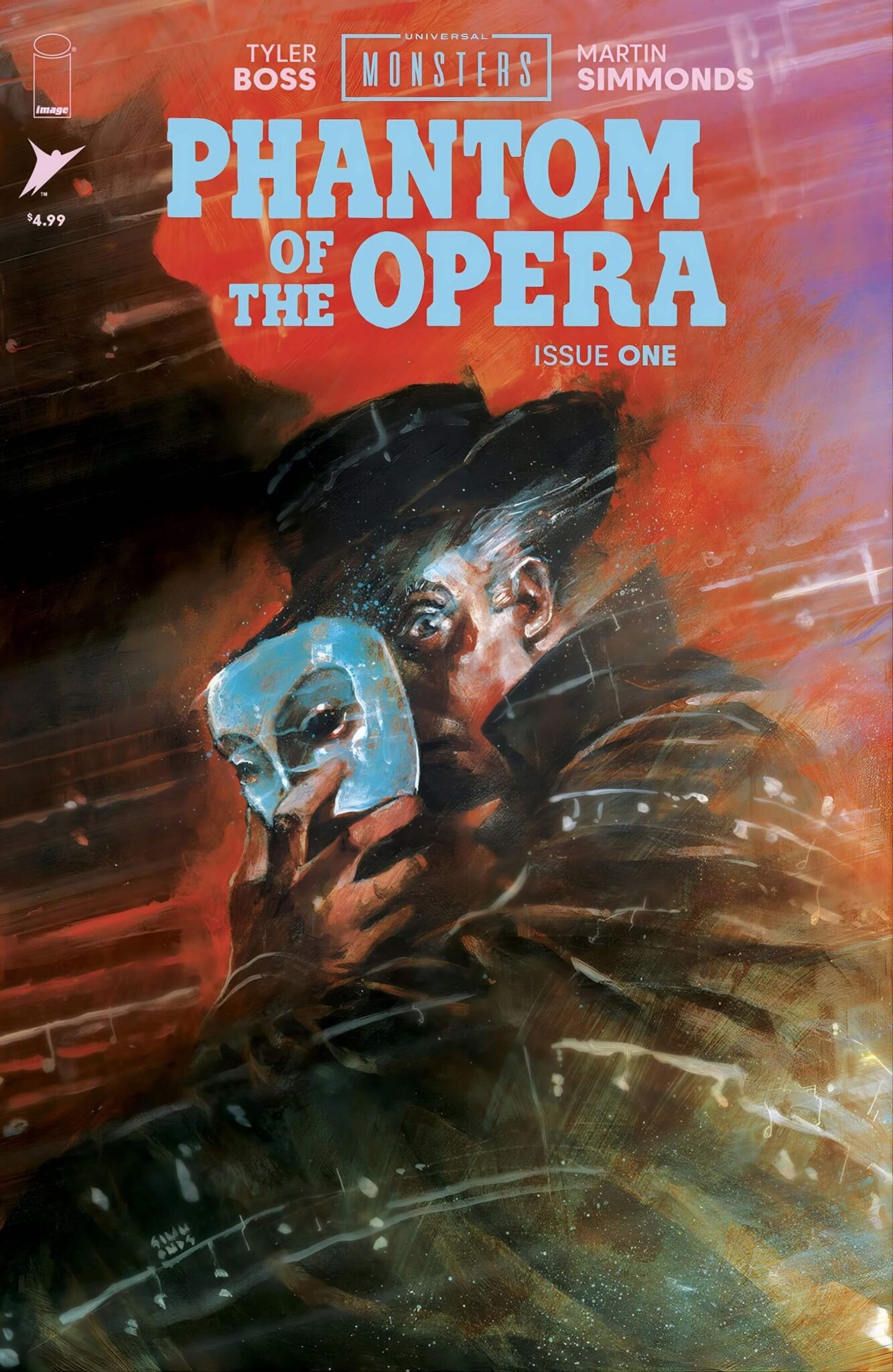
Simmonds’ visual approach in #1 is built on the Degas reference Boss introduced in pre-production. In an interview, Simmonds confirmed that Boss “had mentioned Edgar Degas as an artist to reference, and I had also been thinking along the same lines of adopting a looser, impressionist approach.”
The connection is precise: Degas’s Opéra paintings are populated by female performers who are perpetually observed from angles that deny them agency, their bodies beautiful and constrained, their audience implied rather than shown. Simmonds applies exactly that logic to Christine. We watch her being watched.
The formal consequences of this choice are immediately visible. The Phantom, when he appears, is rendered as a living shadow: his mask — bone-white, catching the only clear light in the frame — is the exception to a visual field that refuses definition. His laughter is represented not as text but as spiraling musical notation spreading outward across the page, turning sound into spatial event. The coloring is expressionistic throughout: warm golds and ambers in the opera house’s public spaces, near-monochromatic blues where the Phantom moves, saturated chromatic bursts when Christine sings that translate internal experience into something almost visible.
By the closing pages of #1, Christine has accepted the Phantom’s coaching as one would receive divine instruction, his voice reaching her from the opera house’s hidden passages as though transmitted from somewhere beyond the walls. Simmonds renders the issue’s final image as a reflection: Christine and the Phantom staring back at each other in a surface that could be glass, mirror, water, or something less material.
The pact is established without being named. An inspector has already noted Christine’s name with particular attention; a threatening letter demanding she leave Paris has appeared. The momentum of the issue builds not through speed but through convergence — threads tightening toward a center that has not yet been identified.
Issue #2 shifts the formal weight toward consequence. Christine, now actively studying under the Phantom, has shed the uncertainty of her first appearance. She fires her previous vocal instructor, invites Dubert to an upcoming performance, and argues — briefly, tentatively — with the Phantom when he dismisses the inspector as a distraction.
Simmonds matches this shift with imagery that opens up the opera house: full-house atmospheric paintings, rooftop scenes of the Phantom tracking Christine across the Parisian skyline, a sequence depicting Christine’s performance that uses color expressively to render internal pressure as visual sensation.
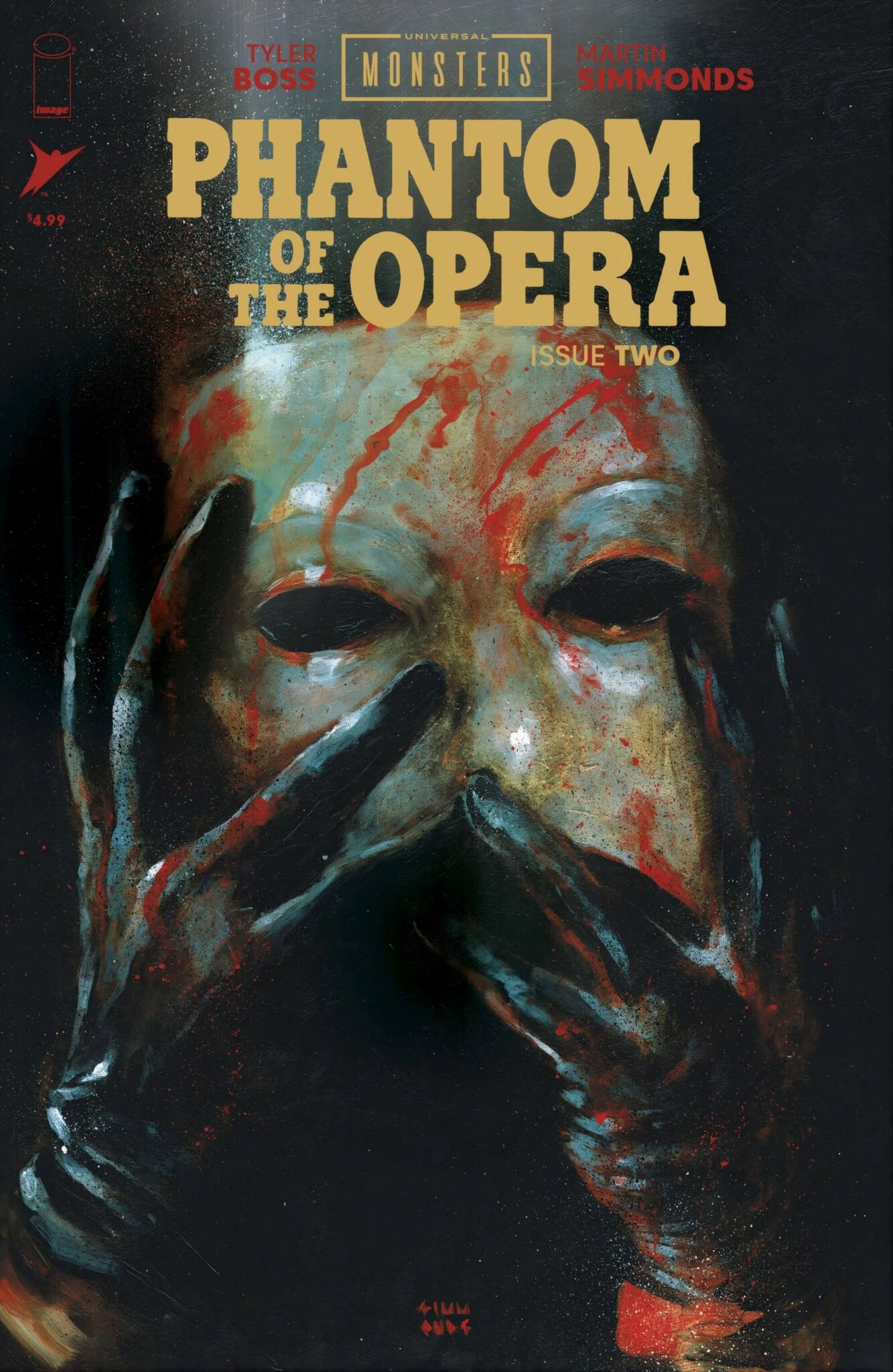
The second issue ends with a second murder. Megan, Christine’s own understudy, receives a note directing her to the roof, believing a lover is waiting. The Phantom is waiting instead. Megan falls. The structural pattern is now fully established: the Phantom clears Christine’s path of every obstacle that might allow another singer to displace her, and Christine is implicated whether or not she knows it.
Boss’s procedural frame — Raoul as detective, each death as a clue advancing the investigation — holds this pattern in tension with the gothic romance register the source material has always occupied. Simmonds renders the rooftop sequence with the same compositional restraint applied to Carlotta’s death: violence as formal event, absorbed into the visual field without exploitation.
The two published issues offer enough formal and narrative evidence to identify the series’ central critical position. Boss and Simmonds are not adapting the Phantom story — they are applying pressure to the assumptions on which every earlier adaptation depends.
Christine is not an innocent who wanders into a monster’s fixation; she is a young woman who has been shaped by systems of performance and observation that the Phantom simply makes more explicit. His violence serves her advancement. Whether the final two issues will allow her to refuse that arrangement, or reveal that she cannot, is the live question the published run has constructed with considerable formal care.
The Woman Who Is Always Being Watched
The Skybound Universal Monsters line has maintained a consistent editorial commitment across six entries: each is defined not by its monster but by its artist. ‘Universal Monsters: Dracula’ made the case for Simmonds’ painted style as the appropriate grammar for supernatural horror derived from the Universal films. ‘The Phantom of the Opera’ tests that argument again, with a different writer and a different source material, and with Simmonds returning to the same aesthetic method but deploying it toward a more ambiguous emotional argument.
The Degas reference is not incidental. Degas spent decades painting the Opéra, and his figures — dancers, performers, members of the audience — are consistently observed from angles that refuse them autonomy. They are beautiful and constrained. Boss and Simmonds are making the same observation about Christine Dubois, and the Phantom is less a monster in this retelling than the most efficient expression of a system that was already treating her as an instrument of performance before he descended from the flies.
What the published run confirms is that Simmonds’ Impressionist method produces a form of horror specific to his technique: horror as dissolution, as the refusal of the edges that would allow the reader to separate victim from complicity, art from coercion, the ghost from the house. Whether the final two issues will resolve that dissolution into clarity or press it further into ambiguity is the question the series has most deliberately left open.
Boss’s retelling positions Christine’s complicity at the center of the story rather than her innocence — by the end of issue #2, she is studying under the man who has murdered twice on her behalf. Does the Impressionist visual approach function to deepen Christine’s moral ambiguity, or to hold it at an aesthetic remove that protects the reader from fully confronting what the story is doing to her?

Leave a Reply