


Dark music has long distrusted the single album as a sufficient container for its ambitions. From the four-part operatic cycle of Wagnerian drama to the multi-disc excursions of progressive rock’s most expansive decades, the impulse to extend a single artistic statement across successive volumes has always been less a measure of productivity than an insistence that certain emotional territories demand more than one door.
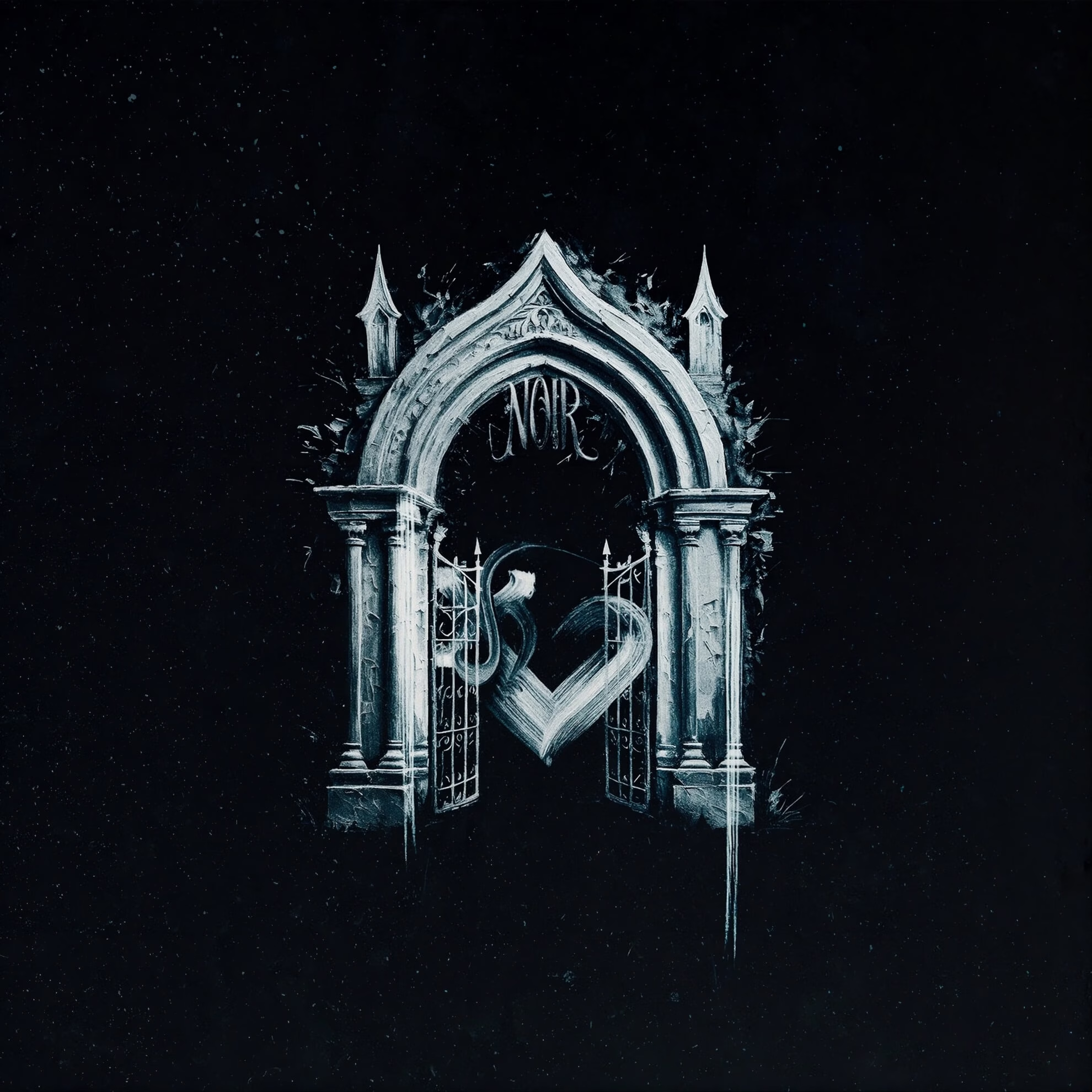
On April 10, 2026 — the final date in a production schedule that began barely eight months prior — Lord of the Lost release ‘Opvs Noir Vol. 3’ via Napalm Records, completing a trilogy that constitutes, by any contemporary measure, a considerable declaration of intent. Three volumes, 33 tracks, produced within a single sustained creative movement and recorded principally at Chameleon Studios in Hamburg.
Hamburg’s Long Shadow
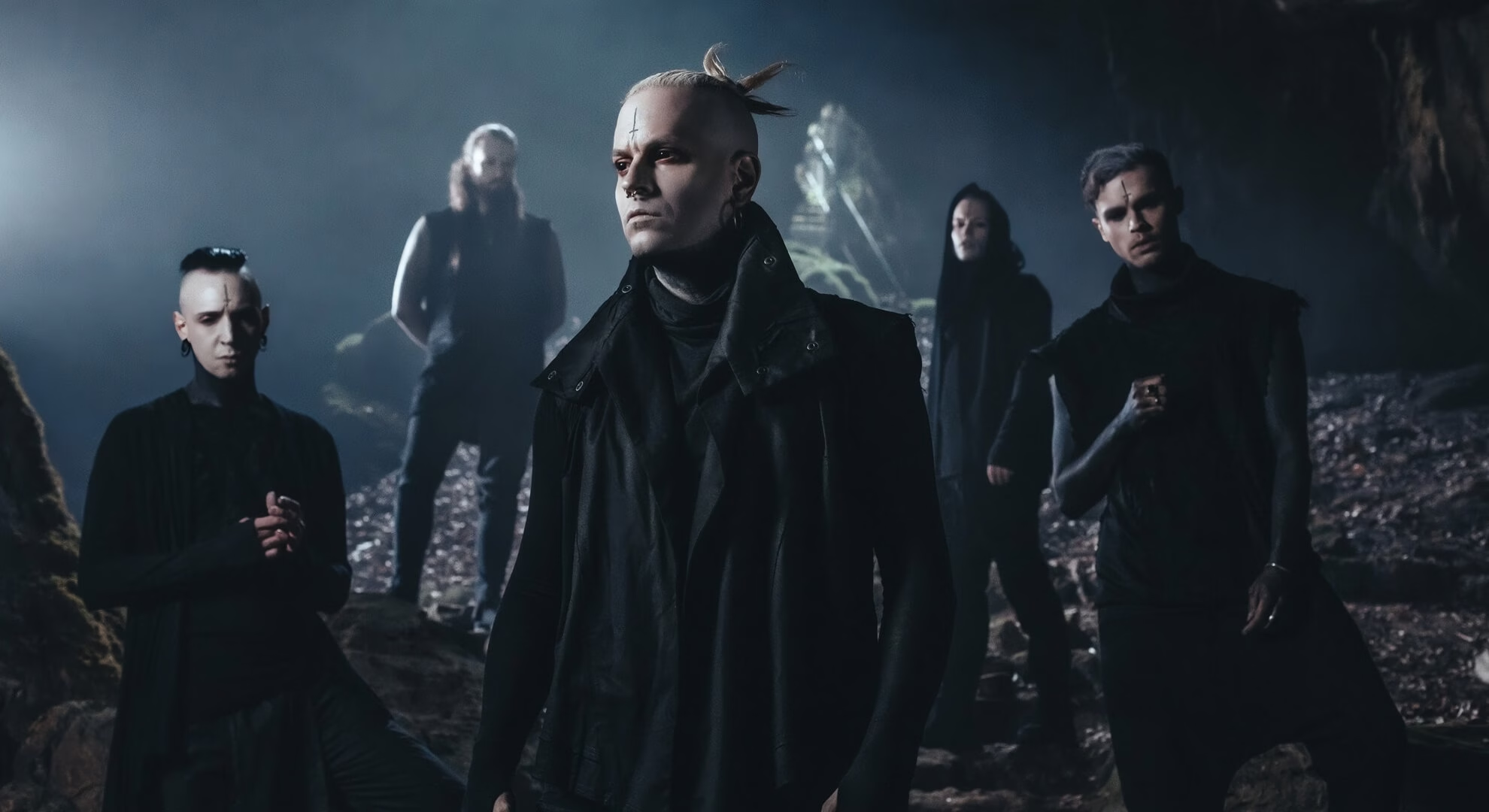
Lord of the Lost were founded in mid-2007 by Chris Harms as a solo project in Hamburg’s St. Pauli district — that port-side quarter long associated with creative transgression and commercial vitality in equal measure — and built their first decade on a fluid fusion of gothic rock, industrial metal, and glam that drew audible lines to Rammstein, Nine Inch Nails, and Marilyn Manson.
The band grew from that solo seed into a six-piece, and their discography expanded accordingly: ‘Fears’ in 2010, through ‘Empyrean,’ ‘Thornstar,’ and ‘Judas’ in 2021, each record a variation on the band’s central tension between melodic accessibility and tonal darkness.
The turning point toward international visibility came not from the underground but from a mainstream stage. Lord of the Lost represented Germany at the Eurovision Song Contest 2023 with ‘Blood & Glitter,’ an album that reached number one on the German charts and placed them on Iron Maiden’s Legacy of the Beast tour support bill — an extraordinary double-exposure for a band that had spent 15 years building its audience through the patient logic of the independent scene.
The pivot of ‘Opvs Noir’ was, in this light, a deliberate act of recalibration. Where ‘Blood & Glitter’ was theatrical and outward-facing — glam-inflected, designed for wide stages and competitive broadcast — the trilogy declared a return to interior ground. Harms described the project as “a travel guide… through the dark sides of our inner world,” positioning the three volumes as a reckoning with darkness, melancholy, and solitude approached not as liabilities but as forms of inner habitation with their own specific textures.
The Arithmetic of Ambition
‘Opvs Noir Vol. 1’ arrived on August 8, 2025; ‘Vol. 2’ followed on December 12; ‘Vol. 3’ closes the sequence today, four months later. That compressed schedule raises a legitimate question about artistic density — a question that several critics of the first two volumes raised, noting occasional moments of dilution within each album’s 11-track span.
Where ‘Vol. 1’ established the trilogy’s emotional grammar — darkness as security, in Harms’s formulation — and ‘Vol. 2’ introduced a counterweight of restrained hope, the third volume is positioned as the most formally venturesome of the three, weaving heavy guitars, dark electronica, and cinematic orchestrals with an unusually broad range of guest voices.
The guest list alone gives some indication of the record’s range: Alea of Saltatio Mortis, shock-rock provocateur Wednesday 13, Kissin’ Dynamite’s Hannes Braun, Xandria’s Ambre Vourvahis, and Cats in Space’s Damien Edwards each appear. Each carries a distinct tradition — medieval folk-influenced German metal, American horror punk, melodic hard rock, symphonic metal, British glam rock — and the resulting panorama is less a unified sonic document than a curated gathering of dark music’s adjacent languages, with all the coherence challenges that description implies.
What the Singles Declare
‘I Hate People,’ the first advance single, features Wednesday 13 and proceeds as a stomping industrial anthem on social alienation — rhythmically relentless, driven by a dense compression of synth and guitar over which Harms and Wednesday 13 trade vocal lines. Where Harms tends toward theatrical formal gestures, Wednesday 13 brings the abrasive directness of American horror-rock, and the friction between those registers gives the track a raw quality that the more polished moments of the trilogy’s first two volumes intermittently lack.
‘My Funeral’ takes a different approach entirely, deploying irony as its organizing principle: the lyrical premise — that black is the “happy color,” pink the new shade of mourning — redirects the gothic-comic mode that dark metal has always had available but rarely handles with this degree of structural confidence.
One hears in it the ‘Blood & Glitter’ theatrical instinct repurposed rather than abandoned, the hook-heavy construction carrying a wry self-awareness about the conventions being inhabited. Together, the two singles position the record at the intersection of industrial directness and gothic self-reflection — the two poles between which the ‘Opvs Noir’ cycle has always operated.
That thread runs back through the trilogy. ‘I Will Die In It,’ the fourth track on ‘Vol. 1,’ established the project’s willingness to treat mortality not as spectacle but as quiet personal reckoning — a tonal commitment that the ‘Vol. 3’ singles carry forward without repeating.
Baudelaire in Hamburg
The record’s deepest textual proposition may be ‘La Vie Est Hell,’ a track conducted partly in French and explicitly sourced from Charles Baudelaire’s ‘Les Fleurs du mal.’ Baudelaire’s 1857 collection was the defining attempt to find formal beauty in registers of urban decay, erotic melancholy, and the deliberate cultivation of darkness as aesthetic and ethical position — what T. J. Clark described as the confrontation between modern life’s conditions and the formal means of representing them with integrity. That Lord of the Lost should locate their trilogy’s philosophical anchor in that tradition suggests something about the seriousness of intent behind the project, however variable the execution across 33 tracks.
Harms produces the entire trilogy at Chameleon Studios in Hamburg — his home facility — with no outside production voice mediating the band’s decisions. That consistent self-production sustains the tonal continuity that gives all three volumes their sense of belonging to a single conceived whole. It is a posture that carries risks, the most significant being insularity, but it also ensures that no individual record in the cycle sounds as though it was made for someone other than the artist who intended it.
A Different Weight in Bogotá
Lord of the Lost played Bogotá on April 29, 2025 — their first confirmed Colombian performance — drawing an audience that had followed the band through the full arc from the Iron Maiden support slots through the Eurovision final. That documented reception grounds what follows as direct evidence rather than inference.
Rock al Parque, Bogotá’s annual publicly funded heavy music festival, has spent three decades performing a civic function that its European counterparts rarely need to: legitimizing the language of heavy music within a society that has processed collective grief through extraordinarily varied means.
The underground scenes that have grown in its proximity have developed a particular relationship with imported European dark music. German industrial and gothic metal, with its roots in post-reunification anxiety, has found genuine purchase among listeners who recognize the emotional register of collective rupture, even when the specific historical context differs sharply.
What ‘Opvs Noir’ offers those listeners is a reading of darkness that refuses its own finality. Harms’s stated framing — that solitude becomes “necessary silence, peace and inner contemplation” — maps onto a tradition of finding dignity in endurance that Colombia’s heavy music underground has practiced without requiring theoretical justification. Whether the trilogy sustains that argument across all 33 of its tracks is the open question that ‘Vol. 3’s arrival today invites the community to answer.
Tovr Noir 2026
The release of ‘Vol. 3’ coincides with the European leg of the Tovr Noir 2026 tour — a 29-date run spanning 14 countries from March through May 2026, presented by Extratours Live Entertainment. The tour carries Lord of the Lost across Oslo, Stockholm, Helsinki, Tallinn, Vilnius, Warsaw, Kraków, Vienna, Budapest, Athens, Sofia, and Bucharest before turning west through Amsterdam, Paris, Madrid, Barcelona, and a clutch of German and Swiss dates closing in Stuttgart on May 9.
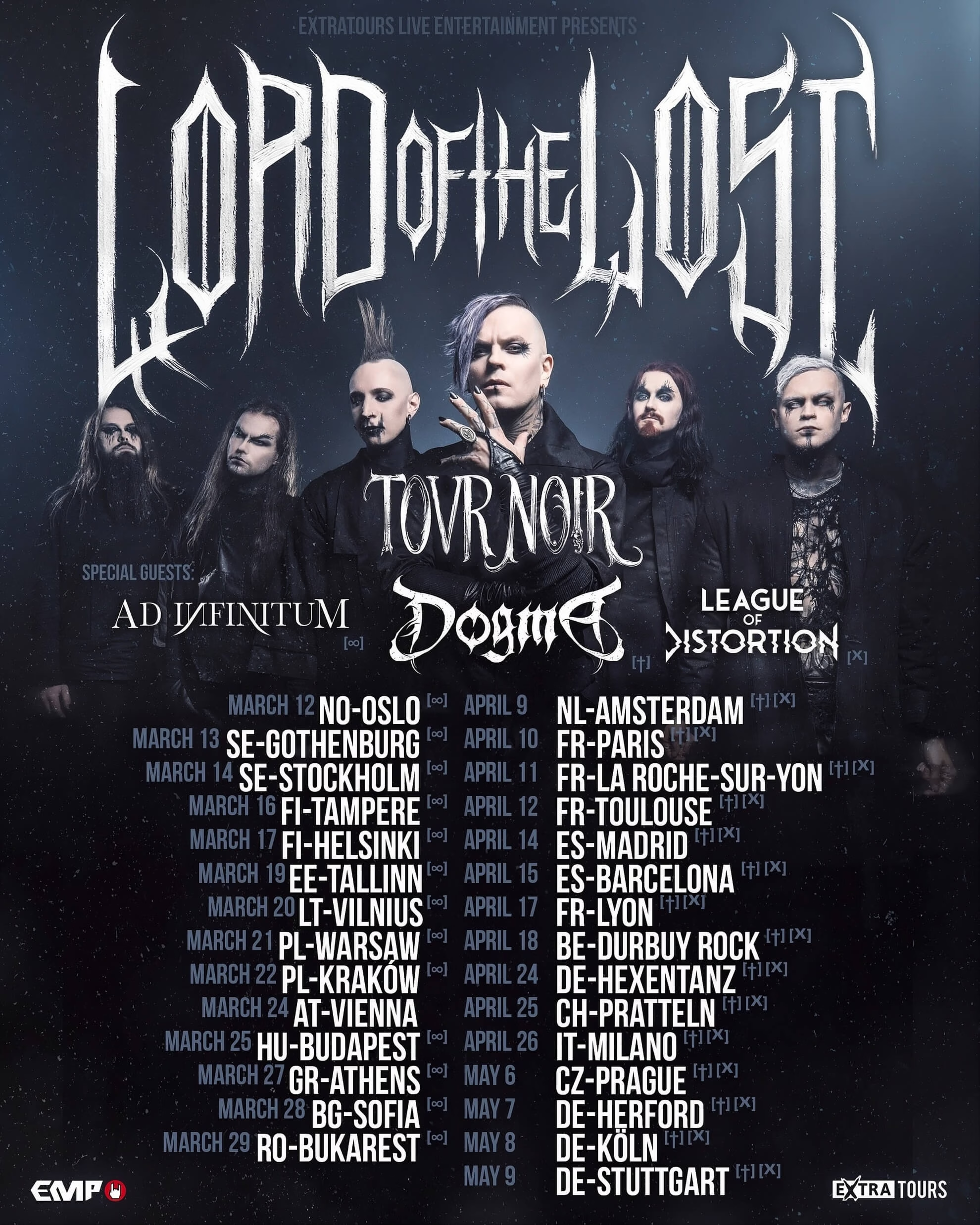
Support across various legs comes from Ad Infinitum, Dogma, and League of Distortion — three acts that collectively represent the darker spectrum of current European hard rock. Ad Infinitum bring melodic symphonic metal of Swiss-German extraction; Dogma operate in the gothic rock tradition; League of Distortion, featuring Anna Brunner who also appears on ‘Vol. 2,’ close the circle between the recorded trilogy and its live presentation. The tour is, functionally, the 33-track argument made physical.
No trilogy is immune to the arithmetic of fatigue. Thirty-three tracks in eight months tests the patience of even the most committed listeners, and Lord of the Lost are not a band that has ever placed compression above elaboration. The ‘Opvs Noir’ project carries its ambition openly — in its scale, its self-production, its philosophical sourcing, and its refusal to abbreviate — and that transparency is itself a kind of integrity.
When ‘Vol. 3’ reaches the Colombian underground today, it arrives as the conclusion of an argument that began eight months ago and now requires a verdict from listeners who will give it the most thorough attention it is likely to receive anywhere. That is not a negligible thing to offer a record.
How does releasing three complete albums within a single creative season alter the emotional weight you assign to each individual track — and does the scale of the ‘Opvs Noir’ cycle deepen or complicate what Lord of the Lost have been trying to say about inhabiting darkness?
Leave a Reply