


In the nineties, Cali bore the particular gravity of a city that had watched the Rodríguez Orejuela organisation restructure daily life around the arithmetic of violence and impunity. Where Medellín had its cartel mythology — a mythology now industrially consumed by streaming platforms — Cali’s relationship with organised crime was quieter and more corrosive, woven into the city’s commercial and social fabric at a depth that left fewer dramatic episodes for international memory and more sustained distortion of everyday experience. It was inside this distortion that Valle del Cauca’s extreme music community took root: not as spectacle, but as a form of reckoning.
A generation of young musicians, many of them working-class, arrived at the rehearsal room not because the genre was fashionable but because it was the most honest language available for the scale of what they were living through. Cali has always sat slightly outside the narrative that metropolitan Colombian metal criticism tends to construct — a narrative centred on Bogotá’s thrash scene and Medellín’s foundational Ultra Metal legacy. But its underground was no less serious, no less committed, and no less grounded in the specific textures of urban violence and social dispossession.
That inheritance belongs to Sagros as directly as the Cauca River belongs to the department. Founded in Cali in 1997, the band has spent nearly three decades developing a strand of European-rooted thrash metal that refuses either ornamentation or nostalgia. Colombian musicians operating in extreme genres have consistently engaged with their social and political realities in ways that exceed genre convention, transforming the music into what scholars have documented as a vehicle for challenging ongoing oppression through sound.1
Sagros, from their first recordings, placed themselves squarely within that tradition — not as commentary from a distance, but as practitioners living inside the very conditions they described.
Three Decades of Forward Motion
Sagros did not arrive at ‘Sincarnation’ quickly. The band’s pre-history alone — before any formal release — spans nearly a decade of underground activity in Cali’s rehearsal rooms and dive venues, the kind of formative period that Colombian extreme music’s infrastructure demands and rewards. By the time the band issued their first EP, ‘Freedom Lies in Chains,’ in 2007, they had already built the live credibility and network necessary to make the recording mean something inside the scene.
A second EP, ‘For Your Blood,’ followed in 2010, further establishing Sagros as a working band with a specific sound and a growing audience across the regional circuit. These releases were not commercial propositions; they were statements of intent, documents of a band that had earned its place through time served.
The debut full-length, ‘Anger Blinds the Mind,’ released on September 16, 2013, through Hateworks, announced Sagros with a directness that the Colombian press received as both unexpected and entirely overdue. Recorded and mixed at All Music Studios in Cali between May 2011 and September 2012, the eight-track record balanced German thrash severity — the Sodom and Kreator tradition of riff-forward brutality — with the rhythmic authority of the Bay Area school.
The Metal Observer, writing from the United States, described the record as carrying a blend of extreme aggression and musicianship that cut through a significant portion of the competition, awarding it 8 out of 10. Colombian publication Autopista Rock noted that Sagros had managed to gather eight tracks that delivered an intense and entertaining listening experience, drawing the lineage back to Sodom and early Sepultura.
The album was selected as one of the 50 most important Colombian releases of 2013 across all music categories — alongside Grammy recipients — and the title track was subsequently ranked 718th among the 1,000 most important songs in Colombian rock between 1963 and 2015.
Between ‘Anger Blinds the Mind’ and the second full-length, Sagros issued ‘Silencio,’ an EP released in 2018, followed by the archival compilation ‘An Ancient Torment’ in May 2019, which co-released through Hateworks and Green Revolution Prod. and gathered material from ‘Silencio,’ the early EP ‘Paths of the Dead,’ and ‘Freedom Lies in Chains’ into a single survey document — a 10-track retrospective that gave new audiences access to the band’s pre-debut work.
‘An Ancient Torment’ also arrives as something of a philosophical statement: a band choosing to present its own history with care and without embarrassment, making its formative work available rather than leaving it to the archaeological instincts of dedicated listeners.
‘A Justification for Cruelty,’ the band’s second full-length, released in 2022 through Hateworks, represented a deliberate compositional advance. The record featured contributions from musicians associated with Headcrusher, Blasting Hatred, Daycore, Perpetual Warfare, and Revenge, signalling Sagros’s embeddedness within the wider Hateworks ecosystem and the broader Colombian extreme music network.
Hateworks itself — headquartered across Manizales, Los Angeles, and Barcelona — has functioned since the early two-thousands as Colombia’s most consistent extreme music label, home to Masacre, Headcrusher, Eshtadur, Gutgrinder, Fúnebre, and a roster that reads as a reliable map of the country’s underground. Being part of that stable is not incidental; it places Sagros within a specific tradition of documented, internationally distributed Colombian metal.
The physical edition of ‘A Justification for Cruelty’ sold with sufficient momentum that Hateworks was forced to suspend shipping in early 2026, citing high demand, with resumption scheduled for after March 17. That a Colombian thrash album recorded in Cali required a shipping pause in 2026 due to demand — nearly four years after release — is not a minor detail. It speaks to an accumulated audience that has grown steadily, through live performance and word of mouth, across the years of the band’s existence.
Their Place in the Colombian Heavy Music Conversation
Sagros’s importance to the Colombian metal scene rests not on a single release or a single moment but on a sustained practice that has made them a reliable, frequently cited, and widely respected constant. They have taken stages at Rock al Parque — the free civic festival that Bogotá has maintained since 1995 and that the city’s Council formally enshrined as cultural heritage in 1998 — as well as Manizales Grita Rock, Galeras Rock, Ibagué Ciudad Rock, Coexistence Rock, Boyacá Rock Fest, Alternative Unirock, Calibre Underground, Recicla por el Rock, and Mamut Fest.
This is the full circuit, every significant stop on the national extreme music map, which means they have done the work of being present across the country’s geography rather than limiting themselves to the capital or the home city.
Their standing as an opening act calibre for international visiting bands is equally well documented. They have shared stages — in a supporting capacity — with Exodus, Kreator, Annihilator, Testament, Raven, Destruction, Angelus Apatrida, and Nervosa. They have performed alongside Entombed, Carcass, Nuclear Assault, Whiplash, and Behemoth.
These are not name-drops arranged to establish equivalence with foreign counterparts; they are an account of how Sagros has functioned within the Colombian metal circuit’s relationship with international touring, a relationship in which local bands serve as cultural anchors, context-setters, and proof of the scene’s depth. When Kreator and Exodus arrived in Colombia in October 2009 — the show that frontman Sergio Gaviria later described as a dream fulfilled — Sagros was part of the bill. That is a specific kind of credibility.
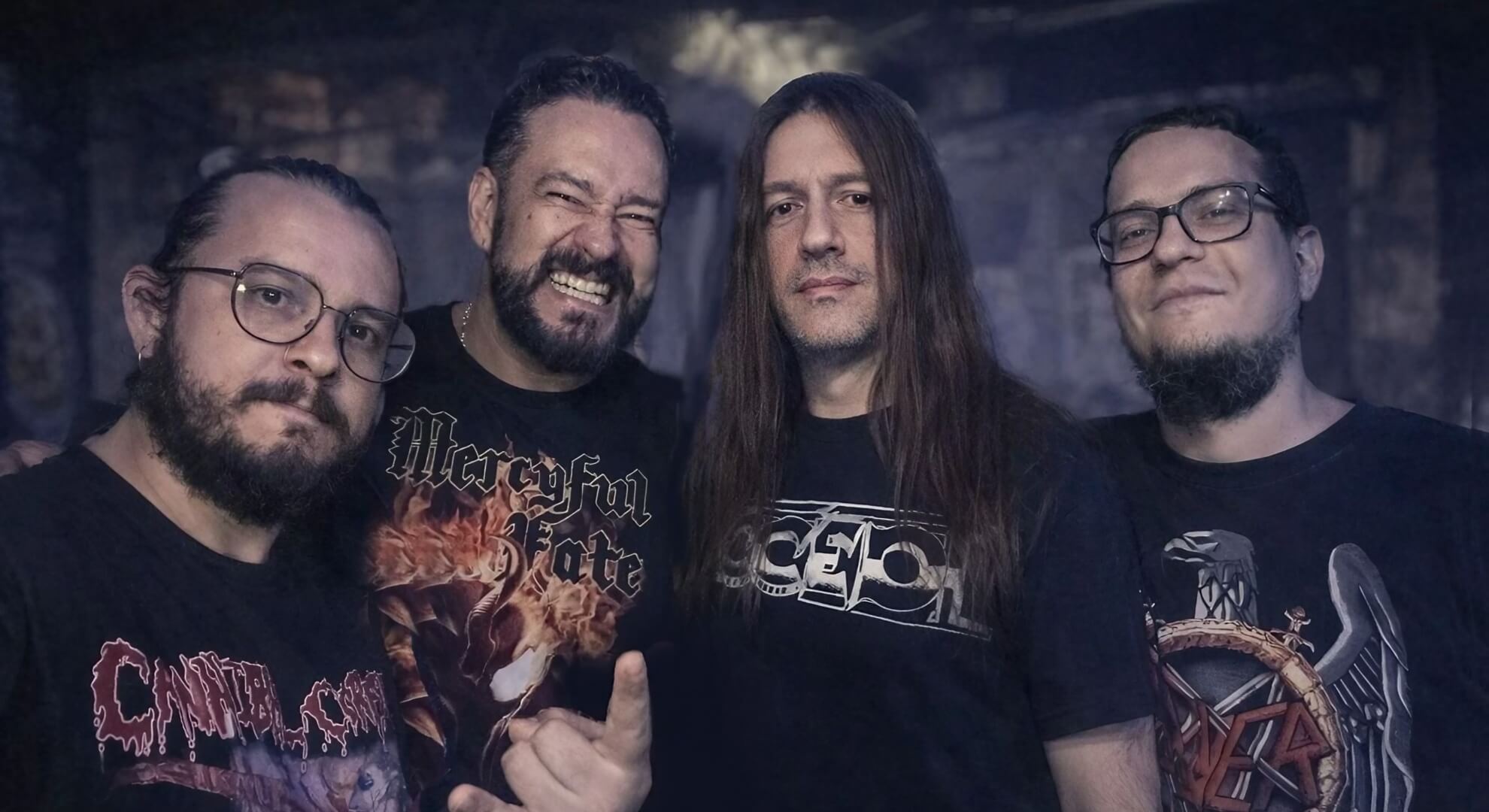
Gaviria himself — guitarist, vocalist, and the creative centre of the band for nearly three decades — deserves particular attention as a figure within Cali’s extreme music history. He has maintained Sagros as an active, recording, and touring entity across periods when the national metal scene contracted, when economic conditions made touring difficult, and when the gap between full-length releases stretched across years.
The band’s humanist lyrical framework — a consistent commitment to examining man as creator and destroyer, drawing on personal experience to build self-criticism and reflection on existence — has remained stable across the full discography, from the earliest demos to ‘Sincarnation.’ That consistency of philosophical intent is rarer in any music scene than it first appears.
The Hateworks affiliation, which began with the signing for ‘Anger Blinds the Mind’ and has continued through ‘A Justification for Cruelty’ and into the new album, situates Sagros within one of the few Colombian extreme music institutions that has maintained international distribution infrastructure over multiple decades.
The label’s reach into the United States and Europe has meant that Sagros’s records have been physically available to listeners outside Colombia who might otherwise have encountered the band only through digital channels. This is not a small thing in a genre where physical product still carries significant cultural weight for its dedicated audience.
Sin as Flesh, Flesh as Verdict
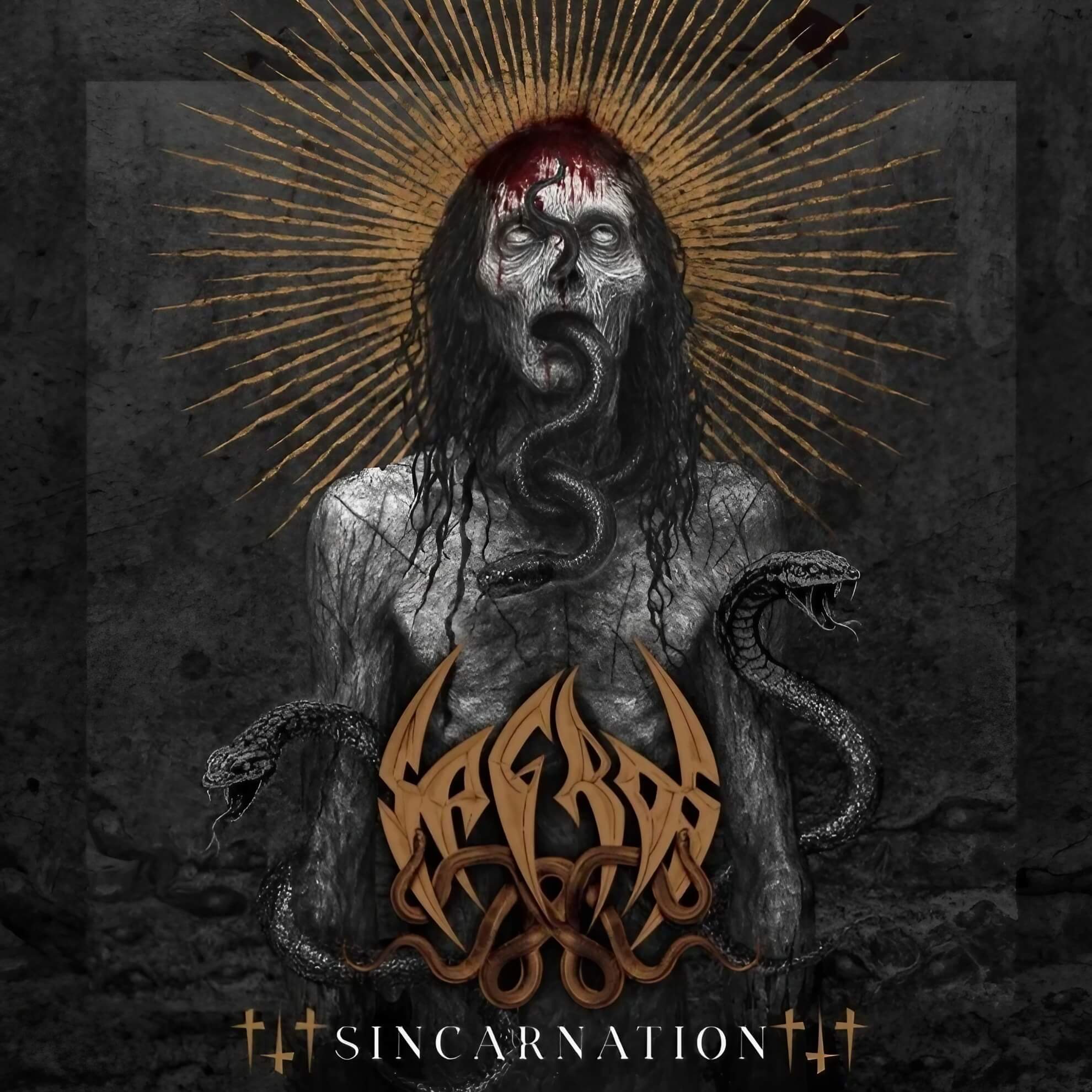
Now Sagros brings ‘Sincarnation.’ The record arrives on May 15, 2026 through Hateworks, and its title carries the kind of compressed theological weight that the band’s humanist lyrical framework has always favoured. The word fuses sin and incarnation: the idea that embodiment itself is implicated in human destructiveness, that the body is not merely the vessel of wrongdoing but its precondition and its home.
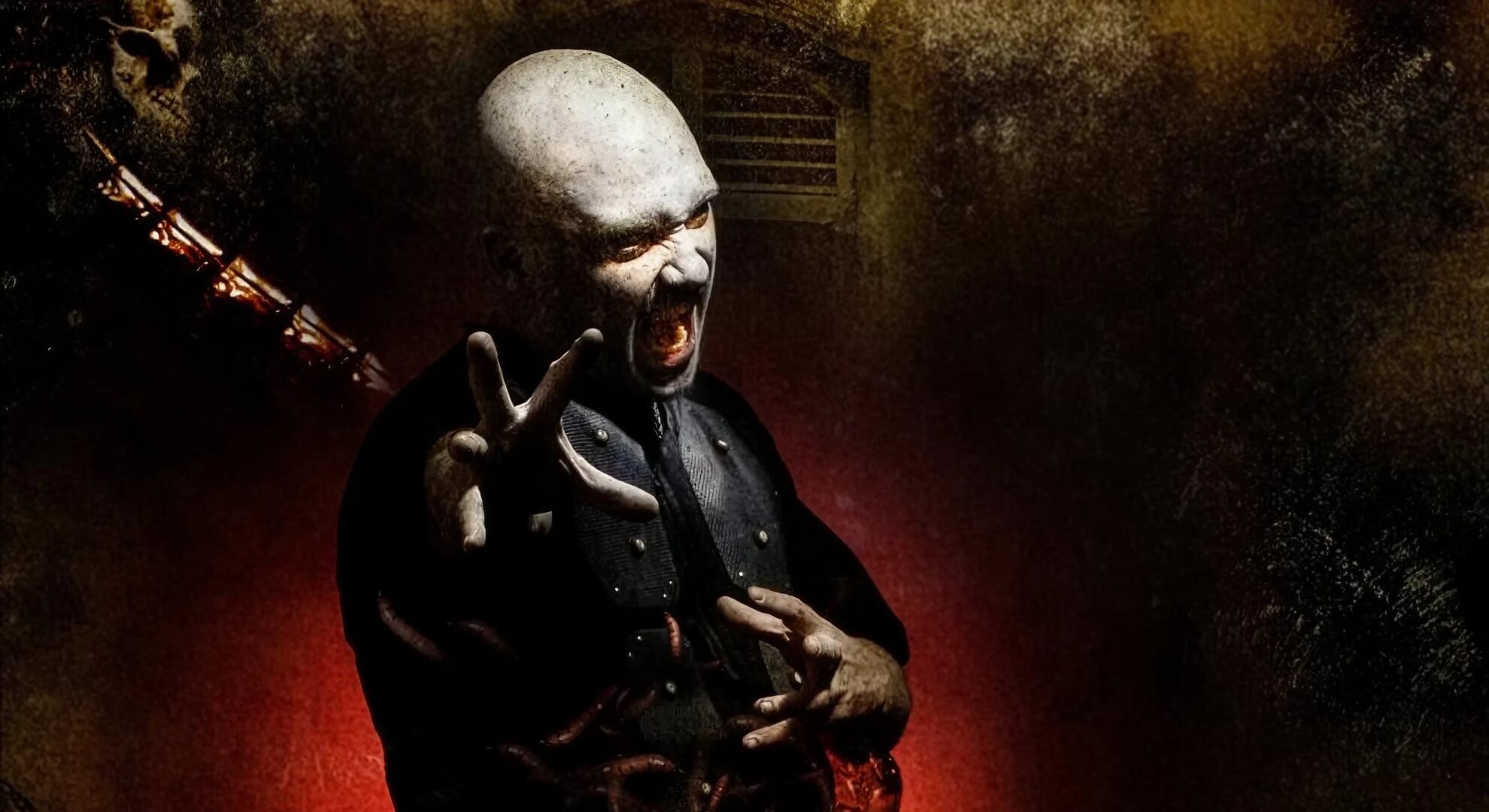
The promotional imagery, featuring a serpent-entwined figure set against radiating darkness and the cross-marked rendering of the album title, reinforces this reading. It is not a record about the devil. It is a record about the human animal.
For a band whose stated philosophy centres on man as creator and destroyer of everything that exists, this is not a departure. It is a deepening. ‘Sincarnation’ takes the premise that drove ‘A Justification for Cruelty’ — that human cruelty requires not explanation but confrontation — and pushes it into the domain of ontology.
If the earlier record asked why people harm each other, ‘Sincarnation’ appears to ask what it means that harm is constitutive of the species. That is a different, and harder, question. It is also exactly the kind of question that thrash metal, at its most serious, is equipped to carry.
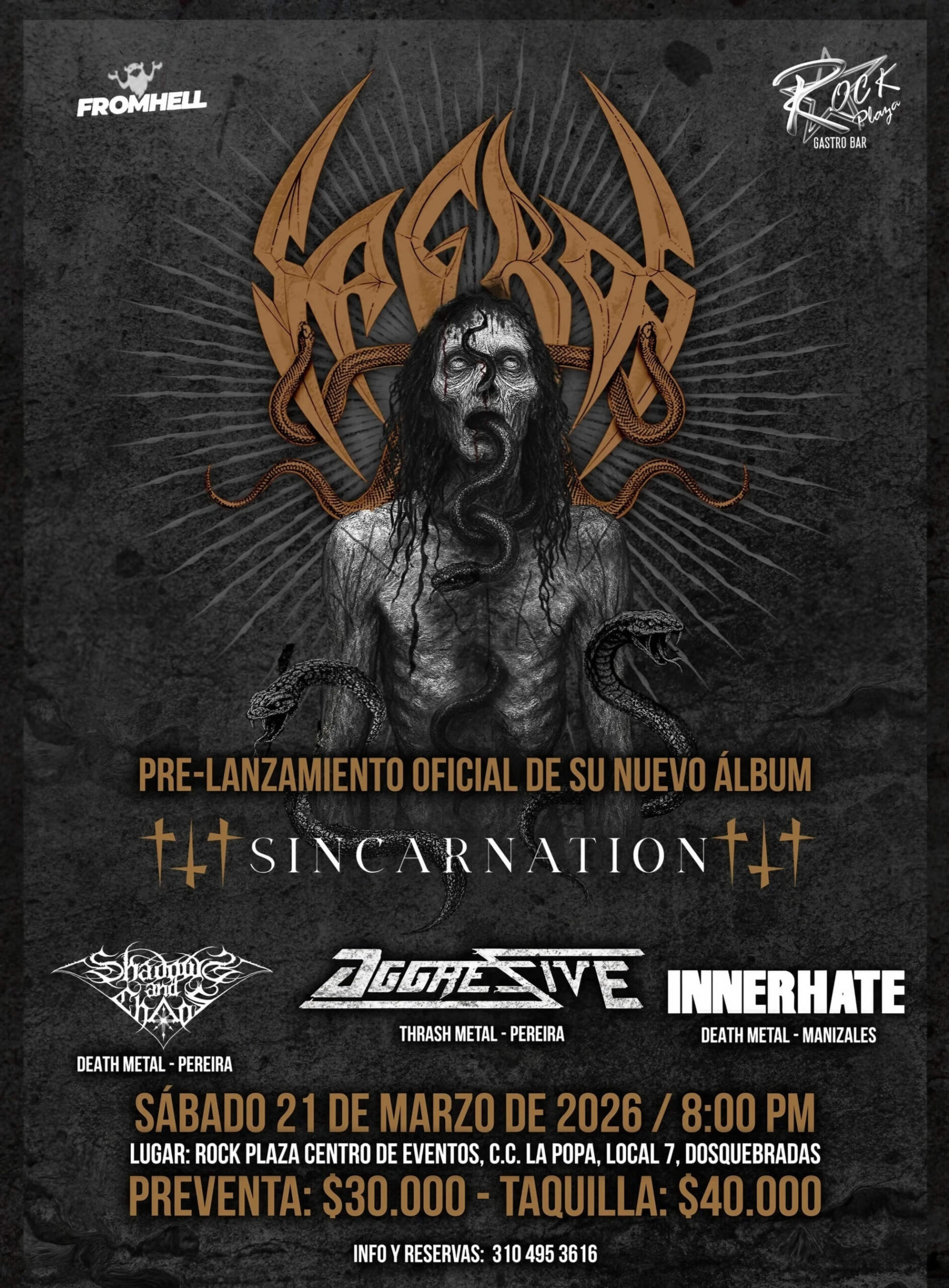
The band has promoted ‘Sincarnation’ through a pre-launch circuit that began with a formal presentation at Rock Plaza Centro de Eventos, C.C. La Popa, Local 7, in Dosquebradas, Risaralda on March 21, 2026, followed by appearances in Bogotá and Cali.
The regional scope of this itinerary — the Eje Cafetero, the capital, the home city — maps the geography of Colombian extreme music’s actual circuit: not the capital alone, but the cities and satellite towns where the underground has maintained its infrastructure through decades of economic adversity.
The Dosquebradas pre-launch event featured support acts Shadows and Chaos (death metal, Pereira), Aggresive (thrash metal, Pereira), and Innerhate (death metal, Manizales), with preventa tickets priced at 30,000 COP (approximately $8 USD) and taquilla at 40,000 COP (approximately $11 USD).
A Band That Has Earned the Right to Ask Hard Questions
There is a particular kind of authority that comes not from external validation but from sustained commitment to a specific practice inside a specific place over a specific time. Sagros have spent twenty-nine years in Cali, working within Colombia’s extreme music tradition — carrying the circuit-tested credibility of a band that has earned its place on every significant stage in the country — and shaping all of it into a form that is distinctly theirs.
‘Sincarnation’ does not need an international comparison to justify its existence. It arrives as a full articulation of what the band has been saying since 1997: that human beings are capable of extraordinary destruction, that this truth deserves musical form, and that Cali has as much right as anywhere on earth to speak it.
The album’s title does not offer comfort. It offers precision. In a genre that has always trafficked more in gesture than in rigour, Sagros remain committed to the harder road.
How does ‘Sincarnation’ — its title, its imagery, its place in Sagros’s ongoing confrontation with human nature — change the way you hear the band’s earlier work, and what does the album’s particular focus on embodiment and sin add to your own understanding of what extreme music can carry?
References
- Nelson Varas-Díaz, ‘Decolonial Metal Music in Latin America’ (Bristol: Intellect, 2021), 38–44. ↩︎
Leave a Reply