


On May 21, 2026, the venerable Italian ensemble Ataraxia will release their thirtieth studio album, ‘Sylfaera the Fair,’ via The Circle Music. In the annals of contemporary music, few entities survive four decades of creative flux; fewer still manage to reach their thirtieth opus with their conceptual vitality intact. For Ataraxia, founded in the twilight of the post-punk era in November 1985, this release is far more than a numerical milestone. It represents the final closure of a massive hermetic circle—a trilogy that began in the dense matter of the earth and now dissolves into the aether.
This release marks a pivotal moment in the career trajectory of the band. Throughout the nineteen-nineties and two-thousands, Ataraxia moved from the melancholic shadows of darkwave into the ethereal, courtly atmospheres of the Mediterranean Renaissance.
‘Sylfaera the Fair’ acts as the spiritual synthesis of these eras. It is a work that completes the thematic arc initiated by 2022’s ‘Pomegranate’ and continued by 2024’s ‘Centaurea,’ proposing a final transcendence into the “Elysian Fields.”
The motivation of the band here is explicitly non-artistic in the traditional sense; they characterize their output as “a functional tool for spiritual engineering,” revealing an intent to move beyond performance into a mode of active, sonic manipulation of the state of the listener.
A Lineage of Mediterranean Humanism
Locating the cultural placement of Ataraxia requires looking past the confines of modern neoclassical labels and toward the Florentine Camerata and the Humanist academies of the fifteenth century. Ataraxia functions less like a rock band and more like a modern-day Accademia, mirroring the efforts of figures such as Marsilio Ficino, who sought to reconcile ancient Orphic hymns with contemporary artistic expression.1 Their work is a sonic continuation of the prisca theologia—the idea that a single, true theology exists across all religions and was given by God to ancient sages.
While their contemporary peers in the Nordic Ritual scene look toward the visceral, chthonic energies of the Iron Age North, Ataraxia looks toward the luminous, mathematical harmony of the Classical world. Where the Nordic scene emphasizes the blood and soil of ancestral memory, Ataraxia emphasizes the spirit and geometry of the Mediterranean mind. They are the southern counterweight to the current pagan revival, replacing the drum of the Viking with the lyre of the philosopher.
This places them in a unique lineage that connects the seventeenth-century Monteverdi madrigals to the twentieth-century esotericism of Franco Battiato and ‘The Fourth Way’ music of Thomas de Hartmann. Culturally, they occupy the same space as the visionary cinema of Sergey Parajanov or the late-career poetry of William Butler Yeats.
They bridge the gap between rigorous scholarship and avant-garde exploration, ensuring that the ancient, solar wisdom of the Mediterranean finds a voice in a century increasingly dominated by northern shadows. This return to the One is structured through the Neoplatonic procession of mone, proodos, and epistrophe, which dictates the necessary reversion of the soul to its source.2
The First Echoes of the Aether ‘Sylfaera the Fair’
The lead single and accompanying video provide the first sensory map of this final destination. More than just a preview, the track functions as a psychological threshold, inviting the listener to shed the weight of the previous albums and prepare for the final Si vibration.
The single creates an immediate feeling of verticality. Unlike the heavy, earth-bound resonance of ‘Pomegranate,’ the atmosphere here is light and volatile. The Uilleann pipes exhale long, spectral sighs that mimic the movement of wind through the Emerald Forest. Below this, the bodhran provides a soft, rhythmic pulse—not a war-march, but the steady thrum of a heartbeat at rest.
The vocals of Francesca Nicoli occupy a new space here. Moving entirely into glossolalia, her voice becomes a pure instrument, soaring into high, crystalline registers before descending into whispered, breathy incantations. This linguistic abandonment is a diagnostic key to the current methodology of the band.
Nicoli frames the shift as a necessary act of subversion, suggesting that to strip away the dictatorship of the dictionary is to kill the formatory mind. She identifies the rational intellect as a primary obstacle to the shock their music aims to deliver.
This sonic technique mirrors the ritualistic use of non-semantic vocalizations found in various historical ecstatic traditions, where language is discarded to facilitate a direct experience of the sacred.3
The Visual Myth of the Emerald Forest
The music video enhances this feeling of transition through evocative, symbolic storytelling. The imagery focuses on the sharp mountains of Vetolian, utilizing high-contrast, emerald-tinted visuals that suggest a world between waking and dreaming. We see the six ancient souls as hooded figures, their movements slow and liturgical, mirroring the internal process of the alchemical reversion to the One.
The video makes frequent use of slow-motion and soft-focus, creating a sense of time-dilation. It avoids a literal plot, opting instead for a series of visual meditations: water reflecting light in impossible patterns, the texture of ancient stone, and the glint of the Travelling Stone featured in the physical box set.
The imagery serves to reinforce the central narrative of the album: that the world we perceive is merely a veil, and that through the right vibration we can glimpse the Elysian Fields beyond, and beneath this luminous promise lies a sophisticated psychological tension.
To ascend, one must first confront the gravity of the self; to become a Sylph of the air, one must endure the dissolution of the ego. This dark side of transformation is where ‘Sylfaera the Fair’ finds its most profound depth.
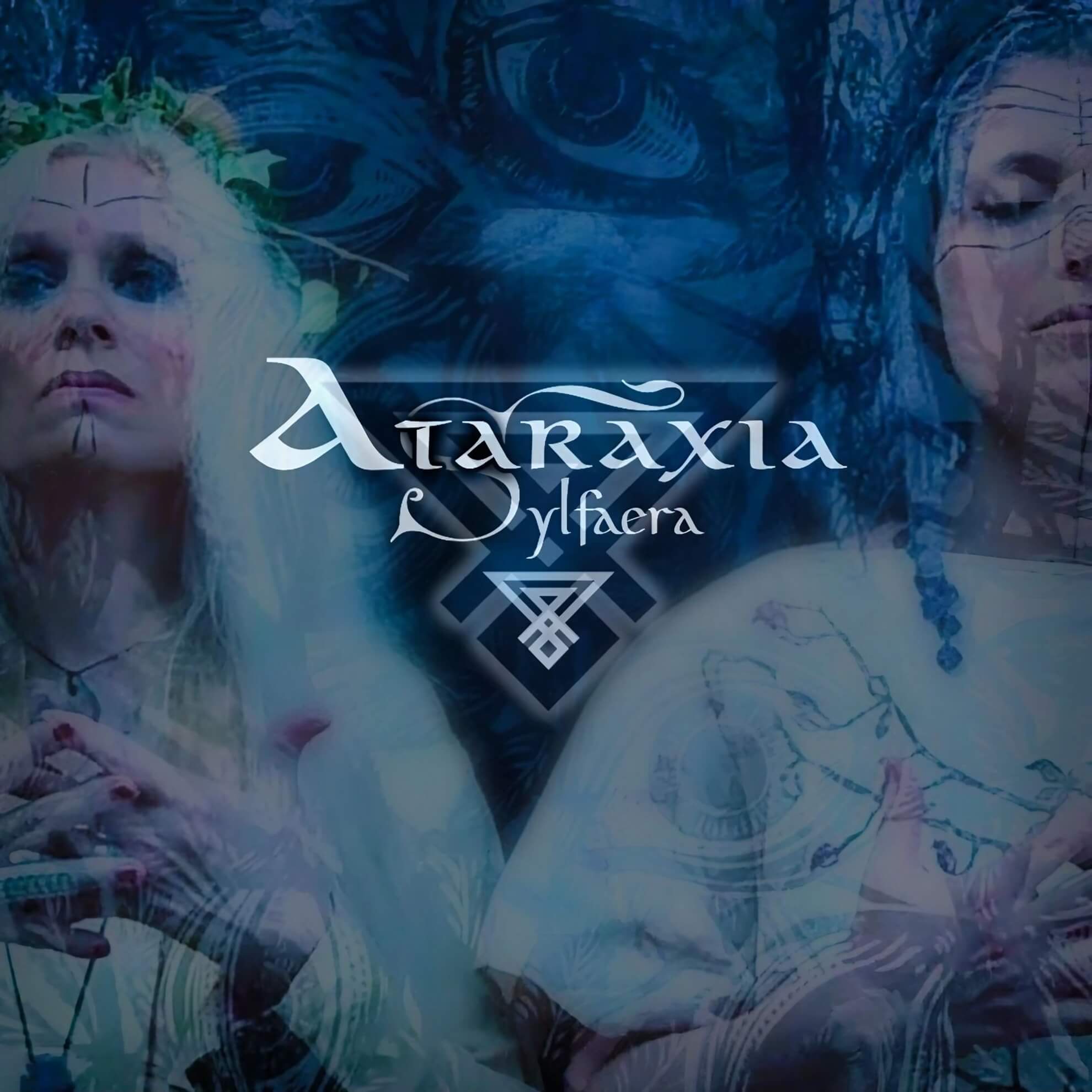
The cover art for the album serves as a psychological Rorschach test. Shifting away from the saturated, earthy tones of ‘Pomegranate,’ the visual palette is now dominated by a cold, crystalline teal and deep, ink-like shadows. The central figure is often obscured or fragmented, suggesting a state of sparagmos, the ritual tearing apart of the self before rebirth.
The cover art for the album functions as a psychological threshold, depicting a lone female figure in a vibrant golden dress ascending a rugged, stone-hewn stairway toward a colossal, snow-capped mountain peak. She carries a lantern—a traditional symbol of the Hermit or the seeker of truth—which casts a warm, solitary glow against the monochromatic, imposing scale of the Vetolian heights.
This composition creates a deliberate sense of verticality and isolation; the figure is small, caught between the heavy ancient masonry of the world below and the blinding, indifferent white of the Absolute above.
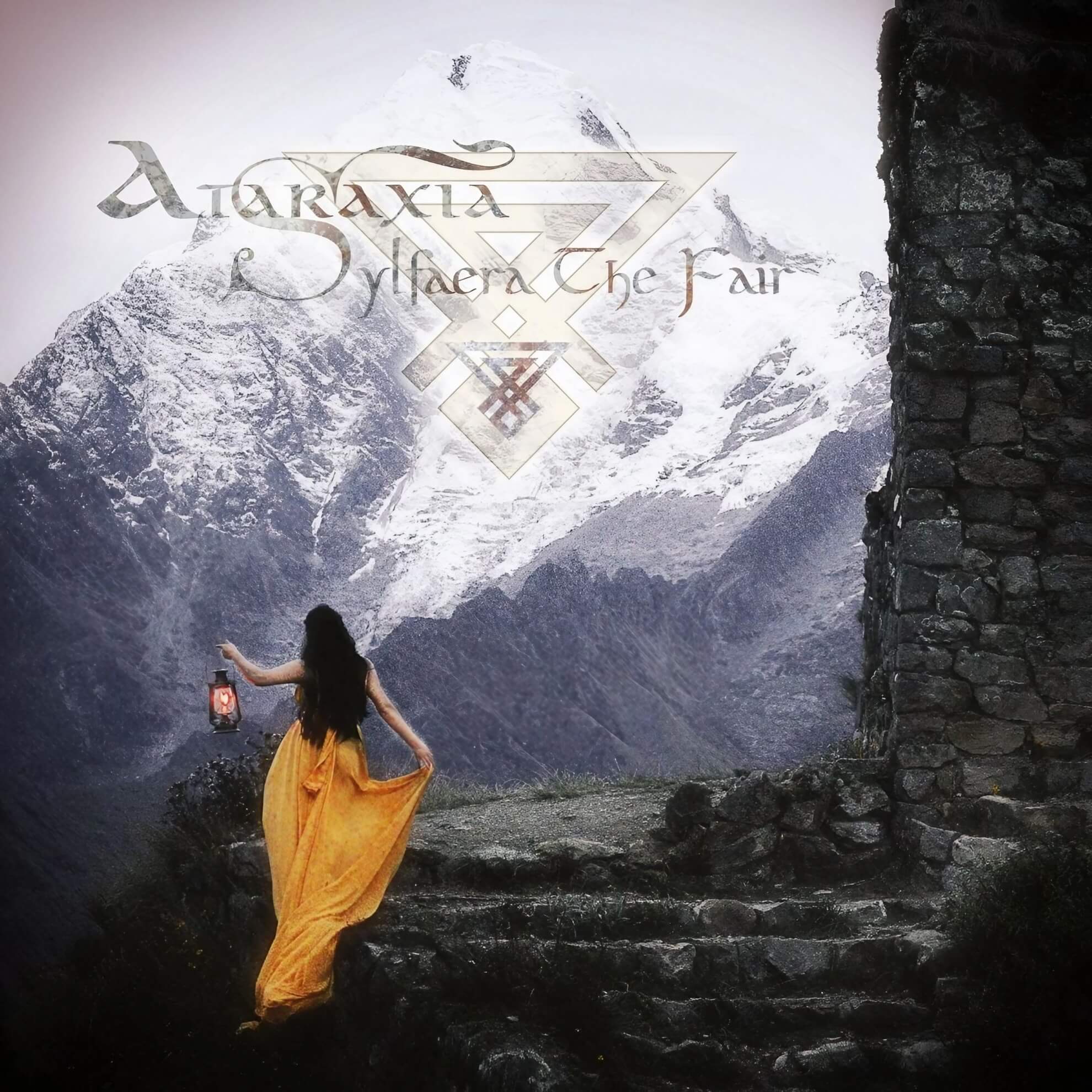
Psychologically, this imagery mirrors the anxiety of the Second Conscious Shock in Gurdjieffian philosophy—the terrifying moment when the seeker realizes that to reach the next octave, the current version of the I must be left behind in the ruins.4
The sharp contrast between the warm yellow of the garment and the cold, crystalline blue of the shadows suggests a spirit caught in the act of volatile transformation. The mountain does not provide a sanctuary but a precipice, representing the strenuous and often violent beauty of a soul caught in the upward draft of transcendence, where the lantern of the intellect is the only light available before the final dissolution into the stellar spirit.
The use of glossolalia further complicates this psychological landscape. While it can be heard as angelic, it also represents a surrender to the irrational and the unknown. By stripping away known words, Ataraxia forces the listener into a state of linguistic homelessness.
In the rare moments where phonemes coalesce into something recognizable, they often hint at themes of loss and the longing for the source. The lyrics are not poems to be read; they are vocalized sighs and sharp intakes of breath that map the internal conflict of the seeker. This is the shadow of the narrative of the album: the realization that the Emerald Forest is not just a destination, but a mirror reflecting the own internal wilderness of the listener.
The diagnostic view of the band regarding this process is cold and unsparing, as they suggest that the actual message resides within the silence between the syllables. This implies that the auditory content is merely a distraction for the ego while the silence does the work.
Viewed as a unified creation, ‘Sylfaera the Fair’ serves as the ultimate movement within a tripartite alchemical composition. While ‘Pomegranate’ established the chthonic base—the nigredo—and ‘Centaurea’ provided the illuminating growth—the albedo—this final entry manifests as the rubedo, signaling the definitive achievement of the Philosopher’s Stone.5
The overarching narrative of the album is one of reversion. The tracklist serves as a series of gates, leading the listener from the foothills of the material world into the rarefied atmosphere of the Emerald Forest. Sonically, this identity is defined by its transparency. While previous Ataraxia works often leaned into dense, layered orchestrations, ‘Sylfaera’ feels deliberately stripped back, allowing the resonance of the natural instruments to breathe.
The structure of the album represents a Law of the Octave in practice. It is not a collection of songs but a single, continuous vibration that builds toward the final track—the resolution of the Si note. By the end of the album, the listener has been guided through a complete cycle of existence.
The sonic identity, blending the ancient Uilleann pipes with modern production, represents the Time-Spirit—the realization that all eras exist simultaneously within the ritual space. ‘Sylfaera the Fair’ is therefore more than a thirtieth album; it is the summary of the entire conceptual history of Ataraxia, a monumental work that completes the circle and opens the door to the Absolute.
Ancient Wisdom in the Law of Seven
The most provocative detail in the announcement of ‘Sylfaera the Fair’ is the explicit citation of the law of the octave. This points directly to the teachings of George Gurdjieff and ‘The Fourth Way,’ signaling a move from purely aesthetic neo-classicism to a more structured, esoteric philosophy.
The cosmology of Gurdjieff posits that the universe is governed by the Law of Seven, wherein nothing proceeds in a straight line because everything vibrates. The musical scale provides the model for this, but there are two intervals where vibration slows and requires a shock to maintain its original direction.6
For Ataraxia, music is the tool used to provide these shocks. This is no mere artistic choice; it is a clinical application of what they describe as the engine of human evolution, an attempt to force the vibration of the listener to a higher level of conscious awareness.
The trilogy guides the soul from the chthonic root of ‘Pomegranate’ through the civilizational portal of ‘Centaurea’ and finally to the stellar ritual of ‘Sylfaera,’ which leads toward the Absolute and the light of the Elysian Fields.
Echoes from the Mountains of Vetolian
Ataraxia has created a mythical terrain for this finale known as the Emerald Forest on the sharp mountains of Vetolian. This designation links directly to Vetulonia, one of the twelve great cities of the Etruscan League.
Hailing from Modena, Ataraxia summons the genius loci of the Etruscans—a people obsessed with the afterlife and divination. This choice roots the finale in the own geographical heritage of the band, bringing their forty-year journey back to the Italian soil from which they sprouted, yet viewed through a transcendental lens.
Historically, Vetulonia served as a primary center for metalworking and high-culture, functioning as a nexus between the chthonic underworld and the civic world above.7
This Emerald Forest represents the Heart Center, symbolized by the color green and the Anahata chakra. It functions as the balance point between the lower triad of the physical and the higher triad of the spirit. Within Islamic mysticism, the Emerald Rock similarly marks the boundary where the spiritual takes on form.
To facilitate this transition, ‘Sylfaera the Fair’ uses glossolalia, an invented, non-linear language. This represents a structural necessity for the band, as the logic and intellect of the formatory apparatus are viewed as obstacles to higher consciousness. Glossolalia bypasses these barriers to speak directly to intuition, providing a language for the Si note that is no longer of the world but not yet of the absolute.
The physical release mirrors the hierarchical nature of the Law of Octaves through three distinct tiers. The exoteric level is the Digi CD, while the mesoteric level consists of marbled turquoise and black vinyl. The esoteric peak is the Deluxe Black Box, containing silver vinyl, a Travelling Stone, and an Oracle.
This approach compares to contemporary ritual acts such as Wardruna, who used white raven imagery for ‘Kvitravn,’ or Heilung, who made use of handmade items in ‘Drif’ to emphasize shamanic healing. Ataraxia distinguishes itself by focusing specifically on the internal mechanics of inner sight and divination.
The Resolution of the Thirtieth Step
‘Sylfaera the Fair’ represents far more than a final chapter; it is the moment where the music ceases to be an object and becomes a threshold. Ataraxia has transcended the role of the contemporary ensemble by reaching the thirtieth step, assuming the position of architects within a modern mystery school. As the final Si note vibrates through the Emerald Forest of Vetolian, it invites a final dissolution—a shedding of the formatory mind and the weight of the dictionary.
The significance of this release lies in its uncompromising demand: it asks the listener not to hear, but to vibrate in resonance with a higher order. When the octave finally resolves, it will not leave us where we began. Instead, it marks the precise instant where forty years of earthly searching finally dissolves into the absolute, proving that for those who follow the law of the scale, the end of the song is merely the first breath of a new, eternal vibration.
In an era where ritual folk often leans toward the ancestral and the chthonic, does the pivot of Ataraxia toward the mathematical and the celestial suggest a necessary corrective to our current cultural stagnation, or does this Law of the Octave simply impose a new, equally rigid hierarchy upon the spiritual autonomy of the listener?
References:
- Paul Oskar Kristeller, ‘The Philosophy of Marsilio Ficino’ (New York: Columbia University Press, 1943), 304–307. ↩︎
- Proclus, ‘The Elements of Theology,’ translated by E. R. Dodds, second edition (Oxford: Clarendon Press, 1963), 33–37. ↩︎
- William J. Samarin, ‘Tongues of Men and Angels: The Religious Language of Pentecostalism’ (New York: Macmillan, 1972), 121–128. ↩︎
- P. D. Ouspensky, ‘In Search of the Miraculous: Fragments of an Unknown Teaching’ (New York: Harcourt, Brace & World, 1949), 284–287. ↩︎
- C. G. Jung, ‘Psychology and Alchemy,’ translated by R. F. C. Hull, second edition (Princeton: Princeton University Press, 1968), 228–232. ↩︎
- Titus Burckhardt, ‘Alchemy: Science of the Cosmos, Science of the Soul,’ translated by William Stoddart (London: Stuart & Watkins, 1967), 101–105. ↩︎
- Sybille Haynes, ‘Etruscan Civilization: A Cultural History’ (Los Angeles: J. Paul Getty Museum, 2000), 47–52. ↩︎



Leave a Reply