
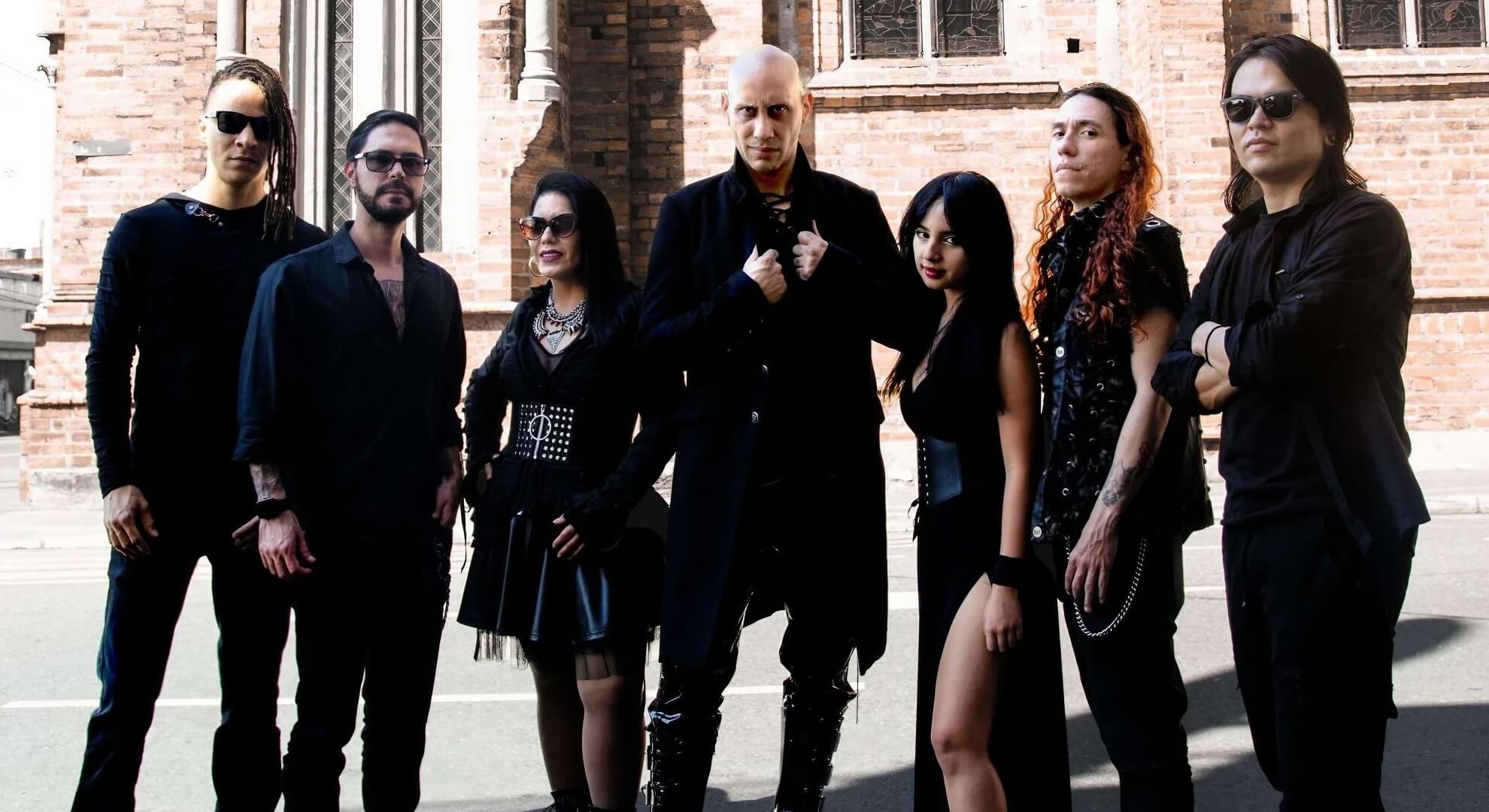


Among the recurring preoccupations of Colombia’s independent rock scene, few have been as persistent as the question of distance — not the poetic distance of heartbreak or exile, but the physical distance between the city that produced a sound and the world that sound eventually reaches.
The bar where Perros de Reserva first performed, around 2011 and 2012, was called Underground. The name was not metaphorical. The Medellín gothic rock circuit that shaped the band operates precisely in the register the name implies: beneath the mainstream, beneath the festival circuits that distribute national visibility, beneath the streaming figures that measure international reach.
That the video for ‘Corazón de Cristal’ — the title track of the band’s third album, released to all major streaming platforms on 6 March 2026 — arrives from New Jersey is, in that context, less an anomaly than a provocation.
The Underground That Made Them
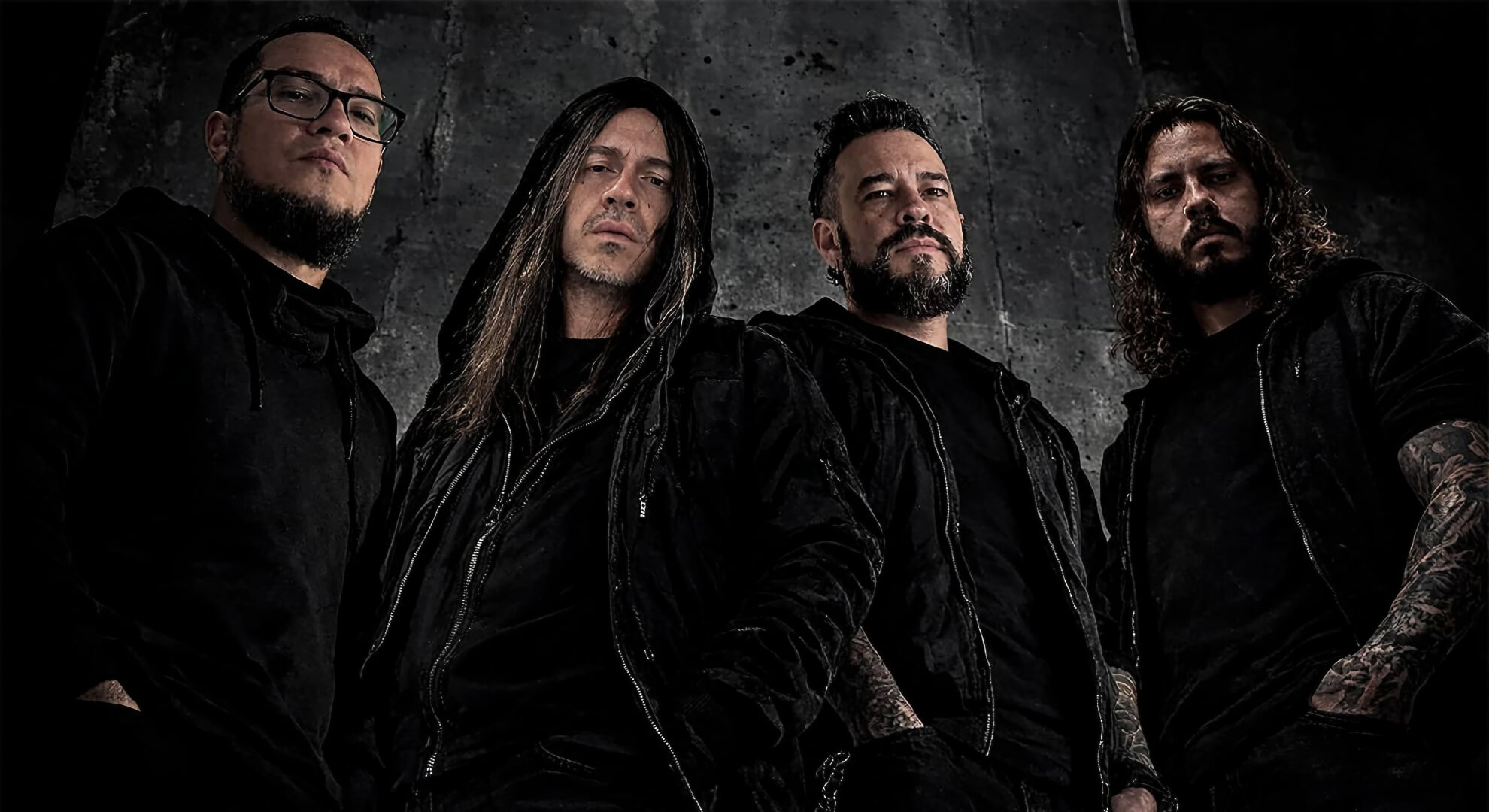
Perros de Reserva was founded by vocalist Juan Pablo Elorza — known throughout Medellín’s circuit as Elliot — as a project that began with covers of industrial material before acquiring its own compositional voice through early recordings at IO Recording studio, where producer Mauricio Serna brought a methodology shaped by extensive work with internationally distributed acts.
The band operated without label support from the beginning, a structural decision that, in the context of Colombia’s independent rock ecosystem, carries as much significance as any explicit artistic statement. Their first album drew on the romantic and erotic registers of gothic rock; the second, ‘Nefelibata’ — a term designating a dreamer incapable of engaging with practical reality — was mixed in Los Angeles by Germán Villacorta, whose credits include sessions with Alice Cooper and Ozzy Osbourne, extending the band’s reach into the global infrastructure of heavy rock production without altering their fundamental independence.1
That combination — radically independent, internationally connected, locally embedded — defines the tension Perros de Reserva have navigated across more than a decade, five international tours covering nine countries, and 16 video clips.
The Gothic Tradition in the Valley
Medellín’s gothic and extreme music history extends back to at least 1990, when Tenebrarum began fusing death metal with classical violin — a combination that predated the genre classifications that would eventually contain it and that demonstrated the particular character of Antioquia’s underground scene: technically ambitious, theatrically alert, and almost entirely self-sustaining in the absence of major-label interest.
The Festival Altavoz has functioned for decades as the scene’s most significant institutional infrastructure, while the Premios Subterránica — which recognised Perros de Reserva as the best new Colombian rock band in 2016 — provided the kind of scene-specific critical legitimacy that the national mainstream’s award apparatus has historically withheld from heavy and underground music.2
Perros de Reserva’s response to this context was not simply to make music within it but to expand what music could mean within it: the band developed a graphic novel, ‘Los vampiros de la carretera,’ a tabletop role-playing game set in their vampire mythology, and a theatrical staging that incorporated body paint, performance, and visual imagery into every show.
The Comunidad Underground collective in Medellín’s barrio Campo Valdés produced that role-playing game, rooting the project in the socially embedded, resource-inventive independent culture that has characterised the city’s alternative arts scene for generations.3
Elliot’s role in the Medellín gothic ecosystem extends beyond the band’s own recordings. He is the creator and producer of Coven Gothic, the festival that has for several years functioned as one of the primary live platforms for the darker end of Colombia’s rock circuit — carrying the Medellín underground into Bogotá neighbourhoods that institutional music policy rarely reaches, and documenting its own logic of community-building as explicitly as the band itself has done.
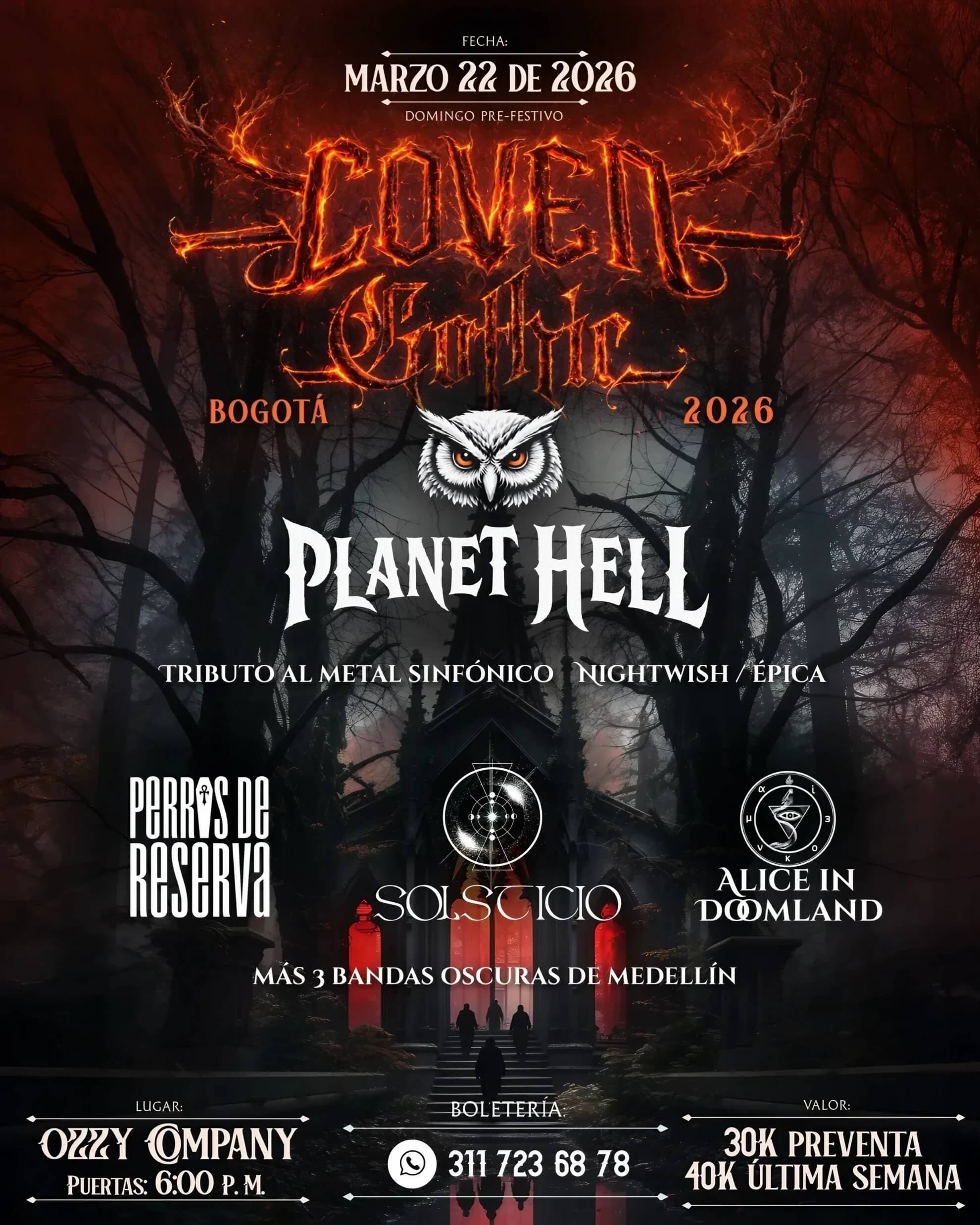
The 2026 edition of Coven Gothic, scheduled for 22 March at Ozzy Company on the Boyacá in Bogotá, brings together Perros de Reserva, Alice in Doomland, Solsticio, Planet Hell — a symphonic metal tribute to Nightwish and Epica — and three further dark acts from Medellín. That a festival produced by the same person who fronts the album’s title act now forms part of the album’s own promotional cycle is not a conflict of interest; it is a precise illustration of how Colombian independent music sustains itself when external infrastructure does not arrive.
A Crystal Heart Promised and Delivered
The title ‘Corazón de Cristal’ was first publicly announced in 2015, before the band had recorded a second album. That the phrase took a decade to become an actual single is not hesitation; it is evidence of a creative timeline shaped by the economics of independent production in Colombia, where international tour cycles, municipal grant applications — including a 2019 Estímulo de Circulación Internacional from the Alcaldía de Medellín — and the absence of label funding all determine what gets made and when.
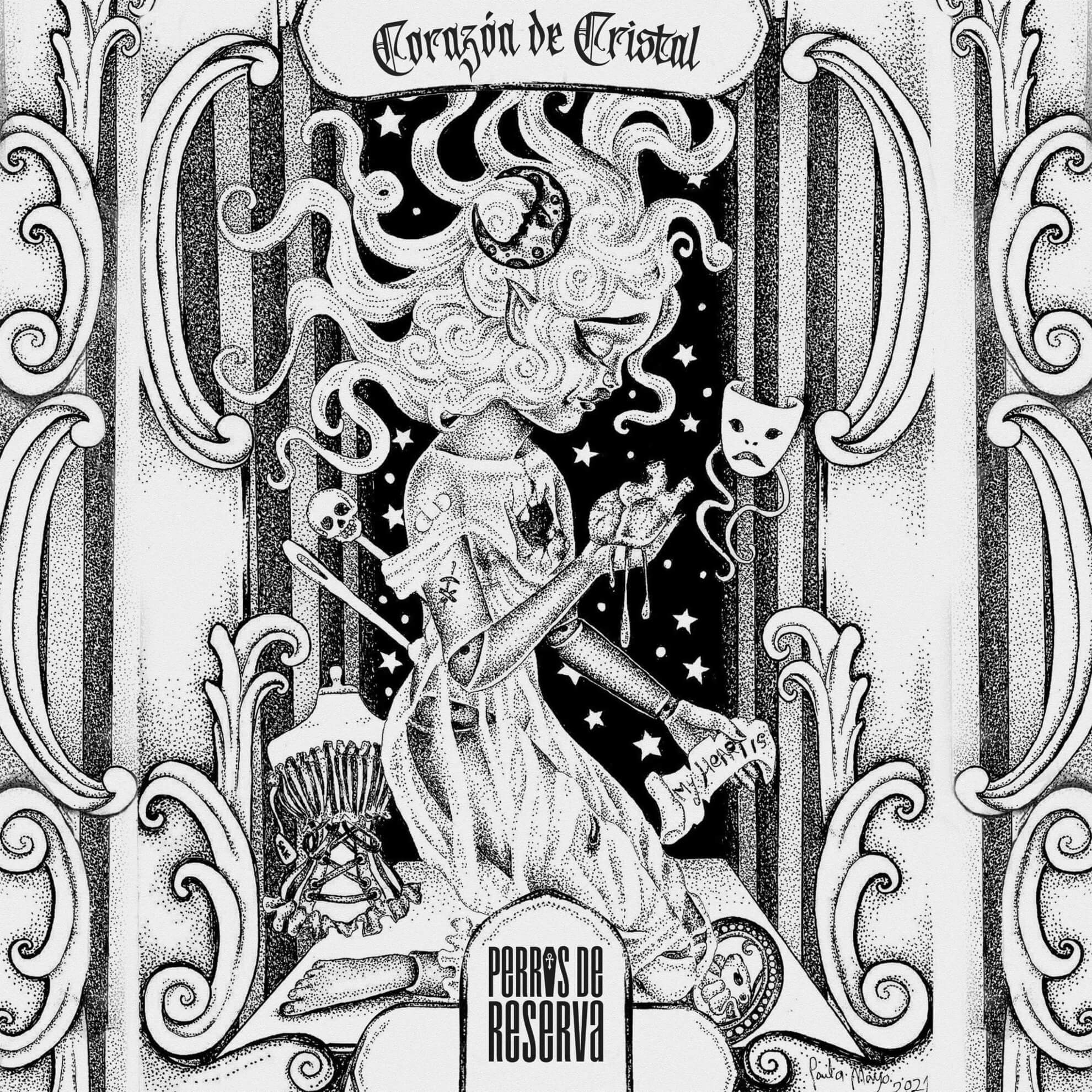
The album arrived on 6 March 2026, produced across two studios: Seven Studios in Zipaquirá under Steven Baquero, and IO Recording in Medellín again under Mauricio Serna, whose return as producer signals a working relationship sustained across the full span of the band’s recorded output.
The record draws together the band’s seven most recent singles alongside the new title track, functioning simultaneously as a compilation and as a reframing: those singles, placed in sequence, acquire the weight of an argument that each individual release could not carry alone.
Guest production from Julián Velásquez of Nadie and Christian de la Espriella of Pornomotora — two of the most distinct figures in adjacent generations of Colombian independent rock — situates the album within a web of collaborative relationships that the independent scene has built precisely because institutional support was never assured.
The New Jersey Question
The music video for ‘Corazón de Cristal,’ directed by Juan David Márquez and Juan Fernando Chinchilla for Nave Terra Films and premiered on YouTube on 7 March 2026, was filmed entirely in New Jersey. Perros de Reserva have filmed abroad before: ‘Tren a Transilvania’ was shot in Canada during the band’s second international tour, its title placing the foreign location within the band’s established vampire mythology and providing the displacement with a narrative alibi.
‘Corazón de Cristal’ carries no comparable alibi. A crystal heart belongs to no particular geography, and New Jersey — as a visual environment — offers none of the gothic European iconography the band’s aesthetic world has drawn upon. What New Jersey offers instead is an otherness that is neither romantic nor explained: an American northeast urban and industrial grammar that the camera must find ways to make speak in a language the mythology has not prepared for it.
The relationship between visual and musical tracks in a music video is never merely illustrative: the image can reinforce, qualify, or contradict what the song argues, and identifying which operation is at work constitutes the primary analytical obligation of any serious engagement with the form.4
Whether the New Jersey footage frames ‘Corazón de Cristal’ as a song about displacement, exposure, or the uncanny familiarity of an unfamiliar place — whether the distance the video travels is presented as loss or discovery — is what the specific visual choices of Márquez and Chinchilla determine. Gothic subculture has consistently demonstrated that its most meaningful spatial claims are made not in sympathetic locations but in resistant ones: spaces that require argument rather than assumption.
What the Streaming Numbers Cannot Tell
Streaming figures for ‘Corazón de Cristal’ were not publicly available at the time of publication. Chart performance data had not been confirmed at the time of writing. Award nominations had not been announced at the time of publication. Perros de Reserva maintained approximately 1,900 monthly listeners on Spotify — a figure that, for any independent gothic or heavy act working primarily through live performance and scene loyalty, substantially underestimates the actual audience the band has built across Colombia and the countries their touring has reached.
The album’s launch campaign spans three Bogotá-area events: the Medellín video premiere on 6 March at All Bar in the Curva alongside the Universidad de Antioquia; a support slot on 17 March for Moonspell’s Bogotá date, the Portuguese act’s Wolfheart and Other Stories retrospective tour, positioning Perros de Reserva as the designated national act opening an international headliner; and, five days later, Coven Gothic on 22 March.
That the band opens for an internationally touring act on one date and hosts its own festival on another, within the same release fortnight, speaks not to overextension but to the layered infrastructure a 13-year independent career produces when no single institution provides a platform large enough to hold it.
The Distance Is the Point
‘Corazón de Cristal,’ as a title, names a substance that is simultaneously transparent and breakable — a material that shows everything while remaining susceptible to fracture along lines no one anticipated. Applied to a heart, the image describes a specific kind of exposure: not the armoured vulnerability of the classic gothic persona, but something more openly at risk.
Across more than a decade of building a mythology dense enough to function as its own world — vampires, comics, role-playing games, theatrical staging, international touring, a festival of their own creation — Perros de Reserva have developed an imaginative world so fully detailed that the emotional directness at its centre can appear mediated, protected behind elaborate iconography.
The video from New Jersey removes that mediation, at least geographically. Whatever the crystal heart encounters in those American northeast frames, it is not the mythology’s home territory. The crossing is the argument, and that argument is not yet finished.
When you watch ‘Corazón de Cristal’ filmed in New Jersey rather than in the Medellín streets that formed the band — do you read that distance as an exposure the mythology was not designed to survive, or as evidence that a crystal heart, precisely because it shows everything, has no fixed geography to protect?
References
- Héctor Fernández L’Hoeste and Pablo Vila, eds., ‘Rockin’ Las Américas: The Global Politics of Rock in Latin/o America’ (Pittsburgh: University of Pittsburgh Press, 2004), 3–24. ↩︎
- Lauren M.E. Goodlad and Michael Bibby, eds., ‘Goth: Undead Subculture’ (Durham: Duke University Press, 2007), 1–35. ↩︎
- Dunja Brill, ‘Goth Culture: Gender, Sexuality and Style’ (Oxford: Berg Publishers, 2008), 27–52. ↩︎
- Carol Vernallis, ‘Experiencing Music Video: Aesthetics and Cultural Context’ (New York: Columbia University Press, 2004), 3–30. ↩︎
Leave a Reply