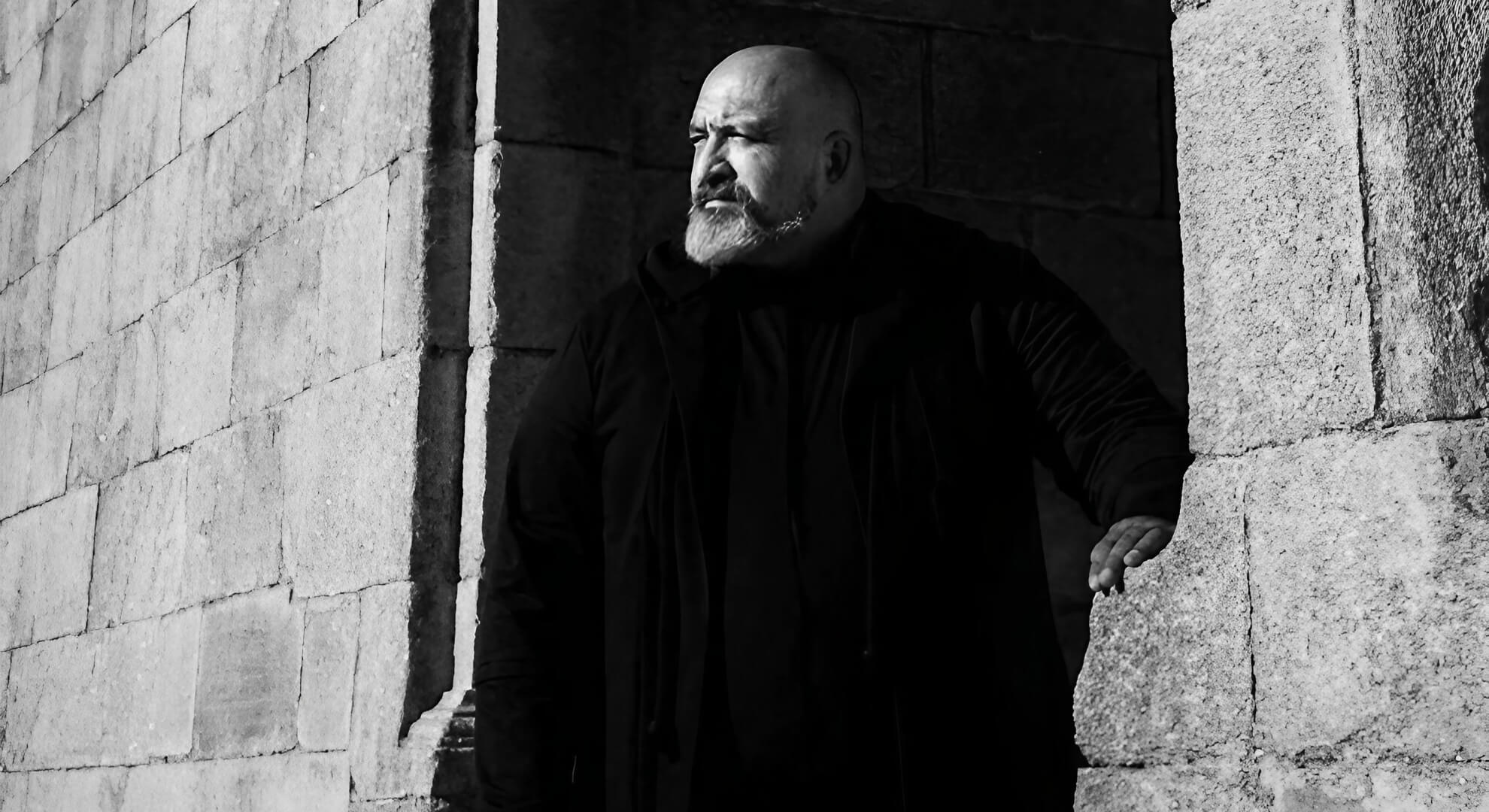


There is a moment in occult cosmology when the spirit, having passed through every celestial station on its downward path, reaches the last threshold before pure matter. Gérard Encausse — the Spanish-born French physician and occultist who published under the name Papus — described it in his 1889 treatise as a meadow lit only by the moon: not by any direct source, but by reflection alone, pale and insufficient, a borrowed glow falling on a field bounded by towers and crossed by the prints of creatures that exist between instinct and language.
It is the nadir before the long return begins. For the Portuguese gothic and dark metal project Heavenwood — now, in every legal and creative sense, the sole province of its founder Ricardo Dias dos Santos — the image carries a biographical charge that the music itself does not need to state. ‘The Moon,’ released on March 6, 2026, and the opening single from ‘The Tarot Of The Bohemians – Part II’ forthcoming via Mighty Music, arrives after a period of rupture whose full weight only the video makes visible.
The Harbour and the Heavy North
The city that produced Heavenwood sits at the southern bank of the Douro, directly across from Porto, where Atlantic air moves in off the ocean and presses itself into whatever cultural life the old stone terraces will allow. The Porto and Vila Nova de Gaia metal scene that coalesced in the early nineties was a community built on record shops, rehearsal rooms, and a generational appetite for the most extreme music then reaching Portugal from Germany, the United Kingdom, and Scandinavia.
When Ricardo Dias dos Santos and his collaborators formed under the name Disgorged in 1992, death metal was their starting register — a logical entry point for young musicians absorbing the influence of those traditions. The shift toward gothic metal was not a concession to fashion. It was the natural movement of composers for whom atmosphere carried as much formal weight as volume, and for whom a song’s internal logic was a question of structure before it was a question of feeling.1
Portuguese metal in the mid-nineties was a scene defined almost entirely by its relationship to a single act. Moonspell had signed to Century Media Records, released ‘Wolfheart’ in 1995, and begun the process of establishing that a Portuguese band could carry genuine weight within the European extreme metal conversation.
Their achievement was real, and its importance to every band that followed them out of the country cannot be overstated. But the shadow it cast was long: for years, Portuguese metal abroad meant gothic black metal from Lisbon, and anything that did not fit that template was received with a curiosity that occasionally edged into surprise.
Heavenwood — rooted in Vila Nova de Gaia, operating in a gothic doom register that owed more to Paradise Lost and Theatre of Tragedy than to any domestic precedent — carved their space at an angle to that narrative. They were not Moonspell’s counterpart. They were evidence that the Portuguese underground was wider than a single aesthetic.
‘Diva,’ released in 1996 on Massacre Records, arrived with the density of a debut made by people who had been listening with exceptional care. The album drew from the British gothic-doom tradition without reproducing it, and received coverage in Metal Hammer, Rock Hard, and Terrorizer Magazine — a 4-out-of-5 in the latter representing an unusual degree of attention for a Portuguese act with no prior international profile.2
The band toured Europe twice behind the record, sharing stages with Theatre of Tragedy and Lake of Tears. Their second album, ‘Swallow,’ released in 1998, pressed further still, featuring guest appearances from Gamma Ray’s Kai Hansen and Theatre of Tragedy vocalist Liv Kristine — collaborators whose involvement confirmed that Heavenwood had been accepted as genuine participants in the wider European gothic metal conversation, not merely observers of it.
In 1998, Heavenwood performed at the Wacken Open Air Festival, the first Portuguese metal act to do so. The fact is frequently cited but rarely examined for what it actually represents: not a credential earned through commercial success or label backing, but recognition from within a community that prizes seriousness.
The Wacken stage in the late nineties was earned, not bought, and Heavenwood’s presence on it was a data point for every Portuguese band that came after them. The underground understands precedent, and what Heavenwood established — that Portugal could produce metal taken seriously on its own terms in its own genre — provided a structural argument that later acts, including the new generation of Porto bands that emerged in the following decade, could build on without having to make again from scratch.
Endurance as Its Own Statement
The band went dormant around 2001, the victim of internal pressures that were never publicly detailed beyond the language of “internal problems” — a phrase that recurs throughout Heavenwood’s history with the weary regularity of a weather report. It is worth pausing on that dormancy, because it is the first instance of a pattern that would repeat itself.
The band that returned in 2003 was Heavenwood in skeleton: Dias dos Santos and a set of reconfigured collaborators picking up a project that had been defined in the nineties and attempting to determine what remained valid about it in a new decade.
‘Redemption,’ released in 2008 and mixed at Fascination Street Studios in Örebro by Jens Bogren, and ‘Abyss Masterpiece’ in 2011 both demonstrated a composer reaching for a more ambitious symphonic palette. Neither achieved the consolidated impact of the early albums. The limited special edition of ‘Redemption’ sold out almost immediately at its release shows in Portugal, an indication that the domestic audience had maintained its loyalty through the silence, but the international conversation around those records was more cautious. What mattered was that the project continued — and that its continuity was understood, within the Portuguese scene, as a form of commitment that counted.
‘The Tarot Of The Bohemians – Part I,’ released in July 2016 on Massacre Records, committed fully to a conceptual framework of an ambition the band had not previously attempted. The esoteric system of Papus — whose 1889 treatise presented the Major Arcana not as instruments of divination but as a cosmological diagram of the spirit’s descent into matter and eventual return — provided both the album’s formal structure and its emotional vocabulary.3
The record was made with a lineup that included vocalist Ernesto Guerra and guitarist Vítor Carvalho, and reviewed positively in the international metal press. The crowdfunding campaign that had partially funded an earlier pre-production phase, raising money from fans in Portugal and abroad, had itself been a marker of the loyalty the band commanded: for a project that had been dormant and reconstituted multiple times, the willingness of its audience to invest financially in its continuation was striking.
Two Registers, One Author
The full understanding of what Dias dos Santos has been building across the past two years requires attention to both of his active projects simultaneously, because they illuminate each other in ways that neither does alone. While the reconstitution of Heavenwood as a sole-author project was unfolding, he was also establishing a parallel creative identity under the name 4 — presented in full as ‘4 by Ricardo Dias dos Santos’ — whose debut album, ‘Alma,’ was released on June 29, 2024.
‘Alma’ is a 20-track work that shares almost nothing sonically with Heavenwood. Where Heavenwood operates within a defined generic tradition — gothic and dark metal, with fixed coordinates of orchestration, heaviness, and conceptual weight — the project 4 moves through dark ambient, atmospheric instrumental music, goth rock, and orchestral vocal pieces, including tracks in Portuguese.
The album was produced, recorded, and mastered entirely by Dias dos Santos himself, with one track, ‘Chovem Lágrimas do Céu’ (meaning ‘Tears Fall from the Sky’), featuring lyrics and vocals by collaborator José Manuel Monteiro Louro. The title of the project — the numeral four, without further explanation — is itself an act of refusal: no genre tag, no inherited name, no prior audience expectation to negotiate with.
The 4 discography has expanded with considerable speed since ‘Alma.’ The project’s Bandcamp catalogue now runs to more than 52 releases, encompassing additional singles, collaborations with guitarist Ricardo Cardoso and singer Augusto Diogo, short-film soundtracks, and experimental pieces that have no equivalent within the Heavenwood catalogue.
The contrast is deliberate and illuminating. Heavenwood is, among other things, a trademark — a registered name that Dias dos Santos has spent 34 years building and which carries obligations of coherence that cannot simply be set aside when the compositional urge moves in a different direction. The 4 project is the space where those obligations do not apply: a laboratory for everything that Heavenwood cannot or should not absorb.
Understanding that duality changes the interpretive frame around both projects. The 2024 rupture with previous members and management was not simply a withdrawal; it was a clarification. By separating the two creative registers — the branded conceptual project with its defined historical weight and the unnamed numerical project with its total formal freedom — Dias dos Santos established a condition under which he could pursue both without either compromising the other. The months between the dissolution of the collective Heavenwood and the start of recording for ‘Part II’ were not months of inactivity. They were months of ‘Alma.’
Alone With the Name
In 2024, Dias dos Santos severed ties with all previous members of Heavenwood — including vocalist Ernesto Guerra and guitarist Vítor Carvalho, who had been with the band since 2016 — and with the band’s management. The specific circumstances behind the break were not detailed publicly; the language used was the same circumspect formulation that has accompanied every previous disruption in the band’s history: a split made “for several reasons,” with no further account offered. What was made explicit was the question of ownership. Heavenwood is a registered trademark. It belongs to its founder.
The first musical statement of the reconstituted project arrived in August 2024 with ‘The Universe,’ a digital single released through SUGO Music Group and El Granada Music. Presented as a demo — not intended for the forthcoming album, but as a form of public declaration — the track was produced and mixed by Dias dos Santos himself and featured backing vocals from Jessica Lobo, whose presence suggested a new working relationship of some durability.
A second single, ‘The World,’ also featuring Lobo, followed the same year. Both were raw by the standards of Heavenwood’s studio output: that was the point. They existed to demonstrate that the creative line continued, even if the production infrastructure around it had been stripped to its foundations.
The archival dimension of 2024 provided an involuntary counterpoint. Porto-based label Larvae Records — which had already released a comprehensively remastered and expanded edition of ‘Diva’ in 2023, with the double-vinyl and deluxe CD versions representing the most serious archival treatment the album had yet received — followed in 2025 with an equivalent release for ‘Swallow.’
The timing was not coordinated with the internal events, but the effect was striking: the earliest and most beloved chapter of the Heavenwood catalogue was being sealed in definitive archival form at precisely the moment its future was being reduced to a single person. The past was being given its permanent edition while the present was being remade from nothing.
Recording After the Break
In November 2024, Dias dos Santos entered Lucky Cat Studio in Portugal to record ‘The Tarot Of The Bohemians – Part II,’ the sixth Heavenwood album. The sessions were completed with drummer Eduardo Sinatra — who had contributed to the 2016 album in a session capacity — whose return underlines the practical reality of the project’s new configuration: Dias dos Santos provides the compositional entirety; Sinatra executes the drums as a collaborator.
The album was subsequently mixed and mastered by Niko HK Krauss at the VAMACARA Studio in France. Krauss’s credits with Loudblast, Sirenia, and Dagoba bring a European heavy music sensibility that positions the finished record within a serious international context without pulling it toward any single generic centre.
In 2026, Heavenwood signed with Mighty Music, the Danish label whose Target Group distribution provides the project with its widest international reach to date. In announcing the deal, Dias dos Santos described it as “extremely symbolic, representative and vital for the continuity of Heavenwood’s legacy.” The word “symbolic” carries particular weight in this context: what the signing represents is not merely a commercial arrangement but the formal legitimation of a reconstituted entity — proof, in the language of the music industry, that what remains of Heavenwood after the dissolution of its collective form is still worth a serious label’s commitment.
Light That Passes Through Another Body
The video for ‘The Moon’ makes a choice that is less obvious than it might first appear: it does not attempt to illustrate the eighteenth Arcanum. It translates it. The video’s director had not been publicly credited at the time of publication, but the decision at the centre of the work — to render Papus’s cosmological abstraction through the physical and emotional proximity of two people — is one of considerable intelligence.
Shot entirely in black and white, with a cinematographic precision that draws more from the romantic tradition of classic European cinema than from metal’s conventional visual grammar, the video places Dias dos Santos and a second figure in a shared frame and allows the interplay between them to carry the symbolic weight that the card assigns to the relationship between Sun and Moon.4
The Moon, in Papus’s system, provides only reflected illumination: it receives light from the sun and returns it to the material world in diluted, indirect form. The duality is not between two equal sources but between the origin and what survives the transmission — what remains of direct radiance once it has passed through another body and come back changed.5
The video makes that dynamic physical. The two figures do not exist in opposition; they exist in relation, each defining the other’s register. The black and white palette removes the distraction of color and forces the eye to attend to contrast alone: what is lit and what is withheld, what is close and what recedes. It is a formally rigorous choice that the romanticism of the imagery earns rather than softens.
Dias dos Santos has described the track as an analogy for the materialisation of personal experiences “charged with profound dualities which, in the eyes of the outside world, are constantly presented to us in a dogmatic way,” placing love and the metaphorical relationship between the Sun and the Moon at its centre.
The video does not illustrate that statement — it inhabits it. What the couple on screen enacts is neither narrative nor performance in any conventional sense, but the embodied logic of the card: two presences in the same field, one of which carries light it has taken from elsewhere and offers back. The video earns its symbolic weight precisely because it refuses to explain itself in the visual language the genre would have made available.
What a Single Author Sounds Like
Gothic metal as a tradition has always occupied an uncomfortable position between genuine symbolic engagement and the merely decorative use of darkness as atmosphere. The best work in the genre holds both in productive tension: the symbols are real, the feeling is real, and neither runs ahead of the other. Heavenwood, at their most focused, have always belonged to the serious side of that division. What ‘The Moon’ adds to that argument is the quality of compositional solitude.
A band, even one with a dominant creative personality at its centre, is a negotiated space. Arrangements are shaped by the range of players present, tempos adjusted to what a shared room demands, dynamics the product of several people inhabiting a single idea simultaneously. The distance between that process and a sole author working through sessions with a drummer and handing finished files to a producer in France is the distance between what ‘Part I’ was and what ‘The Moon’ represents.
The track moves with the controlled patience of music that has determined its destination before it begins. Where ‘Part I’ sometimes allowed its symphonic density to crowd itself, ‘The Moon’ has breathing room — the room, specifically, of a composition that passed through fewer sets of hands.
The project 4 makes this dynamic legible in retrospect. In ‘Alma,’ Dias dos Santos demonstrated that he can compose across a wide range of registers entirely without the generic constraints that Heavenwood requires of him: atmospheric, orchestral, intimate, vernacular, extended and brief, in Portuguese and English, for a listener who arrives without expectation.
The discipline ‘The Moon’ displays is not the discipline of a composer who has been working in one register for three decades. It is the discipline of a composer who worked in an entirely different register — productively, prolifically, and alone — in the months before he returned to the heavier one.
‘The Moon’ does not promise resolution. It presents arrival at a particular threshold: the last point of material depth, the moonlit field where the path ahead is lit only by what has been given back, and the creatures at the edge cannot quite name what they are looking at. For Heavenwood — 34 years after forming in Vila Nova de Gaia under a different name, present at every significant moment in the development of Portuguese metal’s international conversation, and now in the hands of the one person who was there at the beginning — the question of what lies on the other side of that threshold is not a rhetorical one. ‘The Tarot Of The Bohemians – Part II’ has that question to answer. On this evidence, it has arrived at it having done all the necessary preparation.
The Moon card in Papus’s system marks a condition of maximum constraint before the spirit begins its return — a threshold where direct light is no longer available, only its reflection. Knowing that Dias dos Santos arrived at this recording having worked through an entirely separate creative register in ‘Alma’ and having dissolved the collective form of Heavenwood in the same year, does the visual language of ‘The Moon’ read to you as an image of necessary passage, of creative renewal, or as something more ambiguous that the music deliberately refuses to resolve?
References
- Deena Weinstein, ‘Heavy Metal: The Music and Its Culture,’ revised ed. (New York: Da Capo Press, 2000), 46–52. ↩︎
- Robert Walser, ‘Running with the Devil: Power, Gender, and Madness in Heavy Metal Music’ (Hanover: Wesleyan University Press, 1993), 155–160. ↩︎
- Antoine Faivre, ‘Access to Western Esotericism’ (Albany: State University of New York Press, 1994), 88–93. ↩︎
- Papus [Gérard Encausse], ‘The Tarot of the Bohemians,’ trans. A. P. Morton (London: William Rider and Son, 1914), 173–174. ↩︎
- Wouter J. Hanegraaff, ‘Western Esotericism: A Guide for the Perplexed’ (London: Bloomsbury, 2013), 30–35. ↩︎

Leave a Reply