
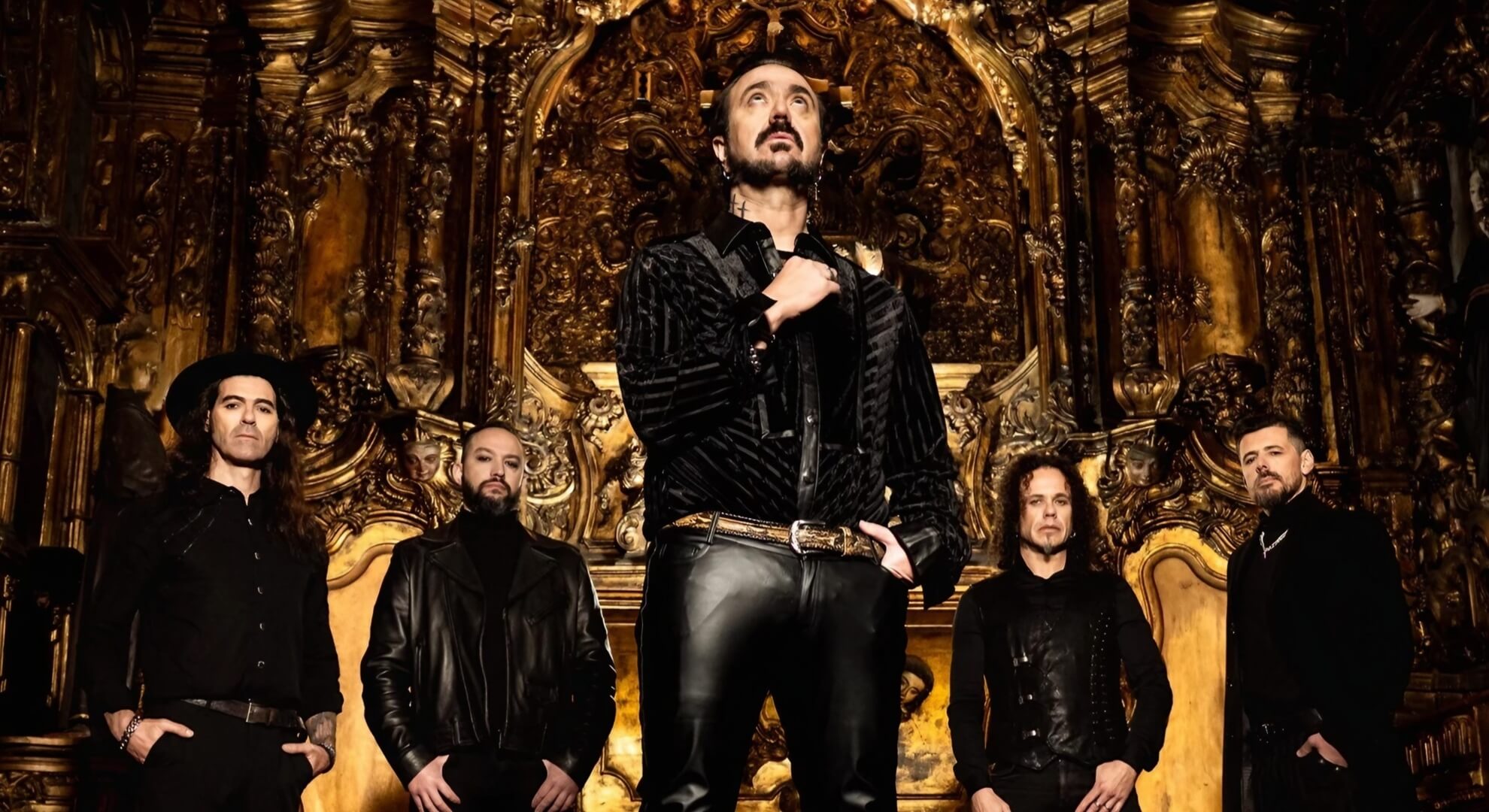


There is a particular kind of cultural defeat that arrives not through attack but through dilution. The vampire — one of European literature’s most potent figures of erotic menace — had by the second decade of this century been reduced to a commodity: the province of franchise cinema, retail aesthetics, and music built for arenas rather than altars.
When Fernando Ribeiro, the frontman of Moonspell, watched Robert Eggers’ 2024 film ‘Nosferatu,’ something older than commercial ambition stirred in him. The film restored to the vampire what the entertainment industry had spent years extracting — a genuine and irreducible capacity for tragedy. What followed was, by Ribeiro’s own account, a song written in a single breath. With the release of the music video for ‘Far From God’ on March 25, 2026, the full weight of that reclaimed inheritance becomes visible.
A Wound That Opens at Dusk
The video was directed by Pavel Trebukhov of tre.film. What the footage communicates is a visual register firmly situated within the tradition of dark Romantic imagery: a world of shadow and ceremonial weight in which the vampire is restored to its original function — not as monster but as metaphor.
The video moves through a visual grammar drawn from late-Romantic painting, bodies in extremis, candlelit interiors, the tension of sacred transgression. Ribeiro appears in a mode that recalls the band’s earliest work, when the overlap between Catholic imagery and nocturnal sensibility first defined Moonspell’s creative identity. The result carries the quality of a reckoning rather than a performance.
What the video makes plain is the deliberateness of the decision. Moonspell are not offering comfort through familiarity. They are making a diagnostic argument about the state of the genre, and the video’s imagery enforces that argument with precision. Where contemporary gothic metal frequently substitutes orchestral excess for emotional specificity, ‘Far From God’ returns to spareness: the solitary figure in darkness, the gesture of devotion that cannot be distinguished from grief, the weight of desire and its aftermath held together in a single frame.
The Years That Almost Ended It
The five years between ‘Hermitage’ — released in 2021 — and ‘Far From God’ were not a period of productive silence. The pandemic arrested the band’s touring cycle and disrupted the internal rhythms on which Moonspell had long relied. More significantly, the departure of founding drummer Mike Gaspar in July 2020, after nearly three decades with the band, raised questions that extended beyond personnel: whether the thing that had made Moonspell distinct could survive the removal of one of its founding voices. Hugo Ribeiro took the drum seat. The band did not disband, but the creative path toward a new record proved longer and more resistant than any they had previously navigated.
Ribeiro has spoken with unusual candour about the process. He noted that he drafted more than 50 sets of lyrics before arriving at the record’s final shape, and held ten potential album titles before ‘Far From God’ claimed its name. The struggle was not one of direction — the emotional territory was always, broadly, known — but of faith. “It took us five long years of hit and miss,” he said, “of despairing to the point of thinking we did not have it anymore.”
That admission is the necessary context for reading what the ‘Far From God’ video does. It is not a promotional artefact. It is a declaration of survival.
Eggers, Stoker, and the Shape of the Night
The creative catalyst arrived from cinema. Robert Eggers’ 2024 film ‘Nosferatu’ stripped the vampire figure of modern irony and returned it to its origins as a being of genuine tragic force — the creature that Bram Stoker, drawing on a long tradition of Central European folklore, had first brought into literary permanence.1 Ribeiro recognised the distinction between that figure and the degraded versions that popular culture had spent decades producing, and it reactivated in him an attachment he had believed lost.
“I lost my faith and hope in vampires for quite a few years,” he said. “They became the clowns of Hollywood, the cheap Halloween shop customs, the old and disgraceful Princes from the East. Until the film director Robert Eggers brought us ‘Nosferatu’ in 2024 and I was immediately attracted back to that tragic, romantic character who Bram Stoker immortalized in his letters.”
In the video for ‘Far From God,’ that attraction takes its visual form. The cinematic tradition Eggers was working within — tracing from F. W. Murnau’s silent 1922 adaptation of Stoker’s novel through to the present — had always understood the vampire as an image of fatal desire, a figure in whom love and destruction are inseparable.2
Ribeiro grasped that logic and gave it a musical correlate: what he describes as feeling “the fire of daylight burning into yours and your lover’s skin” is the precise emotional temperature the video sustains throughout. This is the Baudelairian premise on which the entire album operates — that the most genuine forms of experience exist at the boundary between ecstasy and annihilation.3
That logic manifests in the video not as literary allusion but as compositional pressure, felt in the density of its imagery and the sustained quality of its darkness.
The Artwork, the Album, and Porto
The visual argument of ‘Far From God’ extends from the video into the album’s cover artwork — a painted image that draws on the tradition of dark Romantic figuration, in which the human form is held within an atmosphere of elemental menace, suspended in a condition of sustained pressure that refuses resolution.4
Oil-inflected in its surface quality and dense in its tonal weight, the painting works as an extension of the music rather than an illustration of it, enforcing the same emotional grammar that the video establishes.
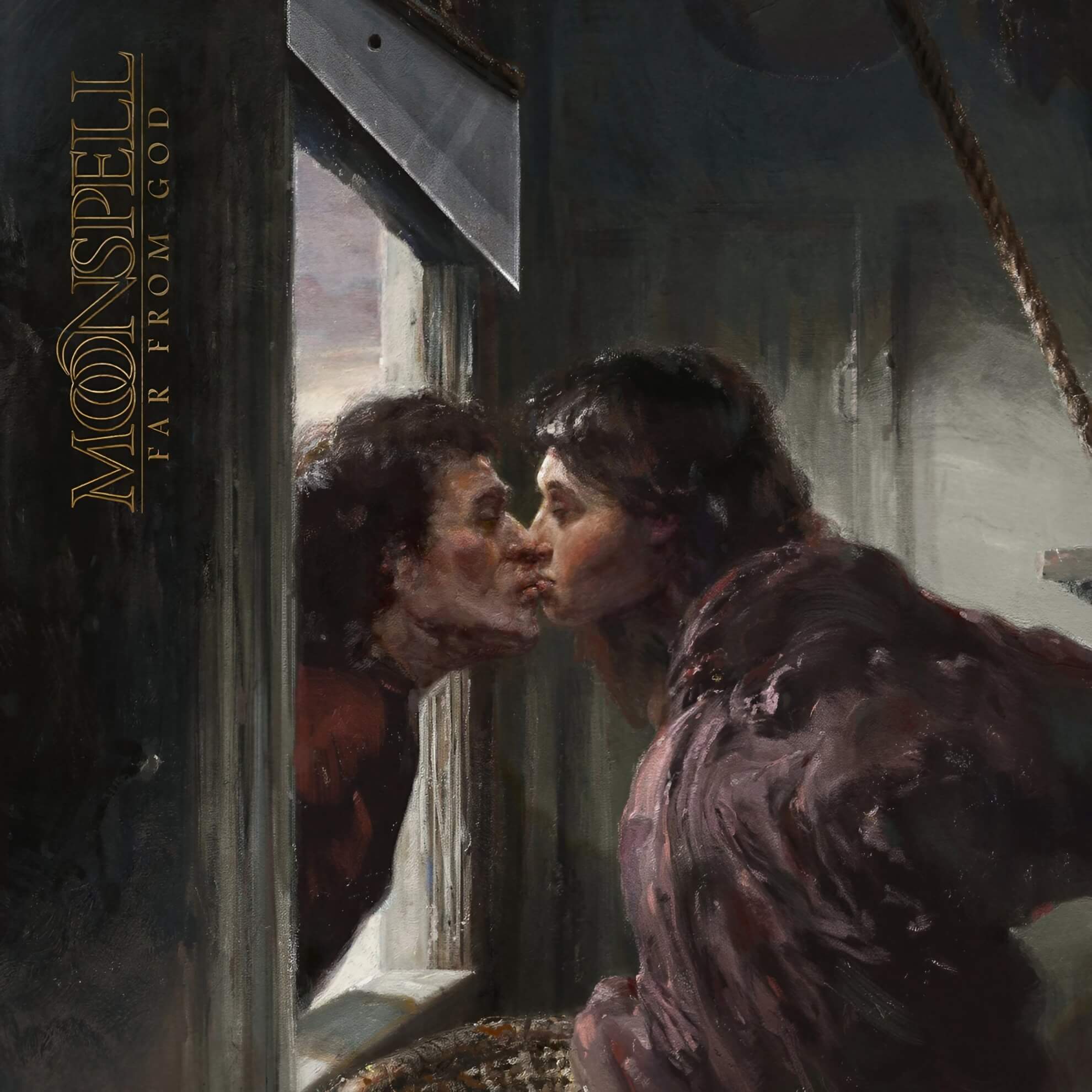
The album itself is scheduled for release on July 3, 2026, via Napalm Records. The production was handled by Jaime Gomez Arellano, who worked with the band on ‘Hermitage’ and whose credits include Paradise Lost and Sólstafir — a producer with an instinct for tonal proportion who understands heaviness and delicacy as aspects of a single register rather than competing instincts.
The record was made in Porto, Portugal, and that specificity carries weight: a city whose layered medieval and Baroque streets hold a nocturnal gravity that places the music back inside the tradition it engages rather than at a clinical distance from it.
The eight tracks — from ‘Cross Your Heart’ through to ‘Reconquista’ — trace a theological arc that moves through guilt, sacrifice, and something resembling redemption. The strings contribution from Alicia Nuhro on ‘The Great Wolf in the Sky’ expands the palette without softening the record’s core.
From Brandoa to the World
Moonspell were formed in 1989 in Brandoa, on the western edge of Amadora in Greater Lisbon, then under the name Morbid God. The rename came in 1992, and the band’s earliest recordings — including the 1993 demo ‘Anno Satanae’ — were grounded in the black metal tradition then spreading through northern Europe.5
The pivot that made Moonspell came with ‘Wolfheart,’ recorded with German producer Waldemar Sorychta and released via Century Media Records in 1995, and was completed with ‘Irreligious’ a year later — a record that abandoned the remaining black metal elements and committed to the gothic mode with a totality that made it not merely influential but definitional.6
‘Irreligious’ did not chart in Portugal on release, but it defined the genre internationally and established the band’s standing across Europe — a trajectory that eventually led to ‘Memorial’ topping the Portuguese album chart in 2006, when Moonspell became the first Portuguese metal band to earn a Gold certification. The single ‘Opium,’ which drew on Álvaro de Campos — the restless, sensation-hungry heteronym of Fernando Pessoa — announced a band with a literary frame of reference that extended well beyond the genre’s conventional limits.
That thirty-year journey from Brandoa to a global audience found a pointed expression only eight days before the release of ‘Far From God.’ On March 17, 2026, Moonspell played Bogotá, Colombia, as part of the Wolfheart and Other Stories: The Best of Moonspell Latin American tour — a run of dates spanning Honduras, Costa Rica, Chile, Argentina, and Brazil that set the band’s foundational catalogue in front of audiences for whom European gothic metal has always carried the weight of discovery rather than nostalgia.
The proximity of that tour’s close to the release of ‘Far From God’ was not incidental: the Latin American circuit reminded Moonspell of the depth of their own history at the precise moment they were preparing to announce its next chapter.
What ‘Far From God’ claims, and what the continuous invocation of ‘Irreligious’ as its reference point signals, is not that Moonspell are repeating themselves. Ribeiro has been precise about this. The comparison is one of values and emotional register, not of sound. ‘Irreligious’ occupied a space of directness, stripped of the philosophical and conceptual layers that later records accumulated. ‘Far From God’ claims the same space — unadorned, committed to feeling over concept, indifferent to commercial calculation.
The Crusade Far From God
There is an old argument within extreme metal communities that the genre’s most vital function is preservation — the maintenance of an atmosphere and a set of values that commercial pressures continuously erode. Ribeiro did not describe ‘Far From God’ solely in the language of artistic ambition. He used the language of necessity, calling it “a true crusade against the decline of the style in the past few years,” a record in which there would be “no politics, no socials, no intervention, just sickly romantic love, vampires, werewolves so we can all die of beauty, in peace and elegance.”
Whether the full album achieves what he claims for it is a question July 3, 2026 will answer. What the title track and its video establish today is the seriousness of the intention and the precision of its execution. After five years of silence, Moonspell have returned with nothing provisional.
The video for ‘Far From God,’ dark and deliberately crafted, stands as the most focused statement the band have made in over a decade — a work in which the distance between desire and grief collapses entirely, leaving behind exactly what Ribeiro promised: beauty in its most uncompromising form.
What does the visual language of ‘Far From God’ — in which vampiric love is treated as a site of genuine tragic weight rather than theatrical convention — clarify for you about the creative identity Moonspell have always been working toward, and does the video feel like an arrival or a return?
References
- Nina Auerbach, ‘Our Vampires, Ourselves’ (Chicago: University of Chicago Press, 1995), 5–7. ↩︎
- Stacy Abbott, ‘Celluloid Vampires: Life After Death in the Modern World’ (Austin: University of Texas Press, 2007), 11–14. ↩︎
- Rosemary Lloyd, ‘Baudelaire’s World,’ in ‘The Cambridge Companion to Baudelaire,’ ed. Rosemary Lloyd (Cambridge: Cambridge University Press, 2005), 1–19. ↩︎
- Robert Rosenblum, ‘Modern Painting and the Northern Romantic Tradition: Friedrich to Rothko’ (London: Thames and Hudson, 1975), 35–38. ↩︎
- Deena Weinstein, ‘Heavy Metal: The Music and Its Culture,’ rev. ed. (Cambridge: Da Capo Press, 2000), 127–130. ↩︎
- David Punter, ‘The Literature of Terror: A History of Gothic Fictions from 1765 to the Present Day, vol. 2, The Modern Gothic’ (London: Longman, 1996), 185–189. ↩︎

Leave a Reply