

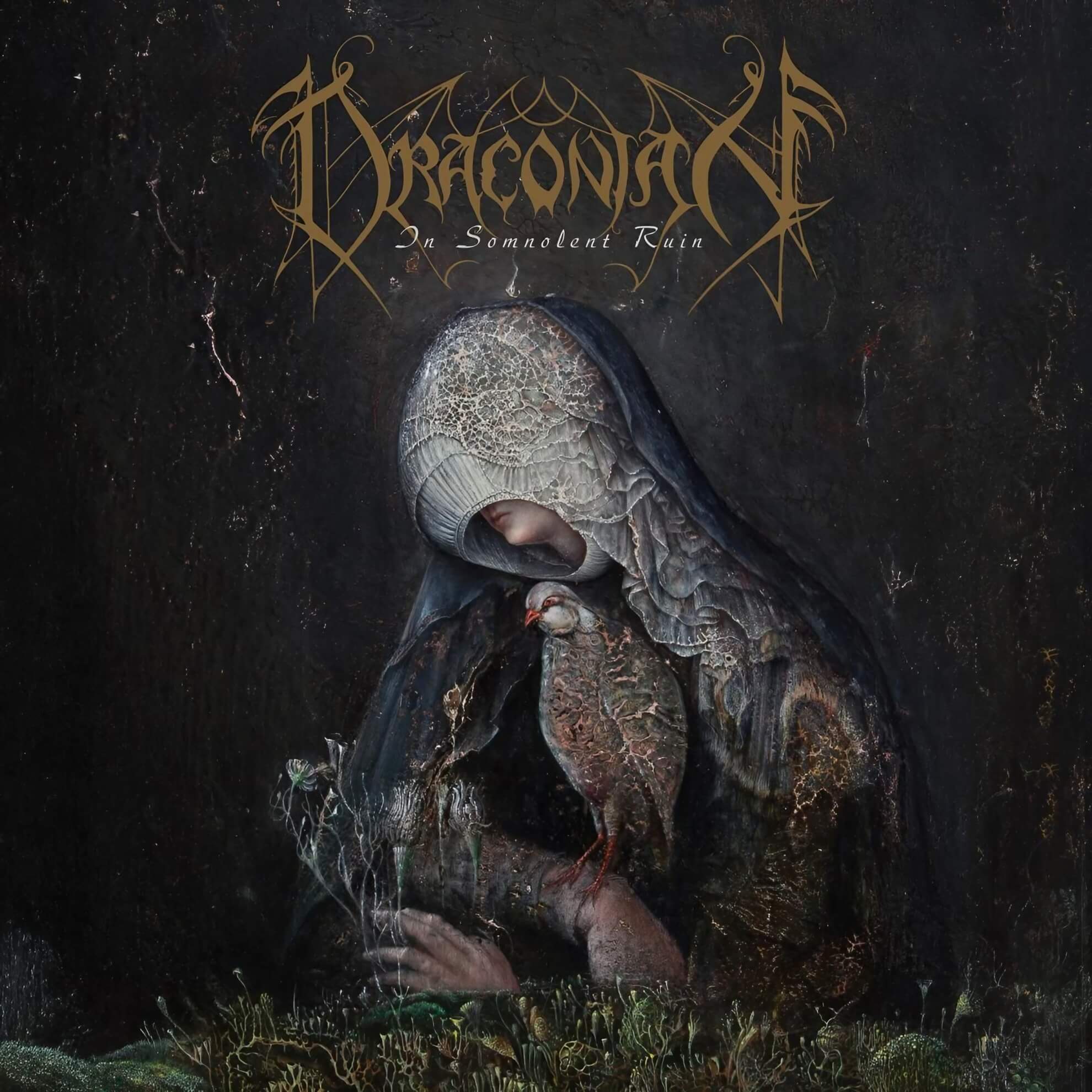
The dual-vocal arrangement that defines gothic doom — the alternation between clean soprano and guttural bass register — has, in most contemporary hands, become a form of decoration: two timbres that signal the genre without actually interrogating it. Draconian’s eighth studio album, ‘In Somnolent Ruin,’ released May 8th, 2026 on Napalm Records, commands critical attention precisely because it refuses that decorative function.
With Lisa Johansson’s return to the studio alongside Anders Jacobsson — her first full studio appearance with the band since ‘A Rose for the Apocalypse’ in 2011 — these two voices no longer simply contrast as light against dark. They argue, divide, and occasionally converge in ways that make the album’s central philosophical subject — Plato’s tripartite soul — audible rather than merely thematic.
The Heike Era and What It Cost
To understand what ‘In Somnolent Ruin’ accomplishes, the eleven-year gap of Johansson’s absence requires direct engagement. When she left Draconian in 2011 following ‘A Rose for the Apocalypse,’ her replacement, South African singer Heike Langhans, brought a fundamentally different instrument to the material: a breathy, low-register voice shaped by darkwave and electronic music that pushed the band toward atmospheric texture rather than structural drama.
‘Sovran’ (2015, Napalm Records) and ‘Under a Godless Veil’ (2020, Napalm Records) — the two studio albums produced with Langhans — were records in which Draconian traded the tectonic contrast of opposed vocal registers for a more unified, immersive atmosphere. The gain was real: ‘Under a Godless Veil’ in particular achieved a gauzy, layered quality that drew on shoegaze as much as doom, and Langhans’ voice had, by that point, fully integrated into Johan Ericson’s production aesthetic.
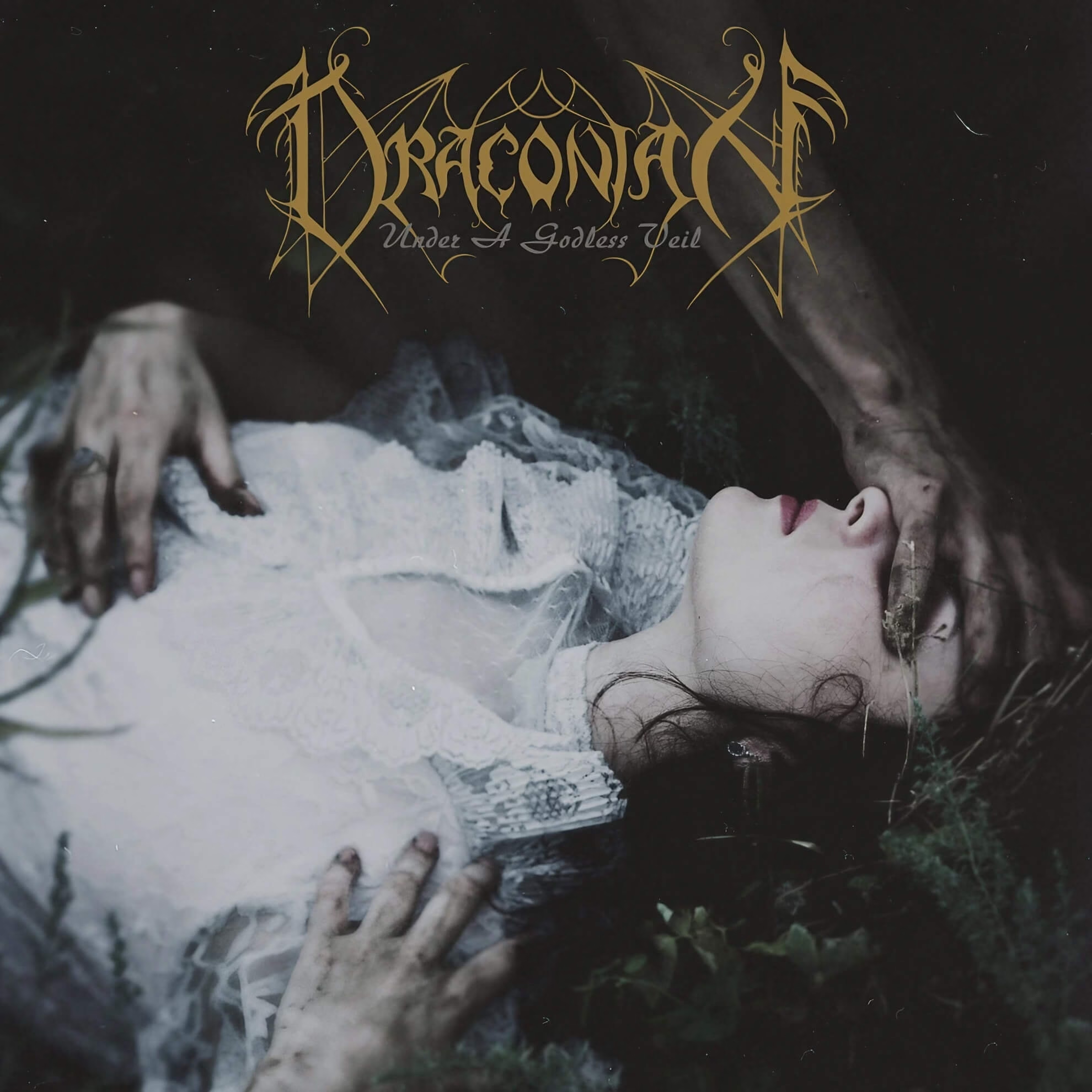
What was surrendered was the structural drama of genuine vocal opposition — the formal argument that had defined classic-era Draconian, in which the descent from soprano to growl functioned not merely as sonic contrast but as a compositional statement about internal fracture.
The “Beauty and the Beast” convention in gothic doom has two possible applications: decoration, where the two registers alternate to signal the genre, and argument, where they occupy the same space and pull against each other. Langhans and Jacobsson generally operated in sequence rather than simultaneously; the tension between them was primarily timbral, not dramatic.
With Johansson’s return — announced in 2022 after a symbolic joint performance alongside Langhans at Hellfest — the question was not whether classic Draconian could be restored but whether the band would use the reunion to deepen that formula or merely reinstate it.
‘In Somnolent Ruin’ answers that question by doing something the pre-Langhans catalogue had not systematically attempted: giving both voices compositional parity across the full album.
The Voice as Structural Argument
The evidence is in ‘I Welcome Thy Arrow,’ the eight-minute track that opens the album. It begins with deep synths, a tolling bell, and traces of distant choral texture, before Johansson enters alone. Her presence in the opening minutes is not introductory — she carries the melodic argument for a substantial early portion of the track before the band’s full weight descends beneath her.
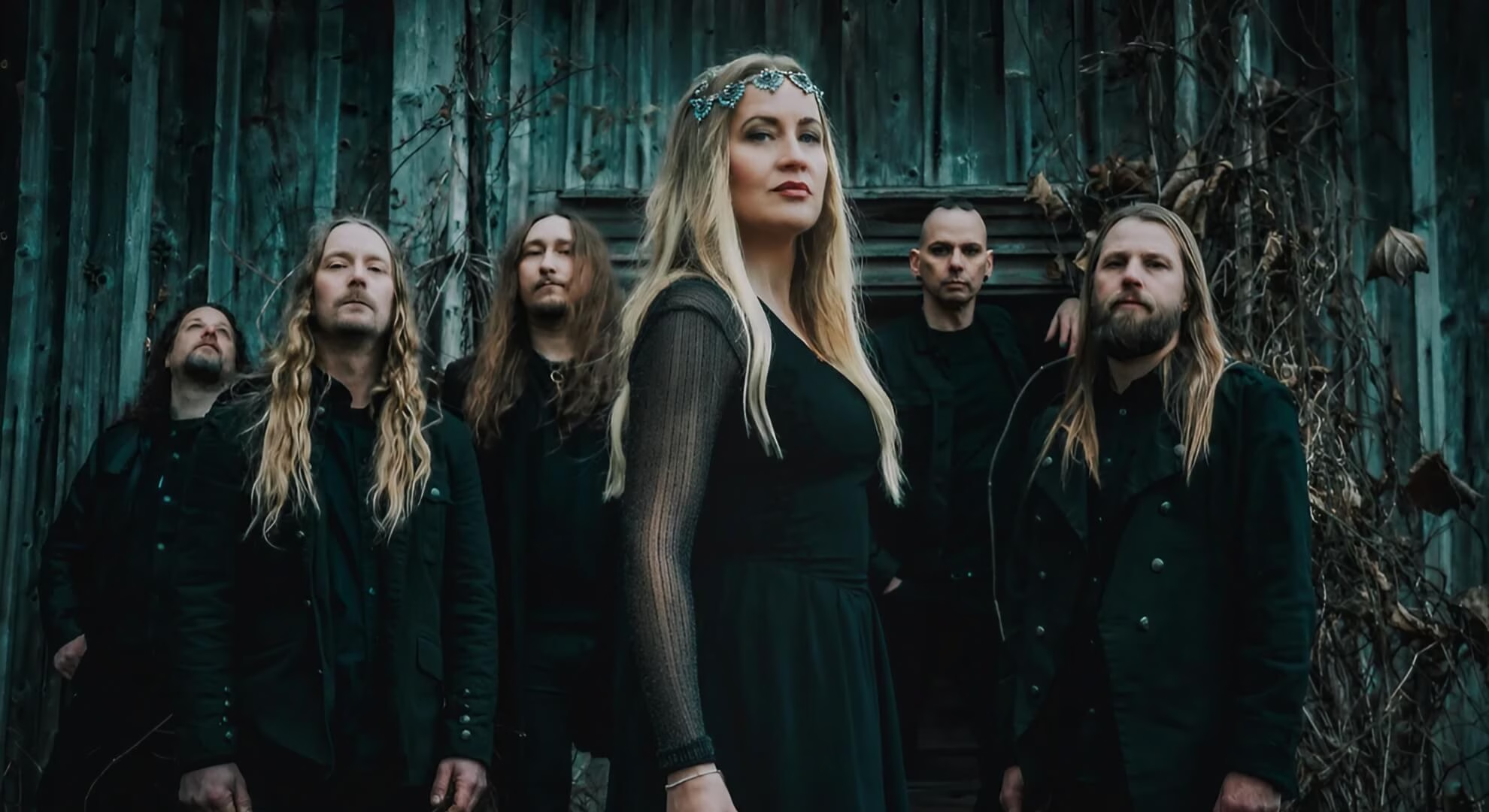
When Jacobsson arrives, his register does not displace hers: the two voices occupy different frequencies in the same moment, creating a vertical rather than horizontal opposition. The effect, in the track’s central passages, is of two forces present simultaneously rather than one replacing the other.
This is a structural shift with implications for the album’s philosophical frame. Plato’s tripartite soul — reason (logos), spirit (thumos), appetite (epithymia) — is not three sequential states but three simultaneous forces in permanent negotiation.1 The arrangement on ‘I Welcome Thy Arrow,’ and to a more compressed degree on the second track, ‘The Monochrome Blade,’ externalizes that negotiation through vocal counterpoint rather than alternation: consciousness that cannot fully unify itself because its constituent parts are genuinely distinct, not merely staged.
The sixth track, ‘Asteria Beneath the Tranquil Sea’ — a two-and-a-half-minute interlude sung entirely by Johansson, over strings and keys with no guitar distortion — functions as the album’s emotional fulcrum precisely because it removes Jacobsson entirely. The silence of the guttural register, after five tracks of its constant presence, registers as an absence rather than a relief.
When ‘Cold Heavens’ shatters that space on the seventh track with the album’s most direct, muscular riff, the contrast reads as confirmation: the appetite, having briefly ceded to reason and grief, reasserts itself with blunt force.
Daniel Änghede’s guest appearance on the third track, ‘Anima,’ introduces a third vocal texture — a clean male tenor against Jacobsson’s baritone growl and Johansson’s soprano.
The track runs approximately six and a half minutes and gives this triangulation genuine compositional development, moving through several distinct sections before the three voices reach a kind of exhausted convergence. That ‘Anima’ takes its title from Jung’s concept of the interior feminine — with the track itself populated by all three vocal registers simultaneously — suggests a deliberate, if unstated, alignment between the Jungian and Platonic frameworks the album orbits. The conjunction is not explained; it functions.
Dead Dog Farm and the Sound of Intimacy
The album was recorded primarily at Johan Ericson’s home studio in autumn and winter 2025, with drums tracked separately at Studio Gröndahl in Sweden. Karl Daniel Lidén, who recorded, mixed, and mastered the album, was identified in production credits as the key agent of a professional finish from home recording conditions.
On listening, the result supports this: ‘In Somnolent Ruin’ does not sound like a home recording. But it carries an intimacy that distinguishes it from the more polished doom productions of this era, and that intimacy is an artistic asset rather than a technical limitation.
The guitars on ‘The Monochrome Blade’ and ‘Misanthrope River’ carry a warmth in the low-mid frequencies that more heavily processed studio work tends to remove. The bass — Daniel Arvidsson’s first studio appearance in that role, having shifted from rhythm guitar when Niklas Nord joined in spring 2022 — sits slightly forward in the mix on the album’s second half, where it operates less as rhythmic foundation and more as a melodic counter-voice to Ericson’s guitar lines.
On ‘Misanthrope River’ in particular, the bass line conducts the track’s emotional direction through the extended instrumental opening, while Simon Bibby’s spoken narration follows its lead rather than directing it. This is not standard gothic doom production, where the low end customarily anchors tempo while keys and guitar carry the emotional content above it.
Lidén’s mastering retains dynamic range rather than maximizing loudness: the quiet passages of ‘Asteria Beneath the Tranquil Sea’ and the opening of ‘Lethe’ are noticeably softer than the peaks of ‘Cold Heavens’ and ‘The Monochrome Blade.’ This choice demands attention from the listener but rewards it structurally — the album’s movement between near-silence and force is inseparable from its argument about a soul in which exhaustion and violence alternate without resolving.
The Album’s Second Half
The album divides structurally at ‘Asteria Beneath the Tranquil Sea.’ The first five tracks establish the dual vocal argument, introduce the philosophical framework, and deliver three of the album’s four longest compositions. The extended format serves ‘I Welcome Thy Arrow’ and ‘Anima’ well — both require time to develop their vocal counterpoint, and both use their length to reach states that shorter tracks could not earn.
The fourth and fifth tracks, ‘The Face of God’ and ‘I Gave You Wings,’ are more conventionally structured, and placed consecutively they share a too-similar approach to vocal deployment — melodic verse, guttural chorus, melodic resolution — to fully differentiate themselves within the running order. Back to back, they dilute each other’s impact without either being weak in isolation. This is the album’s one structural limitation.
The second half recovers with deliberate intention. ‘Asteria Beneath the Tranquil Sea’ resets the album through Johansson’s unaccompanied voice, and ‘Cold Heavens’ — added last of all the album’s compositions, written specifically because the record needed a more direct and up-tempo piece — provides the one moment on the album where Draconian’s roots in straight doom metal are closest to the surface, without gothic refinement.
The riff is blunt and repetitive in the best sense: committed to one argument. ‘Misanthrope River’ is the album’s oldest compositional element, originating as a title from the ‘Under a Godless Veil’ sessions that finally found its music in 2021.
Ericson described the album’s overall compositional aim as “classic doom intertwined with ambient soundscapes,” and ‘Misanthrope River’ is where that description becomes most precisely demonstrable — not as a general atmospheric tone but as a structural method applied track-by-track.
The piece builds from near-silence through an instrumental passage and Bibby’s narration to the full-band arrangement, each stage arriving only when the preceding section has completed its own argument. The track is the album’s most fully developed single composition.
The closing ‘Lethe’ reduces everything to Jacobsson’s voice and three verbs. The instrumentation behind him is spare — guitar, bass, minimal percussion — and the track’s relative brevity after ‘Misanthrope River’ gives the album an ending that refuses resolution. Plato’s ‘Myth of Er,’ in the tenth book of ‘The Republic,’ describes souls compelled to drink from the river Lethe before reincarnation, forgetting their previous lives before beginning again.
Jacobsson’s three imperatives — “Drink. Forget. Repeat.” — are not a lament but a diagnosis. The album ends in a loop rather than a conclusion, and the formal correctness of that choice is exact.
What Plato Earns Here
The Platonic framework on ‘In Somnolent Ruin’ warrants explicit defense, since philosophical scaffolding in heavy metal has a long history of functioning as decoration — a way to legitimate dark aesthetics intellectually without the music enacting the ideas. Draconian’s application is more disciplined than most.
Ericson noted that the Platonic frame was not imposed on the material from the outside but emerged during composition. The album’s internal evidence confirms this. The division of the two voices — one associated throughout with melodic clarity and lyrical interiority, the other with force and grief — maps onto the logos/thumos distinction without requiring the listener to recognize the philosophical reference. The album argues about internal fracture whether or not the Platonic terminology is known. The frame deepens the argument; it did not create it.
Where the Platonic dimension earns its weight most fully is in the album’s refusal of resolution. Gothic doom has a documented tendency toward resigned acceptance — a final acquiescence to melancholy as permanent condition, which is aesthetically comfortable and philosophically inert.
‘In Somnolent Ruin’ proposes neither reconciliation nor acceptance. ‘Lethe’ offers amnesia — not peace between the soul’s warring parts, but erasure of the conflict’s terms. The tripartite soul does not achieve harmony at the album’s close: it forgets it was divided. This is a colder and more precise position than the genre generally takes, and the music does not soften it.
The final track’s instrumentation is the album’s least embellished, and Jacobsson’s delivery on “Drink. Forget. Repeat.” is not cushioned by melodic compensation. The soul forgets itself. The album ends.
What the Ruins Actually Contain
‘In Somnolent Ruin’ is not Draconian’s most unpredictable album — that distinction belongs to the Langhans era, where ‘Under a Godless Veil’ imported shoegaze and darkwave textures into a death-doom frame with genuine surprise.
What the eighth album achieves instead is depth within a deliberately contained range: 58 minutes in which every compositional decision serves the central argument, the production matches the material’s interiority rather than overpowering it, and the dual vocal arrangement delivers what the “Beauty and the Beast” formula has promised and generally deferred.
The reunion of Johansson and Jacobsson does not restore an earlier Draconian: it advances one. The ruins the album inhabits are not nostalgic — they are the present condition of a soul that cannot unify itself and has stopped pretending otherwise. That this condition is rendered in music of genuine beauty and formal discipline, across nine tracks and 58 minutes, is what the album finally contains.
‘In Somnolent Ruin’ fulfills the philosophical ambition of its Platonic framework through compositional rather than thematic means: the dual vocal arrangement creates structural argument, the production’s intimacy matches the material’s interiority, and the album’s refusal of resolution is formally and philosophically correct.
A minor structural weakness in the album’s consecutive mid-sequence tracks prevents it from achieving consistent intensity throughout, but the second half — from ‘Asteria Beneath the Tranquil Sea’ through ‘Lethe’ — is among the finest writing in Draconian’s catalogue.
References
- Plato, ‘The Republic,’ trans. G.M.A. Grube, rev. C.D.C. Reeve (Indianapolis: Hackett Publishing, 1992), Book IV (435e—441e) and Book X (614b—621b). ↩︎
Leave a Reply