
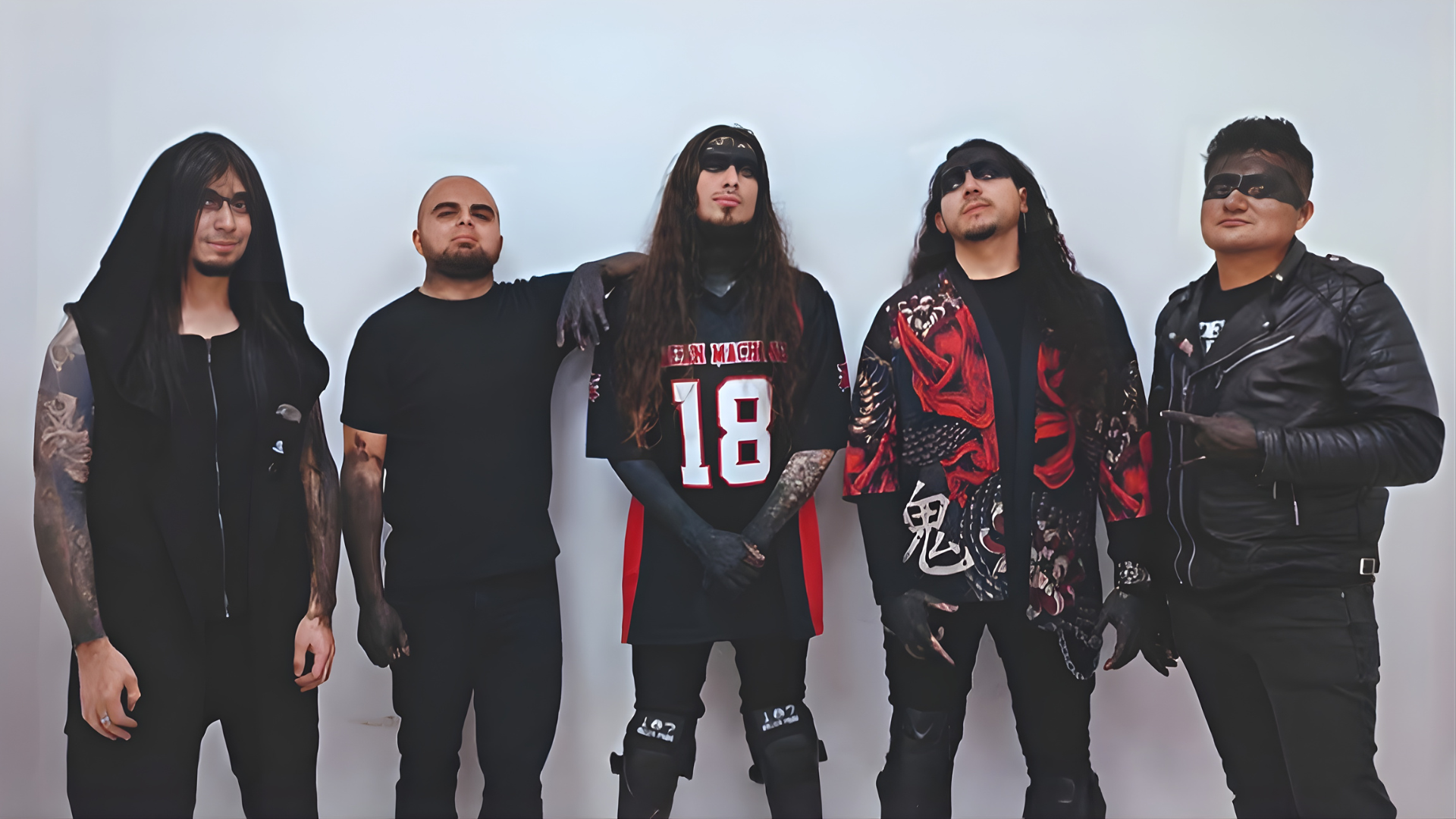


Certain acts are not discovered by the underground — they are produced by it. The bands that emerge from genuine scarcity, from communities that rehearse in borrowed spaces and release their first recordings through networks that operate on nothing but conviction, carry something in their music that cannot be added later.
It is present in the initial decision to make this kind of music at all, under these specific conditions, in this specific city. Dead Silence, the Bogotá melodic death metal act that came together in May 2008, is exactly that kind of product: not a band shaped by the market it hoped to enter, but one shaped entirely by the place and moment that made it possible.
On June 13, 2026, Dead Silence takes the stage at the Relevent Music Hall, at Carrera 9A No. 60-27 in the Chapinero district, as the central act of the inaugural Paranoia Fest — Chapter I: Distorted Minds. Doors open at 6:00 PM. The night assembles six Colombian acts alongside the headliner, constituting one of the densest concentrations of Bogotá death metal talent this venue has hosted in recent memory.
Eighteen Years, One Direction
Dead Silence formed in Bogotá in May 2008, amid conditions that the capital’s extreme metal community of that period knew intimately. The residual weight of Colombia’s conflict decade — the socio-political disruption, the institutional failures, the particular texture of a city that had spent years processing violence without adequate civic language for it — was not background noise for the young musicians who gravitated toward extreme metal in those years. It was the subject matter.1
The underground bars and rehearsal spaces of Chapinero and La Candelaria had been cultivating this orientation for over a decade; Dead Silence stepped into a tradition that was already substantive and already self-aware.
Their debut EP, ‘Macabra Miseria,’ appeared that same year through Eirene Records, distributed across Latin America and Europe — an unusually broad reach for an independent first release. The lyrical position it staked out has not moved in the years since: injustice, systemic violence, child abandonment, the specific darkness that occupies the spaces that institutions fail to address.
This was not borrowed shock theatre imported from North American or European metal templates. It was a direct engagement with what the city had produced in the decade that preceded the band’s formation.2
‘Chernokill,’ their 2015 full-length, documented a compositional maturation that deepened the extremity rather than softening it. Their most recent record, ‘Almagest,’ extended the trajectory further — incorporating symphonic elements alongside the melodic death metal core without abandoning the foundational aggression that distinguished their earlier output. The breadth is not contradiction. It is the natural result of a band that has spent nearly two decades learning how many registers the same preoccupations can be expressed through.
The June 13 presentation also carries additional commemorative weight: the Paranoia Fest billing positions the evening as a fifteenth-anniversary celebration — a milestone the band has woven directly into the event’s promotional identity, alongside the eighteen-year span of their general activity.
When the Stage Becomes a Canvas
Dead Silence’s 2025 performance at Rock al Parque — where the band appeared as one of 20 Bogotá acts selected through the Beca Festival Rock al Parque grant process from a field of hundreds of applicants — distinguished itself through a dimension most metal performances do not attempt. Alongside the band, visual artist Mateo Castaño executed large-format paintings live during the set, each canvas responding in real time to the music’s development.
The collaboration is not decorative. It extends the band’s investment in direct, unmediated expression of social reality — the same investment that has driven their lyrical approach since ‘Macabra Miseria’ — into a second discipline, engaging the eye with the same urgency the music applies to the ear. A live performance that integrates two art forms in this way functions not merely as a concert but as a form of collective witnessing, transforming the audience’s role from passive recipient to participant in a shared act of articulation.3
That same year, Dead Silence were selected as the winner of Betplay Rockers 2025, chosen from among more than 700 national acts. The recognition sits alongside shared stages with international acts including Suicide Silence and Revocation, and an independent international tour through Mexico — a circuit very few unsigned Colombian acts have navigated without label infrastructure.
The Room on Carrera 9A
As this publication noted in its coverage of the Bogodeath Metal Fest at the same address in May 2026, the Relevent Music Hall serves a specific function in Bogotá’s extreme metal ecology: a room whose acoustic conditions and proximity between performer and audience eliminate the separation that larger venues impose as a matter of design.
For a band whose approach depends on that physical intimacy — on the audience receiving the music as a direct transmission rather than a spectacle — the space operates as a compositional factor rather than merely a logistical one.
The venue’s placement in Chapinero is not incidental. This neighbourhood has housed the most consequential underground bars, rehearsal spaces, and independent venues in the capital’s extreme metal history. For a band formed in this city and shaped by its particular conditions, performing on this street on this night is a return to the geography that made the music possible.
Paranoia Fest and the Bogotá Bill
The Paranoia Fest bill for June 13 includes Carnagia, Ashes, All That We Destroy, Almados, Gorenography, and Horror Hell — six confirmed Colombian acts representing distinct approaches within the capital’s death metal spectrum, from the technically oriented to the atmospheric. Their collective presence is not incidental to the night’s identity; it frames Dead Silence’s position not as an isolated headliner above a generic support card, but as the most historically grounded act in a genuinely active ecology.
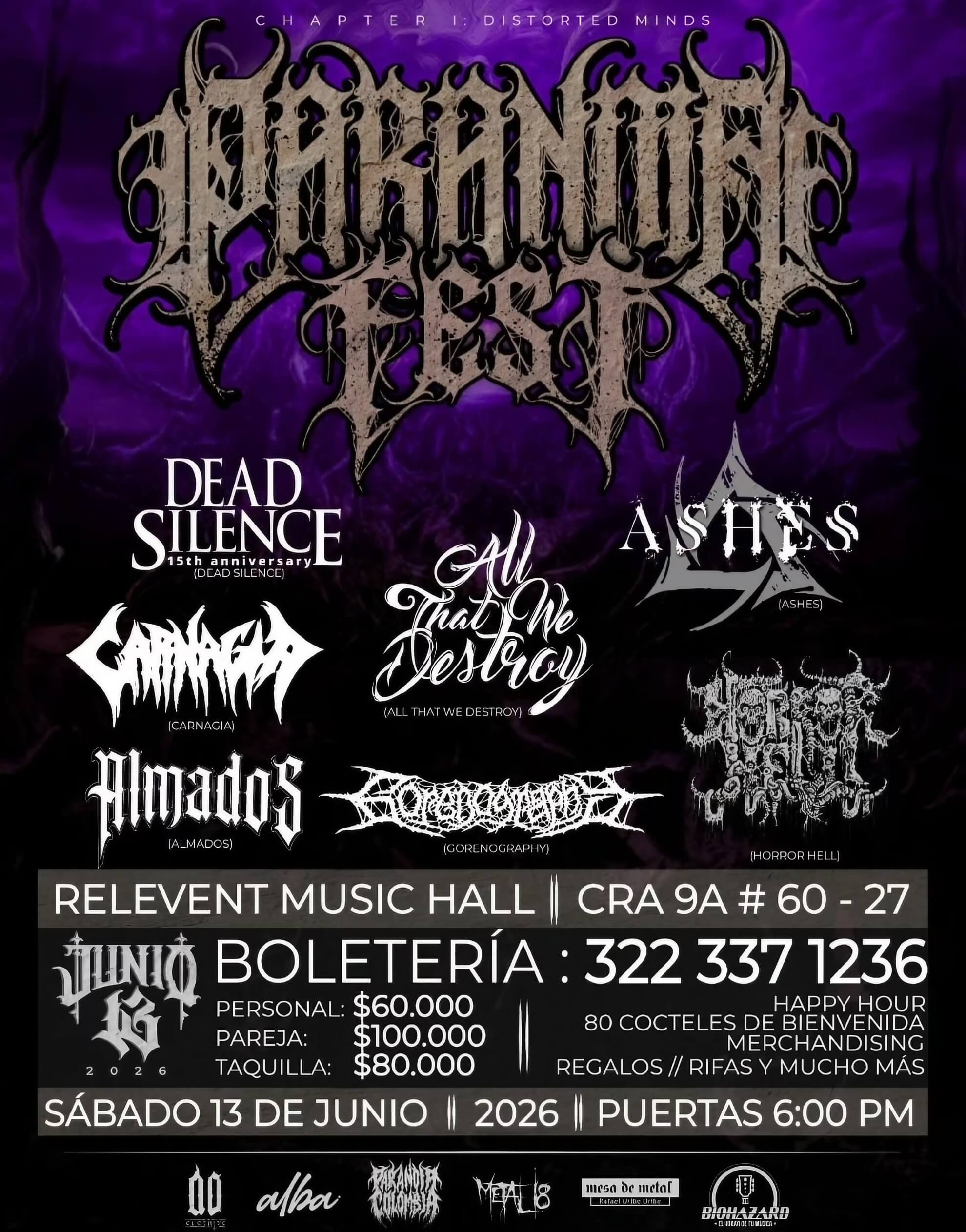
Tickets are available at three pricing levels. The advance personal ticket is priced at 60,000 COP (approximately $16 USD). A couple’s advance ticket is available for 100,000 COP (approximately $27 USD). For attendees who purchase at the door, the taquilla price is 80,000 COP (approximately $22 USD). The evening includes a welcome reception, merchandise, and additional activities. Tickets are available through the Boletería contact listed on the event promotional materials.
The Night the Underground Declares Itself
When Dead Silence performs on June 13, the result will not be the particular catharsis that comes from encountering something foreign and unfamiliar. It will be the other kind — the recognition, compressed into a specific room, of what this community has sustained across thirty years of underground commitment and what a band formed from within that community has continued to carry forward on its behalf.
Eighteen years of death metal made in and for Bogotá, on the stage of a venue that has consistently served as the Chapinero underground’s most reliable home. The Paranoia Fest, in its inaugural chapter, places that continuity at the centre of the evening rather than at its margins.
Which aspect of Dead Silence’s practice do you hold in greater regard — the lyrical confrontation with Colombia’s social reality that has defined their catalog since 2008, or the interdisciplinary live approach that integrates Mateo Castaño’s visual work into the performance itself?
References
- Forrest Hylton, ‘Evil Hour in Colombia’ (London: Verso, 2006), 82–88. ↩︎
- David Bushnell, ‘The Making of Modern Colombia: A Nation in Spite of Itself’ (Berkeley: University of California Press, 1993), 246–251. ↩︎
- Christopher Small, ‘Musicking: The Meanings of Performing and Listening’ (Middletown: Wesleyan University Press, 1998), 183–189 ↩︎
Leave a Reply