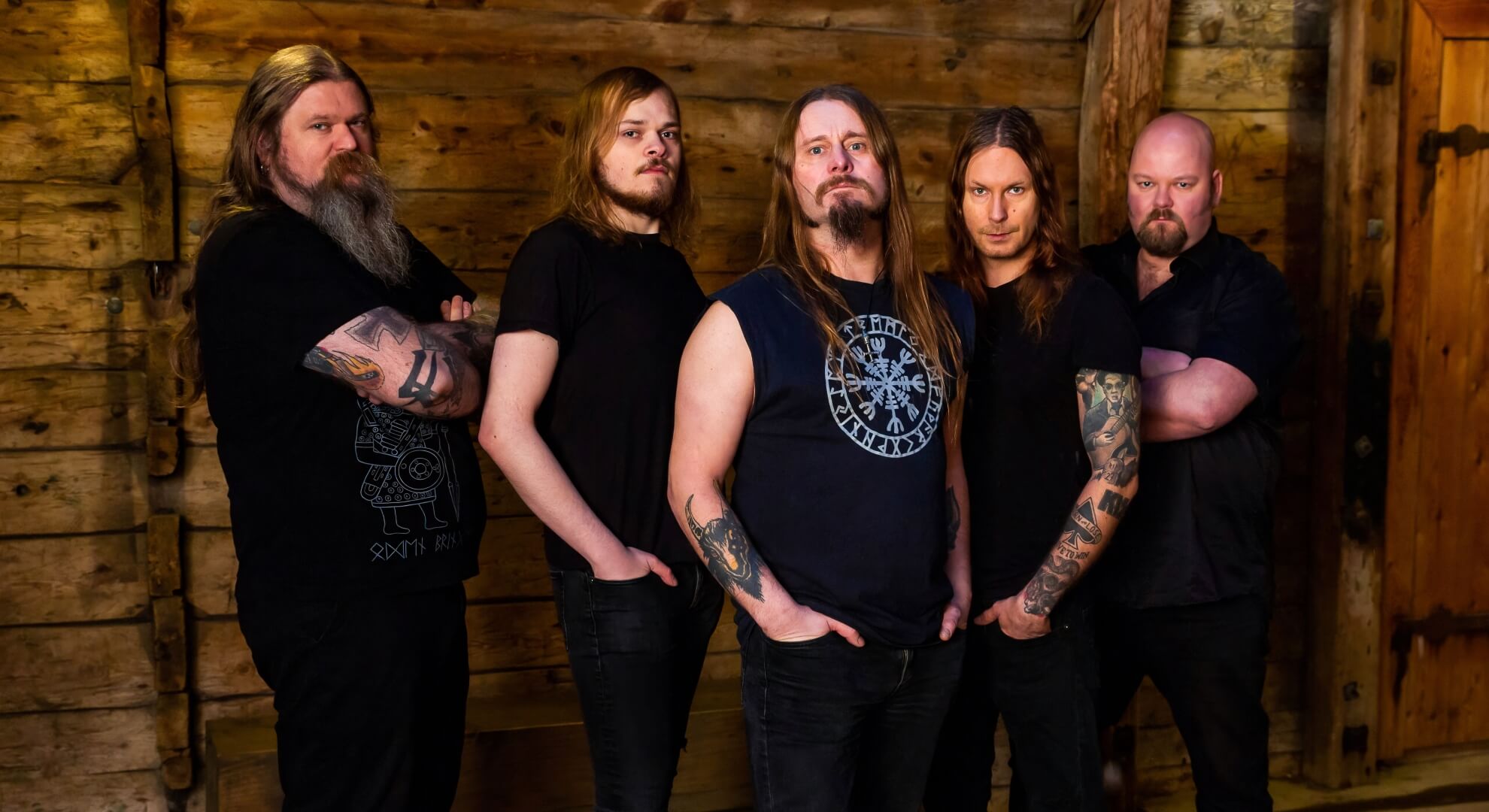


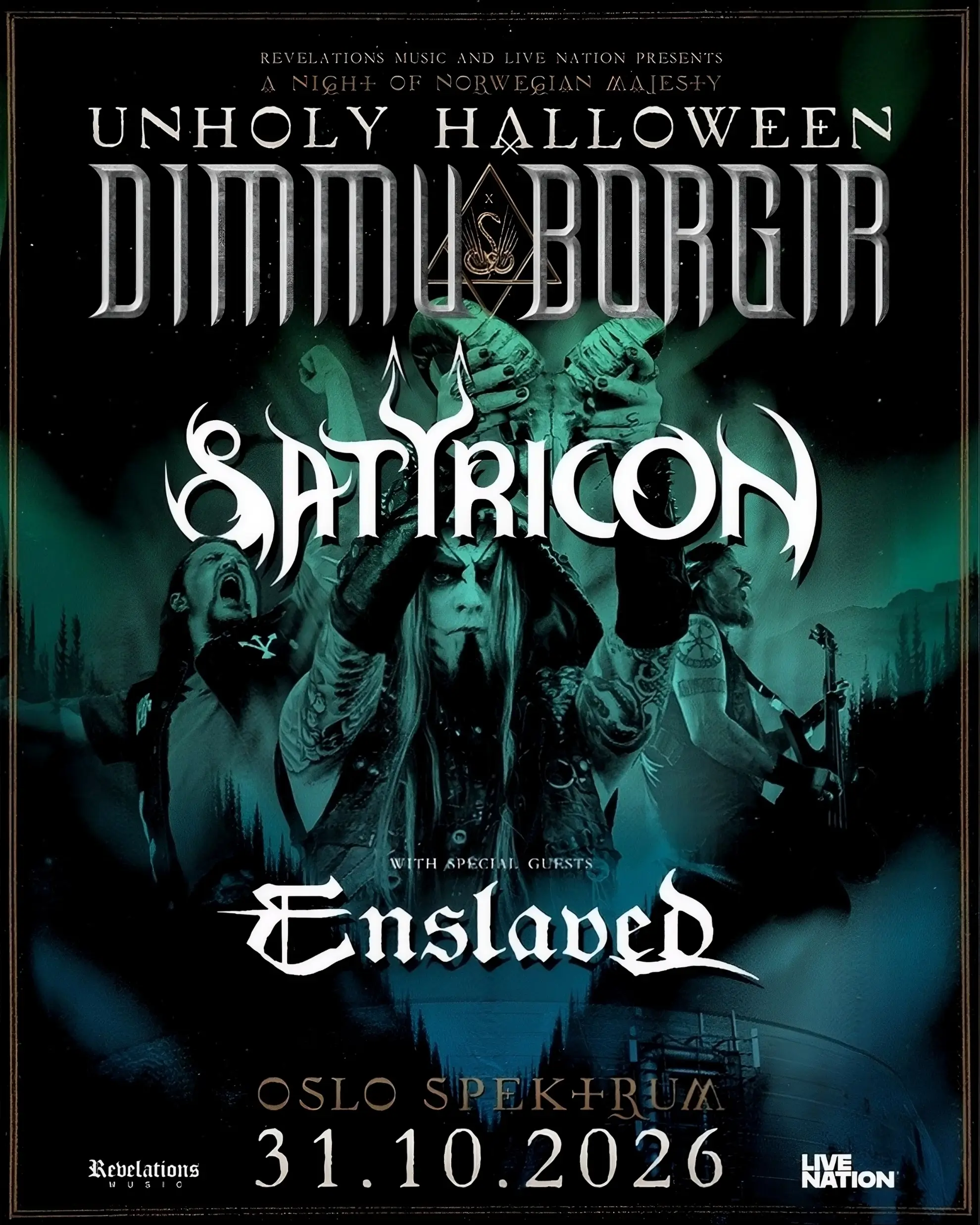
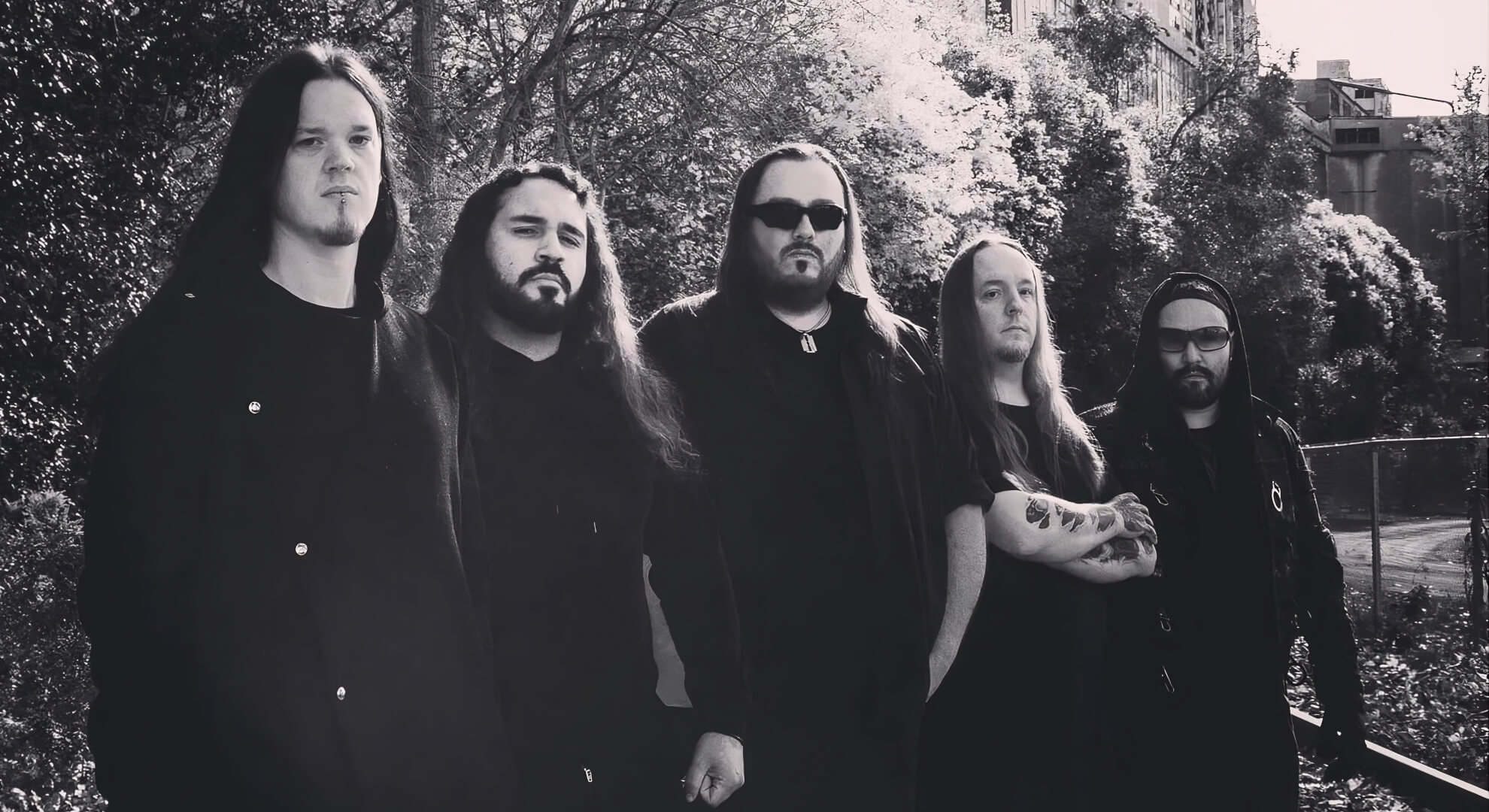
The hall at Sonja Henies plass in central Oslo holds 11,500 people and has, since its opening in 1990, hosted a range of events organized around the central proposition that an arena-scale production demands an arena. On October 31, 2026, the three bands taking that stage carry between them more than a century of combined years in the Norwegian extreme music tradition. The band opening the night — Enslaved — has been making the most consistently unsettled argument of the three for the longest.
Sixteen studio albums across 35 years of activity place Enslaved in a category occupied by very few bands in extreme metal: still active, still developing, and genuinely difficult to categorize without resort to a list of influences rather than a genre name.
Their most recent studio record, ‘Heimdal,’ released through Nuclear Blast Records in March 2023, absorbed progressive rock, Norse cosmology, and compositional structures drawn from jazz into what remains, at its base, a black metal instrument palette. Multiple Norwegian Grammy Awards mark the institutional distance traveled since their debut in 1994.
For the October 31 event, guitarist Ivar Bjørnson signaled that Unholy Halloween will carry a significance beyond its lineup: the night, he noted, marks an undisclosed milestone for the band, with full details to follow.
As we documented in its coverage of the ‘Vikingligr Veldi’ anniversary concert held in Bogotá in 2024, Enslaved has maintained a consistent relationship with the Latin American audience that has followed their work since the mid-1990s — a relationship this night extends rather than interrupts, by placing the band at the center of what may be the most consequential Norwegian black metal event of the decade.
What makes Enslaved’s position on this bill structurally distinct from the other two acts is not prestige but posture. Satyricon and Dimmu Borgir have both, in their different ways, moved toward institutional forms of recognition — the Opera House, the arena — as the natural terminus of their trajectories. Enslaved’s trajectory has no obvious terminus. Each album opens a new set of compositional problems without suggesting that the previous record had resolved anything permanently.1
Satyricon and the Oslo Opera House
Satyricon arrive at this bill at an unusual intersection of contexts. A sold-out performance at the Oslo Opera House and a commission for the Munch Museum place them within a conversation about Norwegian cultural production that few metal acts have entered on comparable terms.
Sigurd “Satyr” Wongraven described the event as the fulfillment of a project he contemplated over two decades ago, noting that what has been assembled exceeds anything he originally imagined: “This will be our Super Bowl.”
The question Satyricon’s presence raises on this bill is the same one their recent institutional appearances raise: whether the move toward prestige venues represents an expansion of what the tradition can contain, or a reclassification of the music into something the tradition’s origins did not anticipate. On Halloween at Oslo Spektrum, that question shares a stage with bands that have answered it differently.
Dimmu Borgir and the Serpent’s Return
Dimmu Borgir arrives at Oslo Spektrum on October 31 carrying the weight of a 15-year absence from headline shows at the venue and a new studio album — ‘Grand Serpent Rising,’ their tenth, due May 22 via Nuclear Blast Records — that represents their first original studio material since 2018’s ‘Eonian.’
As covered in this publication’s recent feature on the lead single ‘Ulvgjeld & Blodsodel,’ the record draws on Old Norse juridical vocabulary to situate a return eight years in the making: wolf-toll and blood-odal as framing devices for a band claiming hereditary right to its own tradition.
The In League with Satan co-headline European tour with Behemoth runs October 9 through 30 — fourteen dates across thirteen cities. What arrives in Oslo on October 31 is a band that will have spent three weeks testing ‘Grand Serpent Rising’ against full European arena audiences before returning to the city where the band’s mythology first cohered. Vocalist Shagrath described the production scale as “the biggest Dimmu Borgir production to date.”
The Scale of October 31
The Spektrum’s capacity — up to 11,500 standing — means that Unholy Halloween, if filled, constitutes one of the largest single-night metal audiences in the documented history of Norwegian concert-going. Specific ticket pricing had not been announced at the time of publication; tickets go on sale April 10, 2026, at 10:00 CET through Ticketmaster Norway and Eventim. Live Nation Norway and Revelations Music are co-presenting the event.
None of the three bands on the Unholy Halloween bill has announced South American or Colombian dates in connection with their current album cycles.
For the audience that has documented Enslaved’s work on this platform since the ‘Vikingligr Veldi’ anniversary Bogotá show in 2024, the significance of October 31 is not logistical but historical: a 35-year tradition arriving at its largest domestic stage, with the band that has most consistently refused to let that tradition settle placed at the front.
The Cathedral Oslo Placed Underground
Across the Bjørvika inlet, roughly 17 minutes on foot from Oslo Spektrum, the Minneparken holds the exposed stone foundations of St. Hallvard’s Cathedral — once the seat of the Diocese of Oslo and the coronation church of Norwegian kings.
Built in the twelfth century and reaching its greatest formal development under King Haakon V Magnusson in the early fourteenth, it housed a burial ground reserved for bishops and monarchs from approximately 1130 to 1639. The great fire of 1624 destroyed the surrounding settlement, and Christian IV subsequently ordered the city rebuilt around Akershus Fortress — leaving the old town to be progressively buried under farmland and, later, urban development.
What remains is accessible without restriction: stone foundations, the outline of apse and nave, and the adjacent Gamlebyen Gravlund, a cemetery still in active use. The oldest surviving grave in Gamlebyen Gravlund is dated to 1829; the ground beneath it contains Christian burials carbon-dated to approximately 980 AD. The full ruin park was inaugurated in 1932, and the area remains under archaeological protection — development is prohibited across the entire site.
For the visitor arriving from the Spektrum on October 31, the site offers the physical record of a city that buried its own origins, compressed a millennium of Norwegian history into a few exposed stone walls at the edge of the modern harbor, and left them there without commentary.
What the Arena Holds
What Unholy Halloween requires of Enslaved is not performance of the past. The band’s 35-year record has been built precisely by refusing to perform the past — by treating each album as a new problem rather than a continuation of a settled argument.
On October 31, that refusal meets an arena organized, logistically and symbolically, around the weight of a tradition. What Enslaved does with that weight — whether the night reads as a homecoming, a summit, or something the tradition did not have a name for — is the evening’s actual question.
Enslaved’s absorption of progressive, jazz, and folk structures over 35 years has produced a body of work that resists easy categorization while remaining anchored in a black metal instrument palette — at what point, if any, does that ongoing expansion constitute a departure from the tradition that made it possible, and does the answer change when the context is a 11,500-seat arena on Halloween?
Reference
- Patterson, Dayal. ‘Black Metal: Evolution of the Cult.’ Port Townsend, WA: Feral House, 2013. ↩︎

Leave a Reply