


The cordilleras that enclose Pereira from the east and west are not background scenery. They are a compositional force. The city sits at the convergence of three mountain ranges in the Eje Cafetero, the Coffee Axis, a region whose international profile rests almost entirely on its agricultural output — its soil chemistry, its altitude, its harvest cycles. What the mountains produce in sound has received far less attention, and that disproportion is precisely the condition that made Eshtadur possible.
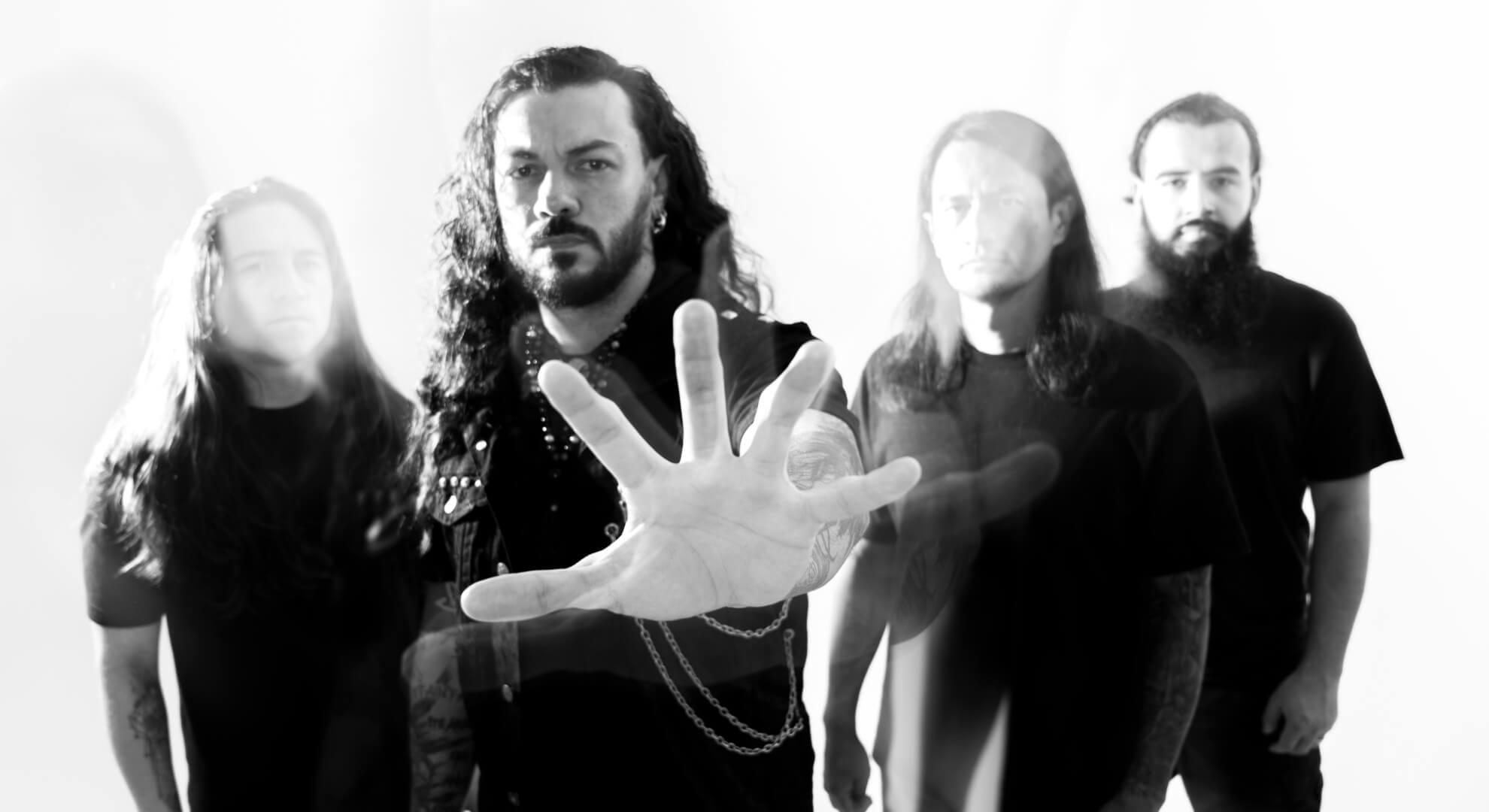
Founded in the autumn of 2005 by vocalist and guitarist Jorg August, the band has spent twenty years converting the pressure of that geography — and of Colombia’s broader social and political inheritance — into melodic death and black metal that carries both institutional weight and an insistently local character.
On October 6, 2026, in Tegucigalpa, Honduras, Eshtadur opens for Finnish progressive metal institution Amorphis. The date arrives not as a promotional gesture but as a coherent next step in a trajectory that has been building, with unusual discipline, across two decades and four continents.
The Rebellion of Angels
The name Eshtadur is drawn from ancient Greek occult literature and carries the meaning of the rebellion of angels — a designation that functions simultaneously as aesthetic declaration and historical self-positioning. The extreme metal underground in Colombia has never been a movement that sought permission.1
From the cartel-era Ultra Metal scene in Medellín, where young musicians in the nineteen-eighties and nineties built sanctuaries against catastrophic social violence, to the steady institutionalisation of Rock al Parque in Bogotá, established in 1995 as the continent’s largest free urban metal festival, the Colombian underground has accumulated its standing through refusal rather than assimilation.
Pereira’s relationship to that inheritance is specific. Without the civic mythology of Bogotá’s underground or the scarred documentary history of Medellín’s scene, the Coffee Axis has operated as a quieter but no less committed musical territory. The Santiago Londoño Theater, the city’s primary concert hall seating 832, was built in 1990 to anchor the cultural life of a mid-sized Andean city that the music industry had little reason to visit. That same theater would eventually host Eshtadur’s most ambitious project to date. The distance between those two facts is the history of the band.
August’s early demo, ‘Timo Be Timo,’ released in the autumn of 2005, drew from a constellation of European influences — the melodic orchestration of Covenant, the symphonic bombast of Dimmu Borgir, the compositional precision of Old Man’s Child — but the exercise was never mimetic. From the start, the project sought to absorb rather than reproduce those models, placing their structural logic in service of thematic material rooted in Colombian cosmological and spiritual traditions.2
Twenty Years of Ascent
The trajectory from that 2005 demo to the current Latin American touring circuit encompasses four full-length records, a pair of EPs, and an accumulated international presence that few bands from any Latin American city outside Bogotá, Medellín, or São Paulo have managed.
‘Mother Gray,’ the third studio album released in 2017 via Bleeding Music Records, marked the decisive threshold. Its themes of planetary decomposition and ecological ruin gave August a framework capacious enough to accommodate both the brutality the genre demands and the cinematic scope he had been building toward. The record sent the band across eight European countries through 2018, followed by the Gray America Tour — their first visit to the United States, extending through Mexico.
The years that followed expanded the radius further. In 2022, the band toured Europe as part of the Black Liturgy Pilgrimage alongside Batushka, crossing Romania, Bulgaria, Greece, Austria, Slovenia, Italy, France, Spain, Portugal, and Switzerland in a single run. The 2023 season was the most concentrated yet: an appearance at 70,000 Tons of Metal as the only Colombian band aboard; a nineteen-date North American tour with Summoner’s Circle covering states from Colorado to Virginia; and then Rock al Parque, where they were placed in the direct support slot for In Flames before a crowd that constituted one of the largest audiences the band had ever faced on home soil.
Each of these accumulations matters not as biographical data but as evidence of a specific approach to the career. Eshtadur has built its international standing through relentless touring rather than through the leverage of a major label deal or a viral single. Their audience in Central America, in the United States, in Eastern Europe exists because the band appeared in those rooms, repeatedly, and earned its standing performance by performance.3
The 2024 Latin American tour with Graveworm — covering Mexico, El Salvador, Guatemala, Honduras, Costa Rica, and Colombia — planted the roots that the Tegucigalpa date in October 2026 now extends.
The Shaman at the Podium
What distinguishes Eshtadur’s current direction most clearly is not its touring range but its compositional ambition. The 2023 singles ‘Umbra’ and ‘Fire Above Mountain Below,’ both released through Blood Blast Distribution, represent the clearest signal yet of what the band’s fifth studio album will attempt.
‘Umbra’ is the more radical of the two. Its session recruited the Caldas Symphonic Orchestra, which recorded at the Batuta Theatre in Manizales — a city in the Coffee Axis, seventy kilometres south of Pereira — contributing cellos, violins, and horns to a composition that already incorporated the tiple, the Andean plucked string instrument whose timbre is irreducibly Colombian, beneath distorted guitars and blast percussion.
The lyrics, written by August, were translated into Purhepecha, the pre-Columbian language of the Michoacán region in what is now central Mexico, spoken by the P’urhépecha people whose civilisation predates European contact by centuries. The invocation is cosmological, addressed to the shaman as a figure who operates at the threshold where light ceases — the umbra, the zone of total shadow during an eclipse.
The decision to integrate indigenous linguistic and instrumental material is not ornamental. Colombia’s extreme metal underground has rarely engaged explicitly with pre-Columbian traditions — the genre arrived primarily through imported European and North American models, and its local practitioners have tended to work within that aesthetic inheritance rather than disrupting it.
‘Umbra’ represents a specific kind of compositional rupture: the introduction of ancestral Colombian and Mesoamerican materials not as decoration but as load-bearing elements of the song’s conceptual and acoustic weight. The tiple and the Purhepecha vocalisations do not arrive as exotic atmosphere; they are structural components without which the song’s argument cannot be made.
Acoustic Monuments
The release that most fully documents Eshtadur’s current phase is ‘Symphonic Crows: Live at the Santiago Londoño’s Theater,’ issued in December 2025. The record captures the band’s live performance with the Pereira Symphonic Orchestra at the Santiago Londoño — the city’s primary concert hall, seating 832 — in a project whose ambition begins with the sheer improbability of its assembly.
Arranging the band’s back catalogue for a forty-piece orchestra while maintaining the compositional integrity of compositions designed for four amplified instruments is a different kind of creative task from writing those compositions in the first place.
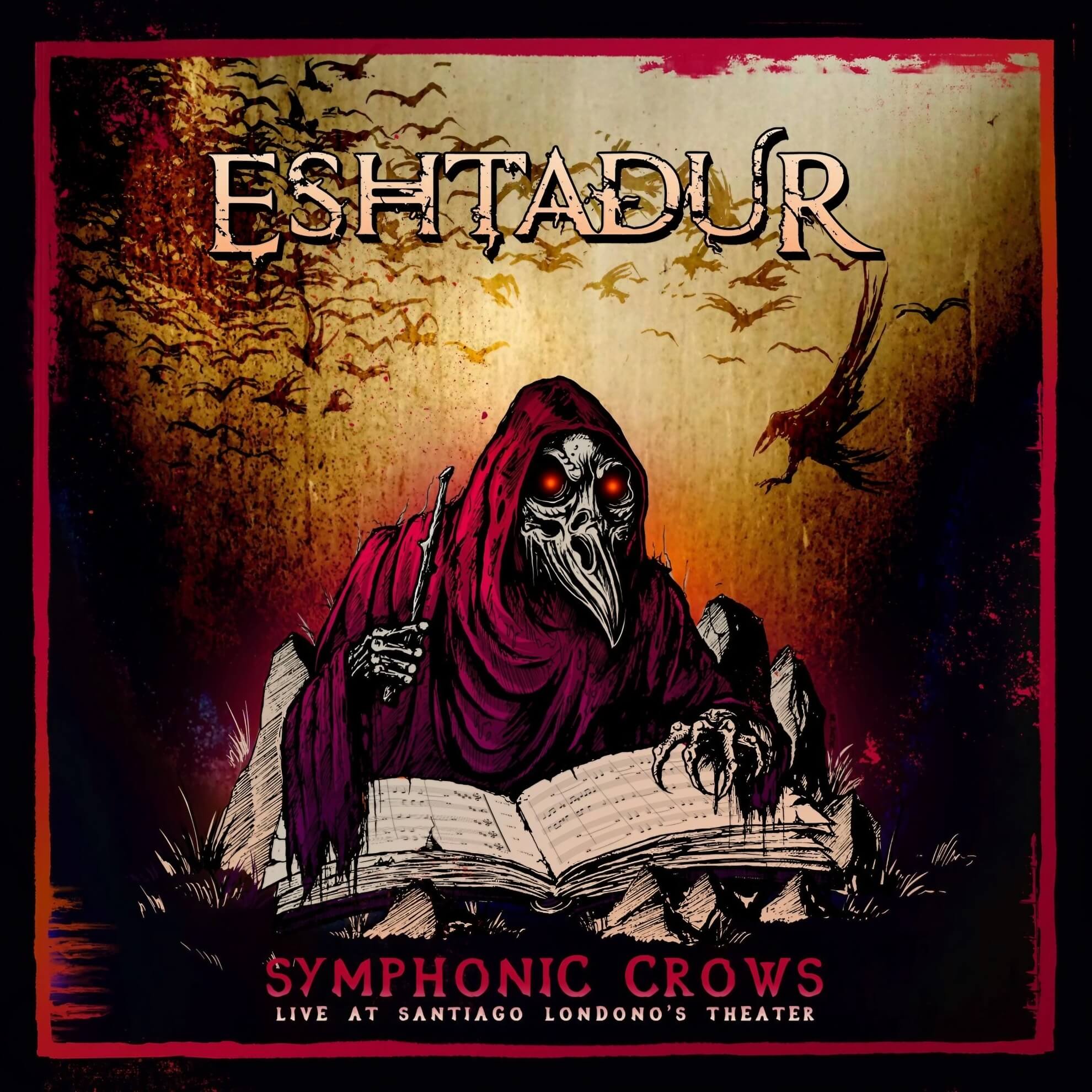
August completed the orchestral arrangements himself, a decision that preserves the interpretive authority of the band’s original intentions while admitting the specific demands of the orchestral setting. The result, across seven tracks, is not a domestication of the band’s extremity but its amplification through different acoustic means.
The opening track, ‘Lowborn Bastard,’ which has been a cornerstone of the live set for years, gains structural density under the orchestra without losing its percussive directness. Blast beats and string sections are not in tension on this record — they are in conversation, and the terms of that conversation are entirely controlled by the band.
The record’s reception outside Colombia was immediate and substantive. Decibel Magazine premiered the live video for ‘Fire Above Mountain Below’ in December 2025, positioning the release at the intersection of orchestral ambition and extreme metal’s demand for uncompromised weight. The French publication Metal Rock Magazine placed the album among the significant extreme metal releases of the year, noting its duality between visceral precision and orchestral refinement. For a band that has spent two decades building its reputation through performance rather than press coverage, this critical uptake at the moment of compositional expansion is significant timing.4
A New Formation
The reconfiguration of the lineup in January 2024 preceded the ‘Symphonic Crows’ album cycle and provides context for it. Camilo Barbosa TV joined as lead guitarist, completing what August and his collaborators presented as a renewed ensemble rather than a reconstituted one. The phrasing in the band’s announcement was deliberate: the crows were gathering from the ground with a new lineup.
The image is consistent with Eshtadur’s established ornithological symbolism — the crow as a bird of collective intelligence, of augury, of territories crossed — and it signals that the arrival of new personnel was understood as a moment of collective reinvention rather than individual replacement.
The current formation — August on vocals and guitars, Barbosa on lead guitar, Andrés Gonzalez on bass, Juan Lopez on drums — performed together through the 2024 Latin American dates with Graveworm and through the sessions and preparations that produced the ‘Symphonic Crows’ album. By the time the band arrives in Tegucigalpa in October 2026, they will carry nearly three years of shared performance history under this configuration.
The fifth studio album, for which ‘Umbra’ and ‘Fire Above Mountain Below’ serve as advance material, remains in preparation at the time of publication. Its release timeline had not been confirmed at the time of writing. What the two available singles establish is a compositional direction that integrates orchestral arrangement, indigenous linguistic material, and the shamanic cosmological framework August has been developing since ‘From the Abyss’ — all executed within the genre’s established parameters of extreme weight and rhythmic precision.
Tegucigalpa and What It Carries
Honduras is not a country that international metal tours visit habitually. Tegucigalpa, the capital, supports a metal community that functions without the institutional density available in Bogotá or Mexico City — no equivalent of Rock al Parque, no consistent pipeline of major touring packages, no established festival infrastructure for the genre.5
The audience that arrives for October 6 will have assembled because the music matters to them in material terms. Tickets for a show of this scale represent a genuine expenditure within local economic conditions, and the emotional investment in the performance is calibrated accordingly.
This is the same condition that has characterised Eshtadur’s relationship with its audiences across Central America, and it is part of what makes the 2024 Graveworm tour — in which the band visited Honduras as part of a circuit — so important as preparation for the October date. That prior visit was not a first encounter with the territory. It was the establishment of a prior commitment, a proof of physical presence, on the basis of which the 2026 appearance carries a different weight.

Opening for Amorphis places Eshtadur in a specific structural position. The Finnish band’s Latin American audience tends toward the progressive and melodic end of the extreme metal spectrum — listeners who came to Amorphis through records like ‘Elegy,’ ‘Tales from the Thousand Lakes,’ and ‘Queen of Time,’ whose tonal landscape is defined by the interplay of death growls, clean melodies, folk-influenced harmonic writing, and atmospheric melancholy rooted in the Finnish national epic tradition.
That audience is not axiomatically the same as Eshtadur’s core Central American constituency. The encounter will expose both groups to unfamiliar territory, and Eshtadur’s particular position — a Colombian band with orchestral ambitions and pre-Columbian cosmological commitments opening for a Finnish band whose own folk material comes from the Kalevala — creates the kind of resonant pairing that does not happen by accident.
The autumn of 2026 arrives in Bogotá carrying a particular density of international attention. Two weeks before the Tegucigalpa date, on September 20, the Teatro Royal Center in Chapinero hosts the Colombian debut of Old Man’s Child — the Norwegian project of Galder, whose return to activity after decades without consistent live presence makes that night one of the most anticipated events in the capital’s black metal calendar.
That Old Man’s Child performs in Colombia for the first time on the Return to the Throne Latin America 2026 tour while Eshtadur is preparing to carry the Colombian flag abroad on the same continent is not a coincidence the underground will miss. The two circuits run in parallel: Europe’s black metal traveling south to claim its first encounter with a Colombian audience, and Pereira’s own heading north into Central America to open for a Finnish institution before that same institution arrives in their home city.
Three days after Tegucigalpa, on October 9, Amorphis continues the Latin American run at Teatro Astor Plaza in Bogotá — without Eshtadur on the bill. The juxtaposition is not incidental. A Colombian band from Pereira opens the tour’s Central American leg in Honduras, and the headliner then arrives in that same band’s home country to a room that will contain fans who know Eshtadur’s catalogue as well as they know Amorphis’s.
What the October Night Represents
Eshtadur does not arrive in Tegucigalpa as a band in transit between one stable identity and another. It arrives in the middle of a genuine transformation — one that began with the compositional experiments of ‘Umbra,’ continued through the orchestral ambition of ‘Symphonic Crows,’ and is still working toward its full statement in the fifth studio album. The opening slot before Amorphis is not a pause in that process but an element of it.
Twenty years after the first demo, the band from the mountains of Risaralda carries into a Central American capital the accumulated product of a specific and non-transferable history: the Coffee Axis as a geographic pressure, the Colombian underground as a cultural inheritance, the pre-Columbian Americas as a cosmological resource, and two decades of performance as the method by which all of those materials have been shaped into something that travels. The crows from Pereira have been gathering force for a long time. October 6 is not a destination. It is the next movement of a flight still in progress.
Which of the two compositional directions Eshtadur has been developing — the integration of indigenous linguistic and instrumental material pioneered in ‘Umbra,’ or the orchestral amplification documented on ‘Symphonic Crows’ — do you find the more compelling argument for where the fifth album should go?
References
- Héctor Fernández L’Hoeste and Pablo Vila, eds., ‘Cumbia!: Scenes of a Migrant Latin American Music Form’ (Durham: Duke University Press, 2013), 144–148. ↩︎
- Deborah Pacini Hernandez, ‘Oye Como Va! Hybridity and Identity in Latino Popular Music’ (Philadelphia: Temple University Press, 2010), 37–41. ↩︎
- Will Straw, ‘Systems of Articulation, Logics of Change: Communities and Scenes in Popular Music,’ Cultural Studies 5, no. 3 (1991): 368–370. ↩︎
- Simon Frith, ‘The Sociology of Rock: Notes from Britain,’ in ‘On Record: Rock, Pop, and the Written Word,’ ed. Simon Frith and Andrew Goodwin (New York: Pantheon Books, 1990), 236–238. ↩︎
- Juan Pablo González, ‘Thinking about Music from Latin America: Issues and Questions’ (Lanham: Lexington Books, 2013), 58–61. ↩︎
Leave a Reply