
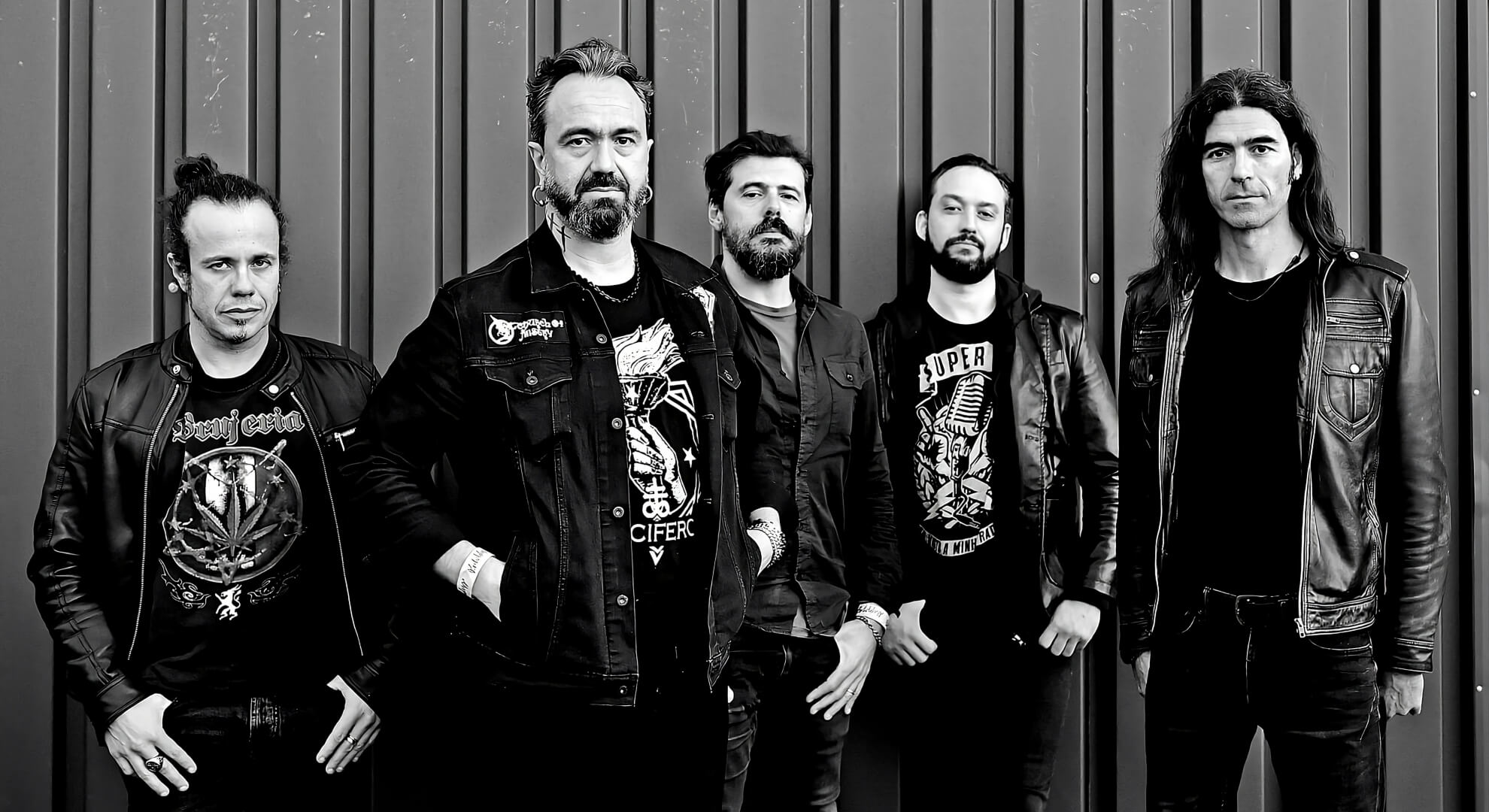


The trajectory of heavy metal is often charted through the Anglo-Saxon centers of power—Birmingham, the Bay Area, Tampa. Yet, there exists a parallel cartography, a shadow map drawn in the ink of melancholy and ancient history, where the peripheries speak to one another with a profound, resonant clarity. As the year 2026 approaches, a significant event looms on this alternative horizon: the return of the Portuguese gothic metal institution, Moonspell, to the high-altitude metropolis of Bogotá, Colombia, on March 17, 2026.
This performance, hosted at the intimate and gritty venue in the Colombian capital, is not merely a stop on a logistical itinerary. It represents a convergence of histories. From the perspective of an aficionado who has grown up witnessing the arc of Fernando Ribeiro and his cohort for over three decades, this event signifies the maturation of a specific “Southern” metal identity—one that bridges the Atlantic not through commerce, but through a shared cultural vocabulary of tragedy, passion, and resistance.
The tour, titled Wolfheart and Other Stories: The Best of Moonspell 2026, explicitly frames this journey as a retrospective ritual. It invokes the spectre of the band’s 1995 debut, ‘Wolfheart,’ a seminal text in the canon of European dark metal. However, the narrative is complicated and enriched by the events immediately preceding the Colombian date: the Opus Diabolicum en México, an exclusive orchestral performance in Mexico City.
This dichotomy—the symphonic grandeur in Mexico followed by the visceral, club-level intensity in Bogotá—offers a unique lens through which to examine the current state of the genre.
Moonspell: The Alchemical Arc
To view the Wolfheart and Other Stories tour as a simple exercise in nostalgia is to misunderstand the alchemical nature of Moonspell’s career. The 2026 return to Bogotá is not merely a replay of the 1995 debut ‘Wolfheart;’ it is a re-contextualization of that raw origin through the lens of thirty years of artistic wandering.
Lead vocalist Fernando Ribeiro has historically characterized that debut album not as a cohesive statement, but as a “hydra with many heads,” a chaotic reflection of a band consuming influences—black metal, gothic rock, folk—faster than they could fully process them. This eclecticism mirrors the post-dictatorship cultural vacuum of Portugal in the 1990s, where a generation emerged from isolation to voraciously consume and re-synthesize European counter-culture.1
When Moonspell first emerged, they were distinct anomalies. But the path from ‘Wolfheart’ to the Bogotá stage was never linear. It was an odyssey that saw the band traverse distinct eras: the “Gothic Ascendancy” of ‘Irreligious,’ which polished their sound for a global audience; the “Experimental Heresy” of ‘Sin/Pecado,’ which risked alienation to explore industrial textures; and the “Hermitage of History” defined by the concept album ‘1755,’ where they embraced their native tongue and tragic history fully.
This evolution reflects a broader trend in semi-peripheral European nations, where artistic identity oscillates between cosmopolitan assimilation and the reclamation of indigenous roots.2
This performance represents the synthesis of these divergent paths. The Moonspell that steps onto the stage in Bogotá is no longer the band that accidentally created a genre in 1995; they are veterans who have learned to wield their history as a weapon. The setlist, anchored in the past but performed with modern precision, demonstrates how the “wolfish heart” of their youth has been tempered by the sophistication of their later work.
The transition of Moonspell from a subversive underground act to a recognized component of national heritage offers a profound backdrop to this tour. This shift was formalized in 2010 when the Portuguese Postal Service (CTT) issued an official stamp commemorating ‘Wolfheart.’ This philatelic validation serves as a potent symbol: the “wolves” are no longer just howling at the moon; they have become ambassadors of the Lusitanian soul.
When they perform in Bogotá, they bring this weight of history with them, transforming a metal concert into an act of cultural diplomacy that resonates deeply with a Colombian audience equally fiercely proud of its own complex heritage.
A Lineage of Shadows in the Cultural Canon
For those of us who lived through the gothic metal explosion of the mid-1990s, Moonspell always felt like a necessary counterpoint to the establishment. While our collections were dominated by the British “Peaceville Three” (Paradise Lost, My Dying Bride, Anathema), who painted the genre in shades of Victorian grey and industrial decay, Moonspell offered a radically different palette: the “Southern” temperament.
They injected the genre with the heat of the Iberian sun, the rhythmic pulse of folk tradition, and a theatricality closer to the opera than the factory floor. If Paradise Lost was the sound of a crumbling English cathedral, Moonspell was the sound of a pagan ritual in a Sintra forest. This difference hits home for the Bogotá audience; culturally attuned to the interplay of Catholic guilt, colonial history, and indigenous mysticism, we find a mirror in Moonspell’s “Mediterranean” gothic that is often absent in the stoicism of Northern European acts.3
Furthermore, watching Moonspell evolve has been a lesson in literary ambition. They are arguably the only metal band to successfully integrate the works of Fernando Pessoa, Portugal’s greatest modernist poet, into the vernacular of heavy rock. Tracks like ‘Opium’ use Pessoa’s heteronym Álvaro de Campos to explore themes of existential fatigue and decadent sensation.
In doing so, Moonspell aligns their work not just with other bands, but with the “decadent movement” of late nineteenth-century literature—writers like Baudelaire and Huysmans who found beauty in decay.4 This elevates the concert experience from a mere musical display to a form of “Literary Heavy Metal.” When Fernando Ribeiro commands the stage in Bogotá, he is channeling a lineage of poetic resistance, transforming the mosh pit into a space where high art and primal aggression coexist.
The Symphonic Counterpoint of Opus Diabolicum
Before the band arrives in the high Andes of Bogotá, they will execute a performance of vastly different character in Mexico City. On March 13, 2026, Moonspell will headline the Pepsi Center WTC with Opus Diabolicum en México: Concierto Exclusivo con Orquesta.
This event is inextricably linked to the band’s recent creative output, specifically the live album/DVD ‘Opus Diabolicum,’ released in late 2025. This project captured a historic collaboration with the Orquestra Sinfonietta de Lisboa.
The Mexico show is designed to be a “spectacle” in the Debordian sense—a massive, visually and sonically overwhelming event that integrates a full orchestra (likely a local Mexican ensemble or a touring contingent) to recreate the symphonic arrangements of their greatest hits.
This fusion of heavy metal with classical instrumentation represents a transgressive appropriation of “high culture” forms, a strategy often employed by metal musicians to validate the complexity and virtuosity of their genre.5

The contrast between the Mexico City and Bogotá dates is central to understanding the 2026 tour’s narrative arc. In our prior coverage of ‘Opus Diabolicum,’ we noted Fernando Ribeiro’s intent to capture something “imperfect, unprocessed, untamed”—an authenticity often lost in modern production. While the Mexico show scales this concept up to symphonic heights, the Bogotá show strips it back to its rawest essence.
On March 13 in Mexico City, the performance manifests as a high-culture fusion, characterized by seated options, massive production values, and sweeping symphonic arrangements. This event focuses on the “grandeur” of the band’s legacy, serving to validate their musical complexity on a grand scale.
Conversely, the Bogotá date on March 17 shifts the narrative to a club atmosphere defined by standing room and a direct, visceral connection. Here, the focus returns to the “energy” of the band’s roots, validating their enduring aggression in a setting that strips away the spectacle to reveal the raw core of their sound.
For the Colombian fan, this distinction is significant. While they may look with some envy at the orchestral exclusivity of México, the reality of the Bogotá venue offers something perhaps more valuable: intimacy. The Bogotá show is not about the separation of stage and crowd imposed by an orchestra pit; it is about the collision of bodies. It is a return to the ‘Wolfheart’ era’s ethos, where the magic was made in sweat and smoke, not in sheet music and conductors.
Inside the Intensity of Bogotá
The venue selected for the Bogotá performance, located in the heart of the city, stands in contrast to the sprawling Parque Simón Bolívar often used for festivals like Festival Rock al Parque. It represents the club-level tier of the capital’s rock infrastructure, a space designed for proximity rather than scale.
Architecturally, the space is compact and dense, characterized by a split-level design with a mezzanine overlooking the stage. The verticality of the layout creates a compressed atmosphere, placing the audience directly above and in front of the performers. For a band like Moonspell, accustomed to varying stage sizes, this configuration forces a direct confrontation with the crowd, removing the buffer often present in larger festival settings.
The acoustic environment of the venue is typical of mid-sized clubs, where volume often competes with definition. In the genre of gothic dark metal, the interplay between melodic guitar lines and atmospheric keyboards requires a careful mix to avoid becoming indistinct. The room’s characteristics will likely emphasize the raw power of the ‘Wolfheart’ material, potentially sacrificing some of the studio nuance for live intensity.
Ribeiro has historically noted that the venue size is secondary to the act of performance itself, stating that “keeping the ghosts away is inestimable,” whether in a “sweaty club” or an arena. For this return to Colombia, the setting dictates a performance stripped of the orchestral formality seen in Mexico, relying instead on the band’s ability to adapt their darker, claustrophobic material to the immediate, unpolished reality of a club environment.

The history of Bogotá’s metal venues carries a weight of danger that adds a unique frisson to every performance. One cannot discuss the scene without acknowledging incidents like the heart attack suffered by Wattie Buchan (The Exploited) at the nearby La Estrella Roja Calle 66 venue in 2022. Moonspell themselves performed at Calle 66 in March 2023.
The transition to this venue for 2026 suggests a move toward slightly more modernized infrastructure, yet the memory of the city’s chaotic past remains. The Colombian audience is known for an intensity that can push physical limits—both their own and the performers’. The high altitude of Bogotá (2,600m) already places a strain on visiting vocalists; combined with the fervent crowd, the venue becomes a crucible. It is a place where performances are not just played, but survived.
Sociology of the High Altitude Crowd
The relationship between Moonspell and their South American audience is defined by a shared sense of struggle. Ribeiro has candidly diagnosed the geopolitical reality of the music industry, observing that bands from the periphery “have to fight ten times harder for attention” than their Central European or American counterparts.
This struggle creates a unique bond; when Moonspell plays Bogotá, it is a meeting of two cultures that have fought for recognition on the global stage. This reflects the broader sociological theory that metal scenes in the “Global South” often develop a heightened sense of community and resistance, viewing the music not merely as entertainment, but as a vehicle for asserting local identity against hegemonic cultural flows.6
In Europe, particularly in the band’s home continent, metal has become institutionalized. Festivals like Wacken Open Air or Graspop Metal Meeting are well-oiled machines, and audiences can be consumers of a lifestyle. In Colombia, the context is different. The “metalero” identity is often built in opposition to social conservatism and political volatility. The music is a refuge and a weapon. Consequently, the reception of a band like Moonspell is not polite applause; it is a cathartic release.
As a Portuguese journalist, one identifies a profound kinship between the Lusitanian and the Colombian spirit. Both cultures are arguably defined by a sense of “The South”—not just geographically, but emotionally. There is a shared heritage of Catholic imagery, of tragic history, and of emotional openness.
Ribeiro has spoken of the “Southern” temperament—melancholic, passionate, contrasting with the stoicism of Northern Europe. This resonates in Bogotá. When Moonspell performs ‘Ruinas,’ a song about the destruction of Lisbon in 1755, the Colombian audience—living in a land of geological and social fault lines—understands the impermanence of things on a cellular level. The shared “Latino” roots (though distinct between Portuguese and Spanish) create a linguistic and emotional bridge that does not exist when the band plays in Germany or Finland.
A pivotal moment in Moonspell’s relationship with Bogotá occurred years ago, recounted by Ribeiro. He visited a bar in the city and heard ‘Vampiria’ playing over the sound system—not as a request, but as part of the atmosphere. The bartender, unaware of Ribeiro’s identity, praised the “band from Portugal.” This moment of anonymous validation—finding one’s art embedded in the nightlife of a city thousands of miles away—solidified the bond. It transformed Bogotá from a tour stop into a home away from home.
The Sonic Ritual Under the Moonspell
Based on the tour branding and recent setlists from the 2025 European leg, we can project the sonic architecture of the Bogotá night as a retrospective journey consisting of five distinct acts. The evening will likely commence with ‘The Awakening,’ anchoring the audience in the atmospheric mythology of 1995 with tracks like ‘Wolfshade’ and ‘Love Crimes’ from the debut album ‘Wolfheart.’
This serves to establish the foundation of the band’s legend before transitioning into the Lusitanian roots, where the band engages the audience’s physical energy with folk-heritage tracks such as ‘Trebaruna,’ ‘Ataegina,’ and ‘Lua d’Inverno;’ the rhythmic interplay of these songs typically incites folk-dancing and mosh pits, blending Portuguese rhythm with Colombian energy.
As the night progresses, the set will move into the Gothic peak, featuring the universally recognized hits from ‘Irreligious’ such as ‘Opium,’ ‘Awake!,’ and ‘Mephisto,’ marking the era of their global breakout. This is followed by the modern epic, a demonstration of survival and evolution featuring tracks from ‘1755’ and ‘Hermitage’ like ‘In Tremor Dei,’ ‘Extinct,’ and ‘Breathe,’ where the use of the Portuguese language reinforces the trans-Atlantic bond.
Finally, the ritual concludes with the climax, the emotional zenith of the performance featuring the communal anthems ‘Vampiria,’ ‘Alma Mater,’ and ‘Full Moon Madness,’ leaving the audience with a final, resonant howl of shared identity.
While the Bogotá show lacks the live orchestra, the ‘Opus Diabolicum’ arrangements will likely influence the performance. The band has been touring with backing tracks or keyboard patches that emulate the orchestral swells for songs like ‘Vampiria.’ This allows the club show to retain a ghostly echo of the Mexico City grandeur without losing the rock-and-roll grit.
‘Vampiria’ deserves special mention. As noted in our publication’s review of the ‘Opus Diabolicum’ single, the orchestral arrangement was not merely a cosmetic addition but a process that granted “new blood and life” to the track. This insight reveals the band’s view of their own discography: these are not static museum pieces, but living entities that require constant reinvention to remain potent.
Curating the National Supporting Cast
While the official opening acts for the March 17 date have not been explicitly confirmed in the initial announcements, the promoter CKConcerts has a history of pairing international headliners with high-caliber local talent.
Historically, Moonspell has shared the stage in Colombia with bands like Charm Designer (Gothic Metal from Bogotá). It is highly probable that the 2026 support will be drawn from this same pool of established Colombian dark metal acts. A band like Herejía (who we recently interviewed and reviewed their debut release) would represent the ideal local flavor.
The selection of the opening act is critical. In Bogotá, the opener is not merely a warm-up; they are the representatives of the host culture welcoming the guests. A band like Herejía, with their symphonic and dark sensibilities, would provide a coherent stylistic bridge to Moonspell’s performance, ensuring the mood remains unbroken from doors-open to the final bow.
The Wolves at the Andean Door
Moonspell’s long-awaited return to Bogotá is more than a simple rock concert; it is a powerful legacy to cultural endurance. Where music is often relegated to ephemeral digital streams, this performance reasserts the physical and historical weight of their work. The show brings thirty years of the landmark album ‘Wolfheart’—a record that proved metal could be poetic, Portuguese, and pagan—to a city that profoundly understands the gravity of survival.
The contrast with the symphonic luxury of Mexico City serves only to sharpen the focus on the raw, undiluted power of the Bogotá experience. Here, in the thin air of the Andes, the “trans-Atlantic pact” is not signed in ink, but sealed in the sweat of the venue. When the Lusitanian wolves howl on March 17, they will not be greeted as foreign visitors, but as kindred spirits returning to a sanctuary built of shared resilience and shadow.
As the wolves prepare to descend upon the Andes, we invite you to reflect on the unique alchemy of this upcoming night. How does the prospect of experiencing these anthems of Lusitanian melancholy in the visceral, high-altitude intimacy of Bogotá reshape your connection to the “Southern” spirit of heavy metal, and which specific element of their “Lusitanian soul” are you most eager to witness thriving in the thin air of the Andes?
References:
- Salwa El-Shawan Castelo-Branco, “Portugal, Republic of,” in ‘The New Grove Dictionary of Music and Musicians,’ ed. Stanley Sadie (London: Macmillan, 2001), 20:184-192. ↩︎
- Jeremy Wallach, Harris M. Berger, and Paul D. Greene, ‘Metal Rules the Globe: Heavy Metal Music Around the World’ (Durham: Duke University Press, 2011), 34-37. ↩︎
- Nelson Varas-Díaz and Niall Scott, ‘Heavy Metal Music and the Communal Experience’ (Lanham: Lexington Books, 2016), 112. ↩︎
- Mario Praz, ‘The Romantic Agony,’ trans. Angus Davidson (London: Oxford University Press, 1933), 55-57. ↩︎
- Robert Walser, ‘Running with the Devil: Power, Gender, and Madness in Heavy Metal Music’ (Middletown: Wesleyan University Press, 1993), 60-63. ↩︎
- Nelson Varas-Díaz, ‘Decolonial Metal Music in Latin America’ (London: Intellect, 2021), 45-48. ↩︎

Leave a Reply