


The sky over the Hauts-de-France is a bruised purple, the color of a hematoma healing slowly under the damp weight of a late winter evening. Standing in Denain, a city whose spine was cast in coal and steel and subsequently broken by the post-industrial collapse of the late twentieth century, an observer cannot help but feel a profound, vibrating resonance.
This is a realm of lost empires, where the longing for something that has vanished and may never return settles deep in the marrow. Here, in the rust belt of Northern France, this melancholy is not oceanic; it is subterranean. It smells of wet soot and forgotten labor.
Anticipation mounts for a ritual of darkness in a city that has made an aesthetic out of its own survival. The occasion is the upcoming In Theatrum Denonium – Acte X, the tenth edition of a festival that has defied the conventions of the heavy metal gathering to become something closer to a high mass for the avant-garde.
At the center of this year’s liturgy is Nubivagant, the solitary vessel of the Italian polymath Gionata “Omega” Potenti. His latest opus, ‘The Blame Dagger,’ released in the autumn of 2024, has been circulating through the underground like a rumor of war.
For those of us in the underground scene, the album arrived not just as a digital file, but as a physical artifact released by Amor Fati Productions, the German label that has become a central pillar for the atmospheric black metal underground, consistently championing the genre’s most enigmatic voices.
A Neoclassical Phantom
The gravity of witnessing Nubivagant in Denain demands an initial confrontation with the venue itself. The Théâtre Municipal de Denain is an anomaly. In a territory dotted with slag heaps (the famous terrics) and utilitarian brick housing, the theatre rises as a neoclassical phantom. Constructed between 1901 and 1912, a period when Denain was a wealthy capital of industry, it was designed to rival the Opéra de Lille and even the Opéra Garnier in Paris.1
The auditorium is an Italian-style horseshoe, a design that prioritizes intimacy and acoustic warmth. For an amplified metal performance, this environment is both a challenge and a gift. It is a “théâtre à l’italienne,” with a parterre and two balconies, adorned with frescoes by Victor Lhomme depicting the lyrical arts. These paintings, gazing down from the tympanum, have witnessed operas, political rallies, and now, the distortion of black metal.
Designated as a Monument Historique since its inscription in 2000, the theatre stands as a monument to the Louis XVI style, boasting a seating capacity of approximately 540 people, a reduction from its historical capacity of 860 to ensure greater comfort. Key features such as the ornate fumoir, or smoking room, and the intricate frescoes by Victor Lhomme further emphasize the venue’s commitment to preserving the grandeur of the early twentieth century.
The Sanctity of Enforced Silence
In the broader metal scene, the live experience is often kinetic—a release of physical energy. In Theatrum Denonium subverts this completely. The festival employs the theatre’s seating to enforce a passivity that borders on the religious.
The audience does not mosh. There is no wall of death. Instead, the listener is seated in red velvet, trapped in their own attention. This restriction transforms the concert from a communal party into a collective introspection. It forces a confrontation with the sound.
For a band like Nubivagant, whose music relies on hypnotic repetition and “monotonous” clean vocals rather than chaotic speed, this setting is not just appropriate; it is essential. The theatre acts as a resonance chamber, turning Omega’s voice into a chant that fills the vertical space, bouncing off the ornate plasterwork and settling into the bones of the listener.
The atmosphere of the venue has been described by previous attendees as warm and inviting, a stark contrast to the cold, industrial exterior of the city. This duality—the hostile world outside and the golden sanctuary inside—is the perfect physical metaphor for the themes of Gnosticism and rejection of the material world that permeate ‘The Blame Dagger.’
Ascending from the Battery to the Pulpit
The upcoming performance by Gionata Potenti at the Théâtre de Denain is more than just a concert; it represents the culmination and architectural consecration of a ten-year transformation, placing him squarely on the center stage. For years, as the rhythmic engine behind the dissonant fury of Blut Aus Nord and the feral aggression of Darvaza, Omega was defined by kinetic violence.
Nubivagant marks a radical inversion of this trajectory, a deliberate step away from the technical chaos of the drum kit toward the exposed vulnerability of the microphone.
Reflecting on this difficult transition, Omega has been candid about the psychological shift required to leave the blast beats behind. He has explained that to properly focus on the melodies, he had to calm down and let the music flow harmoniously within him, contrasting this new state with his previous work which was absorbed by anger and destruction, an attempt to physically expel his rage.
This performance represents the ultimate validation of that internal quieting. Where his previous work demanded a barrage of noise, Nubivagant demands a wall of silence. The simple, looping riffs and clean, chanting vocals are designed to induce a trance state, transforming the venue from a rock hall into a resonance chamber for a soul laid bare.
The Weight of Southern Shadows
To classify Nubivagant merely as black metal is to ignore the distinct cultural lineage from which Omega operates. While the Northern tradition—exemplified by the Norwegians—is deeply Romantic, obsessed with the sublime terror of nature, snow, and forests, the Southern European tradition is fundamentally metaphysical, rooted in the decay of civilization and the silence of the city square.
Omega’s work is not the soundtrack to a walk in the woods; it is the sonic equivalent of a Giorgio de Chirico painting: vast, empty Italian piazzas, long afternoon shadows, and an overwhelming sense of timeless melancholia.
Omega himself rejects the commercial competitiveness that often drives the modern scene, viewing his art through a lens that is almost monastic in its severity. He notes that he hates how the general North American way of conceiving life, the “winner or loser” mentality, has been seeping into music, aligning himself with a European tradition that prioritizes expression over success.
He asserts that art cannot be for everyone and probably should not be. This performance in Denain situates Omega within a specific “Latin Axis” of the avant-garde that favors atmosphere over aggression. Culturally, he shares less with his Scandinavian peers and more with the literary pessimism of Portugal’s Fernando Pessoa. Like Pessoa, Nubivagant weaponizes ennui, transforming the “monotony” of existence into a spiritual discipline.2
The Sonic Theology of ‘The Blame Dagger’
Released on October 4, 2024, by Amor Fati Productions (CD/LP) and distributed on cassette by Signal Rex, ‘The Blame Dagger’ is the third chapter in Nubivagant’s discography. If ‘Roaring Eye’ (2020) was the inception and ‘The Wheel and the Universe’ (2022) the expansion, ‘The Blame Dagger’ is the crystallization.

The album is comprised of six tracks, clocking in at just under 38 minutes. It is a concise, airtight statement. Omega describes the creative impulse behind such works as a violent necessity rather than a choice, stating that art is demonic and rips one apart; it is a creative process one feels inside, something one needs to spit out at any cost.
This urgency permeates the record; the titles—‘Darkness Upon the Face of the Deep,’ ‘Endless Mourning’—evoke a cosmology of judgment where the silence of God is met with the artist’s desperate need to speak.
The Transcendence of Monotony
The critical reception of the album has focused on its “hypnotic, monotonous” quality. To the unrefined ear, monotony is a pejorative. To the historian of sacred music, however, monotony is the gateway to transcendence. Gregorian chant, Sufi dhikr, and the drone of the tanpura all rely on repetition to induce a state of altered consciousness.3
Omega employs extremely repetitive riffs and simple song structures to achieve this effect. He strips away the progressive complexities of his technical death metal peers, opting instead for a sound that is fastidiously fortified by precision-fed drumming. The guitar tone is thick, warm, and fuzzy, recalling the analog warmth of 1970s doom rock or the early recordings of Bathory.
Omega is unapologetic about his technical approach, admitting that he is not especially skilled, but able to do only what he needs to: black metal. Yet he reframes this limitation as a tactical advantage, noting that he uses his instruments as weapons of expressing himself.
The most divisive and distinctive element of Nubivagant is the vocal delivery. Omega employs a clean, chanting style that has been compared to Quorthon of Bathory and the wailing of Urfaust. Critics have noted that the vocals are “a bit pitchy at times,” but this lack of studio perfection is its greatest strength. It sounds human, vulnerable, and desperate. In the context of the Théâtre de Denain, these vocals will not sound like a rock performance; they will sound like a lamentation.
Hymns of Judgment and Void
The auditory journey of ‘The Blame Dagger’ begins with ‘Darkness Upon the Face of the Deep,’ a track of six minutes and forty seconds that sets the template with a rolling, mid-tempo riff akin to ocean waves crashing against a cliff. This is followed by ‘Endless Mourning,’ where the pace slows to a doom metal crawl, allowing the vocals to float above the mix in a weaponized expression of melancholy.
The centerpiece, ‘A Perfect Throne,’ presents a regal yet undermined melody, suggesting the throne is empty. The philosophical weight increases with ‘Who Made the World?,’ a seven-minute inquiry that asks its titular question with accusation rather than curiosity, surrounded by a harrowing, buzzing riff.
The instrumental bridge, ‘The Voice of a Black Candle,’ offers a moment of ritual reflection before the finale, ‘The Judgement.’ This closing track is a slow dirge that brings the album to a halt rather than a climax, leaving the listener in a crucial silence that will be amplified in the live setting of the theatre.
Gathering Shadows for In Theatrum Denonium
The date is set for Saturday, March 7, 2026. As In Theatrum Denonium – Acte X, this edition marks a decade of the festival’s existence, a milestone that promises a curation of exceptional depth. Joining Nubivagant on the bill are entities that share Omega’s dedication to the darker arts.
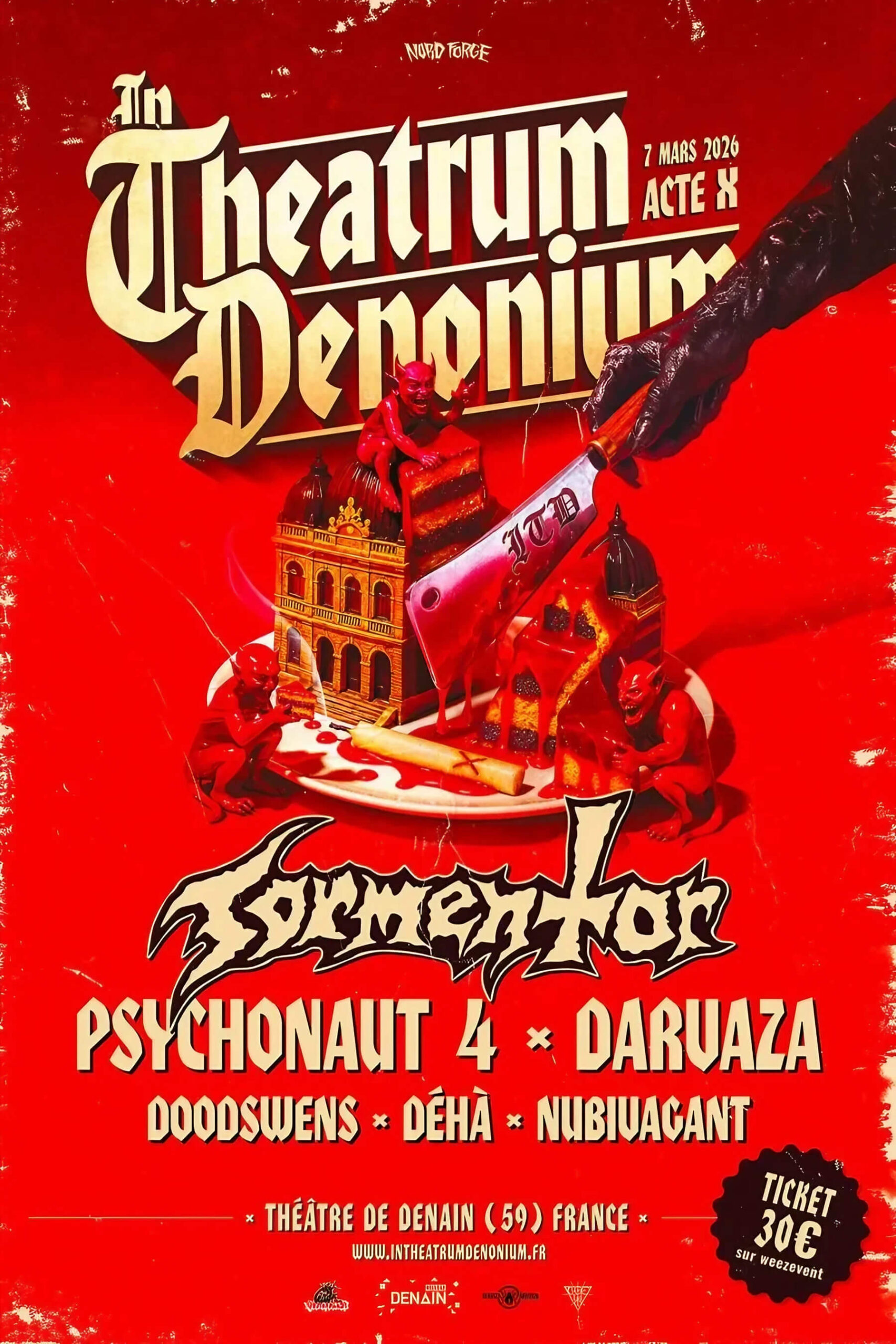
The confirmation of Darvaza, Omega’s own primary black metal band, on the lineup ensures that the audience will witness Omega performing twice: once as the feral frontman of Darvaza, and once as the stoic priest of Nubivagant. This duality—the beast and the monk—is a coup for the festival organizers.
Other acts associated with the 2026 edition include Psychonaut 4, the Georgian depressive black metal pioneers, and potentially Tormentor, the seminal Hungarian band led by Attila Csihar. The presence of these bands creates a narrative arc for the evening: from the depressive lows of Psychonaut 4 to the violent history of Tormentor, with Nubivagant providing the atmospheric counterpoint. Ticket prices for this communion of shadows are set at 135,000 COP (approximately $33 USD).
Anticipating the Live Ritual
Having covered the progressive and technical scenes for decades, I have seen hundreds of bands attempt to translate studio atmosphere to the stage. Few succeed. However, reports of Nubivagant’s previous performances, such as at the Howls of Winter Festival in Estonia, suggest that Omega has mastered the live translation.
Live, Nubivagant is described as refreshing, with the clean vocals cutting through the mix and the rhythm section creating a hypnotic effect that lingers in the mind for days. Unlike ArsGoatia, who use fire and theatrics, Nubivagant’s stage presence is understated. Omega does not need to spit gasoline; he simply needs to stand before the microphone and chant.
In the Théâtre de Denain, this understated approach will be magnified. The stage, framed by heavy red curtains and gold molding, is theatrical enough. Omega does not need to dress the set; the set is already a masterpiece of nineteenth-century aestheticism. The acoustics of the theatre, designed for unamplified opera, will likely treat the clean vocals with a reverence that a club PA system never could. We can expect the reverb to be natural, the decay of the notes hanging in the dome above the stalls.
A Convergence of Iron and Art
For the dedicated listener traveling to Denain, this concert is a pilgrimage. It is a journey to the old industrial heart of Europe, where the echoes of the past meet the sounds of the avant-garde. It is also an observation of the Signal Rex connection. To see an artist supported by this underground infrastructure commanding a historic French stage is a moment of significance.
In the 90s, we looked to Norway. In the 2000s, we looked to France. Now, in 2026, we look at a map that is blurred, where an Italian drummer plays Italian doom-black metal, distributed by a Portuguese label, in a French theatre. The borders have dissolved, leaving only the International Folk Music of the twentieth-first century: Black Metal.
The Silence Remaining After the Dagger
When the final reverberation of ‘The Judgement’ dissolves into the velvet darkness of the Théâtre de Denain, it will mark more than the end of a performance; it will signify a momentary reconciliation between the broken history of this city and the spiritual void of the artist.
In this temple of silence, built by the vanished wealth of coal and now sanctified by the hymns of decay, Omega does not merely perform; he officiates a liturgy for a god who has left the building. As we sit in the hush of the stalls—international pilgrims, French locals, and the ghosts of the industrial age—we are reminded that the most profound heavy metal does not seek to deafen us to the world’s pain, but to articulate it with such clarity that silence becomes the only appropriate response.
In the convergence of Nubivagant’s monotonous prayer and Denain’s architectural memory, we find a rare and terrible beauty: the sound of a blame dagger striking the heart of the empty sky, proving that even in the absence of hope, art remains the final, defiant act of presence.
As the audience descends into this acoustically rich, historical venue, the interplay between the setting and the sacred becomes central. Heavy metal is typically characterized by high energy and movement; yet, witnessing Nubivagant’s hypnotic, monolithic sound within the enforced stillness of a seated theatre compels a new assessment. This raises a fundamental question: how does this environment re-contextualize the heavy metal ritual and redefine what it is capable of achieving?
References:
- Sylvie Aprile et al., ‘Les Houillères entre l’État, le marché et la société: Les territoires de la résilience (XVIIIe-XXIe siècles)’ (Villeneuve d’Ascq: Presses universitaires du Septentrion, 2015), 112–115. ↩︎
- Fernando Pessoa, ‘The Book of Disquiet,’ trans. Richard Zenith (London: Penguin Classics, 2002), 78–81. ↩︎
- Adam Ockelford, ‘Repetition in Music: Theoretical and Metatheoretical Perspectives’ (London: Routledge, 2005), 89–92. ↩︎
Leave a Reply