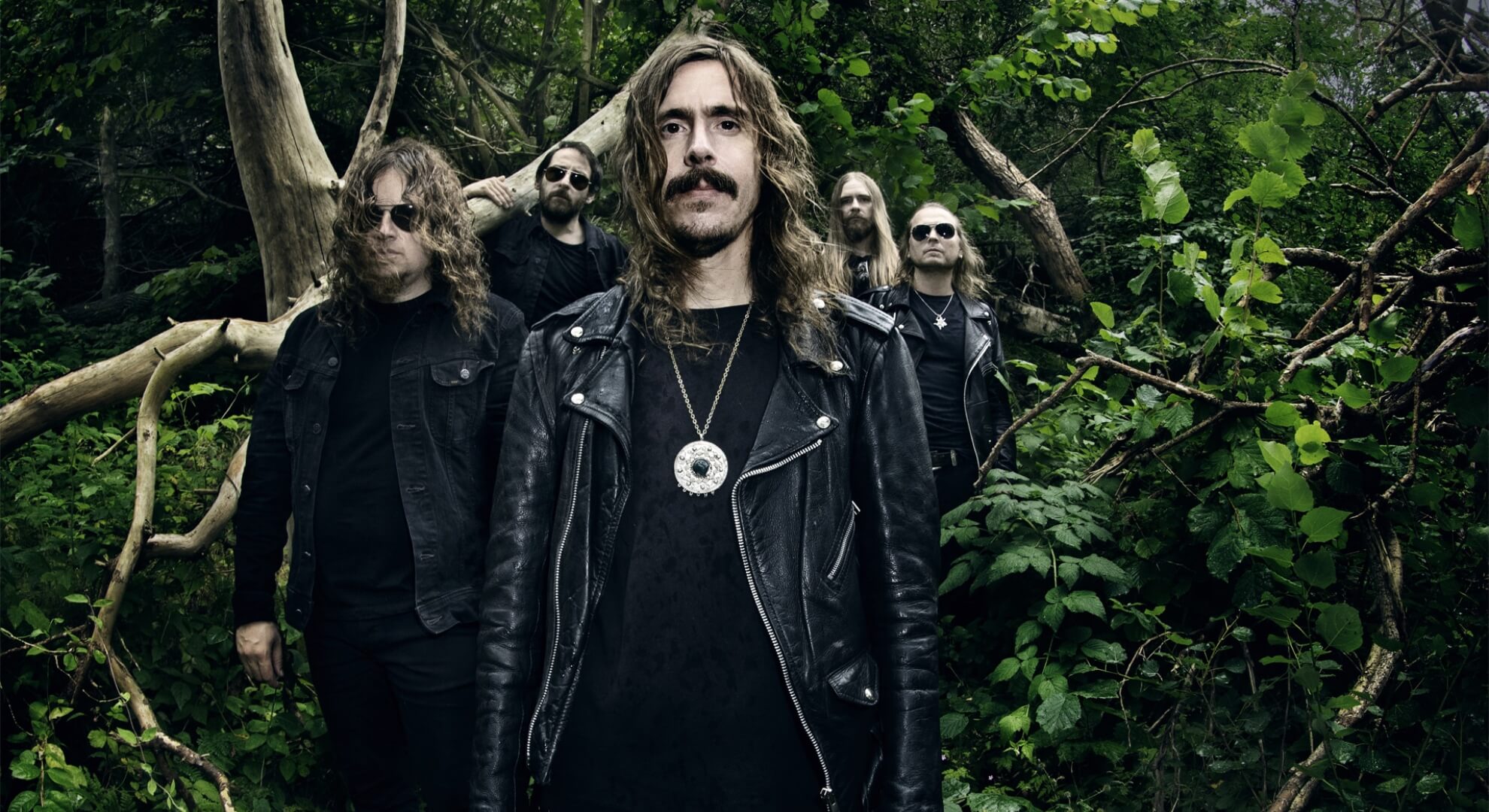


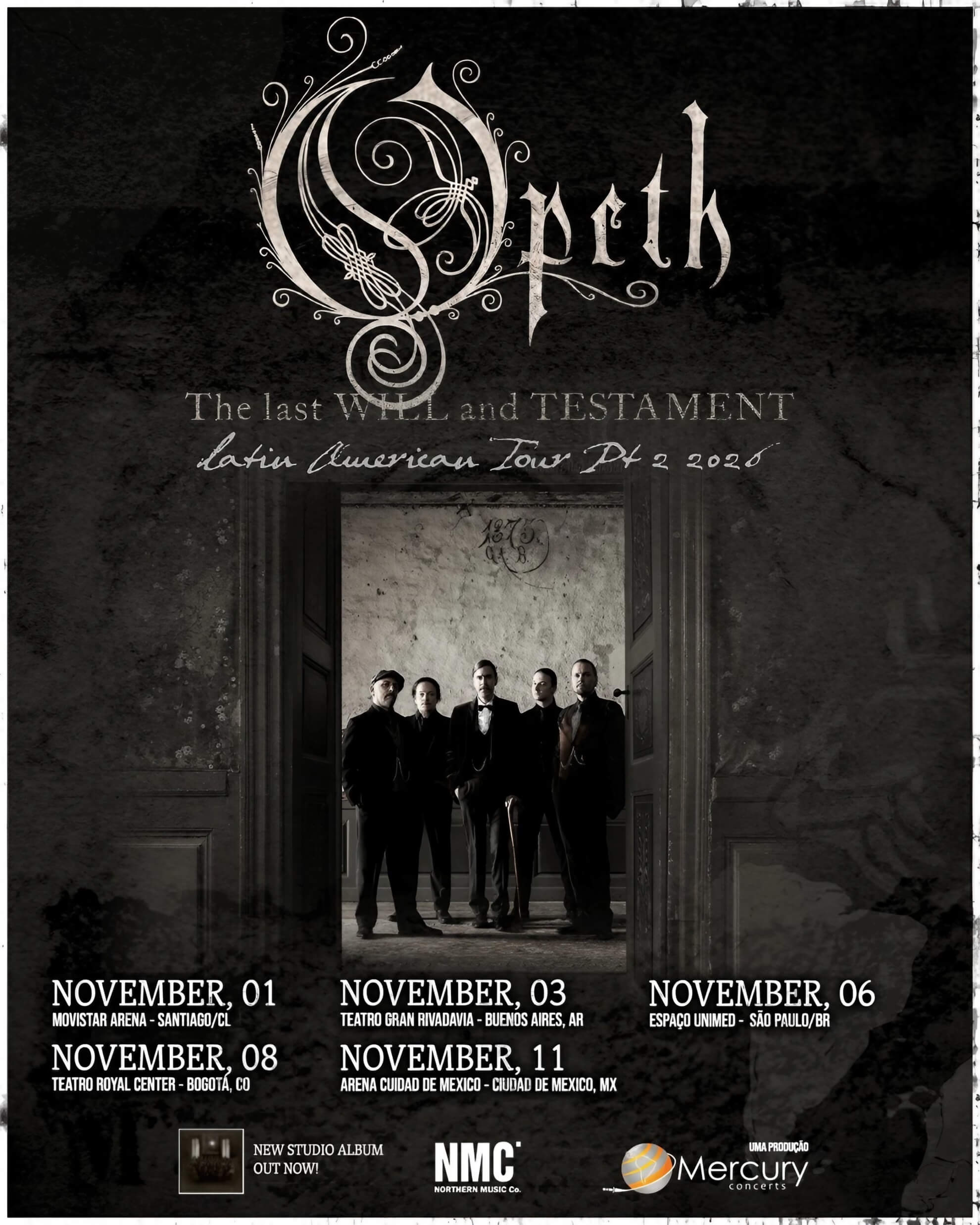
On the evening of November 8, 2026, the high-altitude Andean metropolis of Bogotá will serve as the geographical and spiritual epicenter for one of the most culturally significant events in the contemporary progressive metal sphere. Fresh off an extensive global run—including a defining co-headline slot at the 2025 Vienna Metal Meeting that we had the privilege of covering last autumn—the Swedish musical juggernaut Opeth is scheduled to perform at the Teatro Royal Center, a paramount stop on the Latin American leg of their current international tour.
For a city defined by its chaotic, dynamic mestizo culture and its deeply entrenched extreme music underground, this event represents far more than a standard promotional tour date. It constitutes an essential rite of passage for a populace that has historically relied upon heavy metal not merely as a form of entertainment, but as a vital mechanism for collective catharsis, political defiance, and social resilience.
Opeth’s relationship with the Colombian audience has been solidified through a series of escalating, powerful encounters, making this impending performance a critical atmospheric shift rather than a routine return.
The band delivered a suffocatingly intense masterclass at the Teatro Royal Center in early 2023, only to return to the capital to command the massive Coliseo Medplus for the Festival Monsters of Rock in 2025. Yet, while the 2025 arena spectacle cemented their status as titans capable of moving masses, it lacked the claustrophobic intimacy required for their newest conceptual material.
The deliberate decision to regress from the arena stage back into the enclosed, pressurized environment of the Teatro Royal Center in 2026 is profoundly symbolic. It signifies a purposeful return to the intense, suffocating proximity that best serves the intricate, gothic narrative of their latest opus.
European Sorrow in the Tropics
The emotional core of Opeth’s discography rests on the Portuguese concept of “saudade”—a deep, melancholic longing for an absent person, place, or state of being.1 While traditionally associated with Fado music, this bittersweet wistfulness translates flawlessly into progressive heavy metal.
Frontman Mikael Åkerfeldt has spent decades weaving death metal passages with pastoral acoustic interludes, channeling a cinematic isolation reminiscent of European Dark Romanticism and the psychological depths of filmmaker Ingmar Bergman.2
When this distinctly European, internalized melancholy is performed live in a city like Bogotá, it undergoes a fascinating cultural transmutation. The stoic sorrow of the Swedish compositions collides with the fiery, extroverted passion of the Colombian audience.
The crowd absorbs the intricate “saudade” and projects the acoustic melodies back toward the stage with immense vocal fervor, transforming a traditional rock concert into a grand, exorcising ritual that bridges the vast Atlantic divide.
Survival and Defiance in the Colombian Underground
The arrival of Opeth in 2026 cannot be isolated from the broader lifestyle and historical continuum of the Colombian extreme music scene. The local underground has spent over three decades cultivating one of the most formidable and dedicated metal industries on the continent.
This is a culture built in mythic, now-extinct 1990s venues, underground bars, and clandestine rehearsal spaces—locations that functioned as absolute sanctuaries for a disenfranchised youth.
Comprehending the Bogotano metalhead requires recognizing the socio-political climate that necessitated the music’s existence. In the 1980s and 1990s, Latin America, and Colombia in particular, was marred by extreme inequality, authoritarian violence, and the horrific reality of the cartel wars.
For the youth of Bogotá and Medellín, heavy metal was not a superficial aesthetic choice; it was a literal survival mechanism. When faced with the stark triad of joining the military, the paramilitaries, or the narco-traffickers, young Colombians carved a fourth way through extreme music.3
This era birthed the Ultra Metal movement in Medellín—a raw, lo-fi aesthetic that captured the sounds of death and conflict, subsequently influencing the global black and death metal lexicon.4
Revered national acts like Masacre, Internal Suffering, and Perpetual Warfare laid the foundational bricks of a movement that fundamentally refused to compromise. This shared ethos of defiance and community is most clearly crystallized in the monumental Festival Rock al Parque in Bogotá.
Initiated in 1995, this pioneering, government-funded project has gathered tens of thousands of leather-clad devotees annually for three decades, effectively democratizing access to global culture and forcing the broader, traditional society to accept the roqueros into the civic mainstream.
By 2026, the local vanguard continues to thrive, possessing a musical literacy that is exceptionally high. When international titans arrive, they are met by an ecosystem ready to support and challenge them. The tradition of the telonero (the national opening act) is a sacred duty in Colombia.
While international tours often bring their own support—such as the Swedish gothic metal band Tribulation, who accompanied Opeth on their North American leg—the Latin American dates frequently incorporate the strongest local talent.
Kinetic Devotion of Latin American Crowds
To properly contextualize the significance of Opeth’s return, it is helpful to explore the disparate psychological and sociological frameworks that govern heavy metal audiences across different hemispheres. The behavior of a live audience is intrinsically linked to the socio-cultural environment from which it emerges.
In the context of global rock and metal tours, North American and European crowds are frequently characterized by a phenomenon of cultural saturation. Spoiled for choice by an endless rotation of high-profile tours and summer festivals, northern audiences often project an air of stoic observation.
Conversely, the Latin American audience approaches the live music experience as a transcendent, almost religious expulsion of kinetic energy. The intensity of a Colombian metal crowd is unrivaled, characterized by a frenzy where thousands of bodies writhe, sway, and collide in unified, rhythmic devotion.
It is standard practice in South America for fans to vocally emulate every intricate guitar solo, chant along to instrumental passages, and create massive, swirling mosh pits that resemble scenes from a chaotic battlefield.
This stark contrast is deeply rooted in the aforementioned history of systemic inequality and political strife. Because the cost of a concert ticket often represents a significant financial sacrifice, the emotional stakes of the performance are exponentially higher.
To contextualize this dedication, we might consider the explicit financial reality of the event; tickets for the Teatro Royal Center performance are tiered into three main categories: Balcony seating at 180,000 COP (approximately 45 USD), standard General Admission at 260,000 COP (approximately 65 USD), and premium Platino floor access at 380,000 COP (approximately 95 USD).
When weighed against local economic realities, and coupled with the fact that international tours visit the region less frequently than the Global North, this pricing transforms the concert from a casual Friday night outing into a major, highly anticipated investment.
The atmosphere inside the venue becomes electrified, stripped of genuine malice but overflowing with raw, unbridled release. It is a sacred, communal space where metalheads spanning multiple generations safely navigate the violence of the mosh pit with profound mutual respect. The band, in turn, feeds off this absolute devotion, often resulting in performances that possess a visceral edge rarely captured on European soil.
Atmospheric Vessel of the Teatro Royal Center
The architectural vessel chosen to contain this impending sonic ritual is the Teatro Royal Center, a venue fundamentally woven into the modern fabric of Bogotá’s live music ecosystem. Situated in the bustling, culturally diverse Chapinero neighborhood at Carrera 13 No. 66-80, the theater is a marvel that bridges the gap between historical gravitas and contemporary technical demands.
Officially inaugurated in 2010 to address the capital’s growing need for mid-to-large scale cultural spaces, the venue boasts a capacity of approximately 3,500 spectators, distributed across an expansive main floor and private balcony boxes.
What makes the Teatro Royal Center uniquely suited for a band of Opeth’s unparalleled technical caliber is its advanced acoustic infrastructure combined with a flexible spatial configuration. Progressive metal, particularly the intricate, polyphonic compositions crafted by Åkerfeldt, requires an acoustic environment capable of articulating both the sheer percussive force of blast beats and the delicate, crystalline resonance of a classical acoustic guitar interlude.
The building has absorbed the historic weight of concerts by extreme music titans. It has hosted epic, theatrical performances by Cradle of Filth, the symphonic grandeur of Epica, the aggressive thrash of Megadeth, and the Norwegian black metal invasion of Emperor.
Each of these shows has deposited a new layer of sonic residue into the venue’s identity, fusing its cinematic aesthetic with a modern history of thunderous riffs and passionate crowds. The Teatro Royal Center is not merely a room with a stage; it is an atmospheric amplifier. The darkness of the hall, the proximity of the audience to the performers, and the flawless sound engineering ensure that the complex narrative of Opeth’s new material will be delivered with devastating clarity.
Navigating a Gothic Tale of Familial Betrayal
The November 8th performance serves as the vital Latin American platform for Opeth’s fourteenth studio album, a dark conceptual masterpiece. As noted in our comprehensive 2024 review exploring the album’s conceptual depths, this record functions as the grand reconciliation of a stylistic schism that had divided their audience for over a decade.
As explored in our previous retrospectives, Opeth spent many years deliberately polarized by its own creative courage. Following the watershed moment of 2008, Åkerfeldt plunged the group into the pastoral, vintage-prog aesthetics of the 1970s, shedding the guttural death metal vocals that defined their acclaimed early 2000s zenith on records such as ‘Blackwater Park’ and ‘Ghost Reveries.’
While this extended era produced technically brilliant, highly atmospheric music, a vocal segment of the audience continually yearned for the aggression of the past.
This ambitious record is the breathtaking resolution to this creative tension, heralding the highly anticipated return of Åkerfeldt’s demonic death metal growls. However, this decision was dictated by narrative necessity rather than a regressive capitulation to fan demands.
Reflecting on the creative process, Åkerfeldt explained that the patriarchal character driving the concept album was inherently too vile to be voiced through clean melodies alone. Writing from the perspective of a fundamentally bitter and resentful protagonist made traditional singing feel dishonest. Because “the story demanded a specific kind of darkness,” he realized his signature growls were the only appropriate vehicle for the patriarch’s malice.
By explicitly integrating the vocal and instrumental talents of Ian Anderson of Jethro Tull—alongside a prominent guest spot from Joey Tempest—Opeth stakes a definitive claim on their inheritance of the 1970s progressive rock mantle. Yet, the album’s conceptual ambitions elevate it beyond mere musical homage, placing it firmly within the tradition of Gothic literature.
The story of a decaying aristocratic family, a haunted estate in the aftermath of the First World War, and hidden bloodlines echoes the psychological terror of Edgar Allan Poe’s ‘The Fall of the House of Usher’ or the claustrophobic familial rot of a Shirley Jackson novel.5
As dark family secrets are revealed through Anderson’s captivating spoken-word narrations, the patriarch confesses from beyond the grave that his twins were the product of an anonymous donor—a secret he weaponizes to cruelly disinherit them. He then proclaims that his true, sole heir is the sickly daughter, whom he believed to be the product of his own illicit affair with the estate’s maid.
The instrumentation supporting this gothic soap opera perfectly mirrors the tension of a band reuniting with its own darkness. As we noted previously, the introduction of young Finnish drumming prodigy Waltteri Väyrynen injects a relentless, highly technical groove into the rhythmic foundation, dancing seamlessly with Martin Mendez’s haunting, funk-inflected bass lines.
Furthermore, the strict conceptual framework forced the musicians entirely out of their established comfort zones. Guitarist Fredrik Åkesson delivers highly deliberate, meticulously composed solos throughout the record, shifting away from his recent improvisational approach to serve the crushing, theatrical weight of the story.
As Åkesson detailed in interviews surrounding the album’s release, the strict narrative demanded absolute precision over spontaneous jamming. Rather than entering the studio to see where the feeling took him, he noted that “every single note had to serve the plot.” He described his solos on this record as a form of musical acting, meticulously crafted to convey the specific anxiety or dread of each paragraph in the will. While he found this to be an incredibly constrained method of playing, he acknowledged that this very limitation ultimately made the compositions so special.
Symphonic Climax and Narrative Twist
While our initial preview of this record introduced the overarching post-First World War setting and the warring family dynamics, truly comprehending the sophisticated storytelling Opeth brings to the stage in 2026 requires a deeper examination of the album’s penultimate track, ‘§7’ (Paragraph 7), which serves as the narrative and sonic climax of the record.
‘§7’ is a masterful exhibition of structural tension and release. It opens with an unexpected, eerie guitar progression and a deeply unsettling atmospheric presence, immediately establishing a macabre, almost ethnic ambiance. Joakim Svalberg’s masterful use of synthesizers plunges the listener directly into the claustrophobic, dust-choked air of the patriarch’s drawing room.
The track operates as a slow-burner, gradually accumulating mass and velocity before erupting into a violent, whiplash-inducing return to Opeth’s traditional, ferocious death metal sound.
Narratively, ‘§7’ represents the final, cruel act of the will’s reading. The patriarch formally signs off, distributing supposed heirlooms to the disinherited twins—items of profound symbolic weight but absolute zero material value, serving merely as permanent reminders of a tainted, fragile legacy.
Ian Anderson’s low, aged voice narrates this final decree against a backdrop of sorrowful piano, adding a theatrical, cinematic gravity to the track. As the song transitions back into heavy, progressive knotty riffs, Åkerfeldt’s vocals shift violently between ethereal cleans and demonic growls, mirroring the psychological torment of the family members.
Åkesson unleashes a blistering, highly melodic guitar solo, and the track eventually fades out, leaving a lingering impression of dread and a melancholy, hollow victory.
The structural brilliance of ‘§7’ lies in its deliberate design to leave the listener entirely off-balance, effectively setting the stage for the album’s finale, ‘A Story Never Told.’ It is in this closing track—a deceptive, symphonic ballad rendered in a style reminiscent of Kate Bush—that the ultimate narrative twist is revealed.
Years after the reading, the heiress, now living alone in the sprawling mansion, receives a letter from her mother, the maid. The letter contains a final, devastating confession: the patriarch was entirely sterile. He was not the sickly girl’s father either. The vast fortune was inherited by a child with absolutely no blood relation to the paranoid nobleman, rendering his cruel, lifelong machinations and his vicious will completely meaningless.
This revelation of ultimate futility is the epitome of tragic irony, a narrative masterstroke that will resonate profoundly with Latin American audiences. It bridges the gap between Swedish Gothic storytelling and the region’s own fatalistic literary traditions—specifically the Latin American Gothic and the darker edges of Magical Realism, pioneered by figures like Gabriel García Márquez and Horacio Quiroga.6
In these cultural frameworks, generational curses, aristocratic decay, and the inescapable ghosts of the past are inextricably woven into the fabric of reality, making the Colombian crowd uniquely primed to absorb the patriarchal downfall at the heart of the album.
The Road to a Triumphant November Synthesis
When the house lights finally dim at the Teatro Royal Center on November 8th, 2026, the ensuing performance will represent far more than a mere showcase of their latest concept album. It will serve as a definitive declaration on the enduring power, evolution, and cultural necessity of progressive extreme metal in the global south.
Opeth has successfully navigated the perilous waters of artistic evolution, alienating and subsequently reclaiming portions of their audience, only to arrive at a compositional synthesis that perfectly honors every era of their storied career.
For the Colombian fans, whose dedication is unparalleled and whose kinetic intensity serves as the literal lifeblood of the global touring industry, this concert is a communal celebration of survival and artistic triumph. They will bring the fire, the unified voices, and the unyielding passion that transforms a complex piece of Swedish progressive art into a profoundly shared human experience.
The intricate, syncopated riffs of ‘§7,’ the haunting acoustic flute passages, and the revived guttural roars of Mikael Åkerfeldt will reverberate off the acoustically engineered walls of the Teatro Royal Center, echoing out into the cool, rain-slicked Bogotá night.
This upcoming event highlights the vital, continuing dialogue between the artists who create extreme music to express their inner melancholy, and the cultures that consume it as an absolute necessity for survival. Through the analytical lens of “saudade,” the music of Opeth captures the innate tragedy of human existence; through the lungs and the kinetic motion of the Colombian audience, that very tragedy is transformed into triumphant, defiant joy.
The November 2026 performance stands not merely as a date on a tour itinerary, but as a pivotal, historic epoch for the genre’s presence, resilience, and ongoing evolution in South America.
References:
- Eduardo Lourenço, ‘The Mythology of Saudade’ (Lisbon: Imprensa Nacional, 2000), 45. ↩︎
- Birgitta Steene, ‘Ingmar Bergman: A Reference Guide’ (Amsterdam: Amsterdam University Press, 2005), 112-115. ↩︎
- Nelson Varas-Díaz and Daniel Nevárez Araújo, editors, ‘Heavy Metal Music in Latin America: Perspectives from the Distorted South’ (Lanham: Lexington Books, 2020), 87-92. ↩︎
- Jeremy Wallach, Harris M. Berger, and Paul D. Greene, editors, ‘Metal Rules the Globe: Heavy Metal Music Around the World’ (Durham: Duke University Press, 2011), 210-214. ↩︎
- Fred Botting, ‘Gothic’ (London: Routledge, 2013), 155-159. ↩︎
- Wendy B. Faris, ‘Ordinary Enchantments: Magical Realism and the Remystification of Narrative’ (Nashville: Vanderbilt University Press, 2004), 88-91. ↩︎

Leave a Reply