
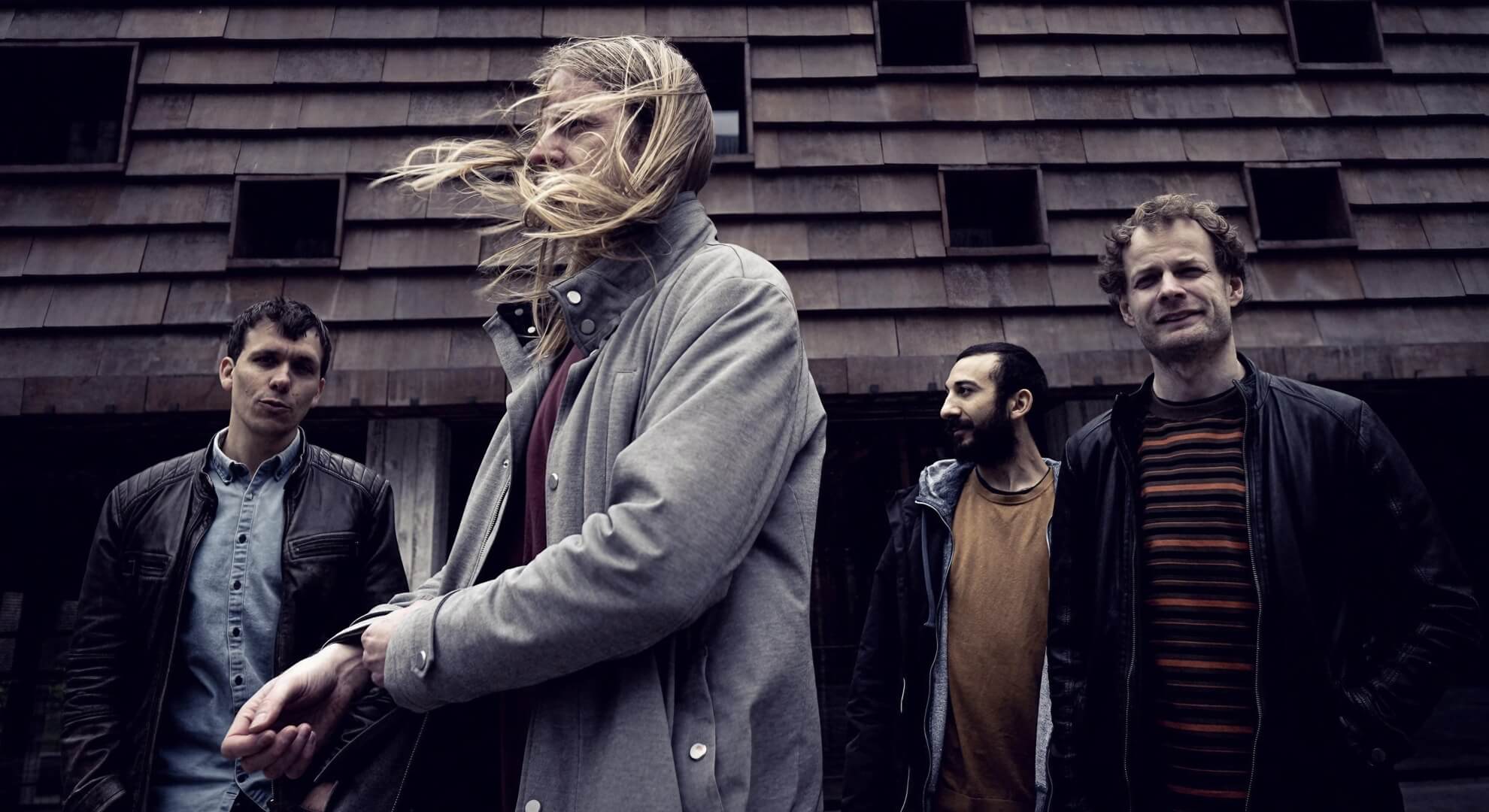


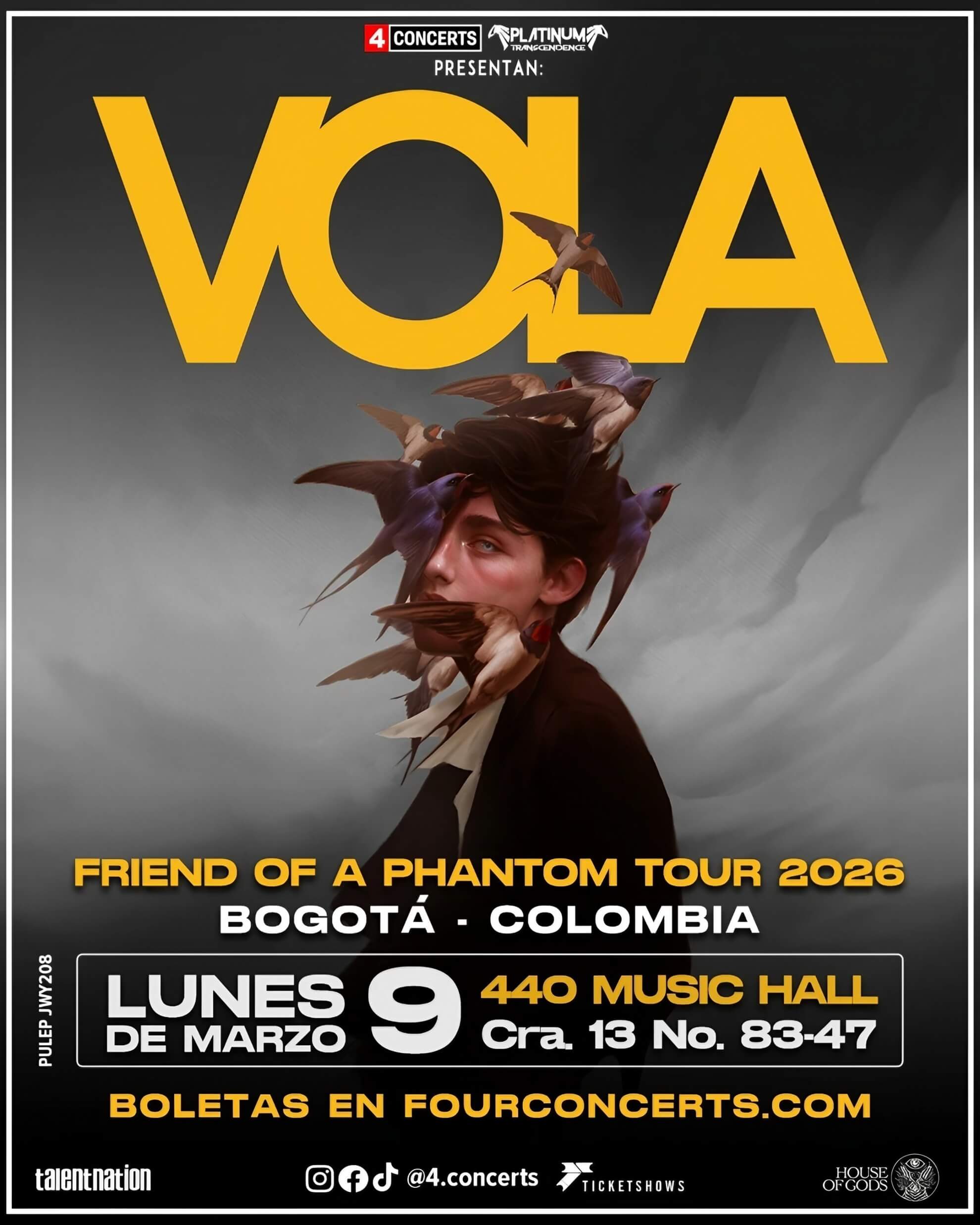
When the Danish-Swedish progressive metal quartet Vola arrives in the Andean capital of Bogotá on March 9, 2026, the performance will represent a critical intersection of musical progression and socio-cultural catharsis. Scheduled to unfold within the industrial confines of the 4.40 Music Hall, the concert serves as a highly anticipated return to Colombian soil. It acts as a defining flashpoint for the progressive, alternative, and technical metal scenes of the region.
Set against the high-altitude, kinetic turbulence of the Colombian underground, this event is far more than a mere coordinate on an international touring schedule. It is a profound transcontinental collision. It represents the meeting of the cerebral, meticulously engineered gloom of Nordic Europe and the visceral, trauma-shaped passion of the Latin American audience.
The Friend of a Phantom, tour arrives in South America at a moment of profound transformation for the genre. To comprehend the monumental significance of this event, an exhaustive contextual framework is required. Tracing the complex trajectory of progressive metal, conducting an anthropological study of the unique psychology of the Colombian audience, and reviewing the historical threads that connect old-world existentialism to new-world sonic warfare places this upcoming performance not merely as a concert, but as a pivotal moment for the continued expansion and cultural impact of the genre within South America.
Nordic Melancholy and Andean Intensity
The emotional weight of this performance is deeply rooted in the contrasting atmospheres of two distinct regions. The Scandinavian peninsula is often culturally defined by a sense of introspective isolation, shaped by long, dark winters and vast, desolate terrains. This quiet, enduring tragedy is reflected directly in the dense, symphonic orchestrations of modern European progressive metal.
It is a sorrow that is highly cerebral, manifesting in the melancholic synthesizer soundscapes and the reflective poetic themes prevalent in the Nordic heavy music tradition.
Conversely, the sorrow and resilience of the Colombian capital operate on an entirely different frequency. Bogotá, perched 2,640 meters above sea level in the Andes, is a metropolis suspended amidst the clouds, where the historical shadow of “La Violencia” and decades of socio-political upheaval have nurtured a culture of kinetic survival.1
As previously observed in our recent coverage of Dark Tranquillity’s engagement at Teatro Astor Plaza, the perpetual gray of the city offers a distinct atmospheric mirror to the Scandinavian peninsula. In Colombia, trauma and existential dread are not quietly endured in isolation; they are expelled through communal movement, deafening noise, and the sheer force of collective will.
When the intricate, melancholic tapestries of European progressive metal are transplanted into the Colombian ecosystem, they are metabolized not as purely intellectual exercises, but as necessary acts of socio-emotional survival. The calculated Nordic melancholy of the Danish-Swedish quartet will be fed into the furnace of the underground scene of Bogotá, transforming passive observation into a kinetic, shared release.
The Metamorphosis and Zenith of a Phantom Sound
To measure the impact of the upcoming Bogotá performance, one must view Vola not as a static entity, but as a band arriving at the absolute zenith of a decade-long metamorphosis. Their return to Colombia is not merely a promotional vehicle for a new record. It is the culmination of a deliberate, highly documented shift in style that has seen them outgrow the restrictive confines of the underground progressive scene to become cinematic sculptors of sound.
Early in their career, particularly during the era of their 2015 debut ‘Inmazes,’ the quartet—comprising Asger Mygind on vocals and guitars, Martin Werner on keys, Nicolai Mogensen on bass, and Adam Janzi on drums—relied heavily on the crushing, labyrinthine complexities of djent. They were defined by a sense of existential entrapment, employing dense polyrhythms to create a feeling of claustrophobia.
However, their trajectory has been characterized by a restless refusal to stagnate. Rather than trapping themselves in the technical limitations of their own subgenre, Vola embarked on a daring stylistic expansion.
They shocked purists by weaving lush, indie-pop sensibilities and sweeping electronic melancholia into their subsequent work. This was most notable when they experimented with lighter, digital-age anxieties on ‘Applause of a Distant Crowd,’ in 2018 before injecting stadium-ready aggression into their 2021 release, ‘Witness.’
Their newest release, ‘Friend of a Phantom,’ issued in late 2024 via Mascot Records, is the masterful reconciliation of these extreme stylistic swings. The record morphs the band into a more accessible, yet emotionally devastating entity. It is characterized by deeply melancholic undertones that are perfectly counterbalanced by moments of soaring uplift. This dichotomy is not an accident, but a reflection of the core conceptual focus of the album.
Frontman and primary songwriter Asger Mygind has articulated that the title reflects an internal reckoning rather than a literal haunting. He has explained that the phantom represents the older versions of oneself, the memories, and the anxieties that trail behind, noting, “Learning to befriend that phantom is the only way to move forward.” This philosophical outlook creates a dynamic emotional journey that resonates deeply with audiences accustomed to both despair and resilience.
The structure of the album proves the band has mastered the art of contrast. Tracks like ‘We Will Not Disband,’ and ‘Glass Mannequin,’ weave ethereal, almost fragile synthesizer leads with subterranean bass grooves. Conversely, the inclusion of the ferociously heavy single ‘Cannibal,’ serves as a historic bridge within their catalog. Featuring guest vocals by Anders Fridén of the revered Swedish melodic death metal pioneers In Flames, the track is a profound acknowledgment of their genetic DNA.
For the audience in Bogotá—a city with an enduring, historic reverence for nineties death metal—the live rendition of ‘Cannibal,’ promises to be an apocalyptic highlight. Playing this mature, synthesized material in a city that respects both heavy history and deep emotion elevates the concert from a standard tour stop into a victory lap. Vola is returning to South America not as a promising tech-metal curiosity, but as an established vanguard operating at the absolute peak of their creative and technical powers.
Sculptors of a Brutalist and Cinematic Soundscape
The contribution Vola has made to modern music exists within a broader artistic and cultural continuum that extends beyond the rigid confines of heavy metal. Aesthetically and structurally, the music functions as the sonic equivalent of Brutalist design.
Much like the imposing, geometrically precise concrete structures that defined post-war European urban planning, the foundational polyrhythms inherited from mathematical metal are massive, uncompromising, and inherently industrial. Yet, where traditional Brutalism can feel sterile, Vola drapes these monolithic foundations in lush, rich tapestries of sound.
This juxtaposition is a highly calculated compositional choice. Mygind has synthesized this approach by observing that relying purely on heavy guitar instrumentation artificially caps the emotional ceiling of a composition. By leaning more heavily into synthesizers, he notes, the band provides a completely different textural expanse, allowing the melancholy to breathe in spaces where distortion would normally suffocate it.
Their reliance on sweeping, melancholic synthesizers draws a direct line to the cinematic science fiction scores of Vangelis or the monumental work of Hans Zimmer on ‘Blade Runner 2049.’ The band captures a distinct sense of post-industrial alienation and technological existentialism. These are themes historically explored by dark synth-pop pioneers like Depeche Mode, but executed here with the crushing weight of modern down-tuned guitars.
Within their contemporary peer group, Vola occupies a vanguard position alongside acts like Norway’s Leprous and the United Kingdom’s Sleep Token. This collective of modern artists is actively dismantling the archaic borders between extreme metal and vulnerable, atmospheric pop. They share a collective ethos: that true heaviness is not merely a product of distortion and speed, but of emotional gravity and dynamic contrast.
Vola marries the structural complexity of seventies progressive rock—akin to the atmospheric creation of Pink Floyd—with the immediate, hook-driven sensibilities of modern alternative music, elevating their sound from a mere subgenre exercise into a sweeping, cinematic art form. For the Bogotá audience, this multi-disciplinary approach transforms the concert from a standard metal show into an immersive, avant-garde theatrical experience.
The Industrial Metamorphosis of the 4.40 Music Hall
To firmly ground this monumental transcontinental event in physical reality, one must examine the specific venue chosen to house the sonic assault. The March 9 performance will be hosted at the 4.40 Music Hall, located on Calle 85, deeply embedded in the bustling, upscale heart of the northern nightlife district of Bogotá.
The physical space itself features a unique, sprawling industrial aesthetic that is heavily reminiscent of an old, abandoned train station, complete with exposed metalwork, brick accents, and cavernous ceilings. Despite its usual programming, the venue is highly versatile and technically sophisticated, equipped with an impressive acoustic capacity, cutting-edge sound systems, and a formidable, dazzling lighting rig. Visitors have frequently praised the excellent sound quality of the venue during live band performances, an essential requirement for progressive metal.
When the tropical rhythms fade and the black-clad metal community takes over for an international tour, the 4.40 Music Hall undergoes a dramatic, almost surreal metamorphosis. The imposing industrial skeleton provides a fittingly dystopian, mechanized backdrop for futuristic, heavily down-tuned riffs. The juxtaposition of a trendy, medium-sized commercial club being temporarily repurposed for a progressive metal communion adds a distinct layer of cultural dissonance to the event.
Furthermore, attentive patrons have noted the commitment of the venue to minor but appreciated environmental consciousness, such as the strict use of metal straws rather than plastic, aligning subtly with the broader ethical concerns often found within the modern progressive music community.
For a band whose live mix relies heavily on navigating the extremely delicate balance between crushing, distorted eight-string guitars and fragile, crystalline electronic synthesizer samples, the acoustic fidelity of the 4.40 Music Hall is of paramount importance. The intimacy of the venue—typically holding an audience capacity that ensures a packed, breathless room—guarantees that the physical barrier between the Danish-Swedish musicians and the roaring Colombian crowd will be virtually nonexistent.
This proximity forces a direct energy exchange, resulting in an atmosphere of suffocating, glorious intensity where every bass drop and snare hit reverberates directly through the ribcages of the attendees.
Securing Passage into the Industrial Venue
For fans preparing to participate in this transcontinental collision, securing passage into the 4.40 Music Hall is a primary concern. Tickets for the March 9, 2026, performance are structured into two primary tiers to accommodate the intimate industrial layout of the venue. General admission is priced at 180,000 COP (approximately $45 USD), while access to the VIP and mezzanine areas requires an investment of 280,000 COP (approximately $70 USD).
Given the passionate devotion of the Colombian progressive metal community and the strictly limited capacity of the venue, these allocations are expected to be claimed rapidly.
The Masterful Curated Sonic Assault
Based on recent global tours, comprehensive statistical aggregations, and the known performance history of the quartet, the shape of the impending Bogotá performance is expected to be a masterfully curated, highly dynamic journey through their discography.
Clocking in at an average of one hour and forty-four minutes of relentless, calculated precision, the setlist will be a formidable test of both the endurance of the band and the stamina of the crowd. The performance will undoubtedly be heavily weighted toward the promotion of ‘Friend of a Phantom,’ deploying the explosive, death-metal infused ‘Cannibal,’ and the hypnotically ethereal ‘We Will Not Disband,’ to immediately establish supreme control over the venue.
However, the band remains deeply loyal to the material that originally cultivated their devoted Latin American following. Staples from their breakthrough era are virtually guaranteed to make an appearance, with the apocalyptic, mechanized groove of ‘Head Mounted Sideways,’ and the melancholic, soaring propulsion of tracks like ‘Straight Lines,’ and ‘24 Light-Years,’ heavily statistically favored to ignite absolute pandemonium on the venue floor.
The inclusion of earlier, foundational works from ‘Applause of a Distant Crowd,’ and ‘Inmazes,’—specifically beloved tracks like ‘Alien Shivers,’ and the monumental ‘Stray the Skies,’—will provide the necessary polyrhythmic whiplash that longtime, dedicated followers crave. The masterful transition from the delicate, almost indie-pop-infused melodies of their quieter interludes to the gargantuan, low-end barrage of their breakdowns is precisely what defines the live experience.
In the enclosed, acoustically primed space of the 4.40 Music Hall, these extreme dynamic shifts will be felt in the marrow of the bones of the audience. The silence between notes will be as impactful as the distortion, creating a push-and-pull dynamic that leaves the crowd physically exhausted but spiritually revitalized.
A Profound Transcontinental Catharsis
The impending March 9, 2026, performance by Vola at the 4.40 Music Hall transcends the standard parameters of international touring, serving instead as a profound transcontinental dialogue. Viewed through the lens of European heritage mingling with Latin American reality, this concert represents a fascinating convergence. It is the precise intersection where the cerebral, synth-laden melancholia of the Nordic peninsula collides with the kinetic, survivalist passion of the Colombian underground.
Vola steps onto the Bogotá stage not merely as musicians, but as fully actualized artists at the absolute zenith of their creative powers, bearing the heavy emotional atmosphere of ‘Friend of a Phantom.’ They are entering a metropolis that treats extreme music as a vital civic sacrament, shaped by historical turbulence and validated by the enduring spirit of the local counterculture.
When the first heavily syncopated, drop-tuned chords of ‘Cannibal,’ inevitably rattle the industrial skeleton of the venue, it will ignite a localized catharsis—proving that the apparition of European sorrow finds its most fervent, life-affirming resonance within the high-altitude intensity of the Andes.
Considering the deeply introspective nature of ‘Friend of a Phantom,’ how do you anticipate witnessing this highly cinematic material live in the uniquely kinetic and visceral environment of Bogotá will reshape your personal connection to their music?
References:
- Marco Palacios, ‘Between Legitimacy and Violence: A History of Colombia, 1875–2002’ (Chapel Hill: Duke University Press, 2006), 134–139. ↩︎
Leave a Reply