
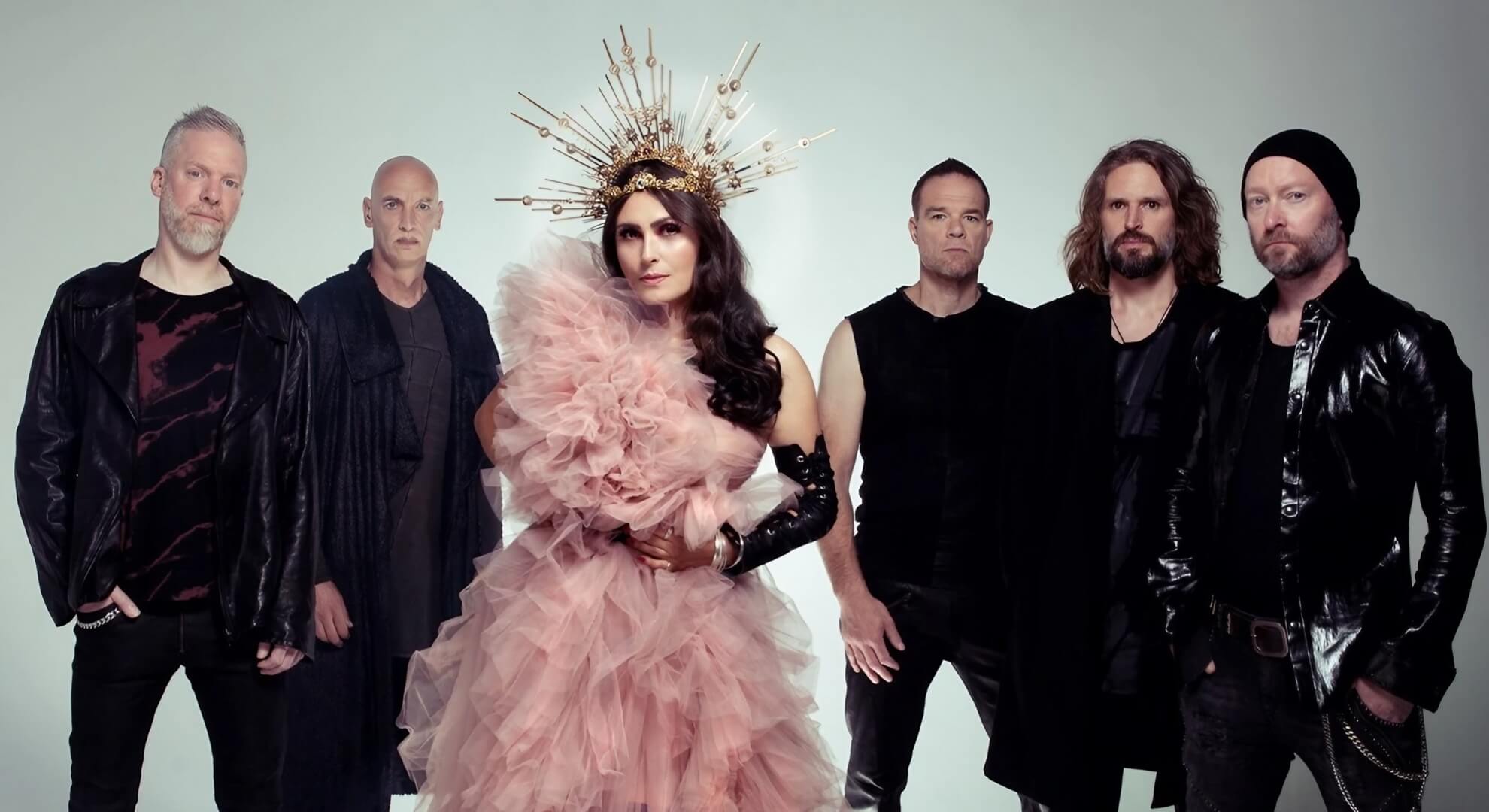


The municipality of Dessel, in the Antwerp province of Belgium, presents a topography of stark contradictions. To the uninitiated, it is a quiet corner of the Flemish Region, a terrain of sandy soil and pine trees situated in the shadow of the nuclear power industry. Yet, for the initiated—the legion of the “black-shirted”—it is hallowed ground. The Festivalpark Stenehei, located on the Kastelsedijk, is not merely a venue; it is a temporary city-state that erects itself annually, a phenomenon that transforms the pastoral silence into a roaring epicenter of heavy culture.
Though the summer solstice of 2026 remains a distant promise on the winter horizon, the announcement of the Graspop Metal Meeting lineup serves as a ritualistic marker of the impending season. The festival’s evolution from a struggling family rock event in the mid-90s to the premier heavy metal summit of the Benelux region mirrors the trajectory of the genre itself.
It is a history of hardening, of refining, and of surviving. And there is perhaps no band that embodies this trajectory more poignantly than the Netherlands’ own Within Temptation, who are slated to grace the South Stage on Thursday, June 18, 2026.
More than a typical summer tour date, this performance is a profound meeting point for historical context and current geopolitical realities. It unfolds against the backdrop of a genre that has evolved from the dark, intimate clubs of the 1990s into a vast, modern lifestyle.
To comprehend the weight of this upcoming set, one must know the soil upon which it stands. The “dust of Dessel” is infamous among veterans—a fine, choking particulate that rises from the mosh pits, turning the twilight sun into a hazy, apocalyptic filter. It is in this atmosphere, amidst the scent of sunscreen, stale beer, and ozone, that Within Temptation will present their latest artistic metamorphosis.
Two Cities of the Festival State
The atmosphere of Graspop is defined by a distinct stratification that reflects the aging and diversification of the metal community. To the west lies the Boneyard, the sprawling, chaotic campsite that serves as the festival’s id. It is a realm of sleepless energy, where the ethos of the 90s prevails—mud, camaraderie, and a feral endurance.
Here, the younger generation and the die-hard purists live in a state of collective effervescence, their experience defined by the raw physicality of the festival. Scholars of the genre note that this intense communal bonding is central to the metal experience, creating a “proud pariah” community that thrives on its separation from mainstream norms.1
Contrast this with Metal Town, situated a kilometer away. This enclave represents the gentrification of the metal lifestyle, a necessary evolution for a demographic that has aged alongside the bands. Here, the “grey guard”—fans who purchased ‘Enter’ upon its release in 1997—reside in organized pitches with breakfast tents and sanitary facilities.
The existence of Metal Town is proof of the genre’s longevity; it allows metalheads to participate in the ritual without surrendering to the chaos of the Boneyard. Within Temptation, a band that bridges the doom-laden past and the polished present, speaks to both these constituencies. Their music resonates with the comfort-seeking veterans of Metal Town and the adrenaline-fueled youth of the Boneyard alike.
The Arc of Dutch Doom
To witness Within Temptation in 2026 is to witness the survival of a specific, atmospheric strain of heavy music that was incubating in the Low Countries thirty years ago. The band that takes the South Stage has traveled a vast aesthetic distance from the melancholy introspection of their origins.
They emerged from a scene defined by a romantic, almost Victorian darkness—a “beauty and the beast” dynamic exemplified by their 1997 debut ‘Enter.’
This early sound was not merely a musical trend but a cultural echo of nineteenth-century Romanticism—a revival of the fascination with the sublime and the melancholic. Much like the Gothic literary tradition that juxtaposed beauty with decay, Within Temptation’s early work echoed the pioneering gloom of Britain’s Paradise Lost and Norway’s Theatre of Tragedy, yet filtered through a distinctly Dutch lens of melodic sensibility.2
However, unlike many peers who remained anchored to the gothic doom of the late 90s, Within Temptation’s career has been defined by a refusal to stagnate. The deep, growling roots of their early discography now serve as the “ghost in the machine” of their modern sound, providing a heavy, ancestral foundation for the polished, stadium-ready anthems they are known for today.
Beyond the Velvet Horizon
For the generation of fans who came of age during the early 2000s, Within Temptation provided the soundtrack to a lifestyle defined by velvet corsets and fantasy literature. The ‘Mother Earth’ era of 2000 marked a pivotal shift from gothic doom to symphonic grandeur, tapping into a turn-of-the-millennium zeitgeist that craved cinematic escapism. Just as Peter Jackson was preparing to bring Tolkien’s Middle-earth to the screen, Within Temptation was sonically constructing their own mythic domains.
Their sound became a heavy metal parallel to the Wagnerian operatic tradition—bombastic, leitmotif-driven, and unapologetically beautiful.3
Tracks like ‘Ice Queen’ became anthems, reaching the top of the charts in Belgium and cementing the band’s status as headliners in the Benelux region. Yet, as they prepare for June 2026, the significance of these older tracks has shifted. They will undoubtedly feature in the setlist as moments of nostalgic release, but they no longer represent the band’s core ethos.
The era of pure escapism has ended. The “fantasy metal” label that once defined them has been shed, revealing a band that now uses its platform to engage directly with reality rather than retreat from it.
The narrative arc of Within Temptation has taken a sharp, jagged turn with their latest cycle, ‘Bleed Out’ (2023). Moving from the Romantic to the Realist, the band has abandoned the idealized worlds of their past for the jagged, uncomfortable truths of the present.
The fantasy constructs have been dismantled, replaced by a brutal confrontation with the geopolitical realities of the 2020s. This is the single most important context for their upcoming performance: the band has transformed into a socially conscious, politically charged entity.
The catalyst for this shift was not market demand, but moral necessity. Reflecting on the Russian invasion of Ukraine and the global erosion of civil liberties, vocalist Sharon den Adel articulated the band’s new philosophical imperative. “To protect your freedom, you have to be active,” she explained, diagnosing the danger of inertia in times of crisis.
“If you are passive, then you are going to lose it.” This sentiment reveals the engine driving their modern sound; the aggression in tracks like ‘Wireless’ is not stylistic posturing, but the sonic manifestation of that refusal to remain passive.
This thematic shift is mirrored by a sonic metamorphosis. The symphonic elements are now buttressed by the staccato rhythms of “djent” and the aggression of metalcore, influenced by modern contemporaries like Architects and Bring Me The Horizon—bands who, notably, share the Graspop 2026 bill on Saturday.
Within Temptation maintains sonic relevance by weaving modern, industrial textures into their music. This approach ensures they are not simply a “legacy act” relying on past hits, but are actively competing with the sound of the new generation.
The Burden of the Banner
The decision to center their art on controversial topics has not been without friction. The band has faced backlash from fans who demand that artists “stick to music” and avoid politics. Yet, the band views this separation of art and society as a false dichotomy.
Robert Westerholt, the band’s guitarist and co-founder, reframed the criticism not as a political debate, but as a defense of artistic integrity. “It is not even politics. It is your opinion as an artist,” Westerholt asserted. “That is what art is for.”
This intellectual courage adds a layer of moral gravity to their live presence. When den Adel waves the Ukrainian flag during the set, it is an act of defiance that aligns perfectly with metal’s historical ethos of rebellion, even if the target has shifted from religious conservatism to authoritarian imperialism.4
This aligns with the genre’s broader sociological function as a space for the re-imagining of national and political identity, where the stage becomes a platform for contesting power narratives.5
Convergence on the South Stage
Giants Among the Pines
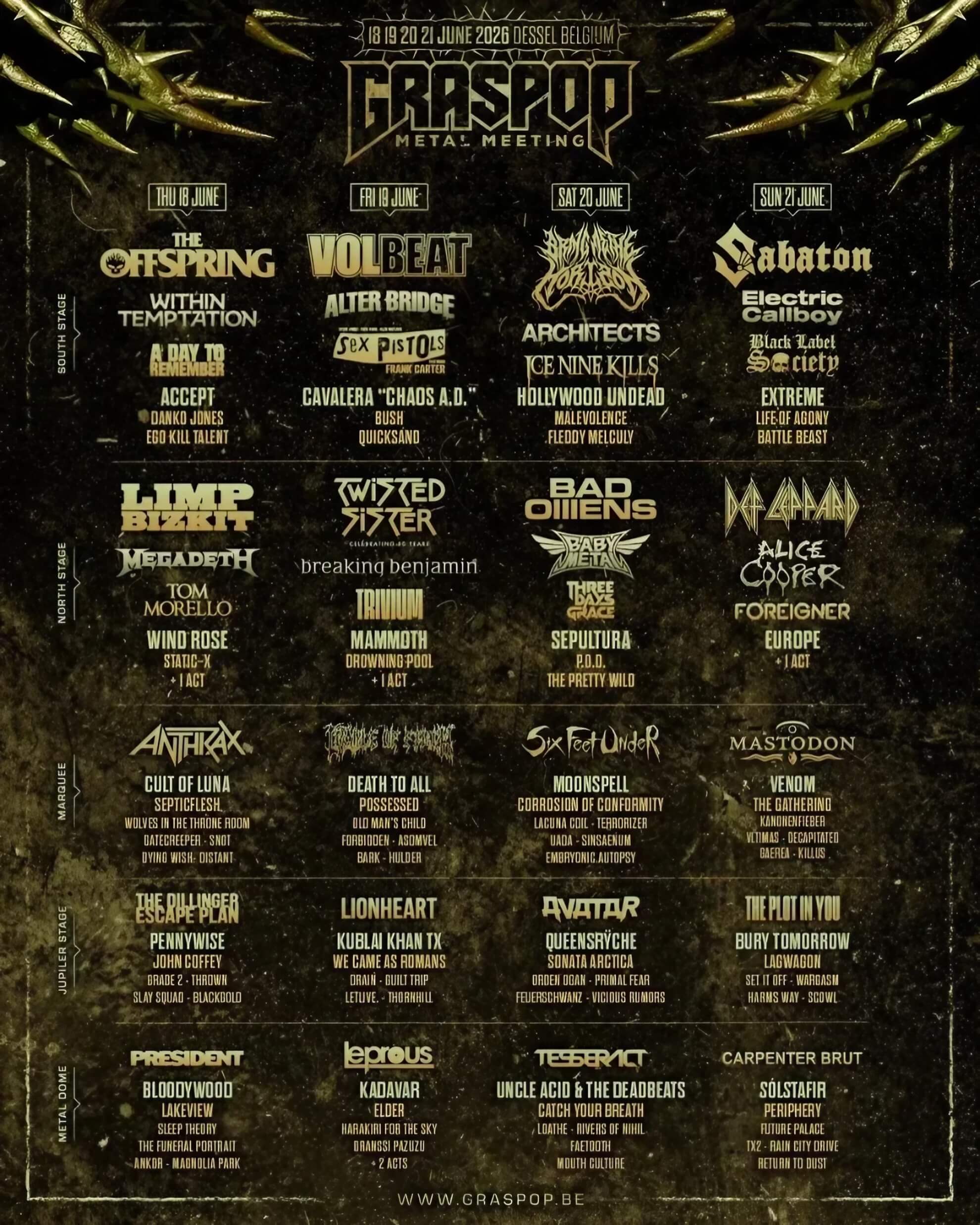
Scrutinizing the official poster for Graspop Metal Meeting 2026, the placement of Within Temptation on Thursday, June 18, reveals a curated clash of musical ideologies. They are listed on the South Stage, sharing the bill with The Offspring, A Day To Remember, and Accept.
This scheduling creates a fascinating dialogue of genres; the South Stage will host the high-energy nostalgia of The Offspring’s punk rock, the metalcore and pop-punk fusion of A Day To Remember, and the classic German steel of Accept, all flanking the symphonic gravity of Within Temptation. Meanwhile, on the North Stage, the day features the nu-metal nostalgia of Limp Bizkit’s aggressive party vibes alongside the technical thrash precision of Megadeth.
This scheduling places Within Temptation in a prime slot, likely in the early evening “golden hour,” just as the heat of the day begins to break and the stage lights can take full effect. The South Stage, standing side-by-side with the North Stage, creates a sonic immensity, allowing the 50,000-strong crowd to pivot between acts with minimal friction.
A Ritual of Fire and Memory
Drawing from the reviews of their 2024 Wembley show and their 2025 Australian tour, one can construct a vivid preview of the 2026 performance. The show will almost certainly open with ‘We Go To War.’ The production for this track is immense and sobering: giant LED screens displaying fields of sunflowers—a potent symbol of Ukrainian resistance—and stark headstones, while den Adel emerges in theatrical, warrior-like attire.
The set will likely function as a dialogue between the band’s past and present. ‘Stand My Ground,’ a hit from 2004, has been repurposed as a political anthem, its lyrics about refusing to back down taking on new resonance in the context of the Ukraine war. ‘Faster’ and ‘Paradise (What About Us?)’ provide the high-octane release that a festival crowd demands, ensuring that the heavy themes do not suffocate the energy of the event.
A centerpiece of the performance will undoubtedly be ‘A Fool’s Parade,’ a track recorded with Ukrainian artist Alex Yarmak. In previous shows, den Adel has paused the music to speak directly to the audience about the conflict, dedicating the song to those on the front lines. In Dessel, a mere few hours’ flight from the conflict zone, this speech will carry a specific, localized weight. It disrupts the hedonism of the festival, piercing the bubble of the “vacation” with a reminder of the fragility of peace.
Beneath the Sentinel Wheel
For the attendee standing in the crowd, the sensory experience will be overwhelming. The South Stage is flanked by the towering Ferris wheel, a surreal sentinel watching over the mosh pits. As the sun sets, the Sky Deck to the left will be packed with VIPs looking down on the sea of black t-shirts. The dust, kicked up by thousands of boots during the preceding sets by Accept and A Day To Remember, will hang in the air, catching the deep purples and reds of Within Temptation’s light show.
This is the physical reality of the “Metal Meeting.” It is not a sterile concert hall; it is a gritty, communal endurance test. The band’s ability to project a pristine, cinematic soundscape over this rugged environment is what separates the veterans from the amateurs. They know how to command the “Stenehei plain,” and how to make the music reach the back of the field where the tired campers are resting on the grass.
Securing Passage
For those preparing to make the pilgrimage to Dessel, securing entry to the festival grounds is the first step. The costs for the 2026 edition reflect the festival’s premier status.
For the full four-day immersion from June 18 to 21, the Combi Festival Ticket is available for 1,407,000 COP (approximately $345 USD). Travelers unable to commit to the full duration may opt for a Day Ticket for Thursday, Friday, Saturday, or Sunday, priced at 595,000 COP (approximately $145 USD).
For those desiring a more luxurious experience, the VIP Combi Ticket is offered at 2,315,000 COP (approximately $565 USD). It is important to note that these figures are based on the standard Euro rates of €319, €135, and €525, respectively.
A Legacy Written in Dust
As Within Temptation takes the stage at Graspop Metal Meeting 2026, they stand not merely as survivors of a genre, but as its conscience. The journey from the velvet-draped escapism of ‘Mother Earth’ to the unyielding geopolitical confrontation of ‘Bleed Out’ mirrors the maturation of the metal community itself—a shift from seeking refuge in fantasy to finding strength in reality.
In the darkening twilight of the Dessel plain, amidst the roar of fifty thousand voices, their performance becomes a monument to the enduring power of the art form. It is a reminder that while the dust of the festival eventually settles, the courage to speak truth to power echoes long after the amplifiers fall silent. On this Thursday in June, the “Bleeding Heart” of Europe does not just beat; it fights.
As you prepare to stand amidst the dust and adrenaline of the Stenehei plain, consider how Within Temptation’s evolution—from the mythic escapism of ‘Mother Earth’ to the stark realism of ‘Bleed Out’—reshapes your anticipation for this performance. Does the prospect of witnessing these anthems of resistance in such a communal setting offer a deeper form of catharsis, and which specific element of their new sonic identity are you most eager to see translated onto the festival stage?
References:
- Weinstein, Deena. ‘Heavy Metal: The Music and Its Culture.’ Revised edition. New York: Da Capo Press, 2000. ↩︎
- Osiecki, Cynthia. ‘Metal and Gothic Literature: Examining the Darker Side of Life (and Death).’ eCommons (University of Dayton), 2014. ↩︎
- Walser, Robert. ‘Running with the Devil: Power, Gender, and Madness in Heavy Metal Music.’ Middletown: Wesleyan University Press, 1993. ↩︎
- Kahn-Harris, Keith. ‘Extreme Metal: Music and Culture on the Edge.’ Oxford: Berg, 2007. ↩︎
- Spracklen, Karl. ‘Metal Music and the Re-imagining of Masculinity, Place, Race and Nation.’ Bingley: Emerald Publishing Limited, 2020. ↩︎
Leave a Reply