
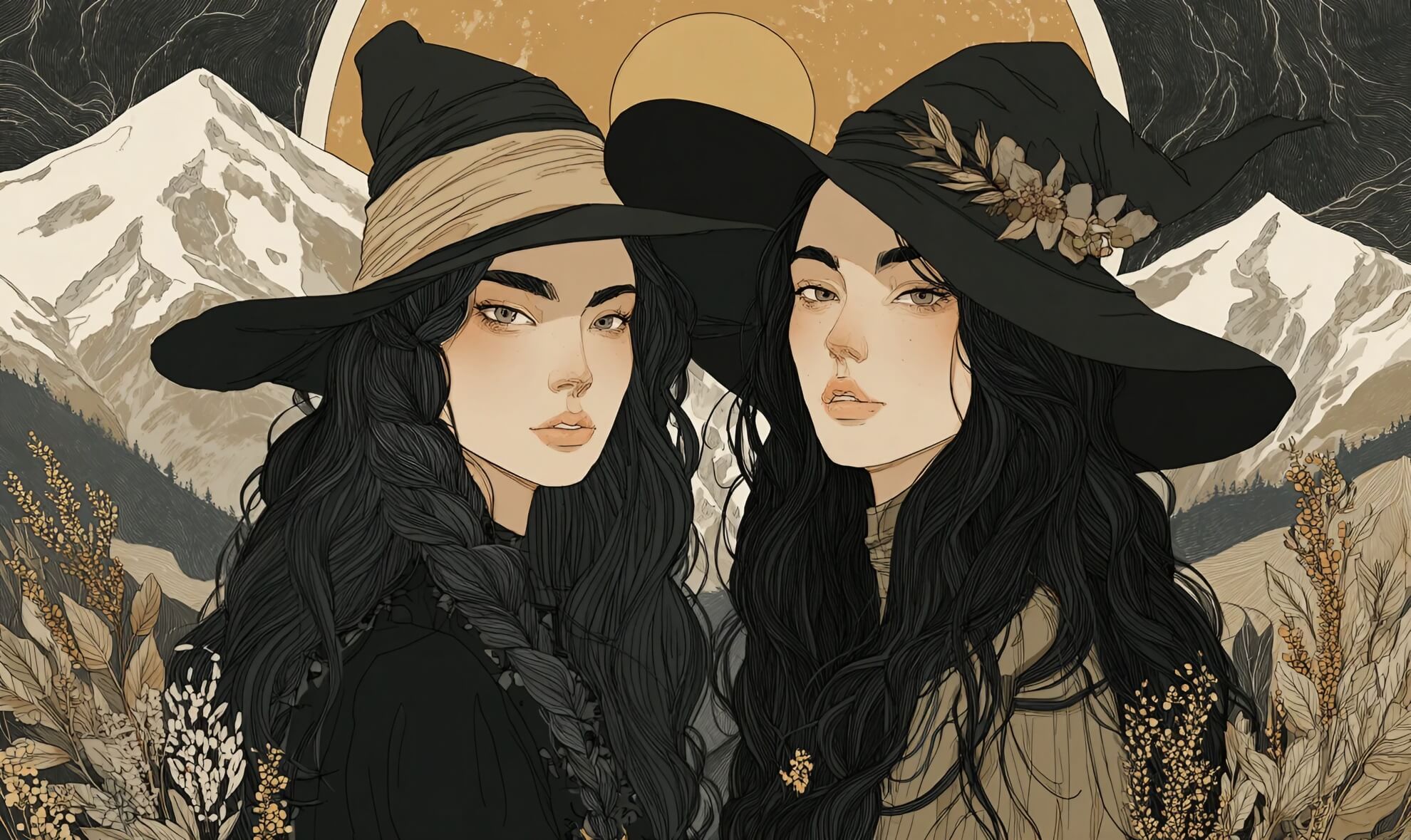


In the weeks before the equinox, a particular kind of attention settles over the herbalists and healers who work at the margins of official medicine. It is the season of transition — between contraction and growth — and in the markets of the Andean capitals, the gathering of plant knowledge becomes briefly visible to those who were not raised in it.
What opens at La Casa Rosada in Bogotá’s Barrio San Felipe on March 28 carries a specific argument: that the “bruja” (“witch”) — the figure historical Christianity spent three centuries working to eliminate — is not a cultural relic but a practitioner, and her gathering a form of scholarship. The same argument opened one week earlier in the eastern highlands of Antioquia, at a flower-growing municipality whose distance from the metropolitan circuits of cultural production was itself part of the point.
The Gathering as Argument
The witch is one of the most politically charged figures in the Western historical record. From the ‘Malleus Maleficarum’ of 1487 — that compendium of persecution deployed by the Inquisitional hierarchy to systematize the identification of suspected witches — to the healing women of the Caribbean palenques who preserved botanical knowledge across centuries of enslavement, she has stood for contested knowledge: medicine against doctrine, embodied authority against institutional suppression.1
The “Wunderkammer” — the cabinet of curiosities — organized the known world into a single room during the sixteenth and seventeenth centuries. Natural specimens, alchemical implements, and ethnographic objects occupied the same shelves; the taxonomy was built not on scientific rigor but on the premise that the world was a resource to be arrayed into possession.2 The gatherings across this Colombian circuit draw on that same appetite for heterodox knowledge, though their politics are inverted: where the “Wunderkammer” was an instrument of dominion, the witch market is an instrument of recovery.
A Network Born South of the Equator
Mercado de Brujas, the Peruvian cultural organization behind this Colombian tour, spent more than ten years as a living network before it acquired a fixed form. According to its own documentation, the project began as a gathering of women — healers, artisans, tarot practitioners, herbalists — who sought to share practices across spiritual and creative traditions without submitting them to institutional frameworks.
Four years ago, that impulse found a physical home in Lima through Aquelarre, a café and meeting space where witches, artists, and seekers began to convene regularly. The Colombian circuit marks the organization’s first sustained expansion beyond Perú: two territories, one in the highland Oriente Antioqueño and one in the capital, selected because of existing partnerships with local collectives who share the same founding premise.
La Yerbalera in La Ceja del Tambo
La Ceja takes its name from the tambo — the roadside shelter that colonial-era muleteers built along the trade route between San Nicolás de Rionegro and Santiago de Arma in 1683. Its territory was inhabited by the Tahamí people before the Spanish arrival in 1541; it was formally founded in 1789 by María Josefa Marulanda, who donated the land for the church, plaza, and municipal council. The event name, La Yerbalera, references both the herbalist practitioner and the specific botanical knowledge of this territory.
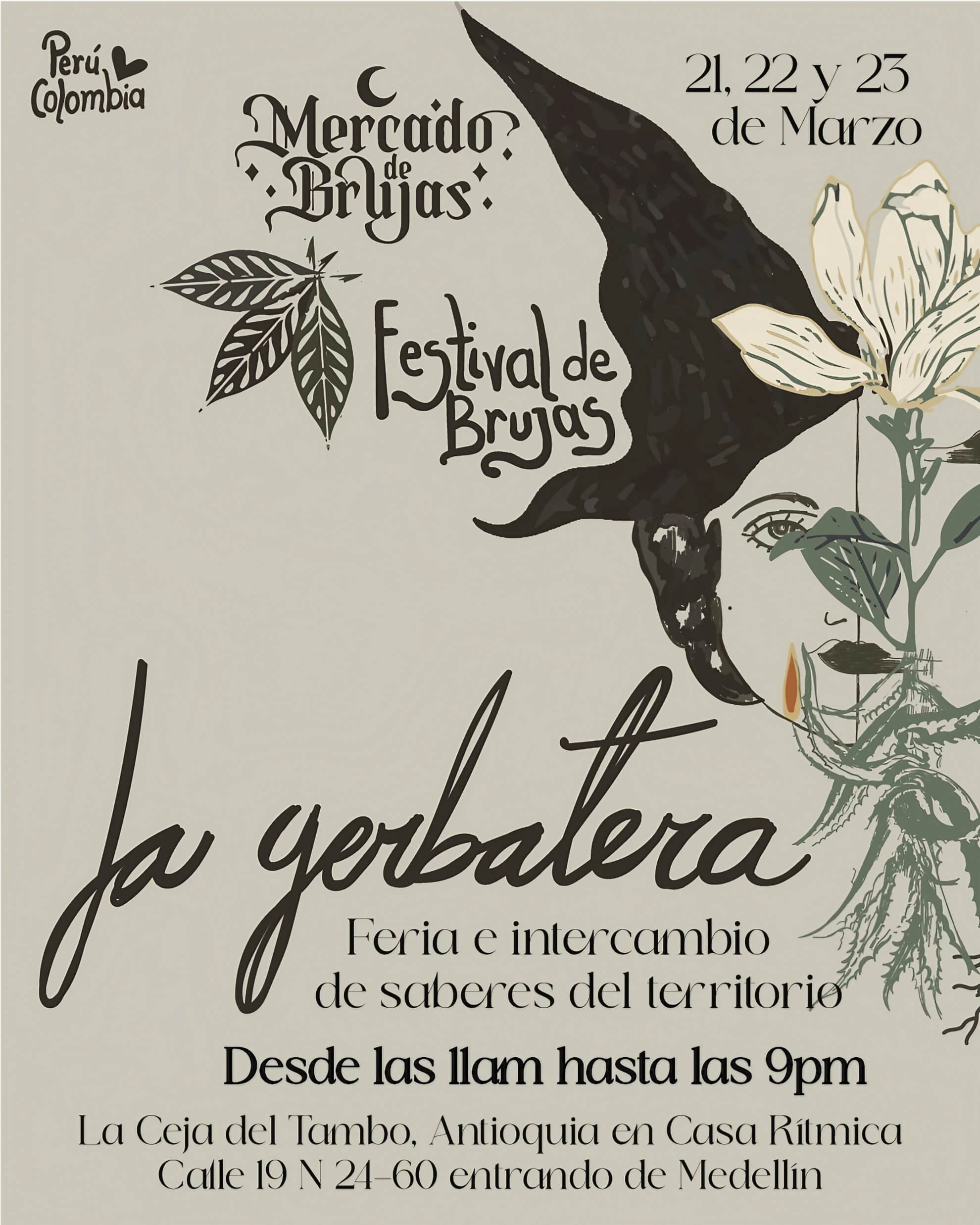
Its formal subtitle — “Feria e intercambio de saberes del territorio” — sharpens that claim: saberes del territorio, or territorial knowledges, is a specific term in Colombian and Andean decolonial discourse that distinguishes place-based, embodied, and community-held knowledge from institutionally certified expertise. The subtitle positions La Yerbalera not as a fair at which things are sold, but as a site at which knowledge belonging to the territory is named, exchanged, and returned to collective use.
The Antioquia edition is produced in collaboration with Festival de Brujas, a local collective whose stated purpose is to decentralize these practices beyond the metropolitan circuits of Medellín and Bogotá. La Ceja’s distance from those centers is not incidental. The choice of an eastern Antioquian municipality as the opening site of a Peruvian witch market’s Colombian debut is an argument in itself: that this knowledge belongs in the hands of smaller communities, flower farmers, and highland practitioners, not only in the gallery districts of capital cities.
The event’s visual identity formalizes that premise: the Perú – Colombia mark that co-brands the poster names Mercado de Brujas and Festival de Brujas as partners in a deliberate binational relay of territorial knowledge, and makes explicit that the circuit is not an export but a reciprocal exchange between two communities who already share the same practices under different names.
The three-day fair runs from 11:00am to 9:00pm on March 21, 22, and 23. General admission is free throughout. Each day carries a full schedule of workshops, conversations, and artistic performances alongside the daily fair, tarot readings, and regional entrepreneurship exhibitions.
Saturday’s program opens with Mercado de Brujas’ ‘Rituales Cotidianos,’ a ceremony that frames everyday acts of care as spiritual practice — the conceptual frame that governs the entire gathering. The afternoon carries Ritmica Artesana’s ‘Al Vuelo – Taller de tejido de escobas’ (voluntary contribution), a conversatorio titled ‘Guerra de Brujas’ led by Marco Mejía, and an archetypal goddess collage workshop by Soy Panela (voluntary contribution). The closing belongs to Tribu Romi, whose ‘Fiesta Gitana’ brings tribal dance into the closing hours.
Sunday’s program opens with the terrarium workshop ‘El Arte de Crear Mundos’ by Helecho Arte Botánica (COP 40,000 / approximately $11), from 11:00am to 12:30pm. Oriente Grow leads a planting workshop on power plants (voluntary contribution) at 2:00pm. Sofi Pérez follows with oral storytelling at 4:00pm. At 5:00pm, Susana of Mercado de Brujas Perú leads a plant ritual workshop on protection and transformation (COP 15,000 / approximately $4). The day closes with a ‘Brujas y Plantas’ conversation by Mercado de Brujas Perú at 6:30pm, and at 8:00pm a serenata by invited artists under voluntary contribution.
Monday closes the La Ceja edition. Mercado de Brujas opens the day free of charge with ‘La luna en el camino de la bruja’ from 11:00am to 12:30pm. A conversation on ‘Ofrendas y pagamentos’ — offerings and ritual payments — between Maga from Colombia and Sofi Winny from Perú follows at 1:00pm, a pairing that formalizes the binational axis of the gathering’s intellectual content.
An energy-cleansing ritual workshop at 2:30pm (COP 25,000 / approximately $7) and Lina Brebajéría’s ‘Cuerpo y territorio’ conversatorio at 4:00pm anchor the afternoon. At 5:00pm, Maga and Alma Nahual lead a knowledge-exchange session on caguana and mambe. Estefanía Cardona closes the programming at 6:00pm with a sound-improvisation circle, ‘Paisajes Sonoros.’ EnCantos del Bullerengue performs the musical closing at 7:00pm.
What Grows on Colombian Ground
Colombia’s relationship to this terrain is not imported. The country has a documented tradition of curanderismo — herbal healing rooted in indigenous botanical knowledge — that colonial Catholic institutions partially displaced and partially absorbed rather than eradicated.3
The ex-voto, a votive offering made to a saint in exchange for intervention in illness or grief, persists in Colombian popular practice as material evidence of the ongoing negotiation between bodily vulnerability and forces beyond medical reach. In La Ceja, a municipality whose identity is in part organized around religious communities — it hosts nearly 25 such communities and is sometimes called ‘el Pequeño Vaticanito’ of the eastern Antioquia — the presence of a market organized around practices the Church once condemned carries a specific local charge.
Bogotá has its own specific history with gatherings organized around esoteric practice. In 1975, the city hosted the first World Congress of Witchcraft — an international convocation that brought healers, mystics, homeopaths, and scholars together under one roof, generating enough public agitation to be noted in international press and Catholic opposition in equal measure.
The Aquelarre Mercado de Brujas does not invoke that congress directly, but it stands in the same current of Colombian civic life that has long accommodated practices beyond official spiritual sanction.
Aquelarre at La Casa Rosada
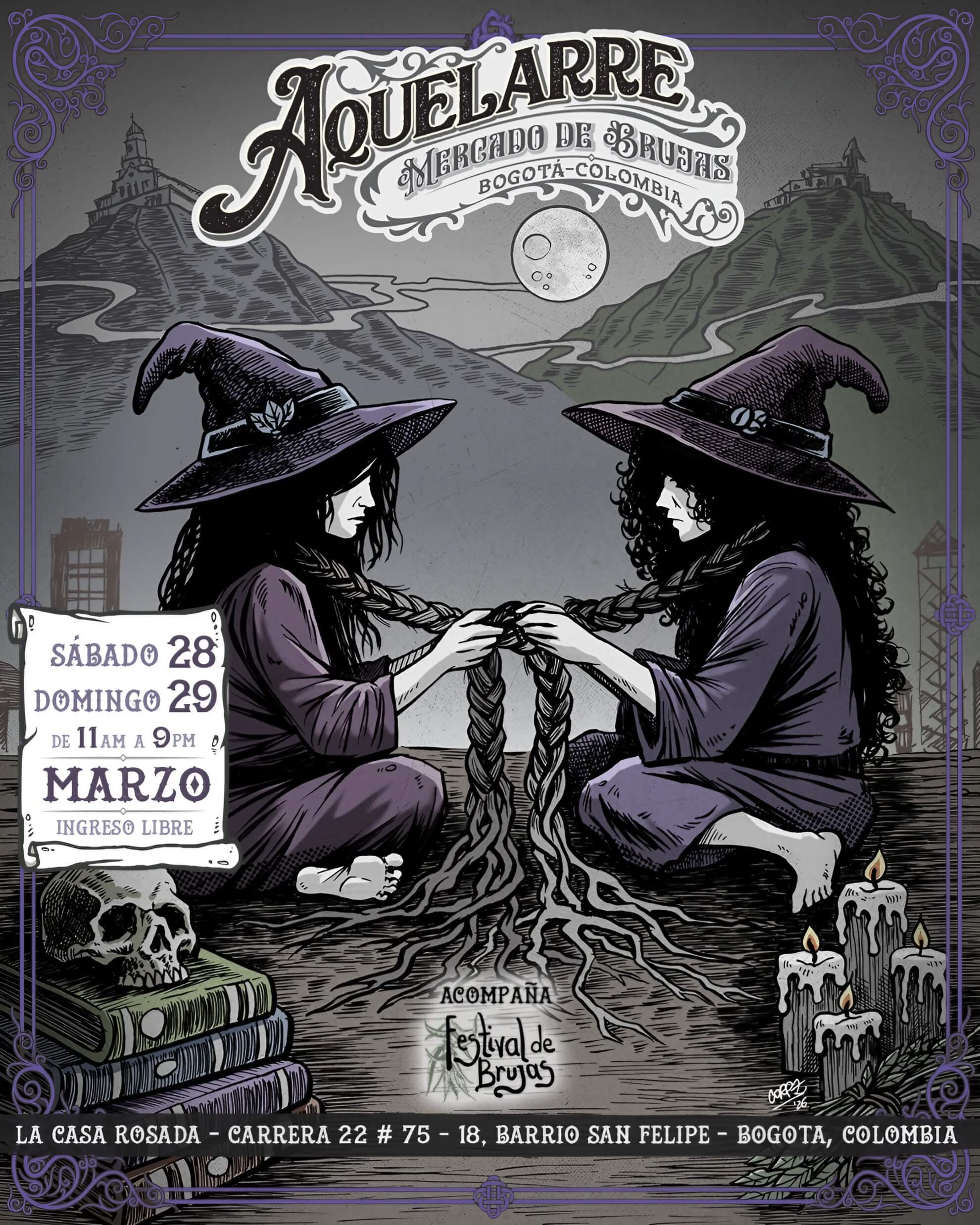
The Bogotá edition — named Aquelarre, the Spanish word for the witches’ sabbath reclaimed by contemporary feminist practice as a symbol of collective female autonomy — opens at La Casa Rosada, Carrera 22 #75-18, Barrio San Felipe, on Saturday March 28 and runs through Sunday March 29. The hours are 11:00am to 9:00pm both days. General admission is free.
Lina Brebajéría, whose conversatorio is titled ‘Cuerpo y territorio’ (“Body and Territory”), represents the market’s explicitly political dimension. The conjunction of body and territory in the Colombian context carries specific historical weight — a country in which land dispossession and gendered violence have operated as inseparable forces for decades.
Her practitioner name, a play on brebaje (brew, potion), situates her work within the herbalist tradition while signaling its social and territorial scope. Lina Brebajéría’s prior exhibition history could not be confirmed at the time of publication.
The musical closing at the Bogotá edition belongs to EnCantos del Bullerengue. Bullerengue is an Afro-Colombian baile cantado born in the palenques — the autonomous communities established by escaped enslaved people along the Caribbean coast in the seventeenth century — and preserved for centuries primarily by elder women.4
In 2025, Colombia declared bullerengue Intangible Cultural Heritage of the Nation. Closing the gathering with this tradition positions it within a lineage of knowledge held and transmitted by women outside institutional structures — precisely the lineage Mercado de Brujas names as its own.
The Witch’s Conjuring
The decision to hold general admission at no cost across both venues is not logistical — it is a statement about the gathering’s intended community. Workshop contributions vary: at La Ceja, the terrarium session carries COP 40,000 (approximately $11), the plant ritual COP 15,000 (approximately $4), and the energy-cleansing workshop COP 25,000 (approximately $7).
Opening ceremonies and musical closings across the full circuit are offered at voluntary contribution. The market does not ask its visitors to credential themselves as practitioners. It asks for attention.
La Yerbalera at Casa Ritmica and Aquelarre at La Casa Rosada are not two stops on a promotional circuit. They are the same gathering held in two territories that have always known this knowledge, under different names and in different soils. In La Ceja del Tambo, the knowledge lives in flower-farming ground, in the hands of practitioners whose municipality the Church itself once trained and whose market it once condemned.
In Bogotá’s Barrio San Felipe, it arrives at a cultural house in a neighborhood that grew northward from a city whose cemeteries were, for decades, the only public institutions willing to hold the body without requiring it to confess.
Both events run free of charge from 11:00am to 9:00pm. La Yerbalera opens March 21 at Casa Ritmica, Calle 19 N 24-60, La Ceja del Tambo, Antioquia. Aquelarre opens March 28 at La Casa Rosada, Carrera 22 #75-18, Barrio San Felipe, Bogotá. What each gathering asks of the visitor is not money but attention — the specific attention that a practitioner deserves when she names, in public, the knowledge she has spent a life carrying.
What draws you to a gathering that treats the herbalist and the drummer as participants in the same tradition — and what does that coexistence ask you to reconsider about how knowledge is transmitted from the body, and whose body that knowledge belongs to?
References
- Federici, Silvia. ‘Caliban and the Witch: Women, the Body and Primitive Accumulation.’ New York: Autonomedia, 2004. 87–92. ↩︎
- Daston, Lorraine, and Katharine Park. ‘Wonders and the Order of Nature,’ 1150–1750. New York: Zone Books, 1998. 255–261. ↩︎
- Taussig, Michael. ‘Shamanism, Colonialism, and the Wild Man: A Study in Terror and Healing.’ Chicago: University of Chicago Press, 1987. 218–224. ↩︎
- Wade, Peter. ‘Music, Race, and Nation: Música Tropical in Colombia.’ Chicago: University of Chicago Press, 2000. 45–51. ↩︎
Leave a Reply