


For three days each August, running from Thursday through the night of Saturday, the Stella Nomine Festival unfolds in the Entenfang (or “Duck Pond”), a nature reserve outside the historic town of Torgau in eastern Germany. The event has become a key gathering for followers of Europe’s “dark scene,” drawing attendees who, often dressed in black, make a pilgrimage to the festival, billing itself as “The Blackest One.” It combines dark music with a summer, open-air environment in a Renaissance-era town. The unique atmosphere has been described by both artists and attendees as a “black garden party”—complete with coffee and cake.
The fifth event is scheduled to run from Thursday, August 14, to the early morning of Sunday, August 17, 2025. The festival was started during a period of uncertainty for live events and has since developed a consistent following. Its appeal is related to its musical lineup, its location, and its organization.
Stella Nomine Festival: A Unique Experience
The city of Torgau, a preserved Renaissance town with Hartenfels Castle as a prominent feature, provides a unique backdrop for the festival. Historically, Torgau was a political hub of the Protestant Reformation in the sixteenth century; Martin Luther consecrated the castle chapel, and his wife, Katharina von Bora, is buried in the town.
The festival organizers have incorporated this historical context into the event. The festival wristband allows attendees free entry to the city’s museums and Hartenfels Castle. Visitors can see the castle halls and the moat, where brown bears have been kept for centuries. A shuttle bus operates between the festival grounds at the Entenfang and the old town. This arrangement allows festival-goers to visit historical sites, such as the tomb of Katharina von Bora or exhibitions on the Reformation, during the weekend.
This integration creates a compelling parallel. At its core, the Protestant Reformation was a profound act of dissent against the established religious authority of its time. Similarly, the gothic subculture is founded on a rejection of mainstream social and aesthetic norms. The festival facilitates a unique dialogue between these two forms of nonconformity, separated by centuries. There is a powerful visual resonance in seeing black-clad attendees, practitioners of a modern subculture, moving through the stone halls of Hartenfels Castle, a historical center of religious rebellion.
The very term “gothic” connects the subculture’s dramatic, often melancholic aesthetic with the architectural style of an earlier era. Furthermore, the historical setting, with sites like the tomb of Katharina von Bora, offers a tangible connection to themes of mortality (a concept of memento mori) that are often explored within the subculture’s art and music. The festival, therefore, does more than simply occupy a historic space; it actively engages with it, creating a layered experience where past and present dissent reflect upon one another.
The festival was founded by Thomas Richter, who also organizes the In Flammen Open Air metal festival at the same Entenfang location. Richter has experience with the logistics of running a festival on this site. Stella Nomine was started in August 2021. With an emphasis on what has been described by attendees as a “family atmosphere,” the event was conceived as an alternative to larger festivals.
One of the festival’s traditions is “Kaffee & Kuchen.” On Saturday afternoon, the music stops, and organizers provide coffee and homemade cake. This practice is an example of the event’s focus on hospitality and shared experience over continuous musical performance. Artists have commented positively on the festival.
Vocalist Liv Kristine recalled her 2021 performance, stating it was a “feeling of freedom” to play in such a “cosy” setting under the old trees. Members of the band Ash Code described the location, people, and organization as “perfect.” Attendees have described an event with a high degree of interaction between artists, organizers, and the audience, noting the friendliness and mutual respect. The festival’s smaller scale is a contrast to larger, more commercial music events.
The 2025 Lineup
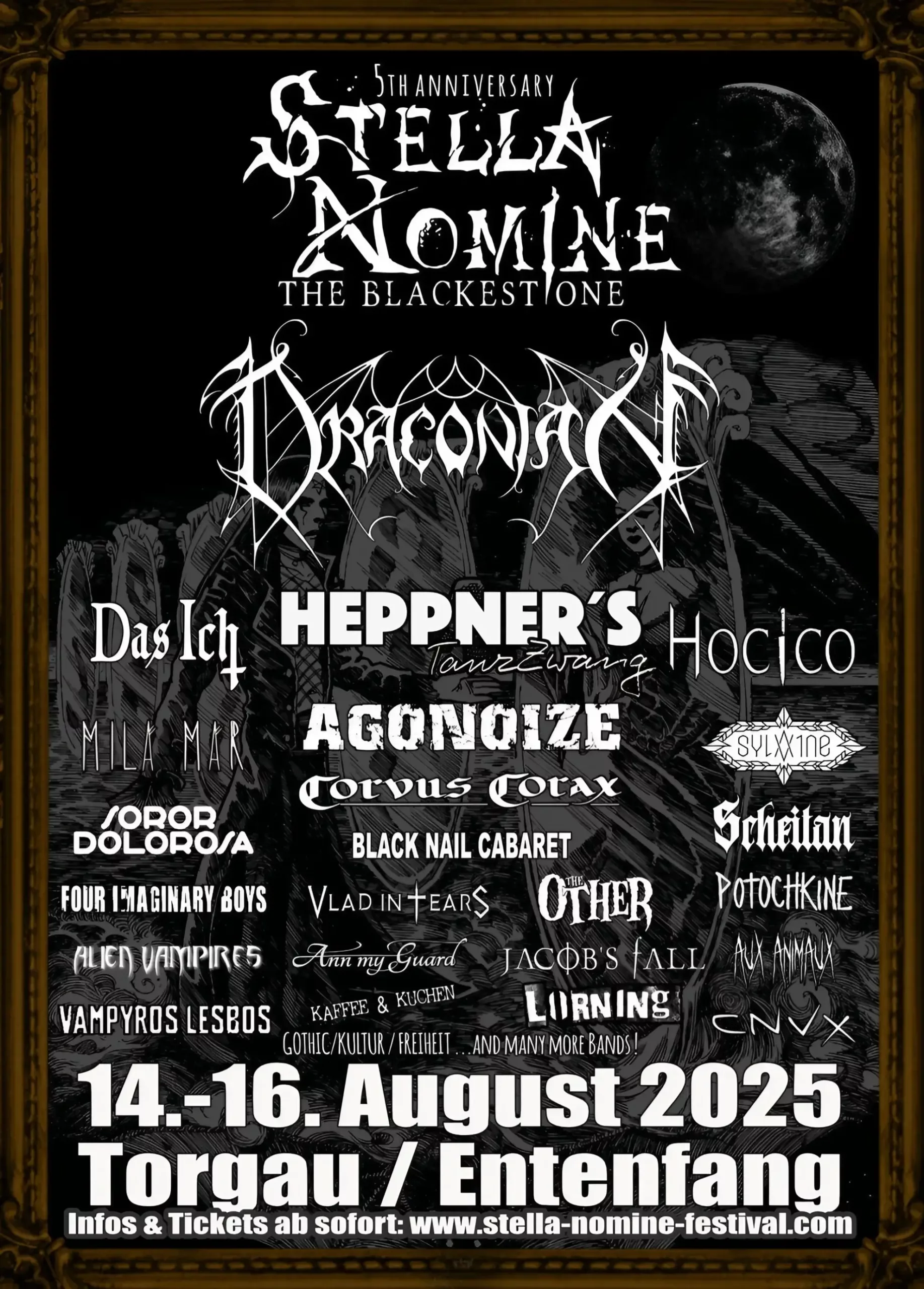
The lineup for the festival’s fifth anniversary draws from different periods and subgenres of the dark music scene, with a particularly strong contingent of performers from the host country.
Headliners from the Homeland
Das Ich, formed in 1989 by Stefan Ackermann and Bruno Kramm, are undisputed pioneers of the Neue Deutsche Todeskunst (“New German Death Art”) movement. Their influential sound merges harsh industrial and electronic textures with sweeping symphonic and classical arrangements. Ackermann’s highly theatrical, expressionist vocal delivery of philosophical and psychological lyrics, combined with Kramm’s complex compositions, has made Das Ich a cornerstone of the global gothic-industrial scene for over three decades.
Known as the “Kings of the Minstrels,” Corvus Corax brings a powerful and bombastic vision of the past to the stage. Formed in 1989, the Berlin-based group performs medieval-style music on a vast array of authentic and replica period instruments, most notably a formidable collection of bagpipes and shawms. Their material is drawn from historical sources, creating a loud, energetic, and immersive experience that has made them a dominant force in the neo-medieval and medieval metal genres worldwide.
Peter Heppner is one of the most recognizable voices in German synth-pop, primarily known for his work as the frontman of the highly successful duo Wolfsheim. For this festival, he presents his solo project, Heppner’s TanzZwang (“Dance Compulsion”). This performance focuses specifically on the electronic and dance-oriented material from his 2018 remix album of the same name, showcasing his trademark melancholic vocals over pulsing, club-friendly beats.
Representing the harsher side of the electronic spectrum is Agonoize. This Berlin trio, formed in the early 2000s, is a leading name in the aggrotech (or “hellektro”) scene. Their music is an unrelenting assault of pounding electronic rhythms, distorted vocals, and dark synth melodies, with provocative lyrics and themes. Their live performances are notoriously intense and often involve the use of copious amounts of stage blood.
The Other delivers a potent dose of horror punk. Originally formed in 2002 as a Misfits tribute band, they quickly evolved, channeling influences from classic horror films and B-movies into their own original material. Their identity is inseparable from their visual aesthetic, with each member adopting a distinct monster-like persona, making their live shows a theatrical punk rock spectacle.
The music of Mila Mar is a unique and ethereal journey. Formed in 1994, the group blends folk, medieval, and electronic styles into an avant-garde sound often compared to Dead Can Dance. The centerpiece of their music is the versatile and powerful voice of Anke Hachfeld, who often sings in a self-invented “imaginary” language, adding to the mystical and otherworldly quality of their compositions.
Originally from Italy but now based in Germany, Vlad In Tears brings a modern gothic metal sound to the festival. Their music combines the heavy, driving guitar riffs of metal with the melodic sensibilities and emotional depth of gothic rock, creating a sound that is both powerful and atmospheric.
Jacob’s Fall is a gothic rock band from Leipzig, a city with a rich history in the scene. Their sound is deeply rooted in the classic 1980s and ‘90s tradition of the genre, characterized by prominent, driving basslines, atmospheric guitars, and the deep, melancholic vocals that define the style.
Also from Germany is the dark rock act Lorning. Their music is a potent blend of rock and metal influences, filtered through a gothic lens and distinguished by the use of German-language lyrics.
CNVX (pronounced “Convex”) is a German project that explores the colder, more minimalistic side of the darkwave and post-punk genres. Their sound is built on stark synth lines, mechanical drum machine rhythms, and the detached vocal style characteristic of classic coldwave.
Finally, Four Imaginary Boys will pay homage to a foundational band of the entire genre. As a dedicated tribute act, they focus on faithfully recreating the sound, look, and atmosphere of The Cure, covering the full range of their influential career.
The Bulletin
Subscribe
Subscribe today and connect with a growing community of 613,229 readers. Stay informed with timely news, insightful updates, upcoming events, special invitations, exclusive offers, and contest announcements from our independent, reader-focused publication.
An International Roster
The festival also features a strong international presence. From Sweden, the gothic doom metal band Draconian will perform, showcasing their signature sound which contrasts the growled vocals of Anders Jacobsson with the clean singing of long-time and current female vocalist Lisa Johansson.
Hailing from Mexico City, the aggrotech duo Hocico will bring their harsh electronics and distorted vocals, a sound they describe as a reaction to the social conditions of their home city.
The New Wave of Dark Music
The festival also showcases a new wave of dark music from across Europe. From Hungary, the duo Black Nail Cabaret delivers a brand of dark pop, defined by a blend of vintage synth sounds with contemporary pop arrangements. Representing France, Soror Dolorosa channels the post-punk and cold wave sounds of the 1980s, characterized by driving basslines and baritone vocals.
Other Performers
The lineup is rounded out by a diverse group of other performers from various countries. This includes the industrial-aggrotech of Alien Vampires; Hungarian female-fronted metal act Ann my Guard; the Stockholm-based darkwave project of Turkish-born artist Gözde Düzer, Aux Animaux; the French EBM group Potochkine; the Greek minimal wave project Night In Athens; Swedish metal act Scheitan; the Norwegian ambient post-metal of Sylvaine; and a performance from the DJ team Vampyros Lesbos.
Conclusion
The Stella Nomine festival has established itself over five years by maintaining a smaller scale and integrating with the city of Torgau. The event provides attendees with a specific atmosphere, access to local historical sites, and a musical lineup that includes a variety of acts from the dark music scene. The combination of music, a communal environment, and cultural activities in a Renaissance town are the distinguishing features of the event.
The fifth anniversary of the Stella Nomine Festival, “The Blackest One,” will take place from Thursday, August 14, through the night of Saturday, August 16, 2025. The event is held at the Entenfang, located at Entenfang 1, 04860 Torgau, Sachsen, Germany.
Tickets are available for purchase directly from the official festival website. A standard weekend ticket costs €84.90 (approximately $98) and includes 3-day festival access and camping. The “DARKEST” weekend ticket is €99.90 (approximately $116) and adds access to shower and toilet facilities. Higher-priced support tickets are also available for those who wish to provide additional support to the festival.
Torgau is accessible by car via the B87 from Leipzig or Luckau. For those traveling by train, a regional express (RE) from Leipzig Central Station reaches Torgau in approximately 36 minutes, and the S-Bahn S4 line also connects the two cities. A shuttle bus service will be available on-site to connect the festival grounds to Torgau’s old town for a small fee.
As a cultural bonus, the festival wristband grants free admission to Hartenfels Castle and all city museums on the Torgau museum path. For more information, visit the official Stella Nomine Festival website.
Support
Independent
Journalism
Fund the voices Behind Every Story
Every article we publish is the product of careful research, critical reflection, and stringent fact-checking. As disabled individuals, we navigate this work with unwavering dedication, poring over historical records, verifying sources, and honing language to meet the highest editorial standards. This commitment continues daily, ensuring a consistent stream of content that informs with clarity and integrity.
We invite you to support this endeavor. Your contribution sustains the work of writers who examine their subjects with depth and precision, shaping narratives that question assumptions and shed light on the overlooked dimensions of culture and history.
Donations are processed through an in-kind sponsorship model powered by Paymattic—a secure, reliable donations plugin that enables direct support for our ongoing editorial work.

Leave a Reply