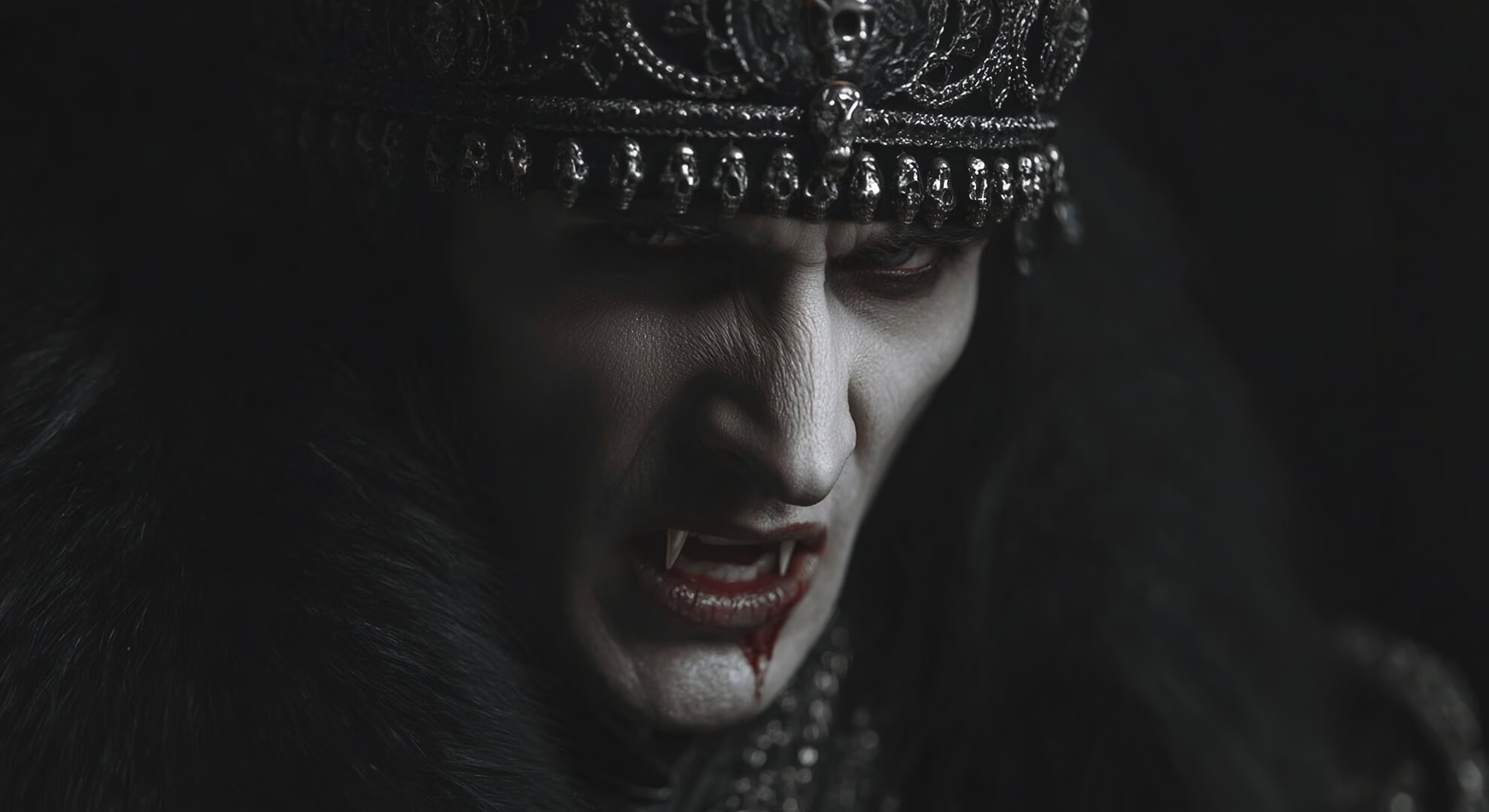


In 1882, the Romanian ethnographer Teodor Burada documented a procedure that villages across Transylvania and Moldavia still performed with communal precision.1 When a death was suspected to have produced a strigoi — a revenant who returned to drain the vitality of the living — the community would excavate the grave, examine the corpse for signs of inadequate decomposition, remove the heart, burn it, and scatter the ashes.
This was not performed in disorder. It proceeded according to established communal protocol, with designated participants and a recognized sequence of acts. It was, by any functional definition, a theological rite.
The vampire legend that Bram Stoker assembled from travel literature in a London reading room is a different subject, covered elsewhere in these pages. What Burada documented was older, more specific, and more philosophically precise.
Affiliate Disclosure
Some links on this page are affiliate links. If you make a purchase through them, we may earn a commission at no additional cost to you. We do not recommend products or services we have not evaluated independently. Affiliate arrangements do not influence editorial decisions, sourcing, or the positions taken in our writing.
The Theology the Frontier Produced
The strigoi belongs to a tradition that the Moldavian statesman and encyclopedist Dimitrie Cantemir recorded in his ‘Descriptio Moldaviae,’ composed between 1714 and 1716, as a belief concentrated specifically in Transylvania and Moldavia.2 The Romanian word descends from the Latin strix — the screech owl, Roman omen of violent death — with an augmentative suffix that connects it to a broader system of Romanian supernatural vocabulary: “moroi,” “bosorcoi,” and “varcolac,” each term marking a different mode of catastrophic or incomplete death.
The strigoi was not generically monstrous. It was the spirit of someone who had died badly: outside the sacraments, by violence, by premature death, under conditions that meant the community’s obligations toward the dead had gone unfulfilled.
That specificity is not incidental. The strigoi tradition is a folk theology of interrupted death, developed across centuries in a region where interrupted death was statistically normal. Transylvania’s position as the eastern frontier of Central European power — pressed continuously between the expanding Ottoman Empire to the south and east and the Habsburg domains to the west — meant that from the fourteenth century onward, its population endured siege warfare, mass-casualty raids, plague, and forced displacement at a rate that Christian burial rites could not absorb.
The body that could not be properly buried was, in the theology of the region, the body that came back.
Agnes Murgoci, whose survey ‘The Vampire in Roumania’ appeared in the Journal Folk-Lore in December 1926, documented the procedures Burada had recorded as a living system still operating in early twentieth-century rural communities.3 Murgoci’s central observation was structural: the strigoi was a communal threat, not a personal horror. It targeted family members first, then neighbors. The community’s obligation to respond was collective.
Philip R. Stone, founding director of the Institute for Dark Tourism Research (iDTR) at the University of Central Lancashire, has argued that dark tourism at its most significant function engages visitors with what he identifies in his 2006 typological study as the relationship between dark tourism supply and the human confrontation with mortality.4
The strigoi sites of Transylvania — the grave sites where excavation rites were performed, the fortified churches where the dead were brought for burial when the raids subsided — represent one of the most sustained examples in the European documentary record of a community formally managing that confrontation.
They are not ghost stories. They are a centuries-long negotiation between the living and the terms under which they must eventually die.
What Sighişoara Was Actually Defending
The medieval citadel of Sighișoara — German Schäßburg, Hungarian Segesvár — is the last inhabited fortified city in Europe, designated a UNESCO World Heritage Site in 1999 for what its inscription describes as “an outstanding testimony to the culture of the Transylvanian Saxons.”5 What this means practically is that the medieval structure never emptied into a museum or a ruin. People live inside its walls. Children walk the covered Scholar’s Staircase of 175 steps to reach the Church on the Hill.
Its construction followed an explicitly military logic. The original 14 towers of the fortification — nine of which survive — were not built by the municipality. They were built and maintained by guilds.
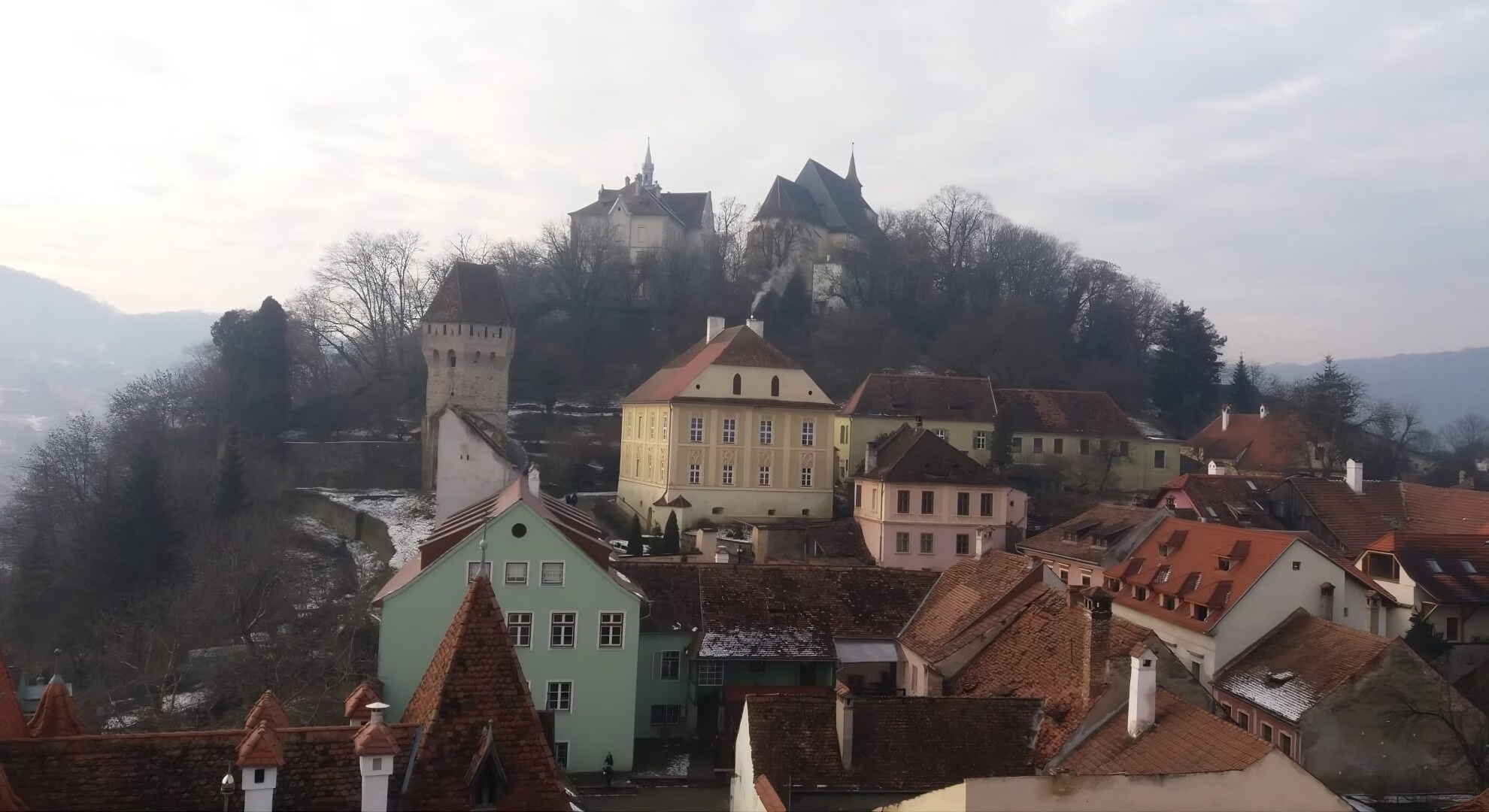
The Cobblers’ Tower, the Tailors’ Tower, the Tinsmiths’ Tower: each professional body was responsible for funding and militarily defending its assigned tower section.6 The city’s entire artisan class was constituted as a garrison. This is the urban form that encodes Sighișoara’s darkness — not a castle isolated on a cliff, but a complete civilian social structure organized around the premise of imminent assault.
Vlad Dracul, the father of Vlad Tepeș, lived in Sighișoara during the 1430s, when he was granted residence by the Transylvanian Saxon authorities while conducting negotiations with the Hungarian Kingdom. His house — Casa Vlad Dracul — is the oldest documented private residential structure in the citadel, dating to the mid-fourteenth century. Vlad Tepeș was likely born there around 1431, though the historical record on his birth location remains contested.
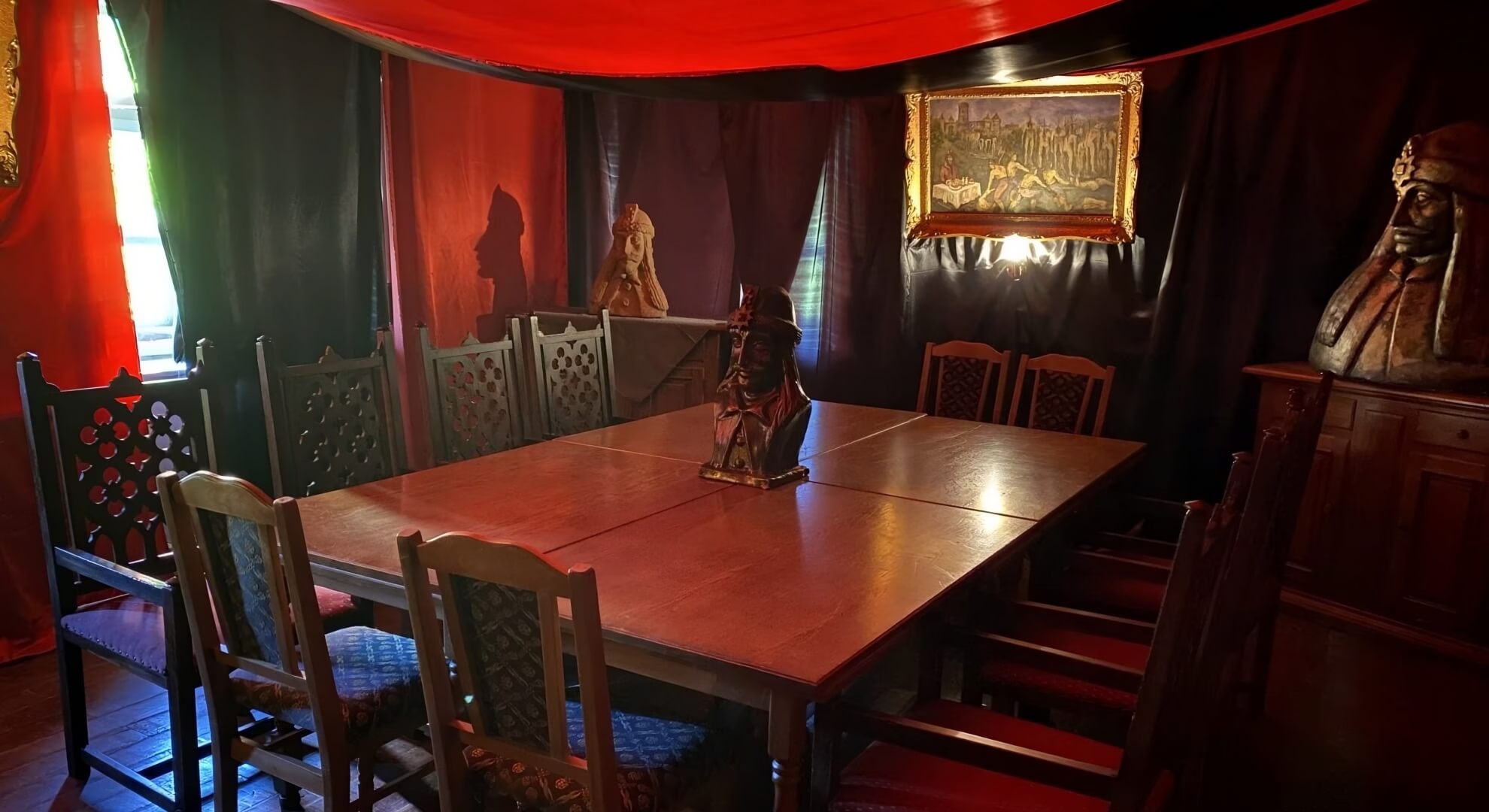
The point is less the biographical claim than the structural one: the future ruler who became the historical substrate for the most famous vampire in world literature spent his formation years in a city organized entirely as a siege machine.
Sighișoara endured plague, fire in 1676 that destroyed much of the lower town, and sustained Ottoman military pressure across the fifteenth and sixteenth centuries.7 What survived is a fortified hill city whose layered material record encodes what it cost to keep people alive in the Carpathian basin during four centuries of intermittent war.
The darkness of Sighișoara is not decorative. It is structural.
Hoia Baciu and the Threshold Mythology
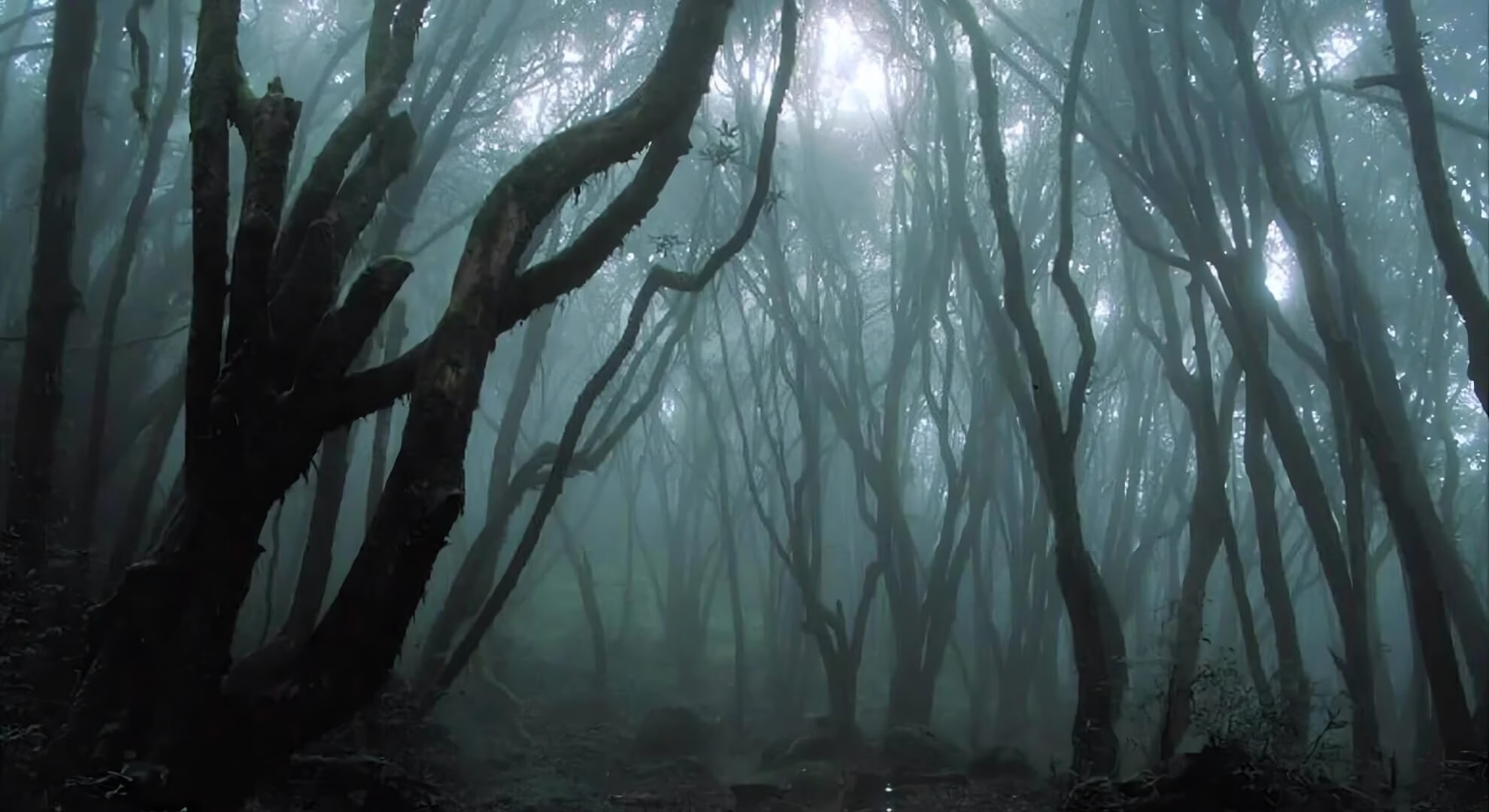
Three kilometers west of Cluj-Napoca, Romania’s second-largest city, a 250-hectare oak and beech forest occupies a plateau on the western edge of the Transylvanian plain.
Hoia Baciu takes its name from a shepherd, Baciu, who according to persistent local oral tradition disappeared inside it with a flock of 200 sheep. The tradition is unverifiable — no chronicle confirms it — but Romanian folklorist Ion Muslea, working in the mid-twentieth century, documented a pattern of forest-avoidance mythology concentrated specifically in dense elevated woodlands across Transylvania.8
Forests were thresholds, places where the village’s rules and obligations ceased to apply — the precise space, in the strigoi tradition, where the improperly dead gathered.
On August 18, 1968, Emil Barnea, a 45-year-old military technician, photographed an unidentified disc-shaped object above a clearing inside the forest using a basic Energija camera. Barnea held Communist Party membership and military security clearance — both made public reporting of unexplained phenomena professionally dangerous under the Ceauşescu regime. He published the photographs regardless.
The regime’s refusal to respond officially had an unintended consequence that any historian of suppressed knowledge would recognize: in a totalitarian state, what the government will not discuss is what citizens believe most fiercely. Hoia Baciu’s reputation as a site of genuine anomaly was amplified precisely by the institutional silence.9
What the forest actually presents: a circular clearing, roughly 300 meters in diameter, where vegetation fails to establish. The soil has been tested without yielding anomalous results. The trees at the clearing’s edge grow in crooked and spiral forms that botanists have not attributed to a single cause.
Visitors report anxiety, nausea, and a persistent sense of observation — responses that psychological research on environmental priming and suggestibility can partially explain. What I find most significant about Hoia Baciu’s specific character is not the UFO photographs — those belong to a global genre of anomalous aerial phenomena — but the clearing’s persistence: an unvegetated circular space that refuses occupation without explanation, and that sits at the precise location where Transylvanian folk theology would have predicted the improperly dead to gather.
The strigoi tradition, which placed its most active presences in threshold spaces outside the village boundary — the forest, the crossroads, the water’s edge — gives Hoia Baciu a genealogy older than the UFO tourism it now mostly attracts. This is a forest at the edge of a major city that Transylvanian folk theology had already identified, centuries before Barnea’s photograph, as a space where the normal obligations of the living toward the dead could not be reliably maintained.
Poenari and the Documented Weight of Stone
Poenari Citadel — Cetatea Poenari — stands on a Carpathian cliff above the Argeş River gorge, accessible by 1,480 concrete steps cut into the mountainside. It is not a famous castle. It receives a fraction of Bran Castle’s visitors, despite holding a substantially more verifiable claim to the historical violence that draws dark travelers to Transylvania.
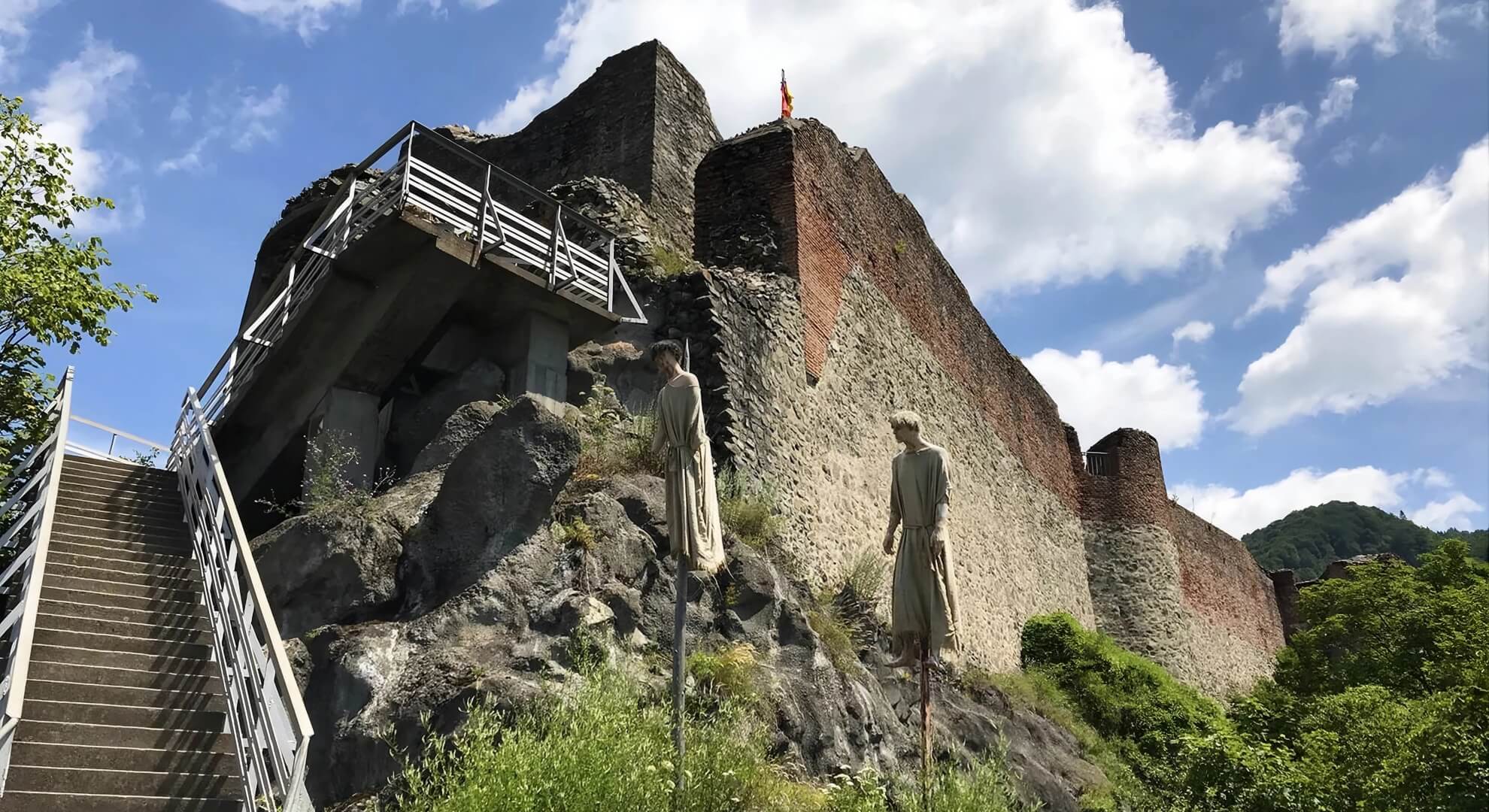
In 1459, Vlad Tepeş repaired and expanded an earlier fortification on the site by arresting Wallachian boyars who had conspired against his rule and forcing them to labor on the construction.10 The older boyars were impaled on the spot; the younger and stronger were worked until the construction was complete. The fortress the survivors built became Vlad’s primary mountain stronghold.
In 1462, an Ottoman force led by Radu the Handsome — Vlad’s younger brother, operating under Ottoman suzerainty — besieged Poenari. Vlad escaped via a mountain passage north into Transylvania. His wife, whose name the historical record has not preserved with certainty, threw herself from a tower rather than face capture; the river below, by oral tradition, ran red.11
The chronicle is partially documented in narrative accounts, though the specific detail of her death exists in tradition rather than in official record.
Poenari was abandoned after Vlad’s death in 1476, fell into disuse in the sixteenth century, and suffered earthquake damage in 1913, 1940, and 1977.12 What remains today — sections of wall, towers stripped by weather and seismic activity — is perched at 850 meters on a near-vertical cliff above the gorge. It is not a romantic ruin dressed for visitors.
It is the exposed skeleton of a fortification built by imprisoned men under sentence of death, used to wage a war, and then surrendered to the mountain.
The 1,480 stairs are a modern addition: without them, the citadel would be unreachable. The effort of the climb is not incidental, and the forced labor that raised Poenari left no memorial. It is present only in what remains.
The Fortified Churches and What Their Walls Encoded
Of the more than 150 surviving fortified churches built by Transylvanian Saxons from the twelfth century onward, the best-preserved complexes — Biertan, Viscri, Prejmer, Dârjiu — share a spatial logic that tourism copy consistently misrepresents as the charm of medieval craftsmanship.
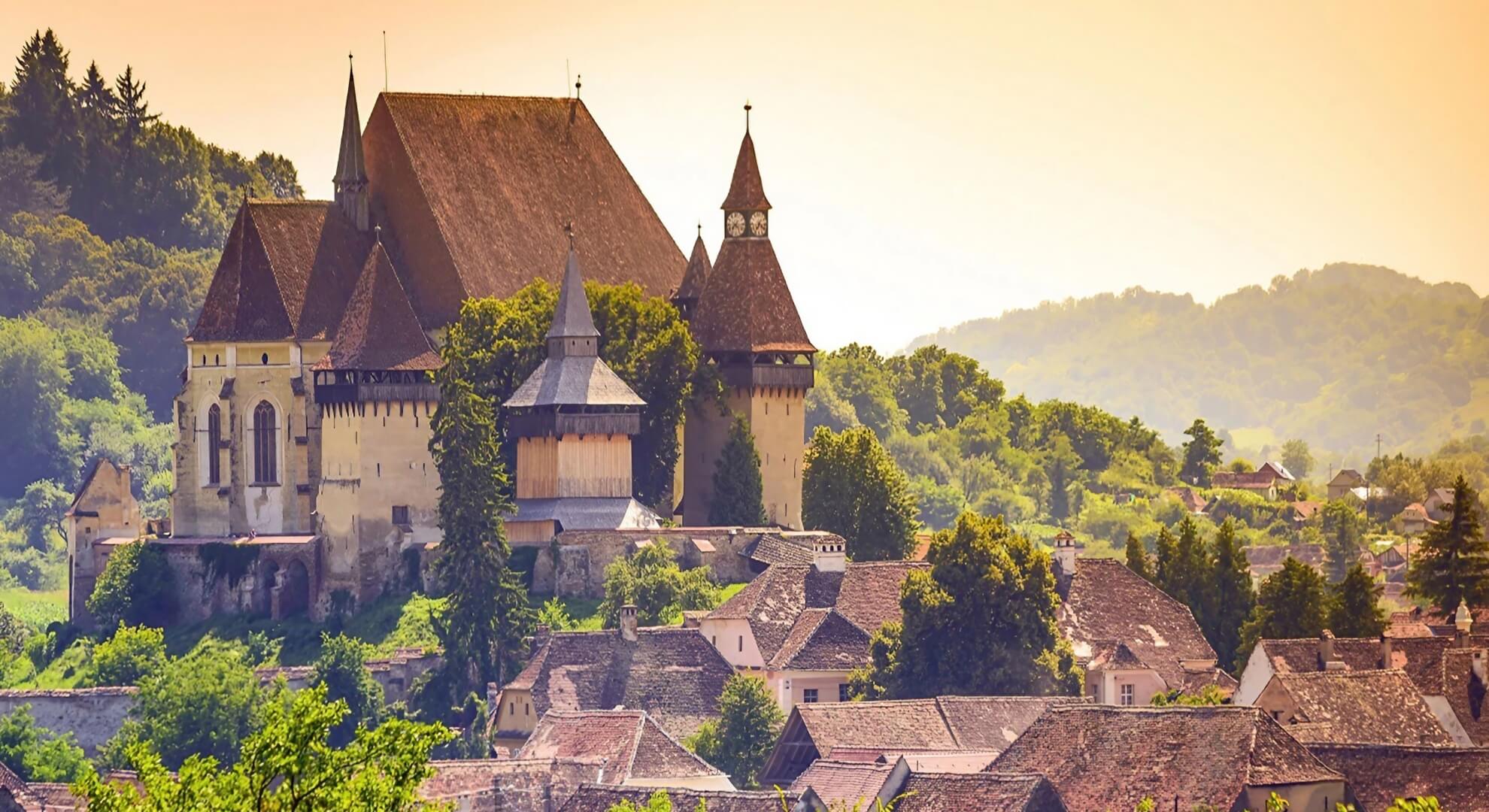
Biertan Fortified Church, fourteen miles west of Sighișoara, was constructed and reconstructed between the fourteenth and sixteenth centuries as a multi-ring defensive complex: three concentric curtain walls, corner towers, and a gate system designed for armed resistance.13 What was being defended was not a garrison. When Ottoman or Tatar raiding parties entered the region, the entire civilian population — men, women, children, livestock, and food stores — retreated inside the church complex and barred the gates.
The storage chambers within the fortifications held provisions specifically for this purpose. Families might shelter for weeks or months.
The Saxon villagers’ experience of the fortified church was therefore the experience of a collective survival structure in which the sacred and the military were never separate functions. The same walls that held the altar and the congregation also held, in their auxiliary chambers, the salted meat and the grain that would keep them alive through a siege.
The strigoi theology that developed outside these walls — in the unfortified space, in the cemeteries alongside the church where the properly buried could, in principle, remain at rest — becomes more legible when read against this material reality.
What Transylvania Actually Offers
The whycation movement’s genuine contribution, if it means anything beyond rebranded tourism, is the recognition that some places carry specific knowledge about human mortality that ordinary travel cannot provide and that is not available through any other encounter.
The dark traveler who arrives in Transylvania prepared to engage only the vampire mythology — Bran Castle’s Dracula shop, the Count’s portrait on a bottle of local wine — has in fact arrived at one of the most concentrated documentary archives in Europe of how communities manage traumatic death across long historical time.
The strigoi ritual that Burada documented in 1882 is not a curiosity. It is a formal system, developed under actual conditions of mass mortality, for maintaining a community’s obligations to those who died before the system could receive them.
The fortified churches, the mountain citadels, the threshold forests — these are the physical evidence base for that system. To stand inside Biertan’s concentric walls or climb Poenari’s exposed stairs without knowing this is to have missed the actual argument the place makes.
What dark tourism offers, at its most serious function, is the chance to hear that argument. Transylvania has been making it for six centuries.
Whether you have already stood inside Sighișoara’s fortified walls, climbed to Poenari’s exposed ruins, or walked into Hoia Baciu’s clearing, or whether Transylvania is still somewhere you intend to go — what draws you toward the region’s documented historical darkness rather than the Dracula circuit, and what did you find there, or expect to find, that a different kind of travel could not have offered you?
Tourism Partnership
We reach an audience that travels with intention — drawn to documented history, dark heritage, and the cultural weight of the places they seek out. If you operate tours, cultural experiences, accommodation, or heritage sites aligned with that ethos, we would like to hear from you. We consider partnerships with tour operators, travel agencies, hostels, hotels, museums, and any organization whose work engages seriously with dark tourism, gothic culture, or historical travel. We do not promote services we cannot stand behind editorially. Reach us through our Contact page.
References
- Teodor Burada, ‘Datinile Poporului Român la Înmormântări’ (Iaşi: Tipografia Naţională, 1882). ↩︎
- Dimitrie Cantemir, ‘Descriptio Moldaviae,’ composed 1714–1716 (first published: Berlin, 1769). ↩︎
- Agnes Murgoci, ‘The Vampire in Roumania,’ Folk-Lore 37, no. 4 (December 1926): 320–349. ↩︎
- Philip R. Stone, ‘A Dark Tourism Spectrum: Towards a Typology of Death and Macabre Related Tourist Sites, Attractions and Exhibitions,’ Tourism: An International Interdisciplinary Journal 54, no. 2 (2006): 145–160. ↩︎
- UNESCO World Heritage Centre, ‘Historic Centre of Sighişoara,’ World Heritage List No. 902, inscribed 1999. ↩︎
- Historic Centre of Sighişoara documentation; cross-referenced with Encyclopædia Britannica Online, ‘Sighişoara,’ accessed April 2026. ↩︎
- Romania Insider, ‘Romanian Cities: Sighişoara, the Medieval Citadel Where Dracula Was Born,’ accessed April 2026; cross-referenced with UNESCO World Heritage documentation. ↩︎
- Ion Muslea, referenced in subsequent Romanian ethnographic scholarship; cited in thedarkatlas.com, ‘Hoia Baciu Forest: The World’s Most Haunted Forest,’ accessed April 2026. ↩︎
- Emil Barnea photograph, August 18, 1968; contextual analysis via IFLScience, ‘Hoia-Baciu Forest: Why the ‘Bermuda Triangle of Transylvania’ Continues to Mystify,’ January 2026. ↩︎
- Wikipedia, ‘Poenari Castle,’ accessed April 2026, with reference to Argeş County Museum administrative records from 2009; cross-referenced with Atlas Obscura, ‘Poenari Castle in Wallachia,’ accessed April 2026. ↩︎
- Atlas Obscura, ‘Poenari Castle in Wallachia,’ accessed April 2026; narrative accounts in Romanian historical tradition. ↩︎
- Wikipedia, ‘Poenari Castle,’ accessed April 2026; earthquake dates 1913, 1940, and 1977 documented in the entry with reference to Romanian geological records. ↩︎
- UNESCO World Heritage Centre, ‘Villages with Fortified Churches in Transylvania,’ World Heritage List, inscribed 1993 (extended 1999). ↩︎

Leave a Reply