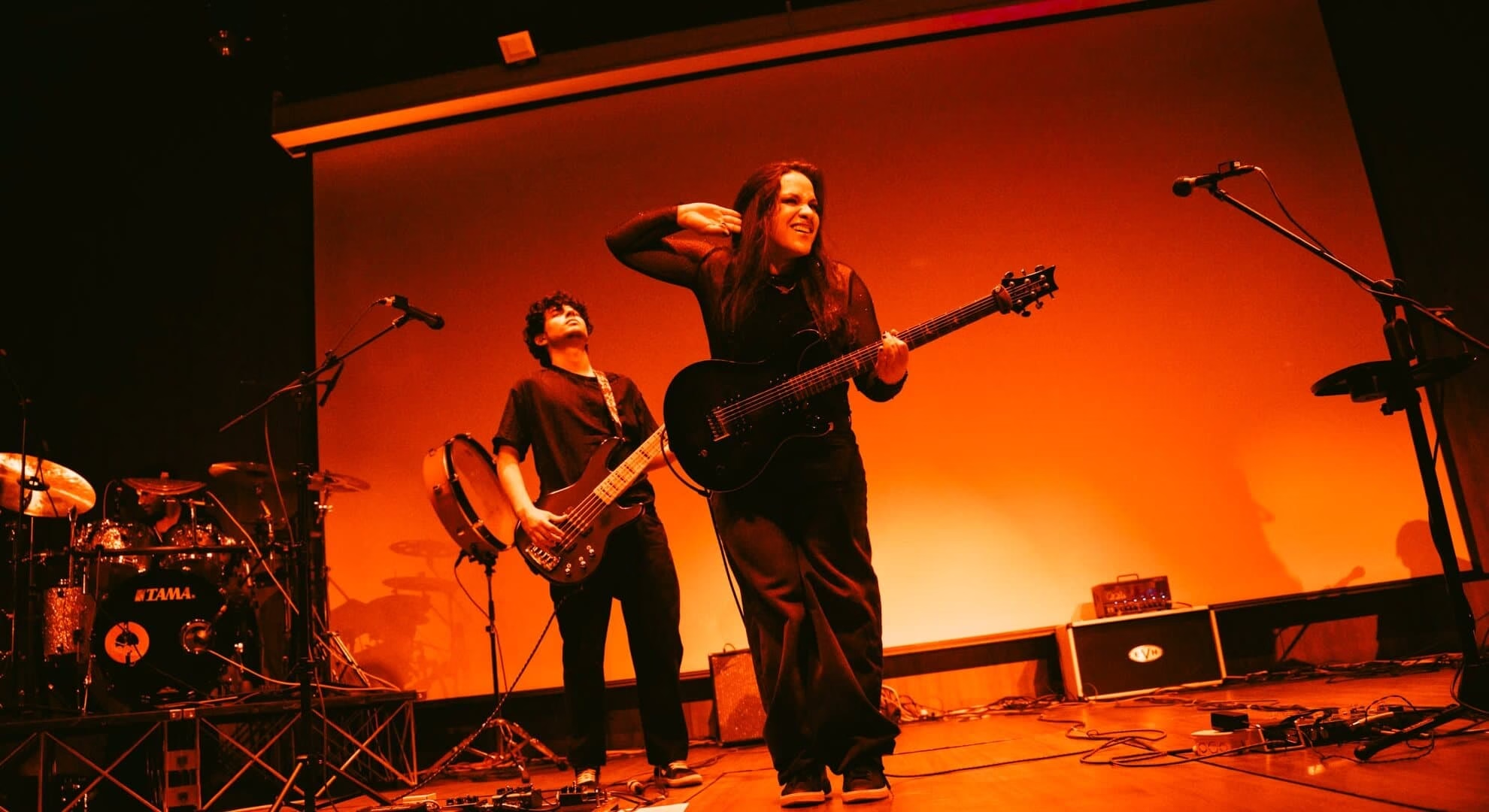


When we covered Argovia’s sold-out album launch at Hall 74 on April 11th, 2026, the record of that evening began at the moment the audience arrived and ended when the band left the stage. The video for ‘Unstoppable,’ released on May 28th, 2026 — 47 days after that concert, 48 days after the album’s official April 10th, 2026 release — goes somewhere the live review could not follow. It begins before the doors opened.
Directors Mateo Chaves and Camilo Báez, working with the Bogotá production company Fishbowl Lab, chose to point their cameras at the private corridor of preparation — the time a performance exists only in the bodies of the people about to give it. The band’s own description is exact: the video documents the journey between the last rehearsal and the launch show. What Chaves and Báez recorded there is the part of April 11th that no audience at Hall 74 could have attended.
What the Camera Chooses
Camera operators Camilo Báez, Tomás Reinales, Mateo Chaves, and Diego Llorente work in the pre-show environment with a restraint that reads as a deliberate visual argument. The footage is cool in its grading — stage-black and concrete gray rather than the warm orange projection glow this publication observed behind the band during the Hall 74 performance. Before the lighting rig was pointed at anyone, that color existed only as potential. The palette holds there.
The editing rhythm, assembled by Chaves in post-production, follows no formal structure derived from the song. It moves at the pace of preparation: deliberate, unrushed, attentive to detail that has no audience. Ani Guillén at an instrument before it is needed. Carlos Arminio at a keyboard not yet amplified for 150 people. These are the same performers we watched command a sold-out room — but in the footage they are not yet commanding anything. They are waiting for the event to exist.
When the concert material arrives, the visual argument has already been established. The audience that chose to sit during Argovia’s set — rising only at moments of particular intensity, as we noted in its live coverage — appears in the footage as the destination toward which all that preparation moved. Chaves and Báez do not editorialize about the room being full. They record it as a fact that follows from what preceded it.
The Song at the End of the Album
‘Unstoppable’ occupies the tenth position in an eleven-track sequence — placed between ‘Alas de Sal,’ the album’s only Spanish-language track, and the closing ‘Where Do We Go.’ Its placement is precise: not the conclusion, but the penultimate declaration before the album’s final open question. ‘Unstoppable’ is what precedes that question — the moment of commitment before doubt is allowed back in.
The song’s structure enacts exactly that sequence. Its chorus arrives first in a tight, syncopated form: semi-spoken vocal lines over pulsating synth swells, with Nicolás Paredes’s bass carrying a funk and Latin undertow that gives the track a rhythmic specificity distinct from the album’s more atmospheric passages. The second presentation of the chorus expands into sustained harmonic resolution. The song commits to its own argument in its final movement, the pulse broadening rather than tightening.
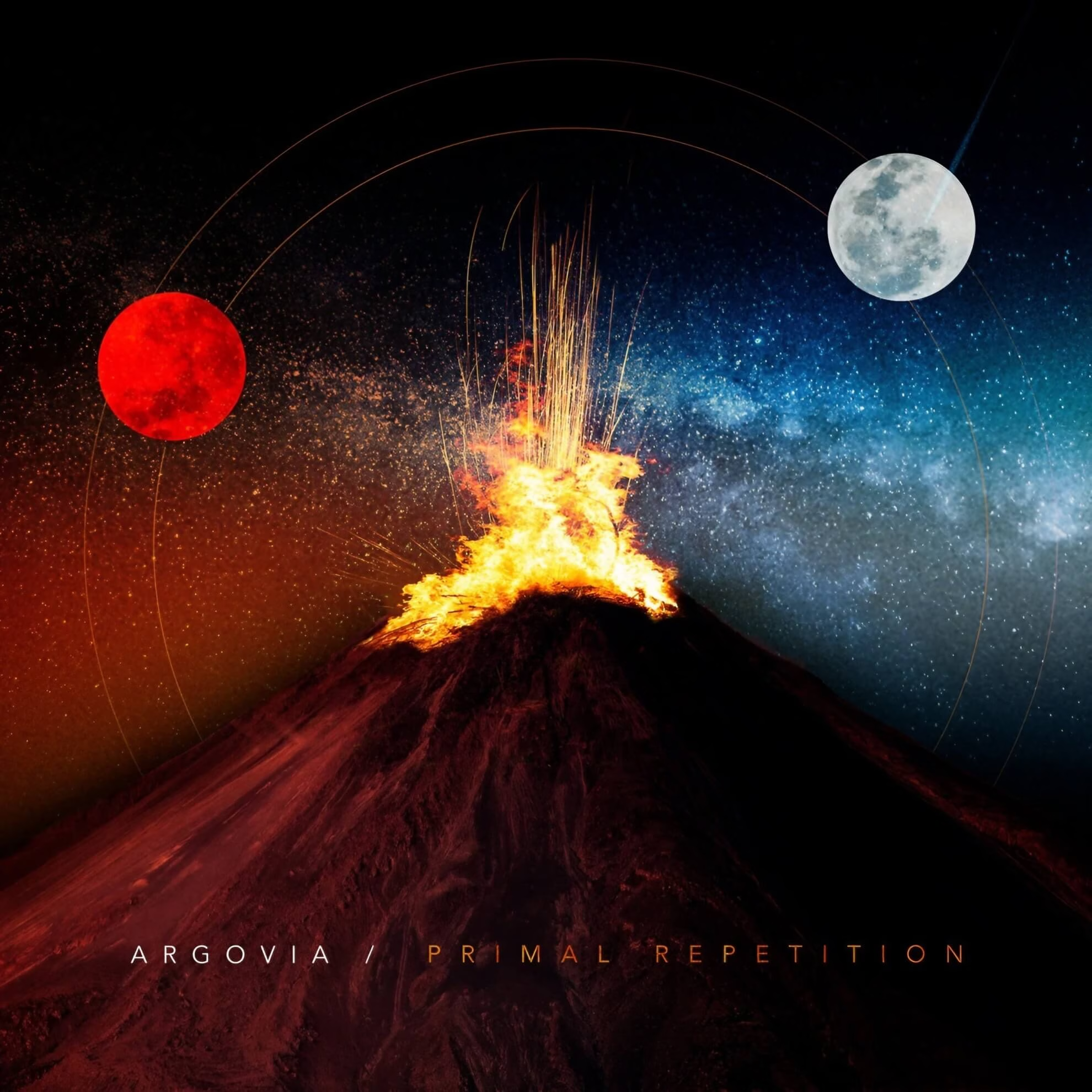
The video does not illustrate this arc. It precedes it. What Chaves and Báez captured — the final rehearsal, the backstage hours, the empty stage — is what the song’s declaration presupposes: that someone chose to go through with it. The footage and the song occupy the same event from opposite temporal positions. The song looks forward toward commitment; the video, released weeks later, looks back at the preparation that made commitment possible.
Prog Magazine and the Circuit
‘Unstoppable’ won Prog Magazine’s Track of the Week during the same week as the album’s release, a recognition that followed a prior Track of the Week win for ‘Mountains,’ an earlier advance single. Two wins from the same record in adjacent weeks by a quartet from Bogotá reflects a specific editorial judgment by an international publication: that this music, from this city, merits the same critical attention as progressive rock produced anywhere else.
The video is addressed to the Bogotá audience — the band’s dedication closes with the words “Este video es para ustedes. Stay prog” — but what it shows is the band in the hours before that audience was present. The preparation documented is the same preparation that produced a record capable of reaching the international circuit. The local and the international are not separate registers in this footage. They are the same rehearsal, observed from two different distances.
The Sequence That Remains
What Chaves and Báez produced is not an account of a successful launch. It is a record of the hours in which success was still only possible — when the room was empty, the equipment was being checked, and the question of whether Bogotá would fill a venue for this music had not yet been answered. The answer, as this publication documented on April 16th, 2026, was yes. The video declined to use that answer as its subject. It stayed with the question instead.
As an addendum to this publication’s live coverage of the Hall 74 launch, the video for ‘Unstoppable’ completes a record of April 11th, 2026 that no single vantage could have captured. The live review held the room. The video holds what existed before the room was occupied. Together they constitute something closer to a full account of what it took to give an album its first performance: preparation, then presence, then the music.
The pre-show hours Chaves and Báez chose to document — the preparation no audience was present to witness — change what the sold-out room means when it finally appears in the footage: does that knowledge of what preceded the performance alter how you hear the song’s final move from pulse to resolution?


Leave a Reply